 WORXMATE
Continuous performance management software pricing typically falls into two models: published per-seat tiers (usually $6 to $20+ per employee per month, scaling with AI features and admin depth) or custom enterprise quotes with no public number at all. The real cost is rarely the seat price. It’s what sits underneath it: implementation weeks, a second tool for OKRs, support tickets in week one, and a rollout that a manager layer never got coached to run. Before comparing sticker prices, a buyer should map cost to three things: how many systems the price is actually replacing, how fast the platform gets a real cycle running, and whether the quote includes coaching or just software. Worxmate and 15Five publish tiered pricing upfront; most enterprise-grade competitors do not.
The Question Every Shortlist Call Ends On
I have sat in enough vendor evaluation calls to know exactly when the room changes. It’s not when someone asks about integrations. It’s not when someone asks about the mobile app. It’s the moment someone finally asks, “So what does this actually cost us?” and the answer is a link to a form.
That moment is the reason this article exists. Most conversations about continuous performance management software pricing happen backwards. Buyers start with a features checklist, fall in love with a demo, and only ask about cost in week three of the evaluation, once switching to a different platform feels like starting over. By then, the price is whatever the vendor decides it is, because the buyer has already spent the leverage that came from having options.
I’ve watched this play out across more than 50 implementations, from a 70,000-person IT services organisation to a 100-person European fintech startup finding its footing after its first funding round. The pattern holds regardless of size: the companies that get a fair price are the ones that understood the pricing model before they needed the software, not after.
Not sure what you should actually be paying for?
An Organization Performance Audit shows you where the real gaps sit, before a vendor’s pricing page tells you what to prioritise.
Why Continuous Performance Management Software Pricing Looks So Inconsistent
Two organisations of near-identical size can get wildly different quotes for what looks like the same product, and there’s a structural reason for it. Continuous performance management software cost is rarely priced on features alone. It’s priced on three variables buyers rarely see broken out: seat count banding, module bundling, and implementation scope.
A platform’s marketing page might show one number. The actual invoice reflects whether you need the AI risk-alert layer, whether payroll integration is a module or a “custom connector” fee, and whether your onboarding requires a dedicated implementation manager. This is precisely why performance management software vs HRIS decisions get complicated at the pricing stage: an HRIS suite might already be sunk cost, making a “free” bundled performance module look cheaper than it actually is once you account for what it can’t do.
Here’s the breakdown that actually predicts what you’ll pay:
| Pricing Driver | Low-Cost Signal | High-Cost Signal |
|---|---|---|
| Pricing transparency | Published, self-serve tiers | Quote-based, sales-gated |
| OKR + PMS architecture | One engine, one login | Two tools stitched with an integration fee |
| AI capability depth | Basic dashboards only | Predictive risk alerts, engagement signals |
| Implementation model | Self-serve, live in days | Dedicated CSM, weeks of configuration |
| Contract structure | Monthly or annual, cancel-friendly | Multi-year enterprise lock-in |
For a full breakdown of how these variables map to actual published numbers across the category, our guide on SaaS performance management pricing is the deeper resource. This article focuses specifically on what drives the price you’re quoted, not the number itself.
Unlock Goal Clarity & Accelerate Employee Growth
Looking to drive goal clarity and employee growth? Discover how Worxmate’s AI-powered Performance Management Software can help.
What Continuous Performance Management Platform Pricing Actually Buys You
How much does continuous performance management software cost is the wrong first question. The right first question is: what is this price replacing? A platform priced at what looks like a premium tier is often cheaper in total cost of ownership than a “budget” tool that requires a second OKR platform, a spreadsheet for check-ins, and a manual export into your HRIS every quarter.
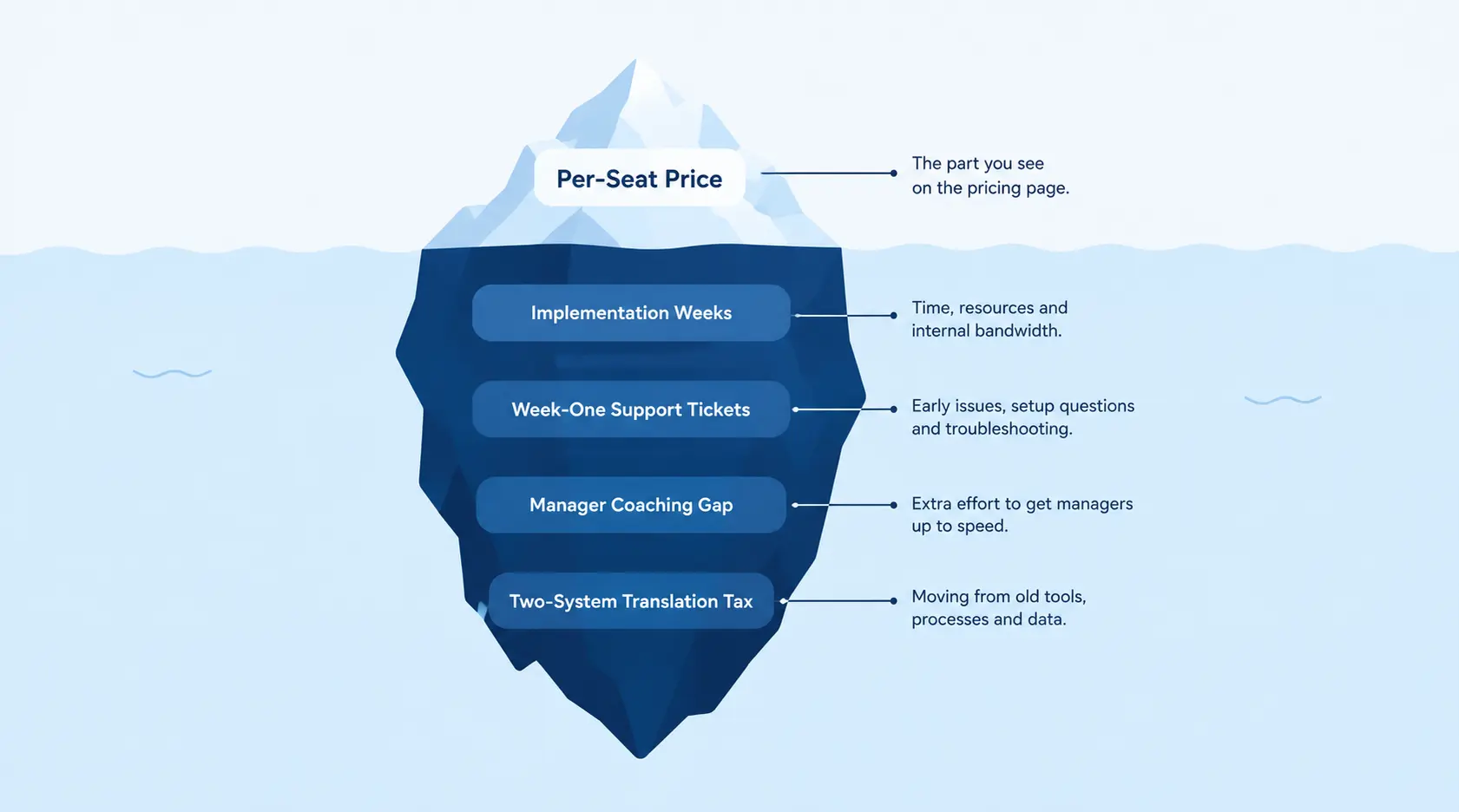
I’ve named this the translation tax in conversations with CHROs: someone on your team has to manually connect what a person is working on to what got reviewed, every single cycle, when goal-tracking and performance conversations live in two disconnected systems. That’s not a line item on any invoice, but it is real cost, measured in hours a manager or HR ops lead spends reconciling two tools that should have been one.
This is the exact reason continuous performance management software pricing plans need to be evaluated against what they consolidate, not just what they cost per seat. A continuous performance management software platform that runs OKRs and performance conversations in a single engine removes that translation tax entirely. One that treats OKRs as a bolted-on feature does not, no matter how competitive its per-seat number looks on a pricing page.
What’s Usually Included vs. What Usually Costs Extra
| Capability | Typically Included in Base Tier | Typically an Add-On or Enterprise-Only |
|---|---|---|
| Check-ins and OKR tracking | Yes | — |
| Basic dashboards and reporting | Yes | — |
| AI-driven risk alerts (e.g., Orbit AI, Axis AI-style intelligence) | Sometimes, at higher tiers | Often gated to enterprise |
| Payroll or HRIS integration | Rarely at entry tier | Frequently a custom connector fee |
| Dedicated implementation support | Rarely at entry tier | Common at enterprise scale |
| Data residency and compliance controls | Rarely at entry tier | Often requires a custom enterprise contract |
The Hidden Costs Nobody Puts on the Pricing Page
If you only compare the number on the pricing page, you will underestimate the real cost of continuous performance management tool pricing by a wide margin. Here are the costs I watch buyers miss most often:
Implementation weeks. A platform that takes four to twelve weeks to configure before your first real cycle runs is charging you in delayed value, even if the seat price is lower. Every week without a live cycle is a week the leadership team isn’t building the habit the software was bought to create.
Support-ticket friction in week one. In my experience across 50+ implementations, 15 to 20 support queries a day in the first week predicts adoption failure within a month, regardless of what the contract says. That failure has a cost. It’s the cost of re-running the evaluation next year.
Coaching that stops at the C-suite. This is the failure I see most often, and it never shows up on an invoice. A vendor sells the platform, runs a leadership workshop, and leaves. Within one quarter, the program dies below the leadership layer, because nobody equipped the middle management layer to run it. The software didn’t fail. The absence of coaching did, and that gap gets paid for twice: once in the wasted license, once in whatever gets bought to replace it.
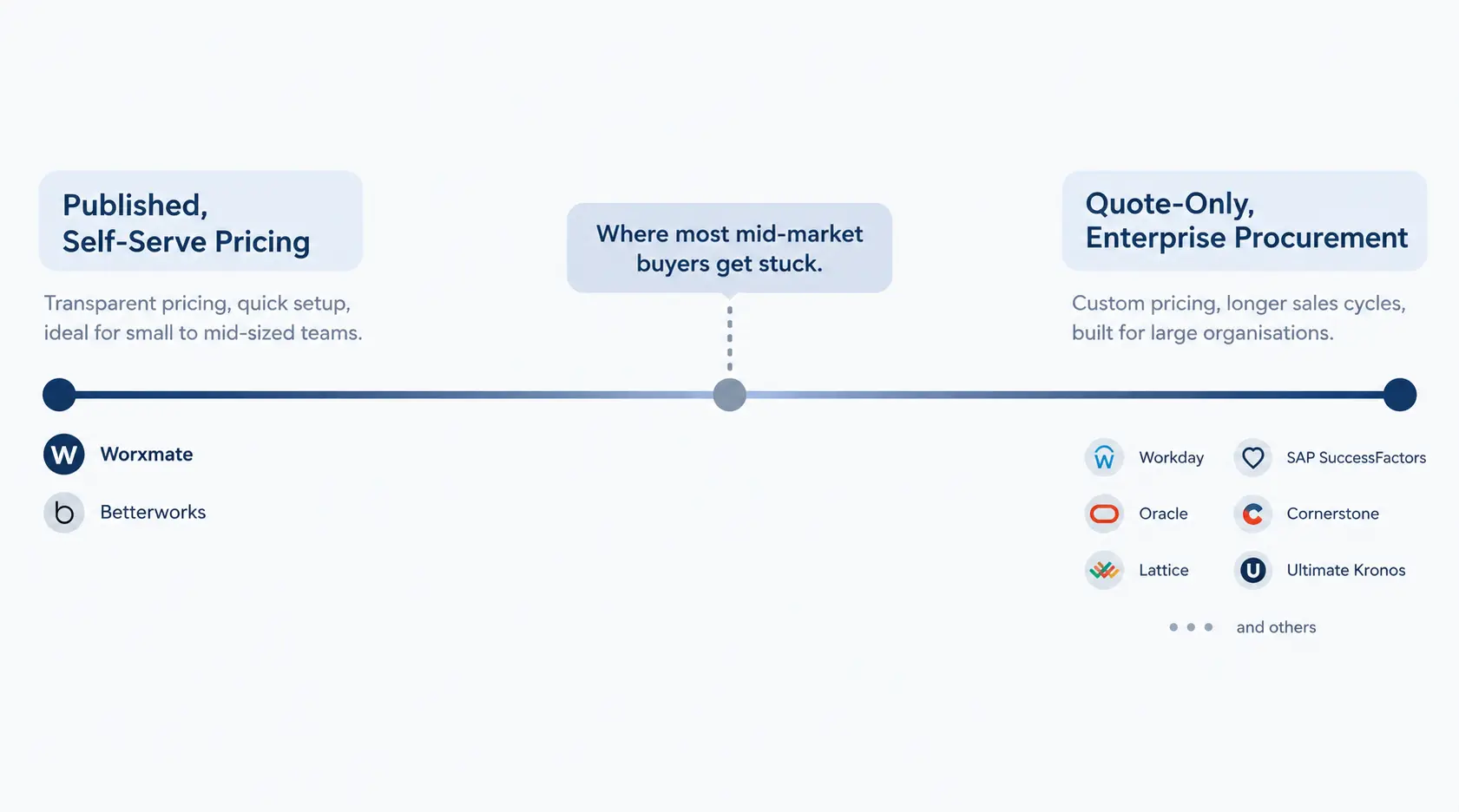
Quote-based opacity. Most platforms on the enterprise end of this category, including several strong tools, don’t publish pricing at all. That’s not automatically a red flag; enterprise performance management software often prices around seat count, modules, and scope in ways that resist a static page. But it does mean you can’t shortlist on price until you’ve already spent a sales call finding out, which quietly pushes buyers toward whichever vendor answered fastest rather than whichever tool actually fits. See our full performance review tool pricing comparison for how this plays out vendor by vendor.
Building the internal case for what you’re about to spend?
This playbook covers how continuous performance investment connects to growth and accountability, the argument finance teams actually want to see.
Continuous Performance Management Software Pricing by Company Size
Pricing pressure doesn’t hit every organisation the same way, and I’d push back on any guide that prices this category with one number for every buyer. A performance management software by company size lens matters as much for cost as it does for features.
Startups, under 100 people. The priority is self-serve pricing and fast setup, not enterprise depth you won’t use for two more growth stages. Continuous performance management software pricing for startups should weigh monthly flexibility and low onboarding friction above almost everything else. Our dedicated guide on performance management software for startups goes deeper on this exact profile.
Mid-market, 100 to 2,000 people. This is where continuous performance management software pricing by company size gets genuinely complicated, because feature needs jump (department-level approval chains, deeper AI risk alerts) faster than headcount does. Buyers here overpay most often by purchasing enterprise-tier depth they won’t configure for another 18 months.
Enterprise, 2,000+ people. Continuous performance management software pricing for enterprise almost always means a custom quote, and that’s appropriate given the compliance, data residency, and multi-level permissioning requirements at that scale. The question isn’t whether it’s quote-based. It’s whether the quote includes coaching capacity for the manager layer, or just software licenses. See performance management software for enterprise for the fuller feature-to-cost mapping.
Company Size vs. What to Prioritise in the Quote
| Company Stage | Priority in the Pricing Conversation | Common Overspend Risk |
|---|---|---|
| Startup (under 100) | Self-serve, monthly billing, fast setup | Paying for enterprise AI depth too early |
| Mid-market (100–2,000) | Department-level configuration, moderate AI depth | Enterprise-tier lock-in before it’s needed |
| Enterprise (2,000+) | Compliance, coaching capacity, multi-level permissioning | Software-only quote with no adoption support |
Pricing by Region: India, UK, and USA
Geography changes the pricing conversation in ways that rarely show up on a global pricing page. Continuous performance management software pricing India buyers often navigate a market where per-seat US-dollar pricing doesn’t reflect local budget realities, which is exactly why our OKR software pricing India guide breaks the category down in INR-adjusted terms rather than converting a US number and calling it done.
Continuous performance management software pricing UK buyers, meanwhile, are frequently comparing against platforms priced for the US enterprise market, where GDPR-aligned data residency requirements can quietly push a “standard” tier into a custom quote. And continuous performance management software pricing USA buyers sit in the most competitive, most transparent corner of the market. It’s also the segment most likely to be shown a published price that excludes the AI features that made the demo compelling in the first place. Always confirm which tier the demo you saw actually maps to before treating a homepage number as the real one.
Unlock Goal Clarity & Accelerate Employee Growth
Looking to drive goal clarity and employee growth? Discover how Worxmate’s AI-powered Performance Management Software can help.
Worxmate Pricing vs. Alternatives: What the Comparison Actually Shows
I’ll be direct about where Worxmate sits in this conversation, because a features list won’t tell you and I’d rather you hear it plainly. Worxmate publishes tiered pricing, self-serve available, which puts it in a small group alongside 15Five rather than the quote-only majority of this category.
Worxmate pricing vs Lattice pricing comes down to what you’re buying alongside the number. Lattice prices as an HR-owned performance platform with OKRs as a feature; Worxmate prices as a single engine where goal execution and performance conversations share the same data model from day one. See the full alternatives to Lattice comparison for specifics.
Worxmate pricing vs 15Five pricing is the closest comparison on transparency; both publish tiers. The difference shows up in cascade depth once a team grows past check-ins into multi-team alignment. Full detail in alternatives to 15Five.
Worxmate pricing vs Betterworks pricing is a different conversation entirely, because Betterworks is quote-based and built for large-enterprise manager effectiveness with a long procurement cycle. See alternatives to Betterworks for where each is the stronger fit.
If your organisation is choosing between a dedicated OKR-and-performance layer and an affordable OKR software point solution, or checking where per-seat cost lands relative to the category, our OKR software cost per user breakdown is the more specific resource for that exact comparison. If budget is the binding constraint before you’re ready to pay for anything, start with our list of free performance management tools instead.
The Fintech Startup That Almost Bought the Wrong Tier
A roughly 100-person European fintech, generating revenue and introducing OKRs for the first time, came to me mid-evaluation with three vendor quotes on the table. Two were quote-based and had already stalled for three weeks waiting on procurement calls. The third had a published tier that looked cheapest on paper.
When I sat down with the CEO and CPO, it became clear within the first conversation that the cheapest tier wasn’t the problem they thought it was solving. Their goals were KPI-led, tracking metrics that produced numbers without telling anyone what actually needed to change. No pricing tier fixes that. I asked one question: “What is the one big thing you want to resolve?” The answer was product demo experience. What followed was a sequence of “so what” questions until the team reached an outcome statement, not a KPI dressed as one.
That reframe changed what they actually needed to pay for. They didn’t need the enterprise tier’s compliance depth; they needed a tier that supported real OKR cascade and cross-functional co-ownership, because the fix required the Product Lead and an Account Executive to jointly own a single Key Result, something neither function could do inside a stripped-down check-in tool. They ended up on a mid-tier plan, not because it was cheapest, but because it was the first one priced for the actual problem rather than the problem the vendor’s homepage assumed they had.
The lesson holds beyond this one engagement: is continuous performance management software worth the cost is the wrong question until you know which problem the price tag is supposed to solve.
How to Evaluate Continuous Performance Management Software Pricing Tiers
Here is the sequence I’d walk a buyer through before signing anything, whether the quote is published or sitting behind a sales call:
- Map the tier to your actual cascade depth need, not your current headcount alone. A fast-growing 80-person team may need mid-tier cascade architecture sooner than its size suggests.
- Ask what’s excluded from the base tier explicitly. AI risk alerts, payroll integration, and dedicated onboarding are the three most commonly gated features across this category.
- Confirm whether the price is per employee or per active user. These produce very different real costs at scale, and vendors are not always upfront about which one they’re quoting.
- Ask what happens in an annual vs. monthly continuous performance management software pricing structure if adoption stalls. Annual contracts with no early-exit clause turn a failed rollout into a sunk cost twice over.
- Request the implementation timeline in writing, not verbally. Four to twelve weeks of configuration is a real cost even at a lower seat price.
- Ask directly whether coaching support extends below the C-suite, or whether it stops at the leadership workshop. This single question predicts more about your total cost of ownership than any line on the pricing page.
Our evaluate a performance management system how-to guide walks through the fuller version of this process if you’re earlier in the buying cycle than a pricing comparison. And if the platform question is secondary to whether your organisation’s structure and leadership alignment are ready for this investment at all, that’s a different diagnostic entirely, one an Organization Performance Audit is built to surface before you sign anything.
What Worxmate’s DEEP AI™ Framework Means for the Price You Pay
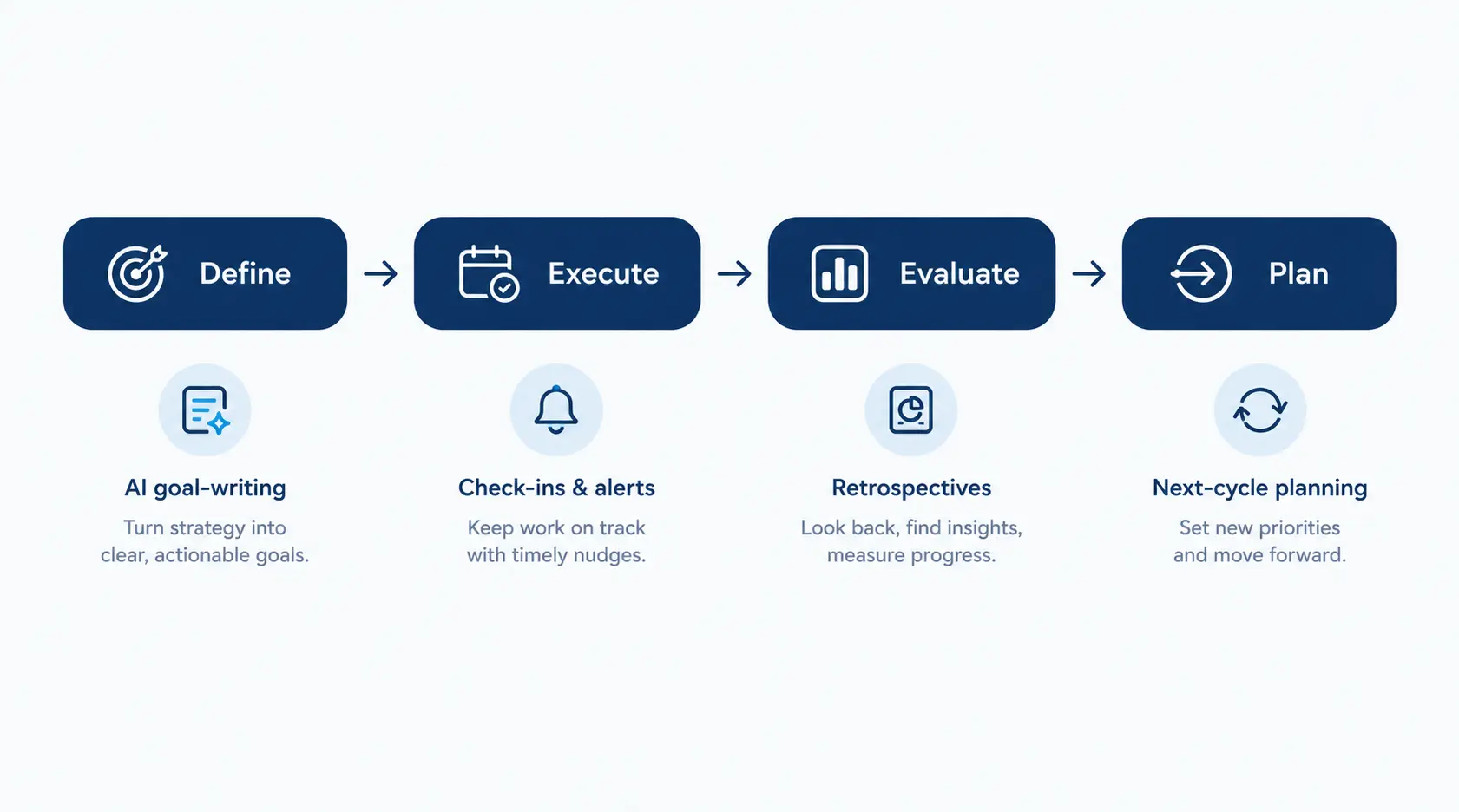
It’s worth naming directly why Worxmate’s pricing structure looks different from most of the category. The DEEP AI™ framework, Define, Execute, Evaluate, Plan, is the actual product architecture, not a marketing layer sitting on top of a goal tracker. Define maps to AI-assisted goal writing and quality scoring. Execute maps to automated check-ins and at-risk detection, the work Orbit AI does on the people side. Evaluate maps to data-backed retrospectives, where Axis AI surfaces the leading indicators a generic dashboard won’t show you. Plan maps to what the organisation carries into the next cycle, connected structurally by Nexus AI.
That matters for pricing because it means you’re not paying for goal-tracking and performance management as two features bolted together. You’re paying for one engine, which is exactly why the translation tax I described earlier doesn’t show up as a line item on a Worxmate quote. It was never a separate purchase to begin with. If you want to see current tier structures directly, our pricing page has the live numbers rather than anything I’d want to quote here and risk going stale.
The Bottom Line on Continuous Performance Management Software Pricing
If you take one thing from this guide, take this: the sticker price is the least useful number on the page. Continuous performance management software pricing only becomes comparable once you’ve normalised for what it replaces, how fast it goes live, and whether coaching reaches past the C-suite. A quote-only enterprise platform and a published mid-tier plan can produce identical total cost of ownership, or wildly different ones, depending entirely on those three variables.
The Platform Path: If you’re ready to compare real, published numbers rather than requesting a quote and waiting, see current Worxmate pricing, explore the performance management software itself, or book a demo to see how the DEEP AI™ engine maps to a tier that fits your stage.
The Consulting Path: If pricing isn’t your first problem, if goal quality, leadership alignment, or adoption below the C-suite is the real gap, our OKR consulting work addresses that directly, independent of which platform you eventually choose. The software is the infrastructure. The coaching is the capability. Most organisations that get real value from this category eventually need both, and in the right order.


Written by
An OKR Coach with 20+ years of implementation experience, Madhusudan has guided over 50 organisations through successful OKR transformations, training more than 500 leaders. Learn more about Worxmate.