 WORXMATE
Quick Answer
The most effective OKR software features in 2026 fall into nine categories: native data integration with CRMs and ERPs, an AI OKR writing tool for goal quality, AI-driven nudging and risk alerts, strategic alignment visualization, predictive scorecards and forecasting, AI-guided retrospectives, integrated performance conversations, customizable OKR frameworks, and enterprise-grade security. Most platforms on the market still do two or three of these well. The ones worth paying for, like Worxmate, build all nine into a single system, connected through the DEEP AI™ framework and three specialised AI models, Orbit, Axis, and Nexus, because software alone has never been what makes an OKR program stick.
Key Takeaways
- Nine OKR software features separate real execution platforms from glorified spreadsheets: integration, AI-assisted writing, AI nudging, alignment visualization, predictive scorecards, AI-guided retrospectives, performance conversations, custom frameworks, and security.
- Across the organisations Worxmate has coached, the Execution Maturity Rate — the percentage of leaders who can write a genuine outcome-driven goal without help — sits at 5–15% in the first cycle and climbs to 30–40% after 12 months of consistent coaching.
- Alignment is agreement between teams, not a configuration screen. A platform can display alignment. It cannot create it.
- Worxmate is built around this distinction, which is why its OKR software features are consistently ranked among the top rated OKR software for mid-market and enterprise teams moving off spreadsheets. See the full vendor shortlist in our best OKR software 2026 guide.
The right OKR software features determine whether a goal program becomes the operating rhythm of a company or a quarterly ritual nobody reopens after week two. The strongest OKR software features prioritize real-time data integration and AI-driven OKR tracking over static goal tracking, letting mid-market companies close the gap between strategy and daily execution through automated alignment instead of manual updates. This article breaks down the essential OKR software features of modern strategic execution tools, and why they are fundamental to organizational agility in a complex global market.
Good OKR software features integrate seamlessly with operational workflows and surface AI-driven predictive analytics that anticipate execution risk. By moving beyond manual updates, these OKR software features keep strategic alignment dynamic, responsive, and embedded in daily work rather than bolted on once a quarter. As enterprises face pressure to deliver faster, strong OKR software features become the central nervous system for organizational performance.
The distinction between “tracking goals” and “driving outcomes” has never been sharper. Organizations relying on legacy systems or manual processes tend to stay reactive rather than proactive. According to research by McKinsey, companies with high organizational agility are three times more likely to be in the top quartile of financial performance agility that depends on OKR software features built for transparency, so leaders can redirect resources toward the highest-impact initiatives. For a VP of People or a Chief Strategy Officer, evaluating OKR software features is no longer just an IT decision; it is a strategic imperative that dictates the pace of innovation and employee engagement.
The Evolution of OKR Software Features: Why 2026 Demands More Than Tracking
The best OKR software 2026 has evolved significantly from the early digital spreadsheets used a decade ago. Initially, Objectives and Key Results (OKRs) were primarily a way to document aspirations. The modern enterprise needs more. Today’s OKR software features must facilitate bi-directional alignment, where top-down strategic priorities meet bottom-up innovation. A shift driven by the “radical transparency” popularized by organizations like Bridgewater Associates and later adopted by tech giants. When teams use software with strong OKR software features, they aren’t looking at a list of tasks; they’re seeing their contribution to the company’s mission in real time.
The best OKR software features also address the “alignment gap” that plagues mid-market companies. Gartner reports that 67% of functions are not aligned with corporate strategy. Solving this requires features like alignment trees and dependency maps, which show how a single key result in engineering might affect a broader business objective in sales. This connectivity is what separates genuinely useful OKR software features from basic project management tools, reducing the risk of “social loafing” and increasing commitment to collective goals.
In 2026, mature OKR software features also support “continuous calibration.” Business environments are too volatile for annual or even quarterly “set and forget” cycles. Monthly or bi-weekly check-ins, automated through integrations with Slack, Microsoft Teams, and Jira, keep the program a living document of company progress rather than a filing exercise. With these OKR software features in place, leaders can spot stalled objectives early and pivot before resources are wasted on low-value work.
Most of this breaks down for a reason software vendors don’t like to say out loud: the coaching stops at the C-suite. A leadership team gets aligned, gets trained, gets excited and then the program is handed to middle management with a login and no support. That’s where OKR programs actually live or die, and it’s a gap no list of OKR software features alone can close. See why OKR implementation fails before you shop for features, or read our complete guide to the best OKR software platforms of 2026 for a named-vendor comparison.
Achieve Your Goals Faster
See how Worxmate can help your team set clear goals and achieve faster results. Book your free demo today and experience the power of AI-driven OKRs in action.
9 Key OKR Software Features to Look for in 2026
Evaluating OKR software features means looking past the interface. What matters is whether the platform’s underlying OKR software capabilities support a high-performance culture end-to-end — from writing the goal to closing the loop on it. Worxmate organizes its OKR software features around the DEEP AI™ framework: Define, Execute, Evaluate, Plan — four stages, each backed by AI, plus three intelligence models sitting underneath all nine: Orbit AI for people, Axis AI for business, and Nexus AI for organisational structure.
-
Native Data Integration
If your teams are manually updating progress bars, the number they enter will always be a little late and a little generous — nobody types in bad news the day it happens. This is one of the most important OKR software features because it removes that lag entirely, pulling straight from CRMs, ERPs, and financial systems so a key result reflects the actual state of the business, not what someone remembered to update. See how this works across your existing stack in Worxmate’s OKR software integrations, which connects 36+ tools including Jira, Slack, and Teams.
-
AI OKR Writing & Quality Scoring
Most OKR programs don’t fail because the framework is wrong they fail because the goals were never measurable to begin with. This is one of the newer OKR software features worth paying close attention to: an AI co-pilot that reviews a draft objective or key result and flags when a “Key Result” is actually a KPI wearing a disguise, or when an objective is really a task list. Worxmate’s AI OKR writing tool, the Define stage of DEEP AI™ pairs an OKR Studio with built-in quality scoring, so goal quality stops depending on how well-trained the person writing it happens to be. This one feature does more to resolve okr vs kpi confusion than any framework template.
-
AI-Driven Nudging and Risk Alerts
Among AI OKR software features, automated nudging is the one that keeps a program alive between quarterly reviews. Machine learning identifies patterns in team performance and sends automated nudges to managers when a key result hasn’t been updated, or when a goal’s trajectory suggests it will likely be missed. Worxmate’s OKR check-in software the Execute stage of DEEP AI™ — flags at-risk goals before they become quarter-end surprises instead of after, with Orbit AI layering in people-side signals like disengagement or capacity risk on top of the goal data.
-
Strategic Alignment Visualization
Visualizing the hierarchy of goals is essential, but it’s worth saying plainly: a cascaded OKR tree only shows an agreement that already exists between teams. If that agreement was never actually reached, the tree is a nice-looking fiction. Real OKR alignment visualization interactive maps that let users drill from a five-year vision down to a weekly tactical goal — is only useful once the underlying alignment work is done. Nexus AI, Worxmate’s organisational intelligence model, maps where that cascade breaks down structurally before it ever reaches the dashboard. Explore what real goal alignment requires beyond the interface, and how organizational alignment differs from a display of hierarchy.
-
Predictive Scorecards and Forecasting
Most OKR software features report the past did the team hit the number or not. A smaller set actually forecasts forward. Worxmate’s OKR scorecard software, the Evaluate stage of DEEP AI™, uses AI-generated forecasts to separate real progress from vanity metrics scoring whether a key result’s current trajectory will actually land it by the deadline, rather than just showing a percentage complete. Axis AI, Worxmate’s business performance intelligence model, reads this scorecard data to isolate the single fastest lever to pull when revenue or execution is falling behind, instead of leaving leadership to guess.
-
AI-Guided Retrospectives and Continuous Planning
Most teams close a quarter and open the next one with a blank slate — repeating the same mistakes because nobody structured what was learned. This is one of the more overlooked OKR software features: an AI-facilitated retrospective that turns each cycle’s data into specific recommendations for the next one. Worxmate’s OKR retrospective tool, the Plan stage of DEEP AI™, closes the loop between Evaluate and the next Define cycle, so continuous performance management OKR data actually compounds instead of resetting every 90 days.
-
Integrated Performance Conversations
Strong OKR software features bridge the gap between goal-setting and performance reviews. Instead of a separate annual appraisal, continuous feedback loops tie directly to objective achievement, making reviews fairer and more data-driven. This is what closes the loop that most performance management software leaves open CFRs (Conversations, Feedback, and Recognition) and goals finally living in the same system instead of two disconnected calendars.
-
Customizable OKR Frameworks
Not every department works the same way. A genuinely customizable OKR framework supports committed OKRs for operational teams and aspirational “stretch goals” for R&D and adapts across business functions instead of forcing every team into one template. The real starting point for this flexibility is goal quality, not goal structure, which is why the AI OKR writing tool that catches a KPI dressed up as a Key Result (feature #2 above) matters more than the framework template itself.
-
Enterprise Security, Compliance, and Scalability
None of the above OKR software features matter if the platform can’t be trusted with the data behind it. For mid-market companies on a path to enterprise scale, this means SOC2 compliance, single sign-on, and permission controls granular enough that a board-level objective isn’t visible to every individual contributor by default. It isn’t a checkbox it’s what determines whether leadership actually uses the platform for real strategic conversations, or keeps the sensitive numbers in a side spreadsheet, quietly defeating the entire point.
OKR Software Features at a Glance
A quick-reference summary of the nine OKR software features covered above, what each one solves, and which part of Worxmate powers it.
| OKR Software Feature | What It Solves | Powered By (Worxmate) |
| Native Data Integration | Manual, lagging progress updates | OKR software integrations (36+ tools) |
| AI OKR Writing & Quality Scoring | Vague, unmeasurable goals | Define stage — DEEP AI™ |
| AI-Driven Nudging & Risk Alerts | Missed goals discovered too late | Execute stage — DEEP AI™ + Orbit AI |
| Strategic Alignment Visualization | Cascades that look aligned but aren’t | Nexus AI |
| Predictive Scorecards & Forecasting | Vanity-metric progress bars | Evaluate stage — DEEP AI™ + Axis AI |
| AI-Guided Retrospectives | Lessons lost between cycles | Plan stage — DEEP AI™ |
| Integrated Performance Conversations | Goals and reviews on separate calendars | Performance Management Software |
| Customizable OKR Frameworks | One-size-fits-all templates | OKR Studio |
| Enterprise Security & Compliance | Sensitive data kept in side spreadsheets | SOC2, SSO, granular permissions |
For a deeper side-by-side against specific named platforms rather than a feature checklist, see our full product comparison, including how Worxmate compares against tools like Betterworks, Lattice, and Quantive.
Top Rated OKR Software For 2026: Comparative Analysis
Choosing the best OKR software 2026 requires a clear understanding of the competitive landscape. While many tools claim to offer comprehensive features, the best OKR software 2026 stands out by balancing ease of use with deep analytical power. In the table below, we compare the leading categories of enterprise goal setting software to help you identify which best OKR software 2026 fits your specific needs.
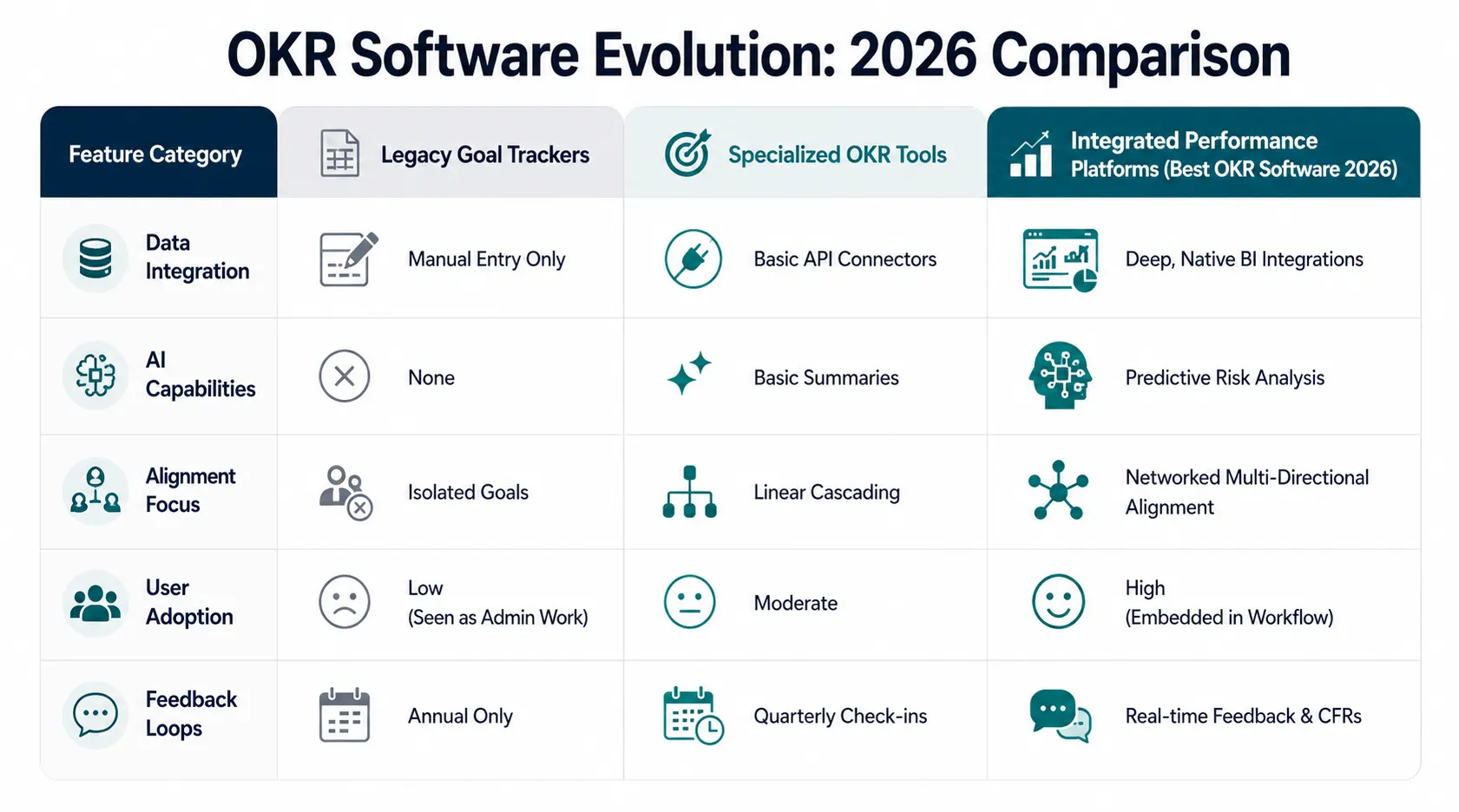
When selecting the best OKR software 2026, consider the “time to value.” The best OKR software 2026 should be intuitive enough for a team to adopt within weeks, not months. High-growth companies cannot afford long implementation cycles. Therefore, the best OKR software 2026 often features templated libraries and “OKR wizards” that guide users through the process of writing high-quality, measurable key results. This educational component is a vital part of what makes a platform the best OKR software 2026 for organizations that are new to the framework but eager to scale.
Why Worxmate Leads on OKR Software Features
Most tools focus solely on the “what” (the goal). Worxmate’s OKR software features are built around the “how” (the performance) and the “who” (the people) as well, through three connected AI models Orbit AI for people intelligence, Axis AI for business intelligence, and Nexus AI for organisational intelligence all running on the DEEP AI™ framework. This holistic approach is why Worxmate is consistently ranked among the top rated okr tools for mid-market enterprises.
The Worxmate OKR features are designed specifically to solve the common pain points of growing companies. For example, many organizations struggle with spreadsheet vs okr software transitions. Worxmate makes this migration seamless, offering a structured environment that eliminates the version control issues and data silos inherent in manual tracking. As the best OKR software 2026, Worxmate provides a “single source of truth” that leaders can trust during board meetings and strategic reviews. This level of reliability is non-negotiable for companies aiming for IPO or significant market expansion.
This isn’t theoretical. In one recent engagement with a fast-growing retail company in aggressive expansion mode, leadership had the framework in place and the intent behind it but couldn’t name three clear priorities to cascade from, even after 45 minutes of trying in the first alignment call. Not because the CEO wasn’t sharp. Nobody had ever asked him to compress the vision into three outcomes an entire organisation could build from. A structured alignment process closed that gap within one quarter: clear cross-functional dependencies surfaced in advance instead of discovered mid-cycle, and budget tied directly to the growth model for the first time.
You cannot set alignment in a tool. You can display it. You cannot create it.
That’s the difference between owning a tool and owning an execution system. If you want to see what strategic planning looks like when it’s actually tied to execution, not just intent or want to try the live intelligence experience and watch Orbit, Axis, and Nexus activate on a real scenario get a demo to see how Worxmate handles this from week one.
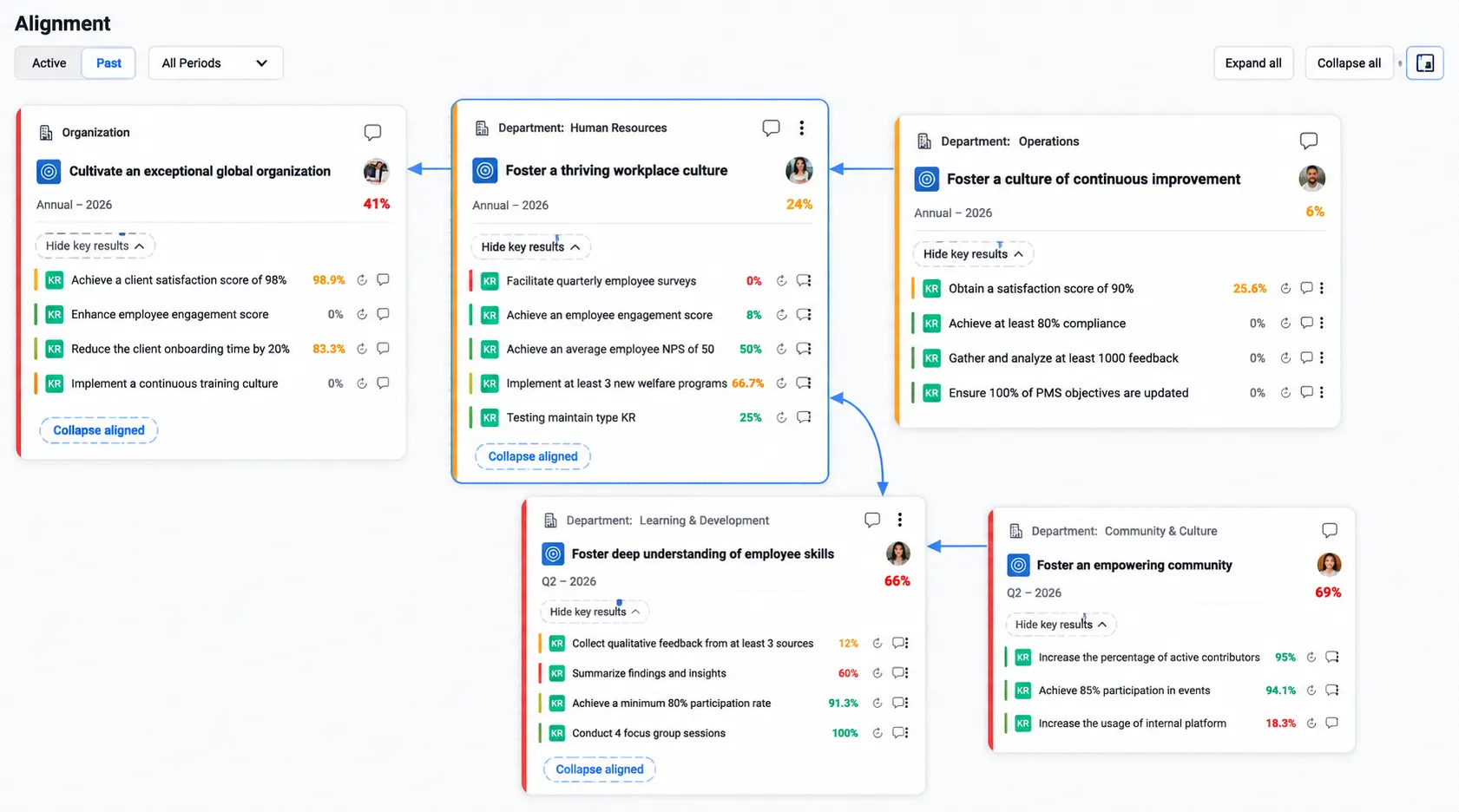
Another reason Worxmate stands out on OKR software features is its emphasis on strategic alignment. The platform doesn’t just show a list of goals; it visualizes the entire ecosystem of the organization, helping managers identify “orphaned” goals objectives that aren’t contributing to any higher-level priority and reallocate effort accordingly. By providing real-time visibility into OKR tracking metrics, Worxmate empowers teams to own their outcomes and drive the business forward.
The Role of AI and Predictive Analytics Among OKR Software Features
The integration of artificial intelligence is perhaps the most transformative trend among OKR software features. Traditional goal setting is historical you look back at the end of the quarter to see what you achieved. The strongest OKR software features are predictive instead: by analyzing historical performance data, they forecast the probability of achieving a future goal, letting leaders intervene weeks before a deadline is missed. This shift from “autopsy” to “diagnosis” is why AI-driven OKR tracking is now a core requirement, not a nice-to-have.
AI-powered OKR software features also help teams write better goals in the first place. Many struggle to write key results that are truly measurable and outcome-oriented. Worxmate’s AI writing assistant in the Define stage of DEEP AI™ can critique a draft OKR and flag when a Key Result is actually a KPI wearing a disguise, reducing the administrative burden on HR teams and raising the baseline quality of goals across the organization.
Beyond writing and forecasting, these OKR software features also surface “hidden” insights. For example, the software might notice that whenever Team A and Team B share a dependency, project completion rates drop by 20%. This kind of pattern detection is exactly what Axis AI, Worxmate’s business performance intelligence model, is built to surface the cross-team alignment gaps nobody notices until a deadline is already at risk. This is why AI-driven performance management software is fast becoming essential for any organization undergoing digital transformation.
How to Choose OKR Software Features for Your Organization’s Maturity
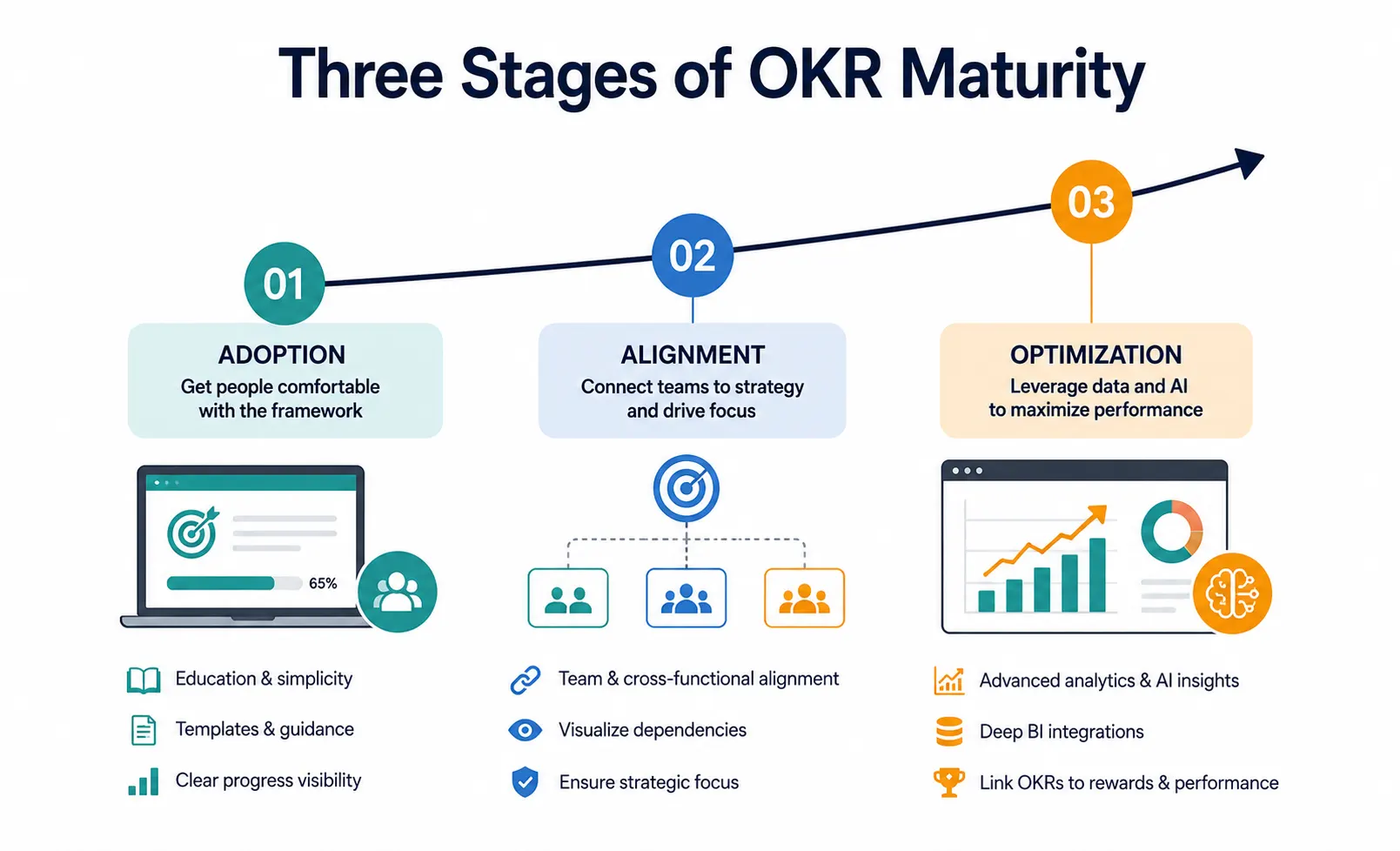
Selecting the right OKR software features is not a one-size-fits-all process. Your choice must be calibrated to your organization’s current maturity level. A startup with 50 employees needs very different OKR software features than a mid-market enterprise with 2,000. To find the right fit, consider three stages of OKR maturity:
-
Stage 1: The Adoption Phase
In this stage, the goal is to get people comfortable with the framework. The OKR software features that matter most here focus on education and ease of use — templates and clear progress bars that encourage engagement. This stage suits OKR software for small businesses particularly well. The clearest signal this stage is working isn’t usage stats it’s whether OKRs were introduced as something leadership chose after understanding the why, or announced as a new operating model with a go-live date and a login. The second version collapses between week four and six, almost always.
-
Stage 2: The Alignment Phase
Once the framework is adopted, the focus shifts to connecting teams. The OKR software features required here must offer robust visualization tools to show interdependencies and ensure departmental goals support corporate strategy. This is where most programs quietly stall, because alignment gets treated as something a platform configures rather than something teams actually agree on. Read more on what real organizational alignment requires beyond the dashboard.
-
Stage 3: The Optimization Phase
For mature organizations, the OKR software features that matter are all about data and AI predictive insights, deep BI integrations, and the ability to link OKRs to compensation and rewards. Explore Worxmate’s solutions for OKR software in the US for what this stage looks like when OKRs, performance data, and AI-driven forecasting finally run in one system instead of three.
Regardless of stage, the right OKR software features should be a partner in your growth, not just a vendor. Look for platforms that offer excellent customer support and strategic consulting to help you navigate the cultural shifts OKRs require. Ultimately, the best set of OKR software features is the one your employees actually use adoption is the real metric of success.
Case Study: Scaling Strategic Execution at a Fast-Growing SaaS Company
-
The Challenge
A rapidly expanding SaaS provider scaled from 100 to 500 employees. Their goal-tracking didn’t scale with them manual spreadsheets left leadership with no real visibility, and 40% of departments ended up working on priorities that didn’t align with each other, causing real delays in product launches.
-
The Solution
In early 2025, the company moved off manual processes and implemented a dedicated enterprise goal-setting platform. The focus was automating data check-ins and establishing clear bi-directional alignment across engineering, product, and sales, so all three teams were working toward the same thing.
-
Results and Impact
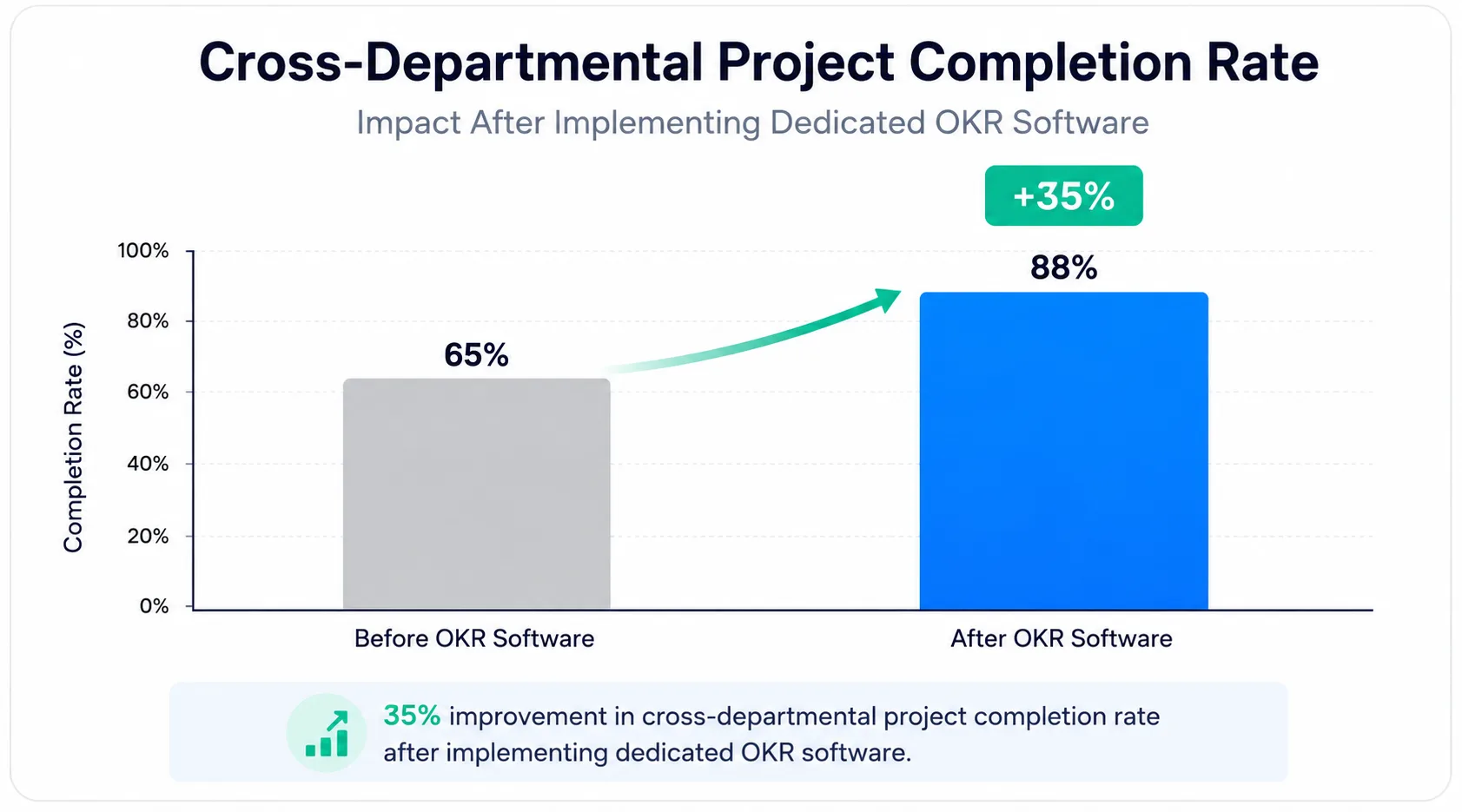
By the end of Q1 2026, the company reported a 35% increase in cross-departmental project completion rates. That came directly from the real-time visibility the new OKR software features gave leaders resource bottlenecks that used to take weeks to surface were now identified and resolved 50% faster than in previous years. (Source: Internal Company Performance Audit 2026)
Goal completion rate is the least meaningful indicator of whether an OKR program is working. What matters is whether outcome-thinking actually took root.
Insights in this article draw on the direct coaching experience of Madhusudan Nayak, Co-Founder & CEO of Worxmate, who has coached 50+ organisations across 10+ industries and trained 500+ leaders on OKR implementation over more than a decade.
Conclusion
The gap between strategic intent and operational reality is the primary barrier to enterprise growth in 2026. As Gallup research consistently highlights, only 22% of employees strongly agree that their leaders have a clear direction for the organization. Adopting the right OKR software features is the most effective way to close this clarity gap, turning vague aspirations into measurable, high-impact results through data-driven transparency.
By implementing these OKR software features, organizations can achieve more cohesive organizational alignment, ensuring every team member understands their role in the bigger picture, while maximizing performance management software ROI and moving toward outcome-driven performance management. Maintaining consistent OKR check-ins ensures momentum is preserved even as market conditions shift.
Ready to move from manual tracking to predictive execution? Explore Worxmate’s OKR software to unify your workforce, compare OKR software pricing plans, and book a demo to see the full set of OKR software features — DEEP AI™, Orbit, Axis, and Nexus — in action today.


Written by
An OKR Coach with 20+ years of implementation experience, Madhusudan has guided over 50 organisations through successful OKR transformations, training more than 500 leaders. Learn more about Worxmate.