 WORXMATE
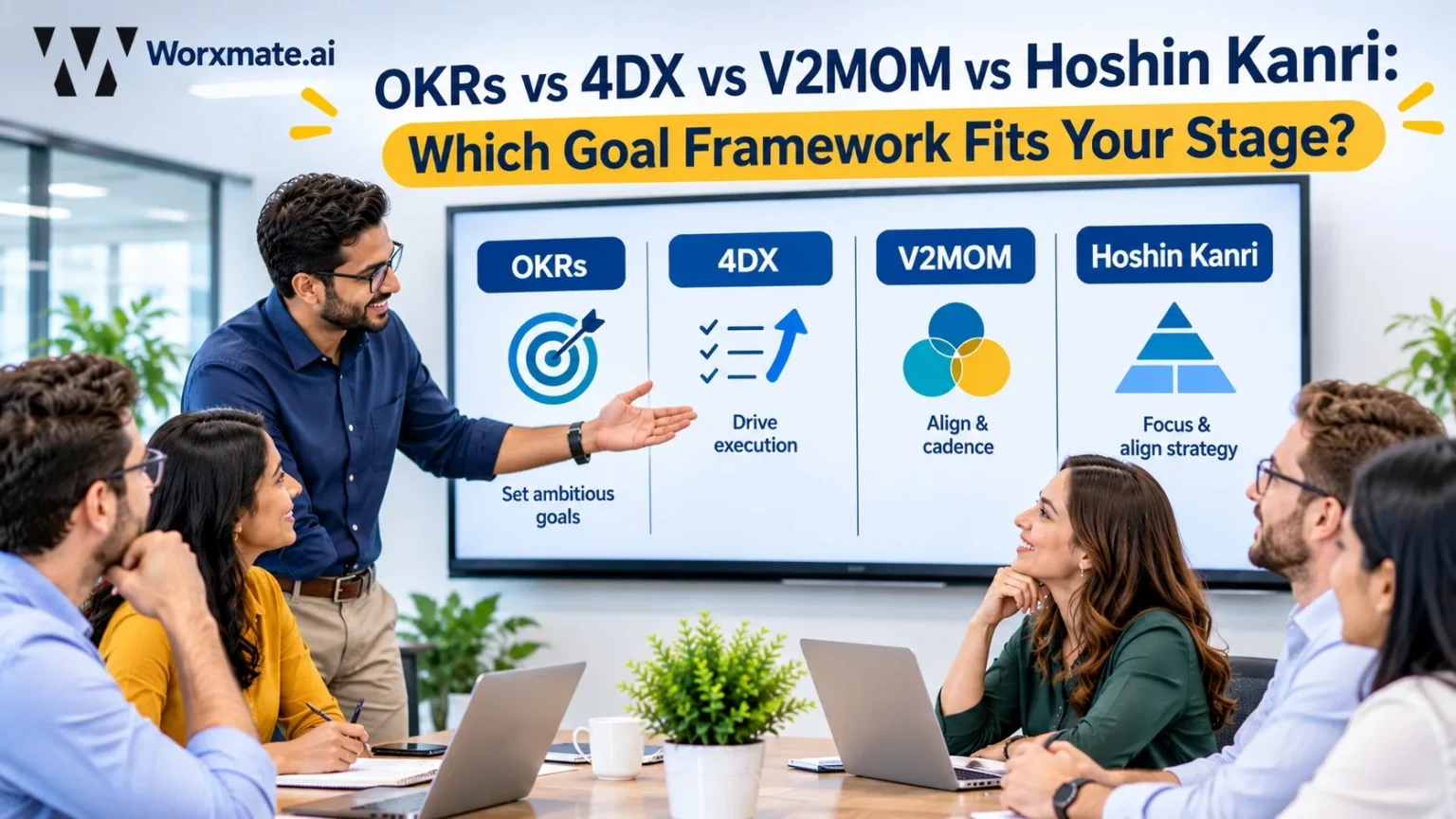
OKRs vs 4DX vs V2MOM vs Hoshin Kanri: choose by the problem and the stage, not the popularity. Use OKRs when many teams must align on outcomes. Use 4DX when one or two goals must be won through weekly discipline. Use V2MOM when leaders need personal clarity on vision, values and obstacles. Use Hoshin Kanri when a large organisation must deploy annual strategy through every level. Founding teams usually fit 4DX or a light OKR set, growth-stage companies fit OKRs, and multi-division enterprises fit Hoshin Kanri with OKRs as the execution layer.
Most leaders asking which goal framework to adopt are really asking why their goals are not moving anything.
That is the wrong place to start. In a goal-setting framework comparison, the framework is rarely the variable that decides the outcome. What decides it is whether the people using it can tell an output from an outcome. Choose the wrong framework and you lose a quarter. Choose the right one with the wrong thinking and you lose it anyway.
This guide compares OKRs vs 4DX vs V2MOM vs Hoshin Kanri honestly, including where OKRs are not the answer, and shows which goal framework fits your stage.
About the author: I am Madhusudan Nayak (Maddy), Co-Founder and CEO of Worxmate. I have spent 20+ years in strategy execution and 10+ years implementing OKRs across 50+ organisations, and I have trained 500+ leaders. What follows comes from implementation rooms, not from a framework textbook.
Why the Framework Debate Starts in the Wrong Place
In a European fintech of about 100 people, revenue was coming in and OKRs were being introduced to drive growth. When I spoke to the CEO and the CPO, it was clear they could not articulate outcomes. Their goals were KPI-led: metrics that produced numbers without saying what needed to change. The room was full of activity, and none of it was clearly connected to what the company needed to achieve.
I asked one question in the first coaching session: “What is the one big thing you want to resolve?” The answer was product demo experience. Then came a chain of “so what?” questions until the team reached a real outcome statement. That sequence changed the quality of every goal written after it. We then asked the Product Lead and the Account Executive to co-own a single key result. Cross-functional co-ownership had never happened there before.
No framework did that. The thinking process did. Whichever of the four you pick, the same gate applies: can your leaders write an outcome without help? I measure this as the Execution Maturity Rate, and in a typical first cycle it sits between 5% and 15%. Read our piece on output vs outcome before you compare anything else.
OKRs vs 4DX vs V2MOM vs Hoshin Kanri: The Four Frameworks at a Glance
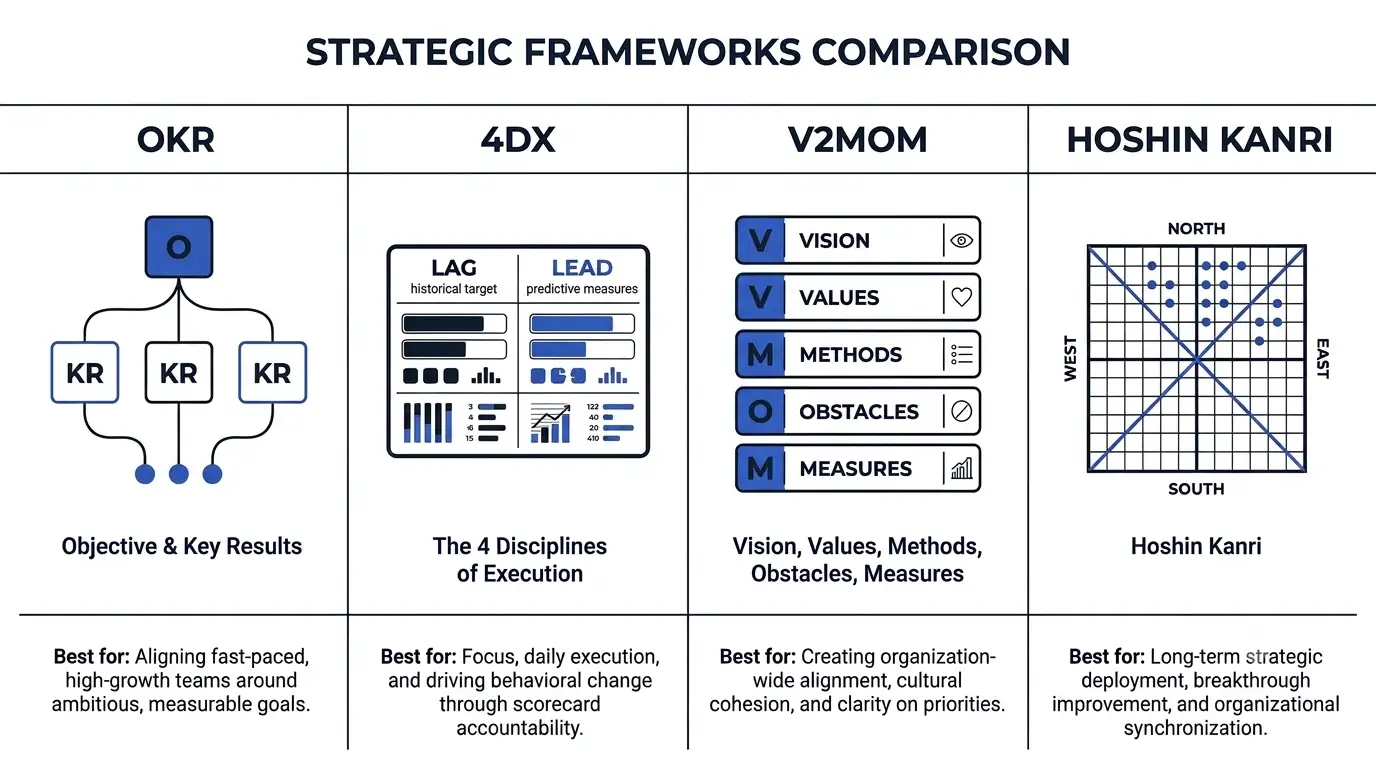
OKRs link an inspiring objective to measurable key results, usually on a quarterly cycle, cascaded and negotiated across teams. The method came out of Intel and spread widely through Google; our history of OKRs covers it. If you need the basics, start with what is OKR and our OKR framework overview.
4DX, the 4 Disciplines of Execution, comes from FranklinCovey. The 4DX framework has four disciplines: focus on the wildly important, act on lead measures, keep a compelling scoreboard, and create a cadence of accountability.
V2MOM is the Salesforce method. V2MOM stands for vision, values, methods, obstacles and measures. Each person writes their own, aligned to the one above it.
Hoshin Kanri is a Japanese strategy deployment framework, often translated as policy deployment. It uses an X-matrix to connect long-term direction to annual objectives and actions, with a negotiation step called catchball between levels, and a PDCA review loop.
| OKRs | 4DX | V2MOM | Hoshin Kanri | |
|---|---|---|---|---|
| Core mechanic | Objective plus measurable key results, cascaded | One or two wildly important goals, lead and lag measures | Vision, values, methods, obstacles, measures | X-matrix, catchball, PDCA |
| Typical horizon | Quarterly, with an annual view | Weeks to a year per goal | Annual | Annual, with multi-year direction |
| Rhythm | Check-ins and retrospectives | Weekly cadence of accountability | Reviewed periodically | Scheduled reviews up the levels |
| Best at | Cross-team alignment on outcomes | Winning a few goals through habit | Personal and leadership clarity | Deploying strategy at scale |
| Breaks when | Teams write outputs and call them outcomes | The goal needs many teams at once | Methods have no cross-team dependency mechanism | Used without the capability to run catchball |
OKR vs 4DX: Focus on One Thing or Align Many?
OKR vs 4DX is the comparison I hear most, and it usually collapses two different problems into one.
4DX is a focus engine. Pick one or two wildly important goals, find the lead and lag measures, keep a visible scoreboard and meet every week. It works when a single team can move the needle through its own behaviour. Its cadence of accountability is excellent, and I would borrow it for any framework.
OKRs are an alignment engine. They exist because most real outcomes need several functions to move together. Where 4DX asks “what is the one thing we must win?”, OKRs ask “what must change, and who has to agree to change it?”
The two meet at lead and lag measures. At a multi-billion dollar mining engineering company, leaders thought in KPIs because their systems had always measured them. The unlock was separating Objectives (direction), Outcomes (what must change) and KPIs, which are lagging indicators that describe where you are and not where to go. Once they saw leading indicators, they could spot blockers before they became crises and trace daily work to regional growth. If this distinction is new, read about leading indicators and lagging indicators.
Is 4DX better than OKRs? For a single-team execution problem, often yes. Can you combine OKRs and 4DX? Yes, and it is a strong pairing: write the goals as OKRs, then run weekly OKR check-ins with 4DX-style lead measures and a scoreboard.
OKR vs V2MOM and OKR vs Hoshin Kanri
OKR vs V2MOM. V2MOM, the framework Salesforce popularised, is strongest where OKRs are weakest: it forces a leader to write vision and values before methods, and it makes them name obstacles. Naming obstacles is a habit every OKR practice should copy. As written, though, V2MOM has no explicit mechanism for dependencies between teams, and its measures are not designed for the quarterly iteration that OKRs allow. The V2MOM vs OKR Salesforce question is really about unit of clarity: V2MOM clarifies the person, OKRs align the system.
OKR vs Hoshin Kanri. Hoshin Kanri solves deployment. Strategy is set at the top, then negotiated downward and upward through catchball until each level owns its part. The X-matrix is a disciplined way to prove every action serves an objective. It is also heavy. Running a strategy deployment framework like this takes facilitation capability that many companies do not have. OKRs are lighter and faster, and they adapt each quarter.
The other pairings. 4DX vs V2MOM is a team-habit method against a leader-clarity method, and they complement each other. 4DX vs Hoshin Kanri is a weekly discipline against an annual system. V2MOM vs Hoshin Kanri is personal clarity against organisational deployment. None of these is a rivalry. They sit at different layers.
I would add one note on older methods. If you are weighing these against MBO vs OKRs, SMART goals vs OKRs or OKR vs KPI, those comparisons are covered separately. This one is about four modern strategy execution frameworks.
Hoshin Kanri at Enterprise Scale: What Catchball Really Requires
At a 70,000-person IT services organisation, I worked with the leadership team of one business unit. Every strategic meeting and monthly review ended in the same frustration: no one knew what was actually blocking progress or how daily work connected to business expectations.
What shifted it was not a framework. It was a live exercise: leaders identified which of their own goals were output-led and which were outcome-driven. That game broke the myth they had worked under. Then we ran a “Thinking Process” to pick two or three BU-level priorities and write OKRs against them in the room. Two to three quarters later, leaders could find root causes and kill initiatives that were consuming effort without driving outcomes.
That is catchball in spirit: negotiation between levels until each owns its part. It is what Hoshin Kanri promises, and it only works if leaders can think in outcomes. It also depends on structure. Org structure is an OKR pre-condition, and the same holds for any deployment system. Deploying strategy through a structure that does not reflect it embeds the misalignment. If you need the planning layer first, see strategic planning and our organizational strategy framework.
Which Goal Framework Fits Your Stage?
This is where most comparisons stop short. Which goal framework fits your stage depends on how many levels you have and how much outcome thinking you can count on. Use this as a goal framework by company stage guide. The size bands are rough guides, not rules.
| Stage | Typical situation | Best-fit framework | Why | Watch for |
|---|---|---|---|---|
| Founding team (up to about 20) | One product, one or two priorities | 4DX, or one-level OKRs | Maximum focus, minimum overhead | Weekly rhythm slipping when founders get busy |
| Growth stage (about 20 to 200) | Functions emerging, handoffs multiplying | OKRs, top-down first | Alignment across new functions | KPI-led goals relabelled as key results |
| Scale-up (about 200 to 1,000) | Several leaders, several business lines | OKRs plus 4DX cadence at team level, V2MOM for the leadership layer | Alignment, weekly discipline, leader clarity | A leadership team that wrote OKRs but never coached the layer below |
| Enterprise (1,000+, multi-division) | Strategy must reach many levels | Hoshin Kanri-style deployment with OKRs as the execution layer | Structured cascade with a quarterly loop | Heavy process outrunning capability |
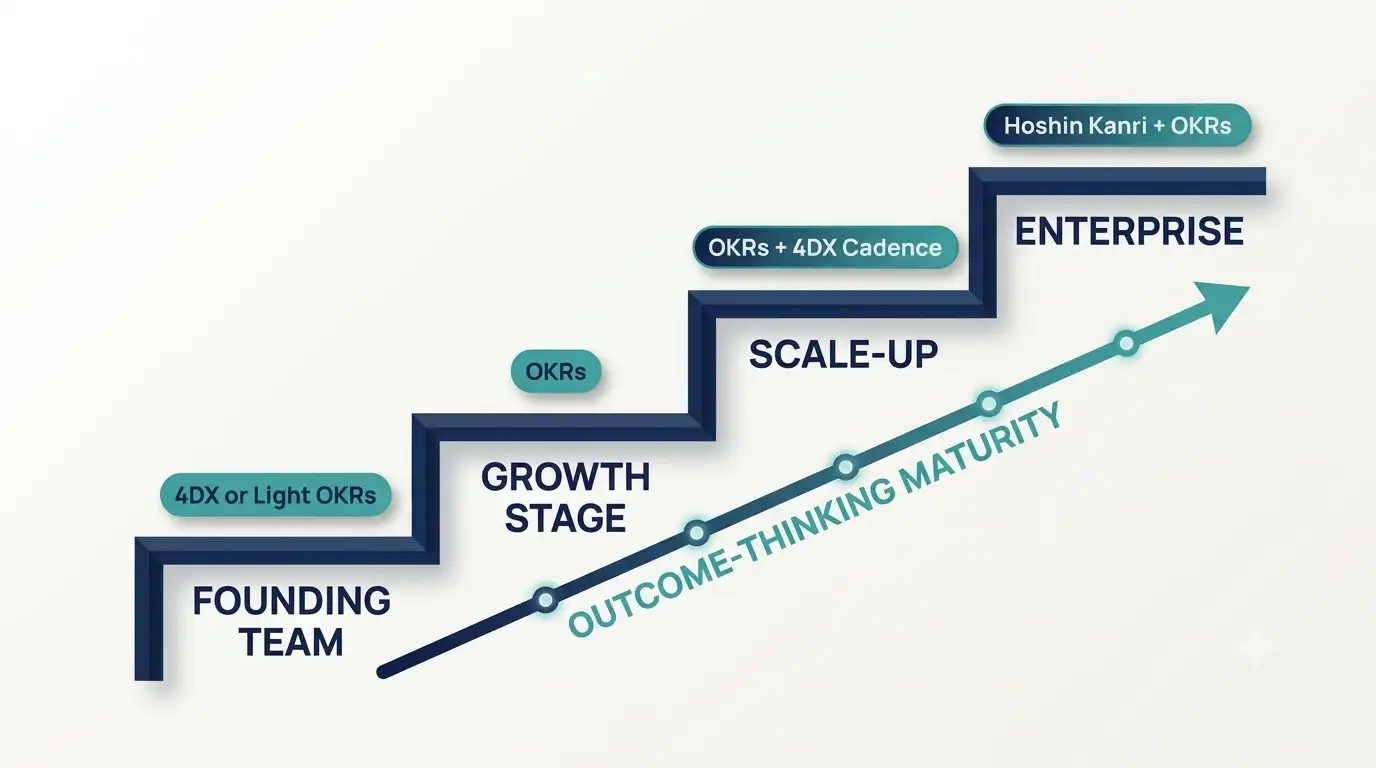
A few notes on the table. For a 50-person startup, the question is usually “one framework or none?” Choose one: I would start with a small OKR set and borrow 4DX’s weekly cadence. Read OKR implementation for small businesses and tailoring OKRs to business stages, or compare OKRs for 5 people vs 500 people.
For scale-ups, OKR implementation for mid-sized companies is the closest match. And a point on sequence: start top-down. Bottom-up is the right destination, not the right starting point, because in the first two quarters it produces noise rather than alignment.
Not sure your team is ready for the framework you just picked?
The OKR execution maturity framework shows where your leaders sit today, so you choose a framework your organisation can actually run.
The Same Goal in Four Frameworks
The clearest way to see the differences is to write one goal four ways. These numbers are illustrative.
| Framework | How “reduce mid-market churn” is written |
|---|---|
| OKRs | Objective: make onboarding the reason customers stay. KR1: cut time to first value from 21 days to 7. KR2: raise 90-day retention from 82% to 90%. |
| 4DX | Wildly important goal: raise 90-day mid-market retention from 82% to 90% by 31 December. Lead measures: share of new accounts with an onboarding call inside three days; number of at-risk accounts with a save plan each week. |
| V2MOM | Vision: customers stay because we made them successful. Values: trust, speed. Methods: redesign onboarding, build health scoring. Obstacles: support capacity. Measure: 90-day retention at 90%. |
| Hoshin Kanri | Breakthrough objective: lead mid-market retention. Deployed through the X-matrix to product, customer success and sales, with targets negotiated by catchball and reviewed monthly through PDCA. |
Notice who is accountable in each. OKRs spread it across the teams that must change. 4DX concentrates it in the team that runs the weekly meeting. V2MOM makes it personal. Hoshin Kanri makes it structural. That is the heart of any OKR vs V2MOM or OKR vs Hoshin Kanri decision.
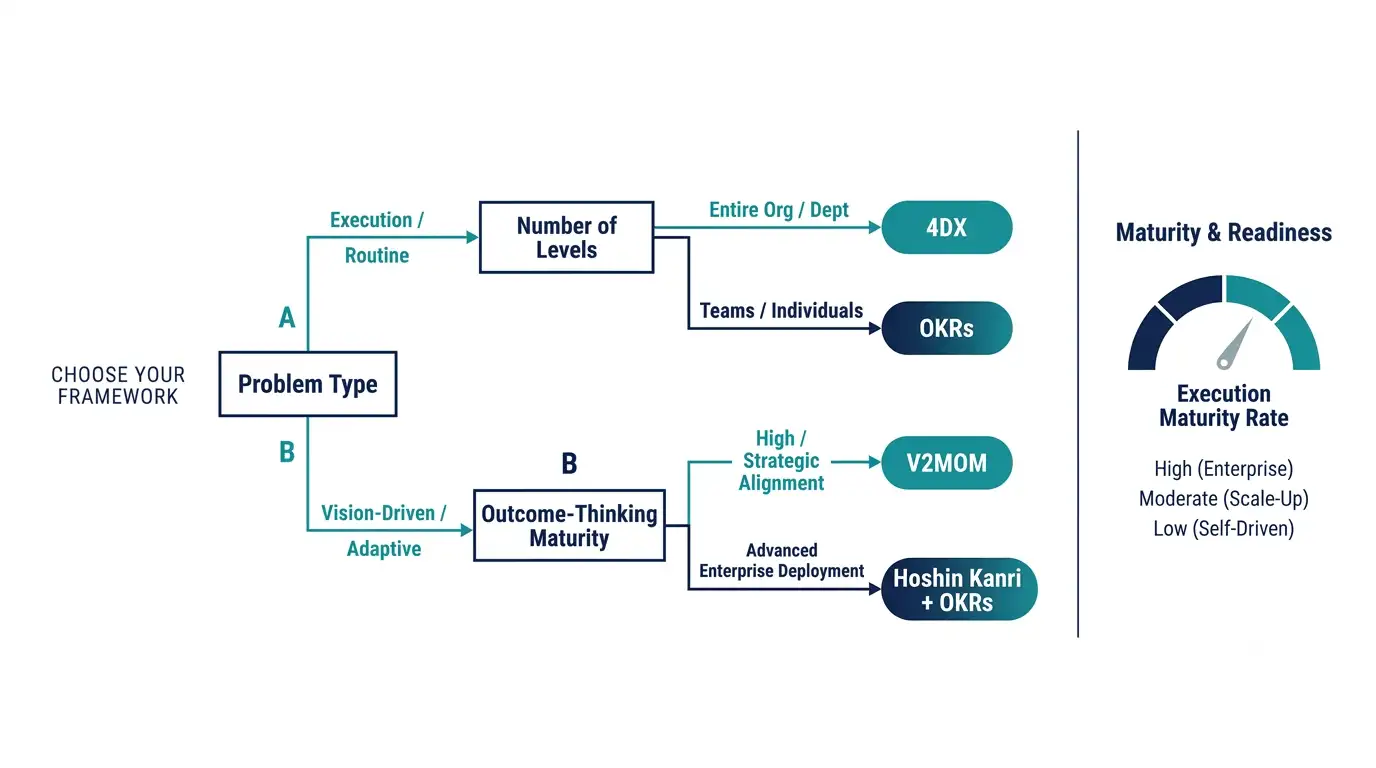
How to Choose a Goal Framework: Three Questions
If you are deciding how to choose a goal framework, ask these in order.
- What is your actual problem? Scattered focus points to 4DX. Teams that cannot see each other’s goals point to OKRs. Leaders without personal clarity point to V2MOM. A strategy that stalls between levels points to Hoshin Kanri. Our piece on the strategy execution gap helps you diagnose this.
- How many levels must the goal travel? One level favours 4DX. Two to three favour OKRs. Four or more, across divisions, favours a strategy deployment framework with OKRs inside it.
- How strong is outcome thinking today? If your Execution Maturity Rate is in the typical first-cycle range of 5% to 15%, no framework will save you. In organisations running a well-coached program for 12 months, it reaches 30% to 40%. Match the framework to that number, not to your ambition.
There is also the question of OKR alternatives like EOS or the balanced scorecard, which solve adjacent problems. And if you adopt OKRs, know the difference between aspirational and committed OKRs so that your best-fit framework does not inflate into a wish list. Remember too that one completed OKR is worth more than five written ones.
Whatever you pick, expect it to fail without one thing: an honest retrospective. A OKR retrospective is where the framework teaches you something instead of just reporting.
Chosen OKRs? Do not launch them from a template.
Our strategic OKR implementation guide covers sequencing, coaching and cadence so your first cycle produces outcomes, not paperwork.
Frameworks Do Not Execute Themselves: Where DEEP AI Fits
Every framework above has the same four moments, and each one fails differently when it is missing. This is why we built DEEP AI™ (Define, Execute, Evaluate, Plan) as a way to run any of them.
- Define. V2MOM’s clarity and OKR quality both live here. Without it, goals get written as outputs. Define is where a weak outcome gets caught before the cycle starts.
- Execute. This is 4DX’s cadence of accountability. Without it, the scoreboard goes stale by week three, and Execute is what keeps check-ins honest and surfaces at-risk goals.
- Evaluate. Hoshin Kanri’s PDCA loop lives here. Without it, reviews are opinions. Evaluate turns the cycle into data.
- Plan. Without it, every cycle starts from zero, and Plan carries the learning forward.
Around that, Axis AI shows where business performance is drifting from the plan, Orbit AI shows which leaders need coaching, and Nexus AI shows patterns across the organisation. Without that visibility, framework choice becomes a debate held in the dark. For goal alignment across teams, our pieces on goal alignment and organizational alignment pick up from here.
Bottom Line: What I’d Tell a Client
Do not pick the famous one. Pick the one that fits the problem and the people you have today.
If your goals are scattered across a small team, start with 4DX discipline. If teams must move together, start with OKRs and coach every level, not just the C-suite. If leaders lack personal clarity, borrow V2MOM’s questions. If you run a multi-division enterprise, use Hoshin Kanri-style deployment with OKRs as the quarterly engine. And when you are ready to evaluate platforms, our OKR software comparison covers that decision separately.
The software is the infrastructure. The coaching is the capability. You need both, and in the right order.
Path 1: the platform. To see how OKRs, check-ins and retrospectives run in one place, explore Worxmate OKR software, look at pricing or book a demo.
Path 2: the consulting. If your honest answer to question three is that outcome thinking is the gap, our OKR consulting is built to close it.
Want an outside read on which problem you really have?
The organization performance audit shows where execution leaks today, so the framework you choose fixes the right thing.

Written by
An OKR Coach with 20+ years of implementation experience, Madhusudan has guided over 50 organisations through successful OKR transformations, training more than 500 leaders. Learn more about Worxmate.