 WORXMATE
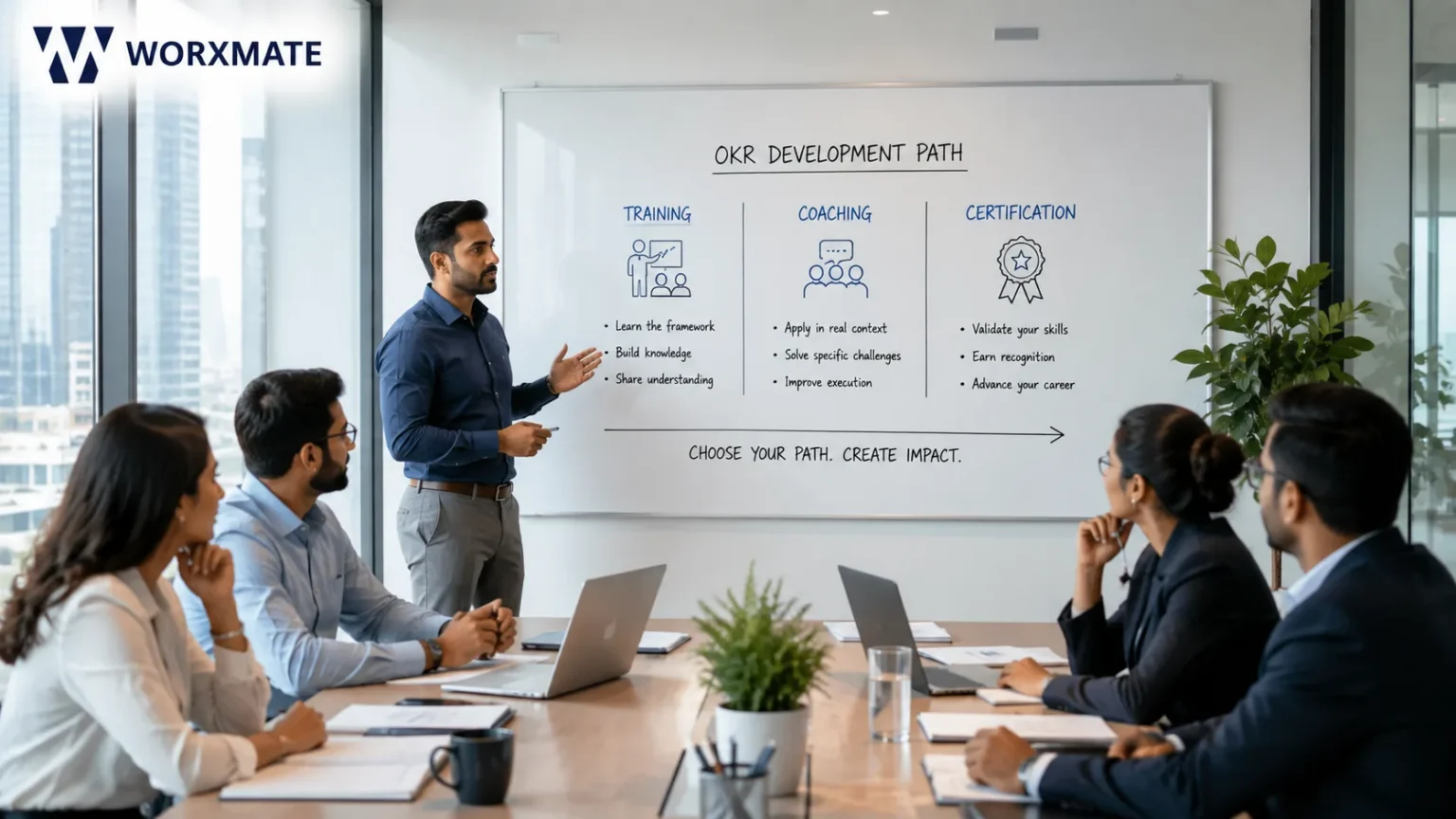
OKR training vs OKR coaching vs OKR certification is not a question of which one is best it is a question of which problem you actually have. Training is a one-time transfer of information, best for closing a vocabulary gap. Coaching is an ongoing, applied engagement tied to your team’s real goals across multiple work cycles, best for closing an execution gap where people already understand OKRs but keep writing weak ones. Certification is a structured, assessed program ending in a formal credential, best when you need a resume-legible qualification or want to build internal capability so your organisation is not dependent on external support. Most organisations that get real value end up using at least two of the three, usually training first, followed by coaching or certification depending on which gap remains.
OKR Training vs OKR Coaching vs OKR Certification: Why the Confusion Costs You Money
OKR training vs OKR coaching vs OKR certification is one of the most common searches I get from HR leaders and CEOs who are about to commit a budget line and in almost every one of those conversations, the person asking has already been quoted all three, by three different vendors, at three different price points, with almost no clarity on what actually separates them. I have sat across the table from CHROs who signed a “certification” that turned out to be a single afternoon workshop with a quiz at the end, and CEOs who paid for “coaching” that never went past one leadership session. The confusion is not academic. It decides whether the budget you spend this quarter closes the gap you actually have, or quietly funds a repeat of the mistake that sent you searching in the first place.
Three different purchases get sold under overlapping language, and almost none of the confusion is the buyer’s fault. A vendor calling a single workshop “coaching,” a certification provider calling their exam-based course “training,” and a consulting firm using all three words on the same page interchangeably is the industry default, not the exception. If you searched for one of these terms and are not sure which one you actually need, that uncertainty is a completely reasonable response to how badly the market has blurred the lines.
This is not another piece arguing one of the three is better than the others. It is the piece that tells you which one solves your actual problem.
The confusion compounds because all three genuinely do relate to each other, and a vendor is not necessarily wrong to use overlapping language. A certification program legitimately includes training modules. A coaching engagement often opens with a training session. The words are not being misused so much as stretched to cover adjacent territory, and the buyer is left to figure out, from a sales page alone, which specific thing they are actually about to purchase.
Three Clear Definitions
Training is a one-time transfer of information. A session, a workshop, a course, delivered once, covering the framework, the vocabulary, the common mistakes. The provider’s job is complete when the content has been delivered clearly, regardless of whether anyone can apply it afterward.
Coaching is ongoing, applied, personal. Multiple sessions, spaced across real work cycles, focused on your own actual goals rather than hypothetical examples. The provider’s job is not complete until you can independently do the thing, not just describe it.
Certification is assessed and credentialed. A structured OKR certification program ending in a formal credential, ideally requiring real demonstrated work rather than a passive exam, that can be listed on a resume or used to justify an organisational capability claim.
Notice what distinguishes the three is not seniority or price, though pricing often tracks with depth. It is what the provider is actually accountable for delivering. A trainer is accountable for content clarity. A coach is accountable for your applied capability. A certification provider is accountable for a fair, rigorous assessment of demonstrated skill. Confusing which one you are buying means holding the provider accountable for the wrong thing, and being disappointed when they deliver exactly what they promised, just not what you assumed you were asking for.
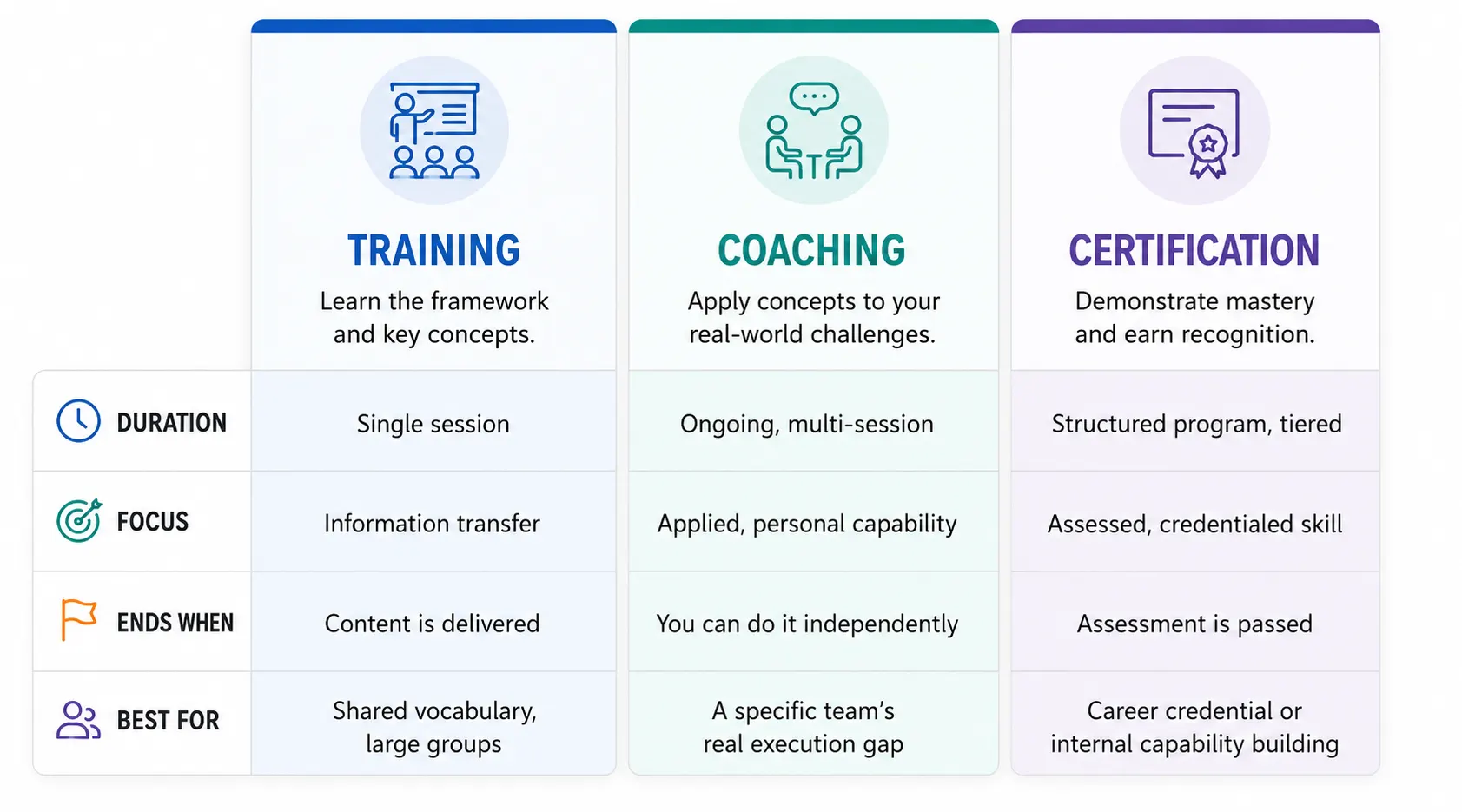
A Simple Decision Framework
The question worth asking yourself first is not which of the three sounds most serious. It is what problem you are actually trying to solve.
If the problem is a vocabulary gap, a team that has never encountered OKRs and needs a shared starting point before anything deeper can happen, training is the right and sufficient answer. Do not over-buy here.
If the problem is an execution gap, a team that understands the theory but keeps writing goals that do not move the business, coaching is what actually closes it. Training will not fix this, because the team already has the information; what they lack is applied capability.
If the problem is a credential or capability-building need, either your own career or your organisation’s ability to run the program without ongoing external support, certification is the right target, provided it requires demonstrated work, not just attendance.
Most organisations, in practice, discover they have more than one of these three problems at once, usually because the vocabulary gap and the execution gap were never actually separated when the original OKR rollout happened. A single leadership workshop was treated as if it had solved both, and only months later does it become clear that leaders can define the terms perfectly and still cannot apply them under real pressure.
Buying the wrong one of the three does not fail loudly. It quietly produces a room full of people who can describe OKRs perfectly and still cannot write one that matters.
The Practitioner View: What OKR Coaching Actually Looks Like Inside a Real Engagement
OKR Frameworks and comparison tables can tell you what OKR coaching is supposed to be. They cannot show you what it looks like when a real leadership team is inside it, which is usually messier and slower than any sales page admits.
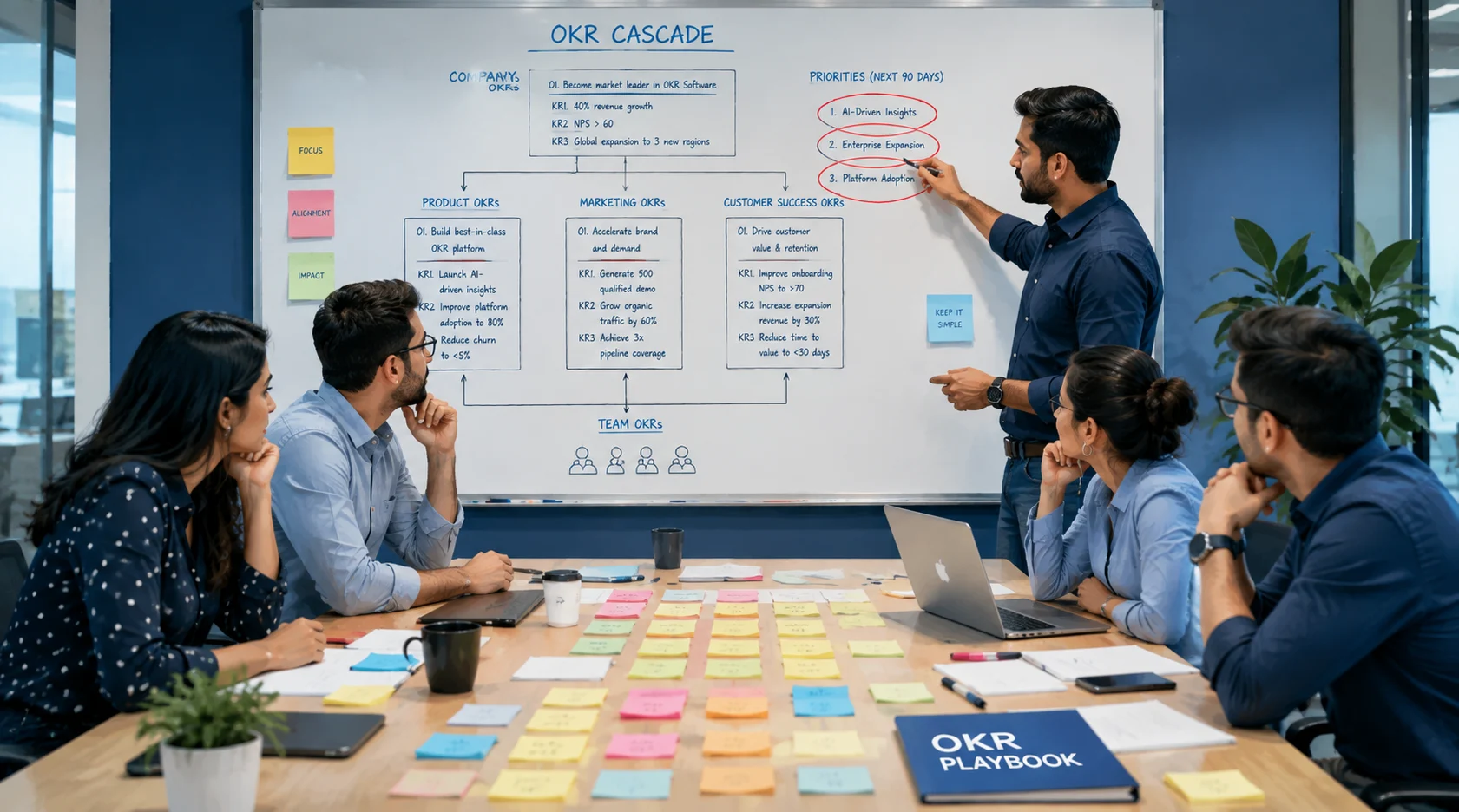
Take an APAC retail company I worked with, in aggressive expansion mode and hiring leadership at every level. The intent behind bringing in OKRs was right the company wanted a rapidly growing leadership team to stay focused and aligned on growth. The framework was in place. The problem was that the foundation underneath it was not. In the first alignment call, I asked the CEO to share his top three priorities so the leadership team could begin writing their OKRs against them. Forty-five minutes later, he still could not define them clearly not because he lacked sharpness, but because nobody had ever asked him to compress an entire company vision into three outcomes an organisation could actually cascade from. That meeting ended without a resolution. What followed was a two-day war room before a single OKR was written.
No training workshop produces that outcome, because training is not built to sit with a CEO through forty-five uncomfortable minutes of not having an answer. Coaching is. What made the difference here was running one-to-one sessions with each leader individually rather than group training creating space for leaders to admit where they were actually stuck, without doing it in front of peers they needed to look strong in front of. Two to three quarters later, that organisation had clear alignment across the leadership team, cross-functional dependencies surfaced before they became mid-cycle surprises, and budget tied directly to the growth and revenue model it was chasing.
A European fintech startup, roughly a hundred people and already generating revenue, showed the same pattern from a different angle. The CEO and CPO could not articulate outcomes in the right direction every goal was KPI-led, tracking numbers without clarity on what needed to change. In the first coaching session, I asked one question: what is the one big thing you want to resolve? The answer was product demo experience. What followed was a sequence of ‘so what’ questions if you fix this, so what, what happens next repeated until the team reached a genuine outcome statement rather than a restated metric. That session also produced something this organisation had never done before: asking the Product Lead to co-own a Key Result jointly with the Account Executive, accountable together for demo experience improving conversion. Cross-functional co-ownership of a single KR forced a dependency conversation that had never happened. Three quarters later, product and commercial were working from the same goal instead of duplicating effort against two versions of it.
Neither story is a training outcome. Both are what OKR coaching produces when it is delivered as an ongoing, applied relationship rather than a workshop with a good facilitator which is exactly why Worxmate’s OKR consulting engagements are structured as coaching relationships, not one-off sessions.
See Where Your Organisation Actually Sits
The 2026 OKR Execution Maturity Framework benchmarks execution maturity across 50+ real implementations — use it to find out whether your gap is vocabulary, execution, or capability before you spend on any of the three.
Where They Genuinely Overlap
None of these three exist in clean isolation, and pretending otherwise would be its own kind of oversimplification.
A well-run coaching engagement usually opens with a short training component, since coaching a group with no shared vocabulary spends its early sessions re-explaining basics instead of doing real work. A well-built certification’s Practitioner tier is, structurally, coaching with an assessment attached: live sessions, applied to real goals, ending in a credential rather than an open-ended relationship. The three are not competitors. They are stages that often belong in sequence.
Where the overlap gets genuinely confusing is in how providers name their own offerings. A program calling itself “certification” might, on inspection, be a single exam with no coaching component at all, functionally closer to training than to the ongoing, assessed process the word implies. A service calling itself “coaching” might turn out to be one workshop with a follow-up email. The label on the page is a starting point for your evaluation, not a substitute for it. Ask directly what the engagement actually includes, session by session, before assuming the name tells you everything.
Where DEEP AI™ Turns OKR Training and OKR Coaching Into a System
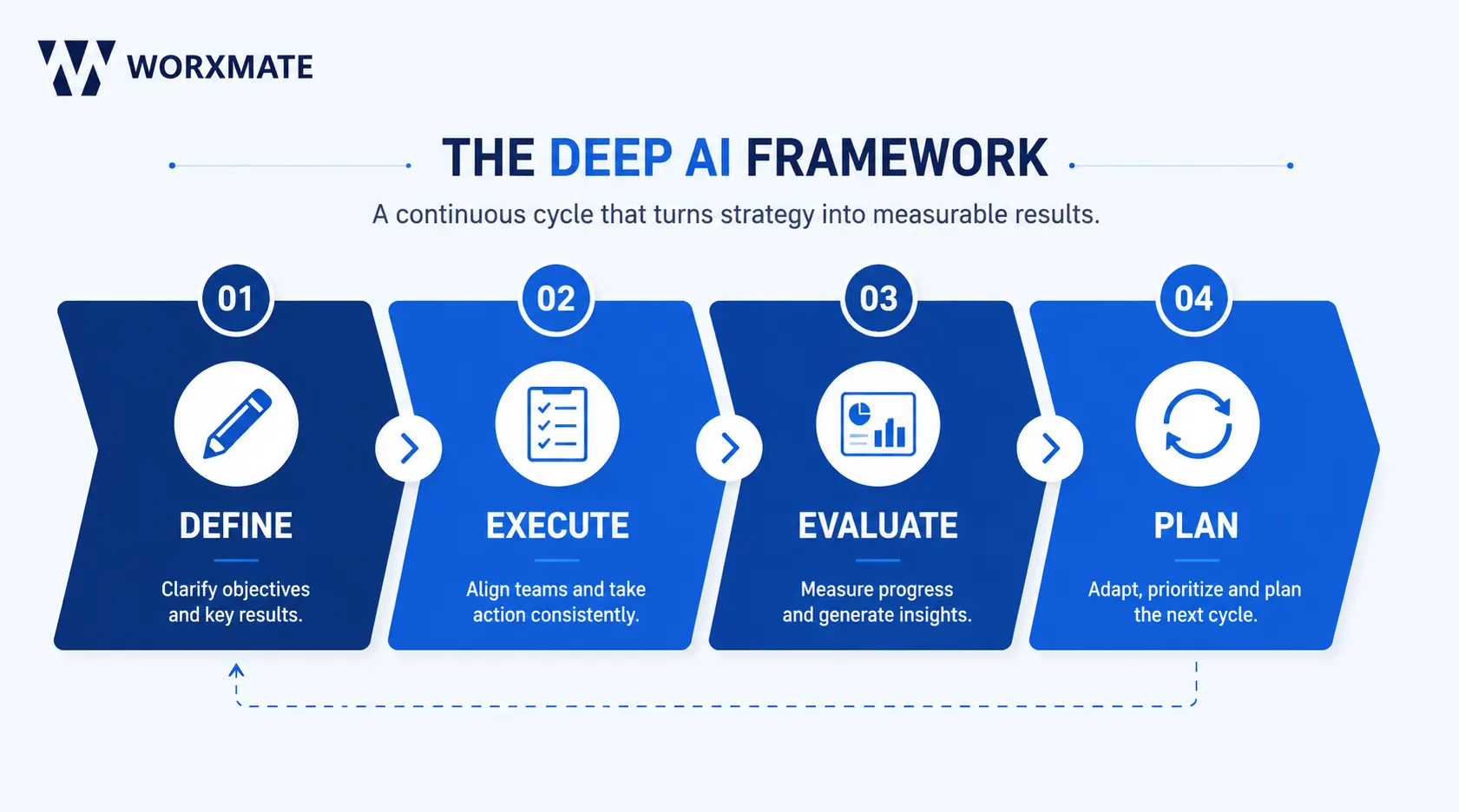
Training and coaching both eventually run into the same wall: neither, on its own, gives an organisation a repeatable system for cycle after cycle of OKR execution. That is the gap the DEEP AI™ framework – Define, Execute, Evaluate, Plan was built to close, and it maps directly onto the training vs coaching vs certification decision rather than sitting apart from it.
Define is where the vocabulary gap and the execution gap actually meet. Worxmate’s AI-assisted goal-writing and quality-scoring tool inside Define exists because teams that have been trained on OKR theory still default to writing KPIs and labelling them Key Results a pattern I see constantly with finance and operations leaders whose career background trained them to think in budget cycles, not outcome statements. Execute is where coaching earns its keep past the first quarter: automated check-ins and at-risk detection surface the blockers a good coach would otherwise have to chase down manually, which is exactly the layer most ‘certification’ programs never touch because their engagement ends at the exam. Evaluate turns retrospectives from a box-ticking exercise into a data-backed conversation, and Plan is what carries one cycle’s learning into the next the step a single training session, by definition, cannot provide because it ends when the content has been delivered.
None of this replaces the human judgement that OKR coaching and OKR certification are built around. It is the layer underneath it. Orbit AI, Worxmate’s employee performance intelligence layer, keeps individual capability visible cycle over cycle, so a certification credential earned in one quarter does not quietly go stale by the next. Axis AI, the business performance intelligence layer, connects OKR execution to the commercial numbers a CEO or CFO actually reports on, so an execution gap surfaces before it becomes a missed quarter rather than after. Nexus AI, the organisational intelligence layer, is where the org-structure precondition gets checked because cascading OKRs through a structure that does not reflect the company’s real strategic priorities does not reveal the misalignment, it embeds it.
The honest way to put it: the software is the infrastructure, the coaching is the capability, and training is what makes the first cycle of either possible without wasting its early sessions re-explaining basics. You need more than one of the three, and you need them in the right order.
Which Path Solves Which Execution Gap
| Your Gap | Right First Move | DEEP AI Stage That Supports It |
|---|---|---|
| No shared OKR vocabulary yet | OKR training | Define |
| Team understands OKRs but writes weak ones | OKR coaching | Execute |
| Need a resume-legible credential | OKR certification | Define + Evaluate |
| Need internal capability, not vendor dependence | OKR certification (Practitioner tier) | Plan |
| Program worked at leadership level, stalled below it | OKR coaching (past the Coaching Cliff) | Execute + Evaluate |
Not Sure Which Gap You Actually Have?
A short Organisation Performance Audit tells you, in specific terms, whether your team’s problem is vocabulary, execution, or capability — before you commit a budget to the wrong one of the three.
My Take
I would not tell someone to pick exactly one of these three and stop there. Most organisations that get real value eventually use at least two, usually training to establish shared vocabulary, followed by either coaching or certification depending on whether the gap that remains is organisational execution or individual capability building.
What I would push back on is buying the most expensive-sounding of the three by default, on the theory that more investment must mean a better outcome. A large training budget spent solving a coaching problem does not produce a coaching result. It produces a well-attended training session and the same execution gap it started with.
The sequencing question is worth being deliberate about too. Training before coaching almost always works better than the reverse, since coaching a group with no shared vocabulary wastes its early sessions re-explaining basics. Certification, when it is the right target, usually comes after at least one of the other two, not instead of them, since a credential earned without any prior applied experience tends to be thinner than one earned on top of real coaching or training already absorbed.
The Week-One Signal That Tells You Whether You Need OKR Coaching or OKR Training
There are two signals I look for in the first week of any engagement, and they predict which of the three training, coaching, or certification an organisation actually needs more reliably than any sales conversation does.
The first is whether OKRs were chosen or pushed. An organisation where leaders have been sensitised to the framework, understand why it matters for their specific team, and have chosen to commit needs something very different from one where OKRs were announced as the new operating model with a go-live date and a software login attached. The second scenario collapses between weeks four and six — not from resistance, but because nobody answered the one question every employee is silently asking: what is in this for me. Training does not answer that question. Neither does a certification exam. Only ongoing coaching, delivered by someone willing to sit with that discomfort in real time, does.
The second is support-query volume in week one. If a team is raising fifteen to twenty product queries a day inside the first week of a new OKR platform, adoption breaks within the next few weeks not might break, will break. That volume signals a mismatch between the tool’s complexity and the team’s current OKR literacy, and no customer success call fixes a mismatch that a training session should have closed before rollout. If you are seeing that signal right now, the honest diagnosis is usually a vocabulary gap masquerading as a software problem, and the fix is training first, not more support tickets.
Where to Go From Here
If your gap is organisational execution, Worxmate’s OKR consulting is built around ongoing coaching, not a single session.
If your gap is a credential or internal capability, OKR Certification — DEEP Framework is tiered from foundational training through assessed coaching-level credentials.
If you are specifically hiring an individual coach, here is exactly how to tell a real coach from a trainer before you sign anything.
The right purchase is not the one with the most impressive name. It is the one that matches the actual gap you are trying to close.
Further Reading
OKR Coach in India: How to Find One Who Actually Coaches — the individual-hiring version of this same distinction.
How to Choose an OKR Certification Program — what to look for once you have decided certification is the right target.
The Coaching Cliff: Why OKR Coaching Fails After the Workshop Ends — what happens when even genuine coaching stops too early.
OKR Certification India: What HR Leaders Should Look for — the organisational-buyer version of choosing between these paths.
2026 OKR Execution Maturity Framework — the benchmark data behind why applied coaching outperforms training alone.


Written by
An OKR Coach with 20+ years of implementation experience, Madhusudan has guided over 50 organisations through successful OKR transformations, training more than 500 leaders. Learn more about Worxmate.