 WORXMATE
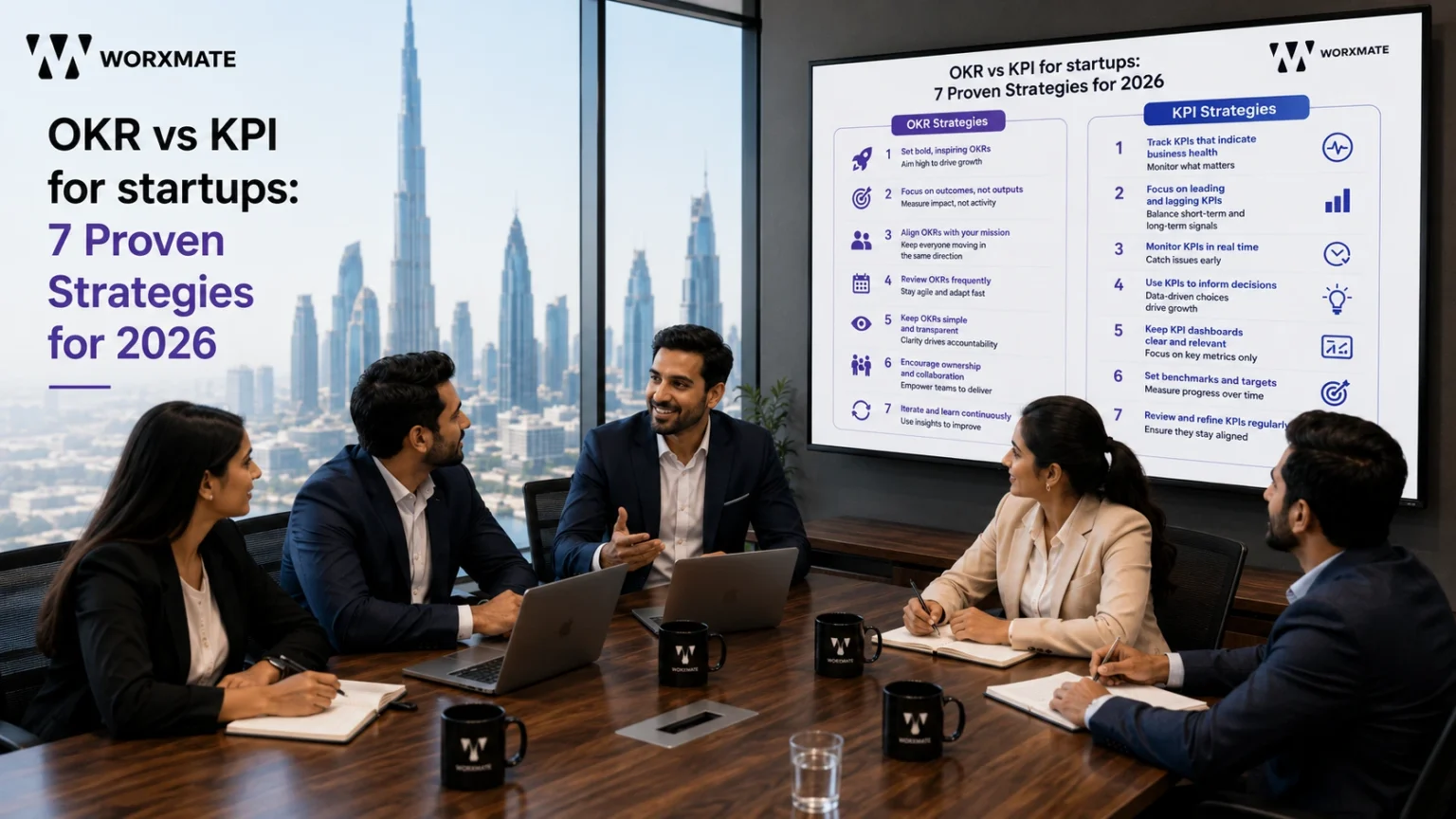
OKR vs KPI for Startups: Startups often fail by confusing activity with impact. OKRs provide directional growth and ambitious strategic leaps, while KPIs monitor operational health. Pairing these frameworks with advanced performance management software ensures teams execute outcomes rather than mere output.
The moment a startup CEO realises their team is busy, but not moving the needle on what truly matters, is a familiar one.
The moment a startup CEO realises their team is busy, but not moving the needle on what truly matters, is a familiar one. I’ve sat in countless review meetings where the energy is high, the activity log is full, but the core strategic objectives feel untouched. This isn’t a lack of effort; it’s a fundamental disconnect in how goals are defined and measured. For many startups, the initial excitement of growth often masks a deeper confusion between activity and impact, between outputs and outcomes. The question of okr vs kpi isn’t academic; it’s about survival and scaling.
I recall working with a European fintech startup that was burning through capital with impressive velocity, but their product-market fit wasn’t improving fast enough. Every team was hitting their “numbers” lines of code shipped, marketing campaigns launched, sales calls made. These were all valid Key Performance Indicators (KPIs) for operational health, but they weren’t driving the desired business outcomes. The CEO was frustrated because he couldn’t point to a single, overarching objective that truly aligned everyone. The engineers were optimizing for speed, the marketers for reach, and sales for volume, but the collective impact on customer acquisition cost or lifetime value remained stagnant. This is the classic startup trap: mistaking a flurry of activity for genuine progress.
An OKR Coach with 20+ years of implementation experience across diverse industries, I’ve seen this pattern repeat too often. My work involves guiding leaders from this state of “busywork” to a focused, outcome-driven approach. This isn’t about theoretical frameworks; it’s about getting teams to actually execute on strategy. From 70,000-person IT services organisations to nimble fintechs, the core challenge remains the same: translating vision into measurable progress. I’ve personally coached over 500 leaders and overseen more than 50 OKR implementations, observing firsthand what works and what consistently breaks down in the pursuit of strategic goals. My perspective is rooted in these practical experiences, focused on tangible results and sustainable change, especially when helping startups navigate the critical early stages of goal setting.
The Startup’s Dilemma: Growth vs. Direction
Startups operate in an environment of inherent uncertainty and rapid change. Every decision carries significant weight, and resources are almost always constrained. In this context, the clarity of purpose and the efficiency of execution are paramount. However, many startups fall into a common trap: they adopt metrics that measure what they do, rather than why they do it. This is where the debate of OKR vs KPI for startups becomes critical.
Too often, a startup will launch with a strong vision, but that vision quickly dilutes as it cascades down to individual teams. Marketing focuses on impressions, sales on call volume, product on feature releases. These are all valid operational metrics, but they become the goal rather than indicators of progress towards a larger, more impactful outcome. The result? Teams are productive, but their collective efforts don’t compound into strategic momentum. Leaders find themselves constantly course-correcting, trying to connect disparate activities to a vague sense of “growth.” This usually manifests in review meetings where the leadership team struggles to articulate three clear, overarching priorities for the quarter, let alone how individual team efforts contribute to them.
Execution Maturity Rate: In a typical first OKR cycle for a startup, the rate of leaders who can independently write genuine outcome-driven goals without coaching sits between 5% and 15%. This highlights the deep-seated challenge in shifting from output to outcome thinking.
The pain is palpable when a CEO realises that their “dashboard” is full of green lights, yet the company isn’t hitting its funding milestones or user acquisition targets. It’s because the KPIs they are tracking are measuring process efficiency or activity completion, not the actual impact on the business. For example, a KPI might track “number of marketing qualified leads,” which is an output. An OKR would focus on an outcome like “increase qualified pipeline conversion to 15%.” The distinction is subtle but profound. Without this clarity, precious startup resources are often misallocated, leading to burnout and missed opportunities. The real question isn’t whether to use OKRs or KPIs, but how to integrate them to drive strategic execution while maintaining operational health.
Beyond the Buzzwords: The Real Difference for Startups
Achieve Your Goals Faster
See how Worxmate can help your team set clear goals and achieve faster results. Book your free demo today and experience the power of AI-driven OKRs in action.
AI Automation vs Static Spreadsheets in 2026
While traditional OKR tools rely on static spreadsheets and manual updates, modern startups require real-time predictive forecasting. Leveraging automated when to use KPI vs OKR methodologies combined with continuous tracking prevents quarterly misalignment.
Top-tier engineering and product teams utilize AI-driven performance management software to predict milestone bottlenecks before they derail execution.
The fundamental difference between OKRs and KPIs lies in their purpose and application. For a startup, understanding this distinction is not just theoretical; it dictates whether you’ll pivot effectively or run out of runway.
OKRs (Objectives and Key Results) are about setting ambitious goals, aspirational goals that drive change and growth. An Objective defines what you want to achieve: a qualitative, inspiring statement. Key Results define how you’ll measure progress towards that Objective: specific, measurable, and outcome-oriented metrics. OKRs are designed to push boundaries, to challenge the status quo, and to align teams around a shared, future-oriented vision. They are about moving from point A to point B, where point B represents a significant leap forward for the business.
KPIs (Key Performance Indicators), on the other hand, are about monitoring the health of existing processes and operations. They tell you if you’re on track with what you’re already doing. KPIs are like the gauges on a car dashboard: they tell you your speed, fuel level, and engine temperature. You need them to operate safely, but they don’t tell you where you’re going or if you’re taking the right route. For a startup, KPIs are essential for tracking things like customer churn rate, website uptime, cost per acquisition, or employee retention. These are critical signals for operational stability.
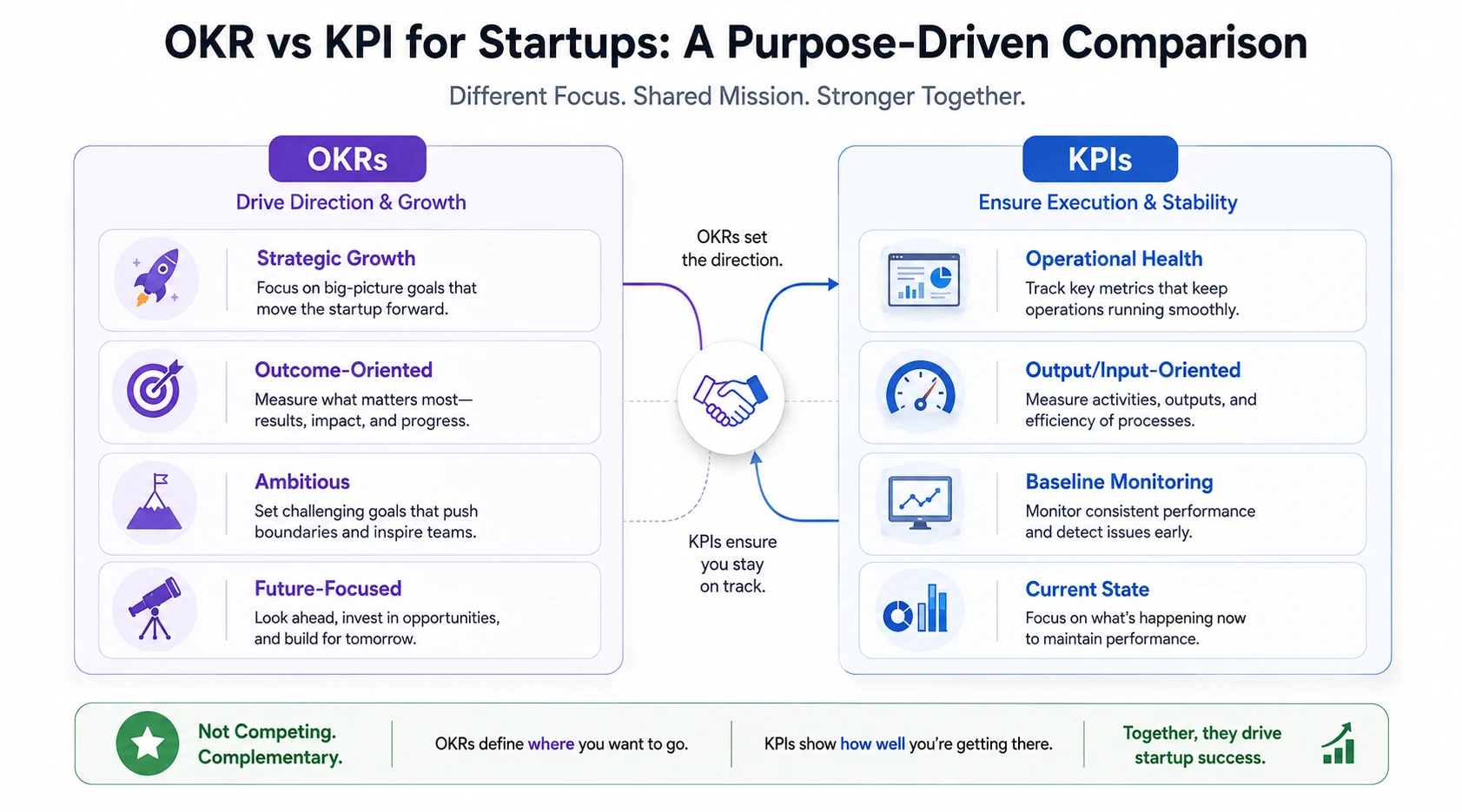
The critical insight for startups is that you need both. OKRs provide the strategic compass and the engine for innovation, while KPIs provide the guardrails and the real-time feedback on your operational efficiency. Without OKRs, a startup can become incredibly efficient at doing the wrong things. Without KPIs, even the most ambitious OKRs can be undermined by poor execution or unnoticed operational decay.
Consider a startup aiming to “Achieve Product-Market Fit for our new AI-driven analytics tool” (Objective). Key Results might include “Increase weekly active users (WAU) from 1,000 to 5,000” and “Increase user retention rate (D7) from 25% to 40%.” These are outcome-focused. Alongside this, the team would still track KPIs like “server uptime,” “bug report volume,” or “customer support response time” to ensure the underlying product is stable. These KPIs are essential, but they are not the strategic drivers of product-market fit.
“Alignment is agreement between teams on what matters, why it matters, and how each team’s work connects to the teams around them. You cannot set that in a tool. You can display it. You cannot create it.”
The real ROI metric for a startup implementing OKRs isn’t just goal completion rate. It’s the Execution Maturity Rate: the percentage of leaders who can independently write a genuine outcome-driven goal without coaching, a template, or a quality review. In a typical first cycle, this rate is low, often between 5% and 15%. However, in organisations coached consistently over 12 months, it can reach 30% to 40%. This indicates a profound shift in thinking, from output to outcome, which is crucial for a startup’s long-term viability.
For a startup, this shift is often harder because the lines are blurrier, and everyone wears multiple hats. This is why coaching must be tailored to the leader’s background. A finance leader in a startup thinks in budget cycles; a product leader in sprints; a sales leader in pipeline. Generic slide decks won’t cut it. The coaching must address their specific context and help them see how their work, and their team’s work, contributes to the larger strategic outcomes defined by OKRs, while still using KPIs to monitor their immediate operational health.
Integrating OKRs and KPIs: The DEEP AI Framework for Startups
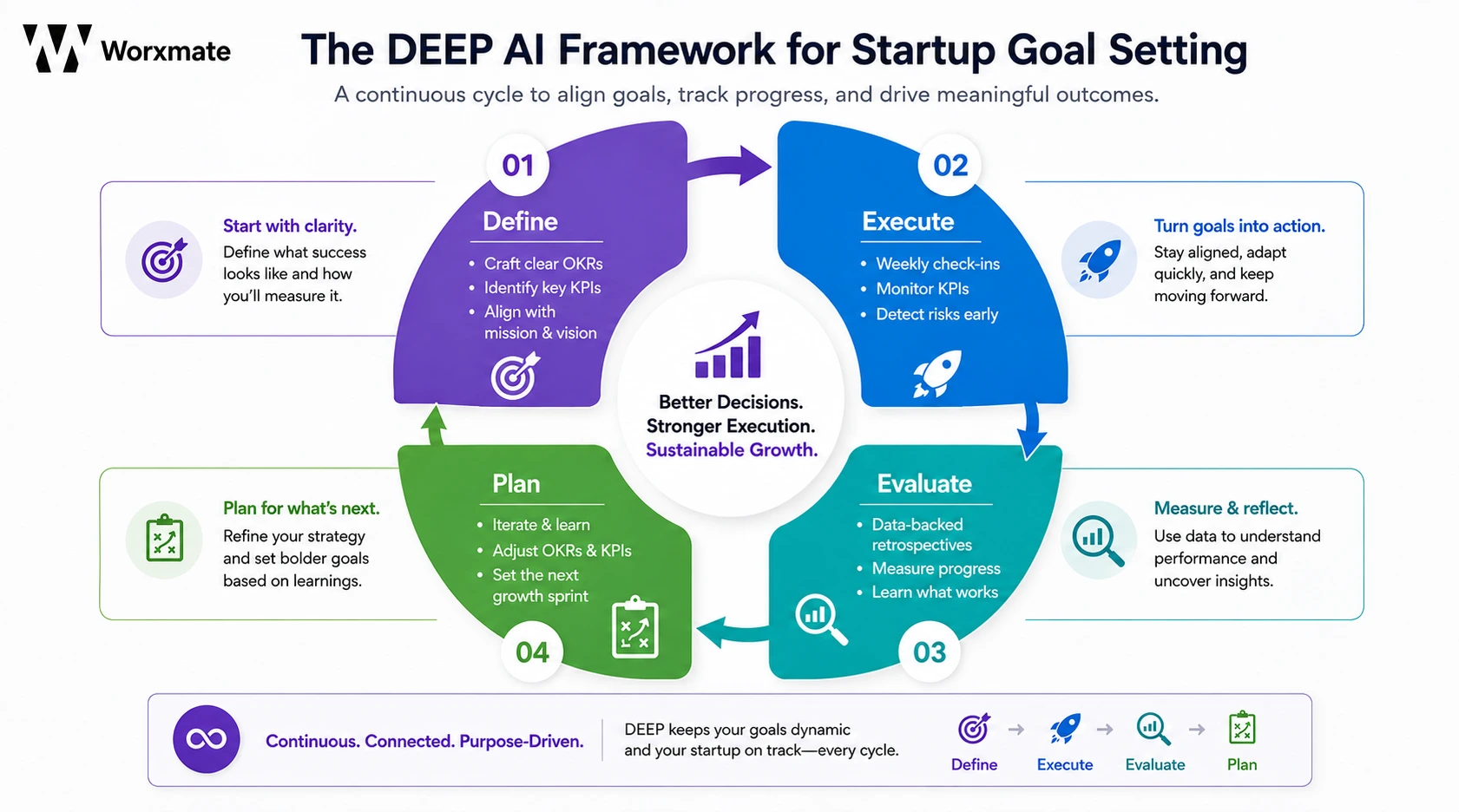
For startups, effective goal setting requires a structured approach that integrates both strategic ambition and operational reality. The DEEP AI framework (Define, Execute, Evaluate, Plan) provides this structure, ensuring that OKRs drive growth while KPIs inform execution.
For startups, the fear of failure is an invisible blocker. Leaders write safe, easily completable Key Results rather than genuinely ambitious outcomes. Explicitly framing cycle-one failure as learning, not performance failure, is critical for fostering true ambition and innovation.
Here’s how a startup can apply DEEP AI, ensuring a harmonious relationship between OKRs and KPIs:
- Define: This is where your strategic OKRs are crafted. For a startup, this means identifying 2-3 truly ambitious Objectives that will move the business forward significantly in the next quarter or year. Key Results must be outcome-oriented, challenging, and measurable. This is also where you identify the critical KPIs that will act as guardrails. For instance, if your OKR is to “Dominate a Niche Market Segment,” a Key Result might be “Increase market share in X segment from 5% to 20%.” Simultaneously, you’d define KPIs to monitor your customer acquisition cost, churn, and operational efficiency, ensuring you don’t achieve growth at an unsustainable expense. Tools with AI-assisted goal writing can help ensure these Key Results are genuinely outcome-driven from the start.
- Execute: Once defined, the focus shifts to execution. This involves regular check-ins on both OKR progress and KPI health. For a startup, weekly OKR check-ins are non-negotiable. These aren’t status updates; they are problem-solving sessions focused on removing blockers and adjusting tactics to hit the Key Results. Automated check-ins and at-risk detection features in software are invaluable here, providing early warning signals. Simultaneously, daily or weekly monitoring of your operational KPIs (e.g., server load, support ticket backlog) ensures that the underlying business doesn’t break while you’re chasing ambitious goals.
- Evaluate: At the end of a cycle, a thorough retrospective is essential. For OKRs, this means evaluating whether the Objectives were met and, more importantly, what was learned. Data-backed retrospectives help understand why certain Key Results were hit or missed. For KPIs, it’s about assessing if operational health was maintained or improved. Did your growth OKRs put undue strain on your support team, reflected in declining KPI scores? This evaluation phase is critical for learning and adaptation, which is the lifeblood of a startup.
- Plan: The final stage involves taking the learnings from the evaluation phase and feeding them into the next cycle’s planning. This ensures continuous improvement. For a startup, this iterative process is key to rapid adaptation and sustainable growth. The insights gained from both OKR achievements and KPI trends inform the next set of strategic Objectives and Key Results, creating a virtuous cycle of learning and execution.
OKR Execution Maturity Framework 2026
Understand how mature your organisation’s OKR execution truly is and benchmark your progress with this comprehensive scorecard.
One of the most common and costly structural mistakes for any organisation, especially a startup, is letting HR own OKRs. OKRs owned by HR often become an appraisal tool, losing their strategic edge. For a startup, OKRs must be owned by the CEO’s office, directly tied to the strategic execution engine. HR’s role is crucial in fostering the culture and capabilities for successful execution, but the ownership of the OKR program itself should reside with strategy.
What This Looks Like in Practice: A Field Observation
In practice, a startup effectively using both OKRs and KPIs will exhibit a distinct rhythm. I saw this with a Middle East energy and utility company (8,000+ employees, $45Bn) that, despite its size, faced challenges similar to a rapidly scaling startup in terms of strategic clarity. They had scattered strategic ownership, with departments setting their own goals without a unified framework. Through coordinated leadership alignment and a clear distinction between strategic OKRs and operational KPIs, they transformed their execution.
For a startup, this means:
- Clear, Cascaded OKRs: The CEO defines 2-3 company-level Objectives. Each team then crafts its own OKRs that directly contribute to these company-level goals. This creates a clear cascade of organizational goals down to individual individual goals, ensuring everyone understands “why” their work matters.
- KPIs as Health Monitors: Each team identifies 3-5 critical KPIs that monitor the health of their core operations. These are not aspirational; they are baseline metrics to ensure efficiency and stability. For example, a sales team might have an OKR to “Expand into 2 new target markets” but also track the KPI of “average deal size” to ensure quality.
- Weekly Check-ins Focused on Outcomes: Rather than reporting on activities, weekly team check-ins are structured around OKR progress. “What’s blocking us from hitting this Key Result?” “What adjustments do we need to make?” These discussions are outcome focused. Any significant dip in a critical KPI would also be a discussion point, as it could threaten the OKR’s success. This is where effective OKR check-ins prove their worth.
- Cross-Functional Ownership: For ambitious OKRs, especially in a startup, Key Results often require cross-functional collaboration. For instance, a Key Result like “Increase qualified lead conversion rate from 5% to 10%” might be co-owned by marketing and sales. This forces genuine agreement and dependency, rather than simply displaying alignment in a tool.
Execution Maturity Rate: First Cycle vs 12 Months of Coaching
The transition from output to outcome thinking cannot happen in a single quarter for a startup, regardless of the founders’ seniority. It’s a 12-month journey, which is why Execution Maturity Rate is measured across a year, not 90 days. This long-term commitment, supported by consistent coaching, is what separates thriving startups from those that merely stay busy. The “Coaching Cliff” is particularly dangerous for startups: if coaching stops at the C-suite, the program dies below it within one quarter. Middle management is where OKR programs live or die, and for a startup, every team lead is a “middle manager” in this sense.
The early warning signals are usually clear: if your team is raising 15-20 product support queries per day in week one of an OKR rollout, adoption will break. This isn’t a software problem; it’s a signal that the program was pushed, not chosen, or that the team lacks the fundamental understanding to engage with it effectively. For startups, where every team member’s engagement is critical, these signals cannot be ignored.
Making the Right Choice for Your Startup’s Future
The choice between OKR vs KPI for startups isn’t a binary one. It’s about a symbiotic relationship where OKRs set the audacious direction and KPIs ensure you stay on course operationally. Without the aspirational pull of OKRs, startups risk becoming stagnant, efficient at doing yesterday’s work. Without the grounding reality of KPIs, they risk running off a cliff in pursuit of an unmonitored goal.
The key is to integrate them intelligently. Use OKRs to articulate your strategic leaps and drive your team towards challenging, outcome-focused growth. Use KPIs to monitor the health of your core business processes, identify potential issues, and ensure sustainable execution. This dual approach provides both the rocket fuel for innovation and the safety net for stability, a combination essential for any startup aiming for long-term success. Tracking a real-time confidence score helps identify at-risk targets before quarter-end. Seamless cascading ensures department milestones stay synchronized with company strategy. Strong goal alignment eliminates siloed efforts and connects daily work to strategic outcomes.
The software is the infrastructure. The coaching is the capability. You need both, and in the right order.
If your startup is ready to move beyond busywork and into truly strategic execution, the path forward involves both robust goal-setting infrastructure and expert guidance. For those ready to implement a dedicated system, explore our OKR software, designed to facilitate outcome-driven goal setting and tracking. You can review our flexible pricing plans or get a demo to see it in action. If you recognise that the challenge is more about shifting mindsets and building capability within your leadership team, our OKR consulting services can provide the hands-on coaching and strategic alignment necessary for sustainable growth.


Written by
An OKR Coach with 20+ years of implementation experience, Madhusudan has guided over 50 organisations through successful OKR transformations, training more than 500 leaders. Learn more about Worxmate.