 WORXMATE
Quick Answer
An OKR and KPI software in one framework bridges the gap between “running the business” and “changing the business.” It integrates steady-state metrics (KPIs) with strategic growth targets (OKRs) into a single source of truth. This unified approach eliminates data silos, ensures resource alignment, and provides real-time visibility into strategy execution velocity.
The CEO of an APAC retail company sat in a war room with me for forty-five minutes, unable to name three clear strategic priorities. He had a dashboard full of KPIs, green lights across the board, and yet the company was losing market share. This is the “dashboard delusion.” When your OKR and KPI software in one framework is missing, you end up measuring everything and moving nothing. You have a team that is incredibly busy keeping the lights on, but the needle on strategic growth never budges. This happens because most organizations treat KPIs as the “day job” and OKRs as “extra work” that happens in a different spreadsheet or a disconnected platform.
If you are managing your business through separate systems, you are effectively running two different companies. One company focuses on the status quo, while the other attempts to innovate. The friction between these two worlds is where execution dies. A unified OKR and KPI software in one framework is not about having more charts; it is about ensuring that every ounce of operational effort is accounted for against your strategic intent. Without this integration, your KPIs become a distraction from your OKRs, and your OKRs become a burden to your KPIs.
I have seen this pattern across 50+ implementations. Organizations that fail to adopt an OKR and KPI software in one framework often suffer from a “Coaching Cliff.” They launch a program at the C-suite level, but because it does not connect to the daily metrics the middle management layer is held accountable for, the program dies within one quarter. To fix this, you must stop viewing these two methodologies as rivals and start viewing them as the two halves of a single execution engine.
By The Numbers
Execution Maturity Rate: Only 5-15% of leaders can write a genuine outcome-driven goal in their first cycle without coaching.
The Practitioner Perspective on OKR and KPI software in one framework
As an OKR Coach with 20+ years of implementation experience, I have learned that alignment is agreement between teams, not a platform configuration. You can display an agreement once it exists, but you cannot create one in a tool. This is why a unified OKR and KPI software in one framework is so critical. It provides the common language for that agreement. When a Product team and a Commercial team look at the same framework, they should see how their steady-state KPI software metrics support the ambitious outcomes they are chasing together.
Across the organizations I have coached, from European fintech startups to Middle East energy giants, the most common failure point is the structural mistake of HR owning the OKR process. When HR owns OKRs, they inevitably become an appraisal tool. When the CEO office owns the OKR and KPI software in one framework, it becomes a strategy execution engine. This distinction is the difference between a process people tolerate and a system people use to win. My work involves training 500+ leaders to recognize that a completed OKR is worth more than five written ones that never move the needle.
The real ROI of this unified approach is measured by the Execution Maturity Rate. In a typical first cycle, this rate sits between 5% and 15%. However, in organizations coached consistently over 12 months using an OKR and KPI software in one framework, it reaches 30% to 40%. This maturity is the ability of a leader to independently write a genuine outcome-driven goal without needing a quality review. It is the transition from output-thinking to outcome-thinking, and it requires a platform that shows both the “what” (KPIs) and the “why” (OKRs) in one view.
The Specific Pain of Siloed Performance Data
Name the pain before offering the solution: your managers are spending four hours a week in 1:1s that are nothing more than status updates. They are using one tool for task management, another for performance reviews, and a third for strategic goals. This fragmentation leads to one of the 9 systemic failures: biased, unwritten verbal feedback that resurfaces as calibration conflict. Because the data is siloed, HR has zero pre-cycle visibility into top and low performers. They are stuck playing referee instead of running a strategic process.
When you lack an OKR and KPI software in one framework, your using okr and kpi together strategy falls apart. Managers default to “gut feel” for L&D recommendations because they have no skills-data-driven insights. IDPs become an afterthought, and PIPs are misused as firing tools rather than development tools. This is the cost of disconnected systems. A CEO sees a “green” KPI for uptime, but fails to see the “red” OKR for the new product launch that is stalled because the team is too busy maintaining that uptime. This is the execution gap.
Consider a 70,000-person IT services organization I worked with. They were drowning in output-vs-outcome confusion. They had thousands of KPIs but no clear sense of which ones actually moved business outcomes. We had to implement a Thinking Process to derive OKRs from just 2-3 BU-level priorities. By bringing these into an OKR and KPI software in one framework, we eliminated the noise. We stopped measuring “activity” and started measuring “impact.” This required a kpi to okr conversion that most software simply cannot handle because they are built for one or the other, not both.
Field Note
The transition from output to outcome thinking cannot happen in a single quarter. It is a 12-month journey, which is why Execution Maturity Rate is measured across a year, not 90 days.
The Practitioner Insight: Alignment is Agreement
One of my most counterintuitive beliefs, framed by field observation, is that the software is the infrastructure, but the coaching is the capability. You need both, and in the right order. Many companies buy an OKR and KPI software in one framework and expect it to fix their culture. It won’t. If your leaders don’t agree on what matters, the tool will only help them disagree faster. I often tell clients: “Alignment is agreement between teams on what matters, why it matters, and how each team’s work connects to the teams around them. You cannot set that in a tool. You can display it. You cannot create it.”
In a 1,500-employee IT services organization, we found that 1:1s were treated as optional. This is a massive signal of systemic failure. By integrating standardizing 1 on 1 meetings into their OKR and KPI software in one framework, we forced the connection between daily performance and strategic goals. We used the PMS-OKR Bridge to ensure that every individual’s KRA was structurally connected to a business goal. This removed the “invisible adoption blocker” of fear of failure. When coaching makes explicit that cycle-one failure is for learning, not for punishment, leaders finally start writing ambitious outcomes instead of safe, easily completable Key Results.
This is where when to use kpi vs okr debate ends. You use KPIs to monitor the health of the business and OKRs to drive the growth of the business. An OKR and KPI software in one framework allows you to see both simultaneously. If a KPI drops into the red, it should automatically signal a risk to the associated OKR. This is the level of intelligence required for modern execution. It is why we look for okr dashboards real time that can aggregate these signals into a single Execution Confidence Index.
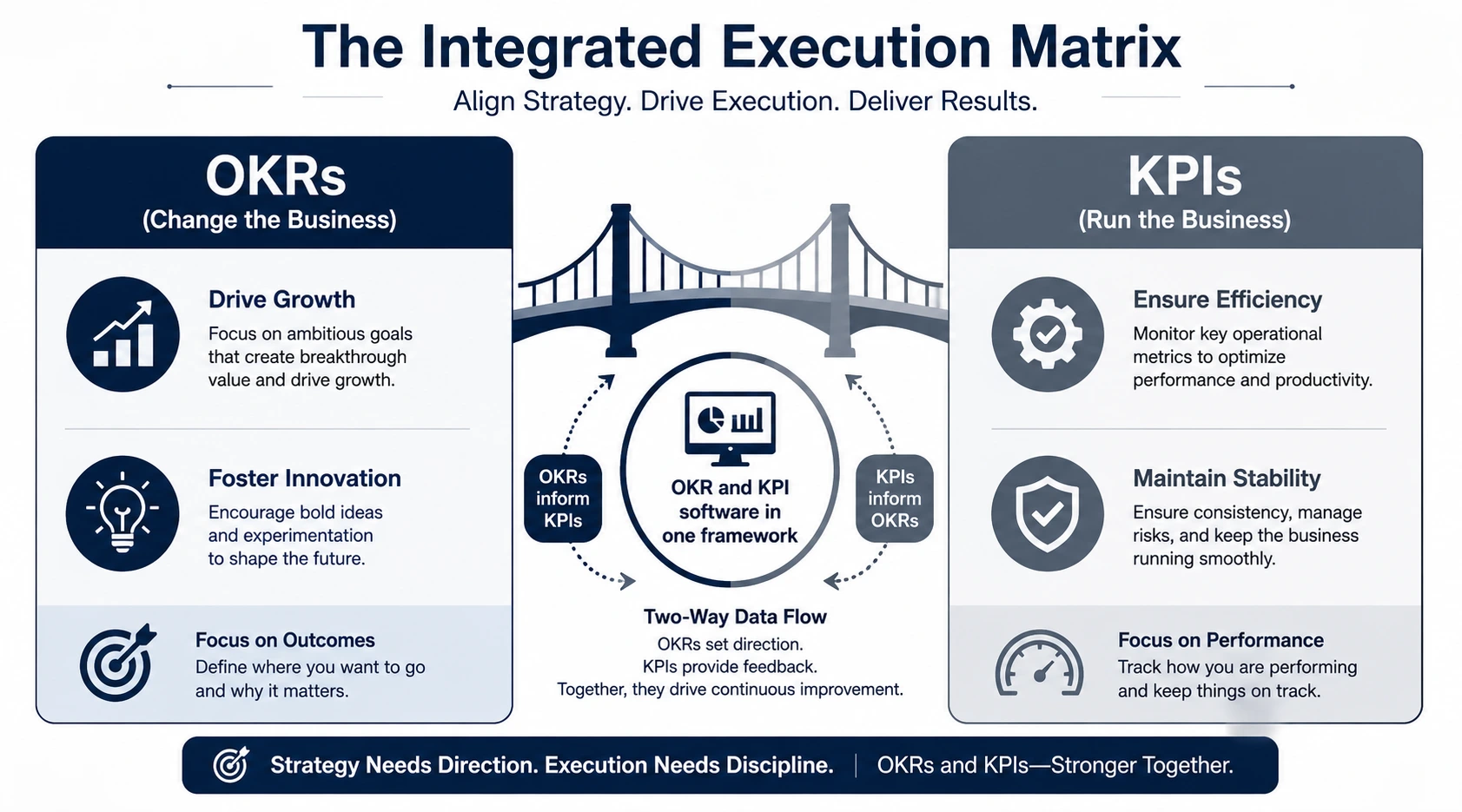
The DEEP AI Solution for Unified Frameworks
To successfully run an OKR and KPI software in one framework, you need a methodology that maps to how leaders actually work. We use the DEEP AI framework: Define, Execute, Evaluate, and Plan. This isn’t just a set of steps; it is a systemic approach to organizational intelligence. It starts with the Define AI OKR writing tool, which uses AI to score the quality of goals as they are written. This prevents the “garbage in, garbage out” problem that plagues most implementations.
Once goals are defined, the focus shifts to the Execute OKR check-in software. This is where the OKR and KPI software in one framework truly shines. Instead of manual reporting, the system detects at-risk goals based on real-time KPI data. If your “Customer Acquisition Cost” KPI spikes, the system flags the OKR for “Scaling the Sales Engine” as at-risk. This is proactive management, not reactive firefighting. It relies on okr check ins that are data-backed and frequent.
The “Evaluate” phase uses data-backed retrospectives to understand why certain targets were missed. This is where we measure the Alignment Index and Execution Confidence Index. Finally, the “Plan” phase uses cycle-over-cycle organizational learning to set better targets for the next period. This entire loop is powered by Orbit AI employee performance intelligence, which monitors for signals like Burnout Risk or Top Performer Flight Risk. These are the human metrics that KPIs and OKRs often miss, but which are essential for sustainable execution.
Execution Maturity Rate: First Cycle vs 12 Months of Coaching
Bridging the Gap: The Tiered Accountability Model
In a unified OKR and KPI software in one framework, accountability must be tiered. You cannot hold a junior engineer to the same strategic weighting as a BU Head. We use a Tiered Accountability Model to solve this. For a CEO or BU Head, the weighting might be 100% on strategic OKRs. For a middle manager, it might be a 40% split between OKRs and operational KPIs. For an individual contributor, the focus might be 20% on OKRs and 80% on their core KRAs and KPIs. This ensures that everyone is moving the business without neglecting their primary responsibilities.
This model is particularly effective for okr vs kpi for startups where roles are fluid. It provides a structure that can scale as the organization grows. By using okr tracking tools that support this tiered approach, you avoid the “social loafing” that occurs when everyone is responsible for everything and therefore no one is responsible for anything. You create a clear line of sight from the individual’s daily task to the company’s annual objective.
Consider the difference between a standard HRIS and a dedicated OKR and KPI software in one framework. An HRIS like Zoho or Darwinbox is built for HR workflows. OKRs are just a feature. In a purpose-built platform, OKRs are the engine. An OKR Coach evaluating a PMS platform asks one question: “Does this platform tell HR whether their people are moving the business, or does it tell HR whether their people completed the process?” If it’s the latter, you don’t have an execution tool; you have a compliance tool.
What This Looks Like in Practice: A Field Observation
In my experience across 135+ HR leader conversations, the most successful implementations of an OKR and KPI software in one framework are those that embrace the “Third Eye Layer.” This is real-time bias monitoring before calibration. It prevents the common pitfall where a manager’s personal bias overrides the actual performance data. When you have okr tracking for remote teams, this becomes even more vital. You need a system that can flag “Rating Inflation Drift” or “Skills Decay” before they become systemic issues.
I recall a European fintech startup that reached genuine outcome-thinking through repeated “so what” questioning. They initially wrote OKRs that were just a list of features to build. By using an OKR and KPI software in one framework, we forced them to link those features to specific business outcomes like “Reducing Churn by 15%.” This required cross-functional co-ownership between Product and Commercial teams. They stopped saying “we built the feature” and started saying “we moved the metric.” This is the essence of okr vs kpi vs smart goals integration.
The week-one warning signals that predict success are often overlooked. I look for how many product support queries the team raises. If it’s 15-20 queries per day in week one, it predicts that adoption will break because the tool is too complex or the process is unclear. A successful OKR and KPI software in one framework should be intuitive enough that the focus remains on the strategy, not the software. It should provide evp enps equation insights that show how goal alignment is actually improving employee engagement.
OKR Execution Maturity Framework 2026
Download our benchmarking framework to score your organization’s actual execution maturity and identify adoption blockers.
Overcoming the Coaching Cliff
The “Coaching Cliff” is a term I use to describe the moment when coaching stops at the C-suite and the program begins to die in the middle management layer. To avoid this, your OKR and KPI software in one framework must be accessible and valuable to every manager. It should not be a “reporting burden” they fulfill once a quarter. It should be the tool they use for their weekly okr check ins. If the tool doesn’t make their job easier, they won’t use it.
We have found that organizations using the PMS-OKR Bridge see a much lower attrition risk. This is because employees have a clear understanding of how their work contributes to the bigger picture. They aren’t just “doing tasks”; they are “achieving outcomes.” This sense of purpose is a powerful retention tool. According to research on strategy execution at Harvard Business Review, companies that align their performance management with their strategic goals are significantly more likely to outperform their peers.
Finally, remember that the software is the infrastructure, but the coaching is the capability. You need both, and in the right order. Don’t just buy a platform and hope for the best. Invest in the capability of your people to think in outcomes. Use your OKR and KPI software in one framework to reinforce that thinking every single day. That is how you close the execution gap and turn your strategy into reality.
By The Numbers
Alignment Index: Organizations with a unified framework see a 25% increase in cross-functional project completion rates within the first year.
“The real ROI metric of an OKR program is Execution Maturity Rate, not goal completion rate. In a typical first cycle it sits between 5% and 15%. In organisations coached consistently over 12 months, it reaches 30% to 40%.”
The Bottom Line on Unified Execution
If you are a CEO or a Strategy Head, your biggest frustration is likely the gap between the strategy you set and what the team actually delivers. You are tired of MBRs where nobody has the right answers because the data is scattered across five different systems. An OKR and KPI software in one framework is the only way to get the visibility you need. It moves you from “hoping” for execution to “managing” it.
The transition requires a shift in mindset. You must move away from the idea that KPIs are for “management” and OKRs are for “innovation.” In a high-performing organization, everyone is responsible for both. Your OKR and KPI software in one framework should reflect this reality. It should be the single source of truth for how your company runs and how it grows. Stop settling for siloed data and start building a unified execution engine.
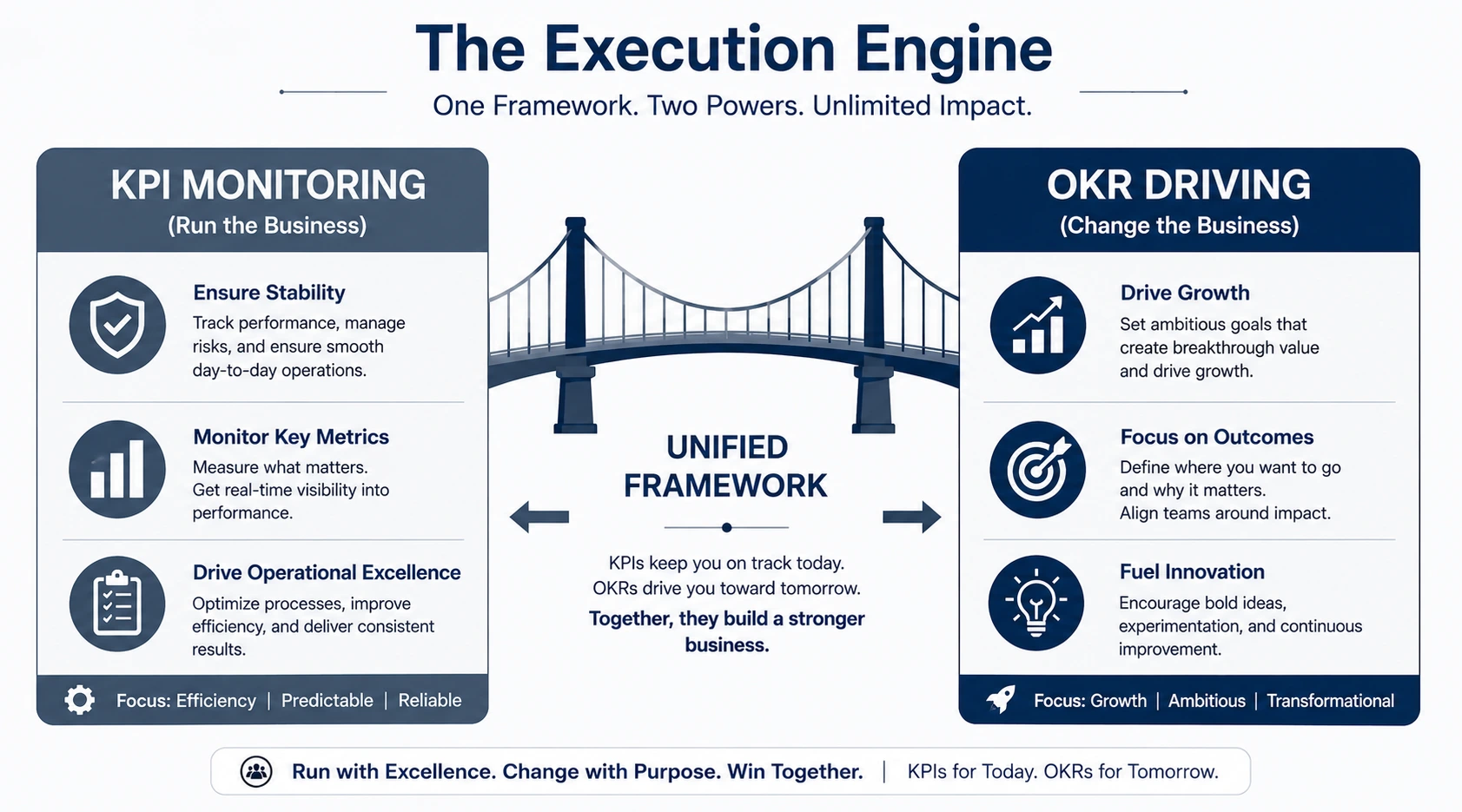
The software is the infrastructure. The coaching is the capability. You need both, and in the right order. For organizations ready to stop the “dashboard delusion” and start driving real business outcomes, the path forward is clear. It starts with a unified framework that respects the difference between running the business and changing it, while providing the bridge between the two.
Path 1: The Platform. If you are ready to evaluate a unified OKR and KPI software in one framework, explore our OKR Software, check our Pricing, or Get a Demo to see how Orbit AI can transform your execution.
Path 2: The Consulting. If you recognize that the platform is not your first problem and you need to build the capability of your leadership team first, our OKR Consulting services provide the hands-on coaching required to reach 40% execution maturity.
Written by
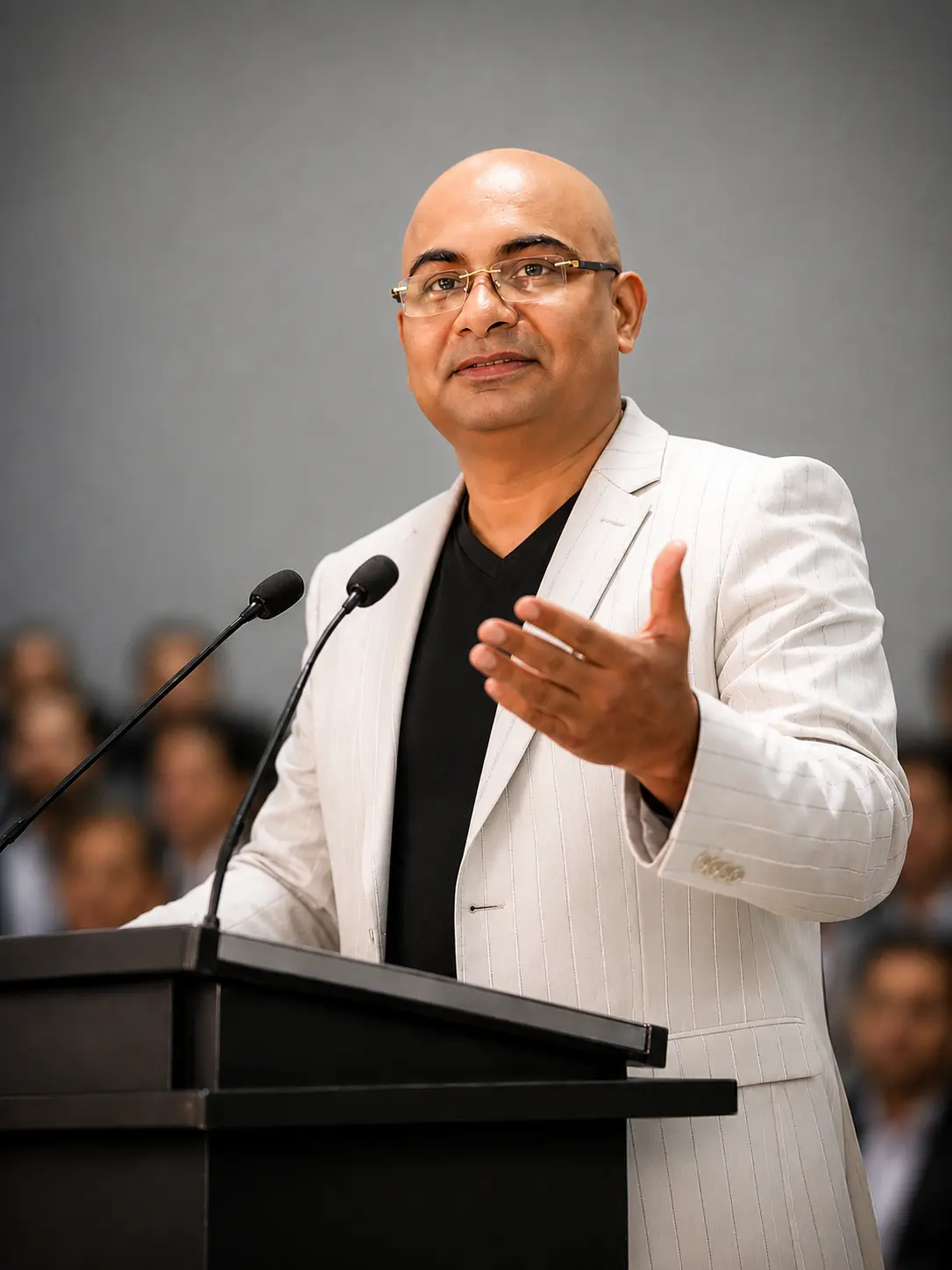
An OKR Coach with 20+ years of implementation experience, Madhusudan has guided over 50 organisations through successful OKR transformations, training more than 500 leaders. Learn more about Worxmate.