 WORXMATE
Quick Answer
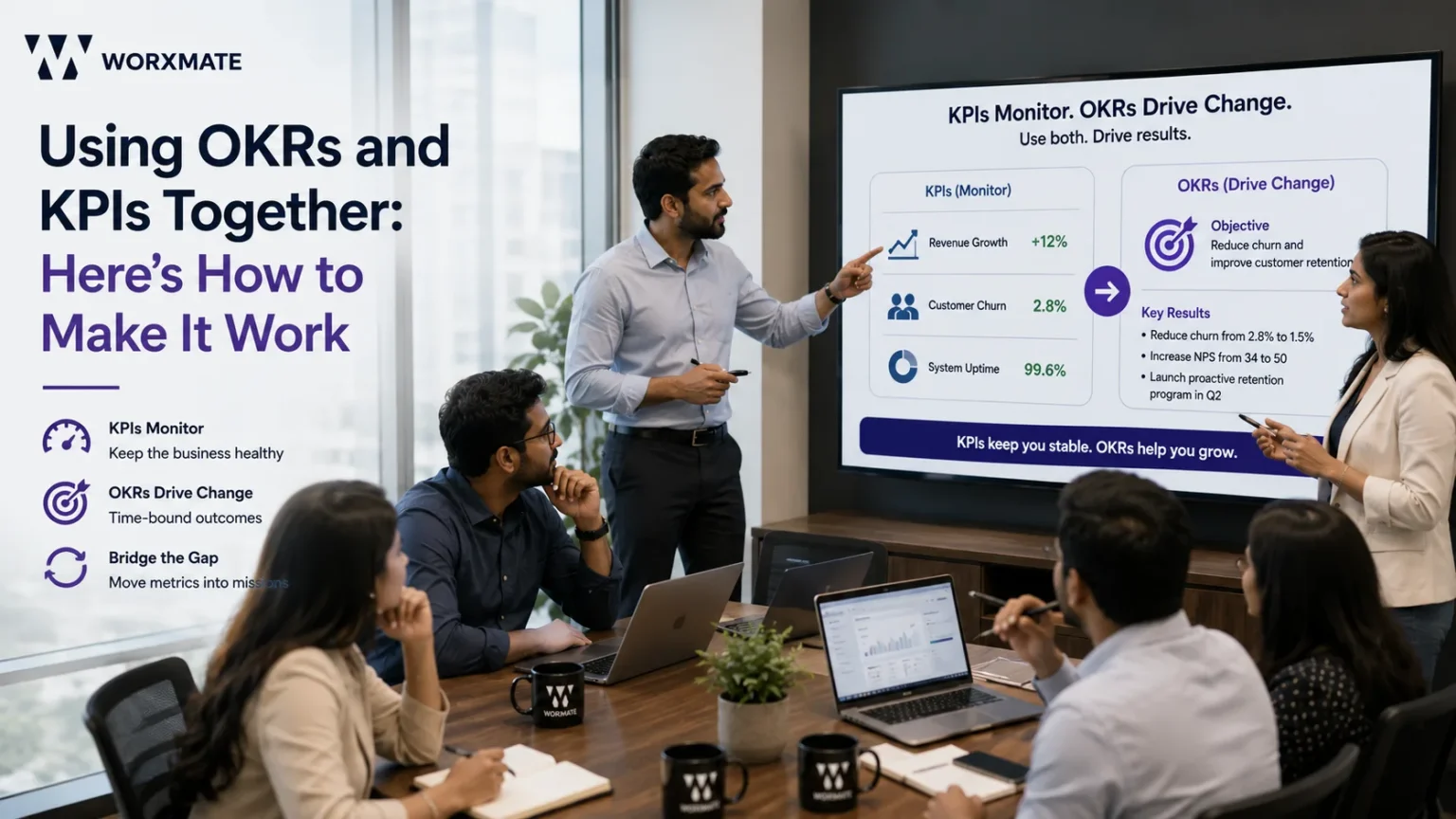
Yes, you can and should use OKRs and KPIs together. They are not two versions of the same system fighting for one slot on your dashboard. Using OKR and KPI together comes down to one method I put in front of every client: let KPIs run as the permanent health check on the business, revenue, churn, uptime, time to hire, whatever tells you the engine is running the way it should. Then, the moment a KPI slips into the red or leadership needs a genuine step-change, promote that KPI into a time-bound OKR that names the outcome you’re actually chasing, not just the number you’re watching. In ten years coaching this exact transition across 50+ organisations, the failure I see is never a leader picking one system over the other. It’s a leader running both with no rule for when a metric becomes a mission.
The Question I Get on Every Integration Call
A few years back I was in a workshop with the leadership team of a multi-billion dollar mining and engineering group, working through their Middle East and Europe division. This wasn’t a company in crisis. It was growing. The problem was quieter than that: new entrants were starting to eat into market share, and the leadership team hadn’t fully registered the threat yet.
Every leader in that room could recite their KPIs from memory. On-time delivery. Machine uptime. Service response time. What none of them could do, until we worked through it together, was connect those numbers to where the business actually needed to go next. The moment that changed the room wasn’t a new metric. It was the distinction between an Objective, an Outcome, and a KPI, a lagging indicator that tells you where you’ve been, not where you’re headed. Once they saw that a KPI trending flat on service delivery was quietly capping their renewal rate and regional expansion plans, the KPI stopped being a report and became the reason for the next quarter’s OKR.
That’s the entire question behind using OKRs and KPIs together: not which one wins, but which one tells you where to point the other.
A quick note on where this comes from: I’ve spent 20+ years in strategy execution, the last 10 coaching OKR implementations specifically, across pharma, fintech, manufacturing, retail, IT services, energy, and mining, in APAC, the Middle East, and Europe. I built the DEEP AI™ framework (Define, Execute, Evaluate, Plan) out of that field work, and I still run 1:1 coaching sessions with leadership teams most weeks. Everything below is the pattern I watch repeat, industry after industry, when a leadership team tries to run growth and stability off the same single dashboard.
Why Most Teams Get “Using Both” Wrong
Here’s the mistake I see before I see anything else: leaders treat this as a philosophical choice, OKR vs KPI, pick a side, when it’s actually a sequencing question. KPIs and OKRs aren’t rivals. One monitors. The other moves. The organisations that struggle aren’t the ones using the wrong framework. They’re the ones with no defined trigger for when a red KPI becomes a quarterly Objective, and no discipline for retiring an OKR back into a KPI once the outcome has been achieved and just needs maintaining.
I’ve also watched this go wrong from the other direction, HR or Ops teams inheriting both systems and running them as separate reporting exercises instead of one connected loop. When that happens, the KPI dashboard gets updated every Monday, the OKR platform gets updated the week before the quarterly review, and nobody in the leadership team is actually looking at the two side by side. If you want the deeper breakdown of where each framework earns its keep on its own, I’ve written that up separately in OKR vs KPI: pros and cons. This piece is about the part that comes after you’ve made peace with needing both: the actual mechanics of running them together without one drowning out the other.
The pattern gets worse under pressure. A conflict between a manager and an employee over a missed number almost always traces back to this confusion, a KPI miss treated like a character failure, or an ambitious OKR miss treated the same way a blown KPI would be. Those are two entirely different conversations, and conflating them is one of the fastest ways I’ve seen leadership trust erode inside a team.
The KPI-to-OKR Bridge: How the Integration Actually Works
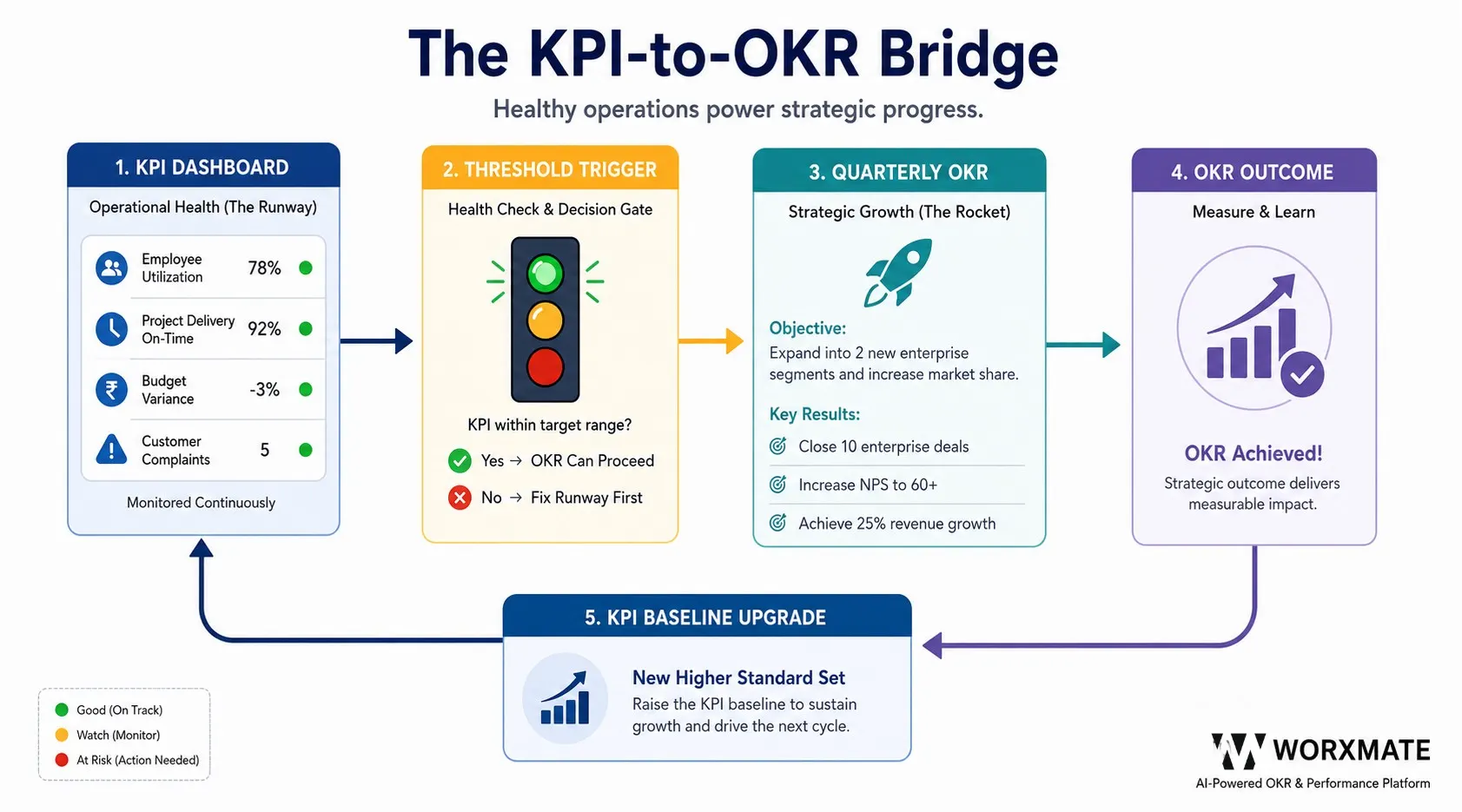
I call this the KPI-to-OKR Bridge, and it’s the model I whiteboard in almost every first integration session. It has three moving parts.
One, KPIs run continuously as your baseline. They don’t need an Objective attached. They need a threshold, a number below which the business is no longer operating in a healthy range. Manufacturing output per hour, gross margin, employee turnover, average handle time, these sit on the dashboard permanently, watched but not chased.
Two, a KPI crossing its threshold becomes a trigger, not a crisis. This is the step most teams skip. The moment a KPI slips, red or trending toward red, it becomes a candidate for a time-bound Objective. Not automatically. A KPI dip doesn’t always warrant an OKR. But when it signals something structural rather than seasonal noise, that’s your cue.
Three, the OKR owns the outcome, not the metric. The Key Result underneath the new Objective can absolutely reference the same number, but the Objective itself has to describe the change you’re trying to produce, not the metric you’re trying to move. This is where what a business outcome actually is becomes worth understanding properly before you write the Objective, because most first-draft OKRs I see in this exercise are still metrics wearing an Objective’s clothes.
A dashboard full of green KPIs and a wall of ambitious OKRs are not two proofs of the same thing. One tells you the business is stable. The other tells you it’s changing. You need both signals, and you need to know which one you’re reading at any given moment.
This is also where organisational alignment actually gets tested, because a KPI crossing its threshold in one department frequently reveals an OKR that needs cross-functional ownership, not a single team quietly fixing its own number in isolation.
 A Practical Walkthrough: Turning a KPI Into an OKR
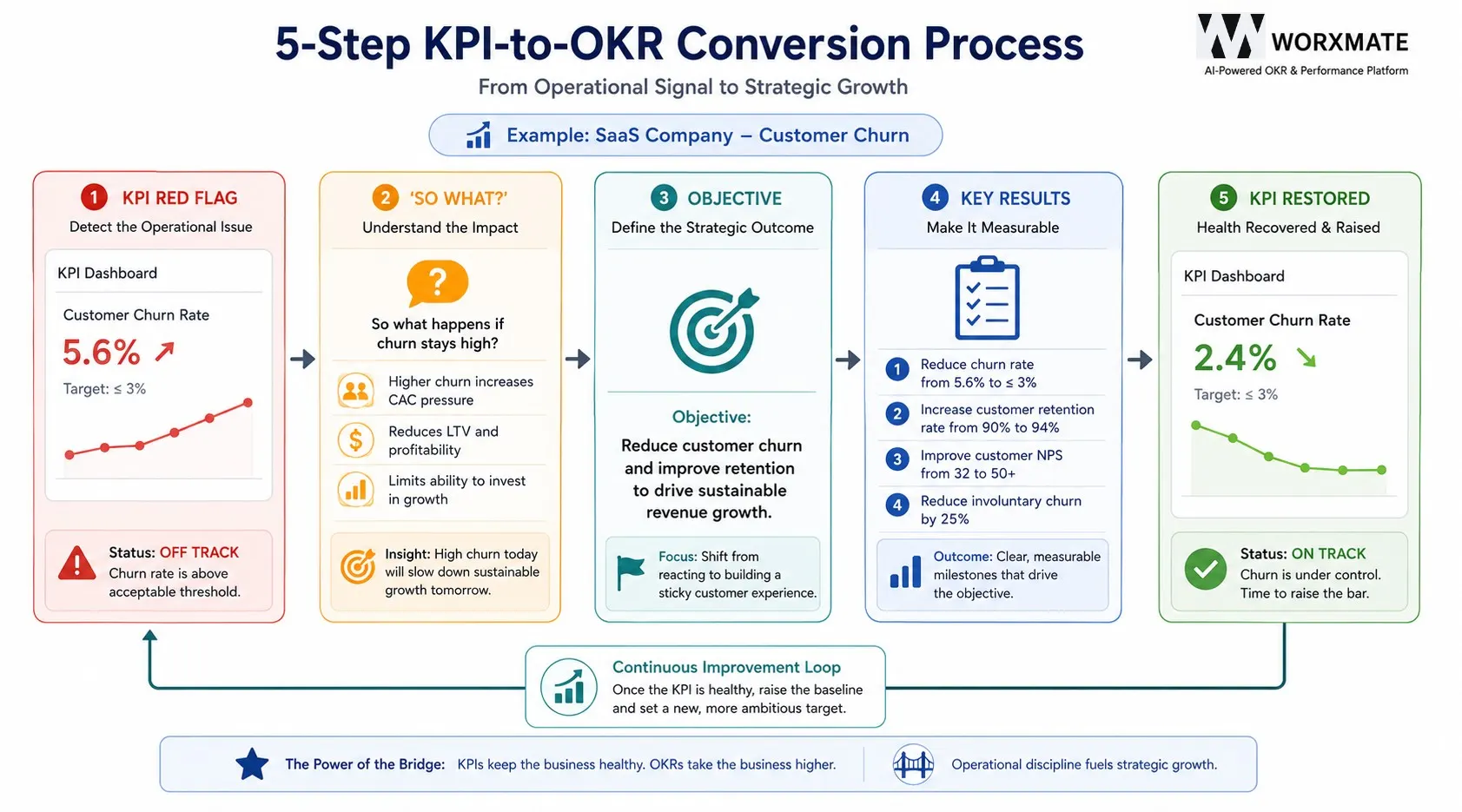
Here’s the exact sequence I run with a leadership team the first time they try this.
- Step 1: Pick the KPI that’s actually costing you something. Not the one that’s slightly under target. The one where the gap is compounding, quietly costing revenue, retention, or market position every month it stays open.
- Step 2: Ask “so what” until the metric becomes a story. I run this question relentlessly with every team: if this number doesn’t move, so what happens? Keep asking until the answer stops being another number and starts being a consequence a customer or the business actually feels.
- Step 3: Write the Objective as the change, not the metric. If the KPI is “average ticket resolution time,” the Objective isn’t “reduce ticket resolution time.” It’s something closer to “Make support a reason customers stay, not a reason they leave.”
- Step 4: Set Key Results that include the KPI and the leading indicators around it. Under that Objective: cut average resolution time from 8 hours to 3, launch a proactive alert for at-risk renewals, and get customer effort score under 2.5. The original KPI is in there. It’s no longer the whole story.
- Step 5: Decide who owns it, and make it more than one function’s problem. In my experience, the KPIs that get promoted to OKRs almost always touch more than the team that owns the number. Support owns resolution time. Product owns the bugs generating half the tickets. If the OKR only sits with Support, you’ve written a KPI with a deadline, not a real OKR.
Here’s what that looks like laid out side by side for a SaaS company watching churn creep upward:
| Stage | What It Looks Like |
| KPI (ongoing) | Monthly churn sitting at 4.2%, above the 3% healthy threshold |
| Trigger | Three consecutive months above threshold, tied to a specific cohort |
| Objective | Rebuild trust with customers in their first 90 days |
| Key Result 1 | Cut time-to-first-value from 14 days to 6 |
| Key Result 2 | Launch a proactive check-in at day 30 for the at-risk cohort |
| Key Result 3 | Bring churn back under 3% for two consecutive months |
| Back to KPI | Churn resumes as a monitored KPI once the threshold holds for a full quarter |
This is the same discipline I walk teams through when they’re moving from a KPI-only culture to a full OKR cycle, it’s a structural shift, not a naming exercise, and most of the resistance I see in week one comes from teams trying to skip Step 2 and jump straight to writing Key Results.
 What This Looks Like in Practice
I ran a version of this with a $45 billion Middle East energy and utilities company, 8,000-plus employees, as part of a broader organisational development effort. Walking in, every leader had their own agenda and their own version of the strategy. Completely scattered, which is what you consistently find at that scale before anyone connects the dots.
The KPIs weren’t the problem. The company had strong operational metrics across the board. The problem was that nobody had built the bridge from those metrics to the specific outcomes the expansion strategy actually needed. Once we ran the cross-functional dependency exercise and each leader could see which of their own numbers were quietly blocking someone else’s OKR, the tone in the room changed completely. Leaders stopped defending their department’s KPI in isolation and started asking what outcome it needed to feed.
Two to three quarters later, the shift wasn’t a new dashboard. It was clarity, every leader able to say exactly what they were contributing to and why, and confidence that had visibly grown because the KPI-to-OKR bridge was doing real work instead of sitting as two disconnected reporting systems. That kind of organisational performance improvement doesn’t come from picking a framework. It comes from the discipline of connecting the two you already have.
The same pattern shows up at a much smaller scale. I coach plenty of startups through this exact motion, except the KPI set is thinner and the “so what” conversation happens faster because there are fewer layers between the founder and the number. A startup doesn’t need fewer KPIs to make this work. It needs the same discipline about which one earns an OKR this quarter.
Where the Integration Breaks: The Coaching Cliff
Here’s the failure mode I’ve watched kill more integrations than any tooling problem. Leadership gets coached through the KPI-to-OKR Bridge, writes strong first-cycle OKRs, and the rollout looks like a genuine success at the top of the org chart. Then the coaching stops there. Middle management inherits the framework with a login and a deadline instead of the same translation the C-suite got.
I call this the Coaching Cliff, and I’ve written the full pattern up separately because it’s the single most predictable point of failure across every engagement I’ve run, regardless of company size. Middle managers are usually the ones running weekly OKR check-ins and watching the KPI dashboard day to day. If they were never coached on how to spot a KPI worth promoting, or how to hold a Key Result conversation that’s honest about a slipping number, the integration collapses back into two separate systems within a quarter, exactly the outcome you were trying to avoid.
This is also where HR strategy decisions matter more than most leadership teams expect. When HR owns the OKR rollout in isolation from the business’s actual KPI conversations, the two systems drift apart by design, because nobody in the room is accountable for both at once.
Using OKR and KPI Together, By Company Stage
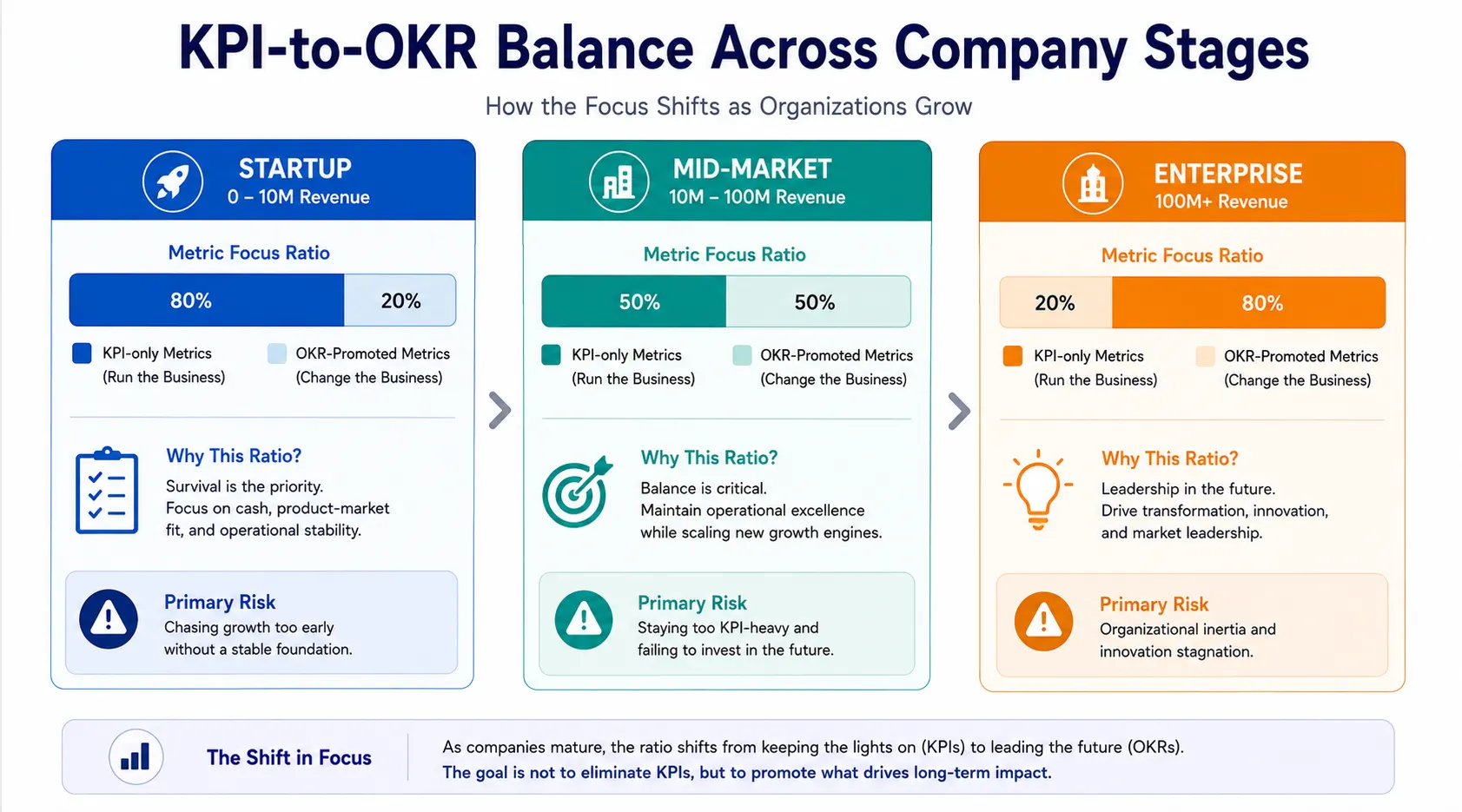
The right balance shifts with stage, and I calibrate it differently depending on where a team sits.
Startups. Thin KPI set, usually 3 to 5 numbers that actually matter, revenue, burn, activation rate. Almost everything else should run through OKRs because the paths to growth aren’t proven yet. I don’t ask an early-stage team to build a KPI dashboard before they’ve earned the data to make one meaningful.
Mid-market. This is where the KPI-to-OKR Bridge does the most work. Departments have real, established KPIs, and leadership needs a disciplined way to decide which ones warrant a quarterly push. A roughly 70/30 split toward KPI-driven stability, with OKRs layered on top for the two or three things that genuinely need to change, is normal here.
Enterprise. KPIs are everywhere, and the risk flips. Too many metrics competing for OKR attention, and every department head convinced their number is the one that deserves a company-wide Objective. This is where the strategic priorities conversation has to happen at the top first, before a single KPI gets promoted, or you end up with twelve competing OKRs and no real cascade.
Diagnose Before You Integrate
Before I recommend the KPI-to-OKR Bridge to any client, I want to know where they’re actually starting from. Two diagnostics I use for this, depending on what’s unclear.
If the question is “are our people’s day-to-day metrics actually connected to the culture we’re trying to build,” I run the Performance Culture Maturity Framework, it benchmarks where an organisation sits on the journey from KPI-only compliance to a genuinely outcome-driven culture, and it tells you honestly whether you’re ready for the Bridge or still building the KPI discipline that has to come first.
If the question is broader, “where exactly is the gap between our strategy and what our teams are actually executing,” that’s a organisational performance audit, a diagnostic that maps the specific strategic gaps before you commit a single quarter to fixing the wrong one. I don’t recommend integration work to a client until one of these two questions has an honest answer.
Where This Goes Next
Using OKRs and KPIs together isn’t a one-time setup. It’s a discipline you rebuild every quarter, deciding which numbers stay on the dashboard and which ones earn a real Objective. If you want the fuller comparison of where each framework stands on its own first, OKR vs KPI is the place to start, and explore Worxmate’s full collection of OKR articles if you want to go deeper on cadence, alignment, or coaching before you commit to a platform.
If your KPI dashboard is solid and you’re ready to layer a structured OKR cycle on top of it, Worxmate’s OKR software is built around the DEEP AI framework I mentioned earlier, and it’s worth comparing against whatever you’re using today through our OKR vs KPI software breakdown or the full product comparison page. Book a demo and bring your actual KPI dashboard to the call.
If the real gap is that your leadership team can see the KPIs clearly but can’t yet translate a red number into a genuine outcome-led Objective, the platform isn’t the first problem. That’s what OKR consulting is for, coaching the specific translation step this whole piece has been about, before the software has anything real to track.
The software is the infrastructure. The coaching is the capability. Most organisations trying to run OKRs and KPIs together need both, in that order.


Written by
An OKR Coach with 20+ years of implementation experience, Madhusudan has guided over 50 organisations through successful OKR transformations, training more than 500 leaders. Learn more about Worxmate.
