 WORXMATE
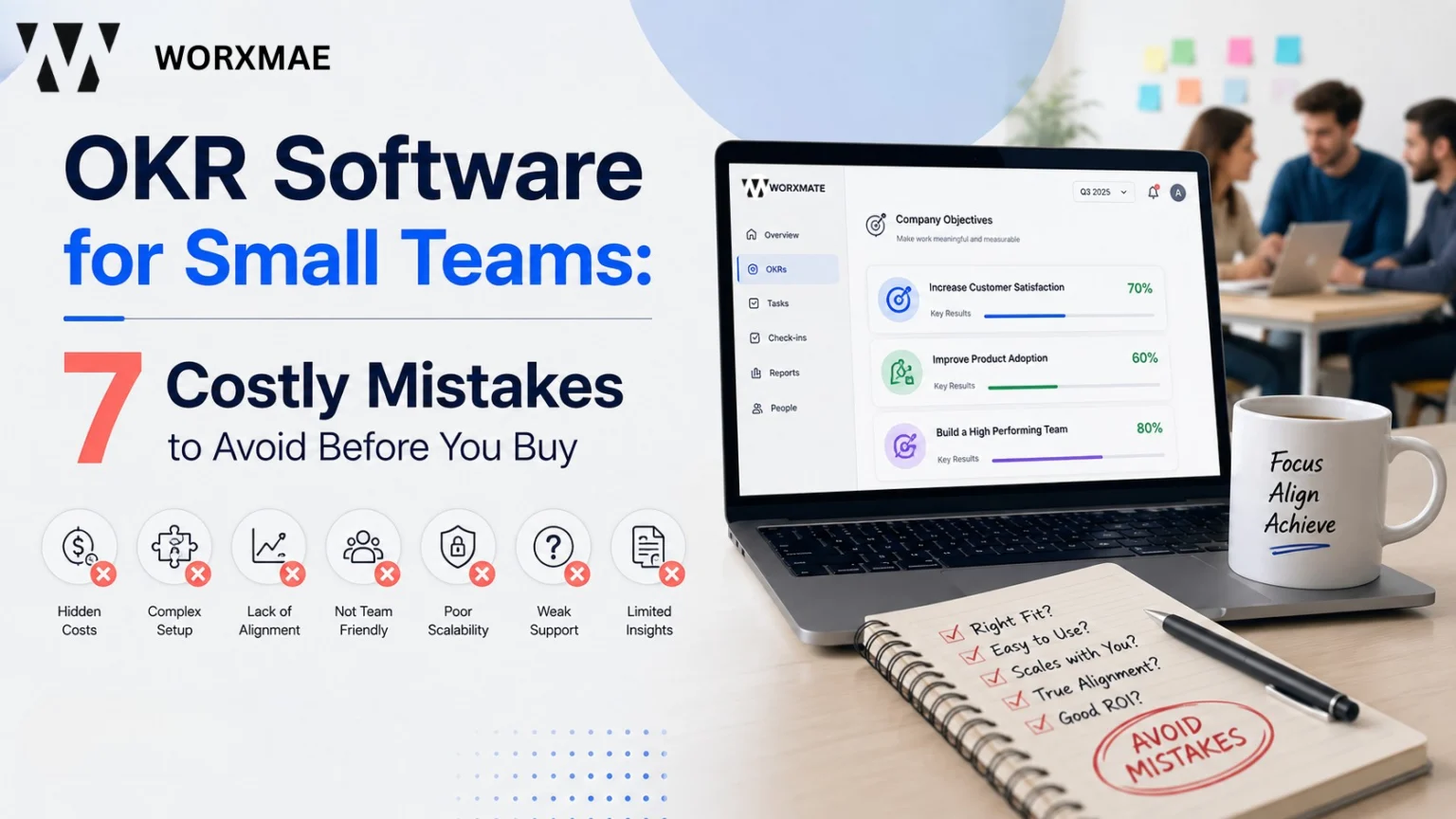
OKR software for small teams fails less often because of the tool and more often because of how it was chosen. The seven mistakes that cost founders the most: judging the tool by the demo instead of week six, ignoring user-cap traps, treating “unlimited free” as full-depth, buying before the leadership team can name three priorities, sizing for today’s headcount instead of next year’s, mistaking integrations for real alignment, and leaving check-in follow-up with no owner. Fix the evaluation process before you fix the shortlist the tool comes after, not first.
Three quarters ago, I sat with the CEO and CPO of a European fintech, about 100 people, generating revenue, introducing OKRs for the first time. Their goals were KPI-led numbers moving on a dashboard with nothing underneath telling anyone what actually needed to change. The tool they were using hadn’t caused that problem. It hadn’t surfaced it either. It let the team keep writing goals that looked complete on a screen while producing no clarity underneath.
That’s the pattern I see more than any other when a small team goes shopping for OKR software for small team: the evaluation gets treated as a feature comparison, when it’s really a test of whether the organization can answer one question honestly what are the two or three things that matter most this quarter? A tool cannot answer that for you. It can only show you, clearly or badly, whether you’ve answered it yourselves.
Why I’m Writing This
I’ve spent 20+ years in strategy execution and the last 10 specifically inside OKR implementations more than 50 organisations, across pharma, fintech, manufacturing, retail, IT services, and energy, training 500+ leaders directly. Before Worxmate, I ran the Business practice at Profit.co and took it from zero to $11M in funding, so I’ve sat on both sides of this decision building the software and buying it. Founders don’t need another feature matrix. They need to know which mistakes actually cost them a quarter, because I’ve watched the same seven happen at five-person teams and forty-person teams using the exact same shortlist.
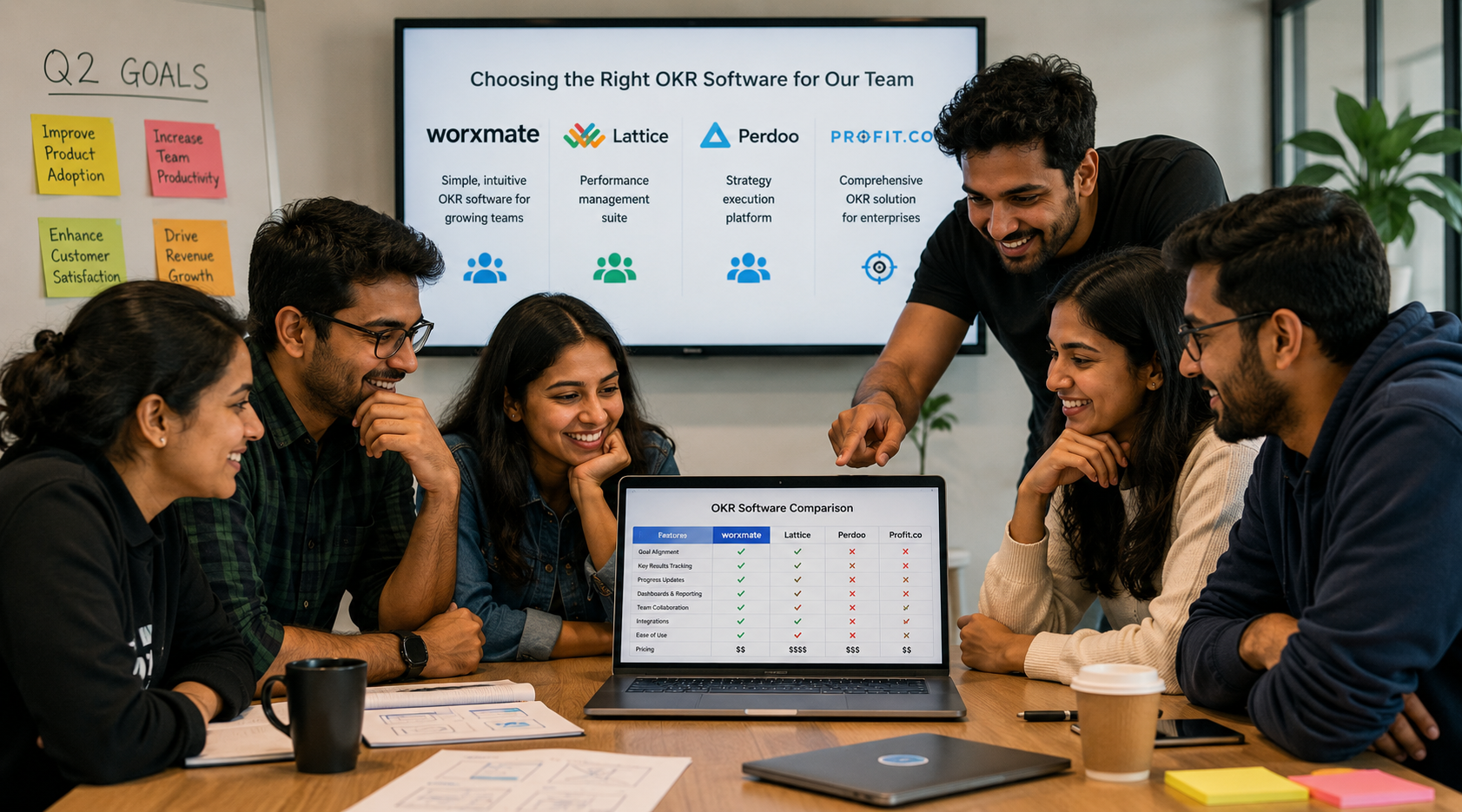
Why Small Teams Get This Choice Wrong Before They See a Demo
Most founders start the search for OKR software for small teams already halfway to the wrong answer, because they’re comparing tools before they’ve defined what the tool needs to protect them from. A Google Sheet or Excel tracker is free and familiar, which is exactly why it survives past the point where it should have been replaced. Teams don’t abandon spreadsheets for OKR tracking because a demo impressed them. They abandon them when a missed dependency costs a launch date.
The second trap is timing. Founders often start this search the same week they decide “it’s time to start OKRs” before the leadership team has actually agreed on what the company’s top priorities are. A tool selected under that pressure gets chosen for its onboarding video, not for whether it will hold up once the real check-in cadence starts. This is where most comparison articles skip the part that actually determines whether a small team’s first cycle succeeds the tool is downstream of the decision-making, not a substitute for it. What follows is less a features list and more an OKR software evaluation checklist built from watching that decision go wrong the same seven ways, repeatedly, across very different companies.
Achieve Your Goals Faster
See how Worxmate can help your team set clear goals and achieve faster results. Book your free demo today and experience the power of AI-driven OKRs in action.
OKR Software for Small Teams: The Practitioner’s Lens
Here’s the deeper version of the fintech story I opened with. When I asked the CEO and CPO one question “what is the one big thing you want to resolve?” the answer was product demo experience. Then came a sequence of “so what” questions: if you fix this, so what happens next? Repeated until the team reached a genuine business outcome statement instead of a KPI dressed up as a Key Result. I asked the Product Lead to co-own a Key Result with the Account Executive, jointly accountable for conversion. Cross-functional co-ownership of a single KR had never happened there before. Three quarters later, product and commercial teams were operating with real dependency mapping instead of assumption.
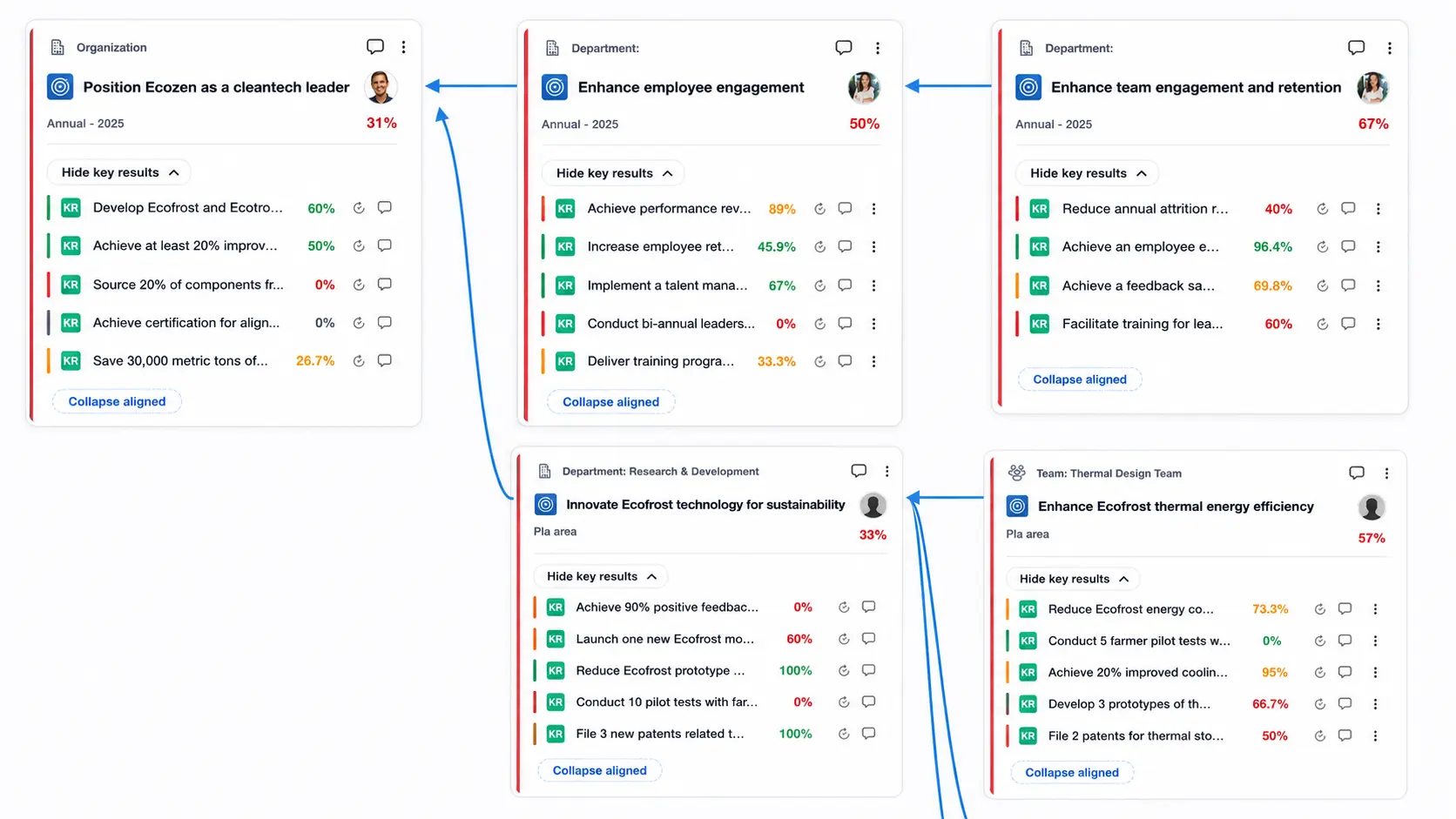
No software license does that work. Alignment is agreement between teams on what matters, why it matters, and how each team’s work connects to the teams around them. You cannot set that in a tool. You can display it once it exists. That’s the filter I’d want every founder to run their shortlist through before comparing pricing pages: does this tool make agreement visible, or does it just give me a prettier place to type goals nobody has actually agreed on?
The 7 Mistakes Founders Make Evaluating OKR Software for Small Teams
These aren’t feature gaps. They’re evaluation-process mistakes, and I see the same seven repeat regardless of industry or team size.
1. Judging the tool by the demo, not by week six. A clean demo with tidy sample data tells you nothing about what happens when three managers haven’t updated their Key Results and the check-in meeting is running late. Ask any vendor what the platform looks like at week six with real, messy data not what it looks like on day one.
2. Ignoring the user-cap trap. Plenty of “free for small teams” plans cap at five users. If your leadership team is eight people, half of them are locked out before the first cycle starts, and nobody realises it until the invite emails bounce.
3. Treating “unlimited free” as full-depth. There is no such thing as a tool that is simultaneously unlimited in users and full-depth in cascade, dependency mapping, and reporting the constraint always shows up somewhere. If you want the fuller breakdown of this trade-off, I’ve written about it separately in free OKR software. This trap hits OKR software for founder-led teams hardest, because there’s rarely a procurement person double-checking the fine print before the founder just signs up.
4. Buying before the team can name three priorities. This is the mistake I watched play out with an APAC retail company in aggressive expansion mode. In the first alignment call, I asked the CEO to share his top three strategic strategic priorities so leaders could start writing OKRs. In 45 minutes, he couldn’t define them clearly not because he wasn’t sharp, but because nobody had ever asked him to compress his vision into three outcomes an organisation could cascade from. The meeting ended without a conclusion, and a two-day working session followed before a single OKR got written. No software fixes that gap. Run your own gap analysis and business impact analysis before you open a single pricing page.
5. Sizing for today’s headcount, not next year’s. The tool that fits a 6-person team comfortably can become the constraint at 25. Read OKRs for 5 people vs 500 people before you assume the plan you’re signing up for today will still fit in twelve months.
6. Mistaking integrations for alignment. A Slack notification when a Key Result updates is not the same as cross-functional team alignment. Integrations reduce friction. They don’t create agreement between teams on what matters and why that’s a conversation, not a webhook.
7. Leaving check-in follow-up with no owner. If a team is raising fifteen to twenty support queries a day in week one, adoption breaks within weeks not because the team resists the tool, but because nobody owns the follow-up on stalled check-ins. A check-in meeting template with a named owner does more for adoption than any dashboard feature. OKR check-in ownership should be assigned before go-live, in writing, not discovered by accident three weeks in when nobody remembers whose job it was.
| Mistake | What to Check Instead | Red Flag to Watch For |
|---|---|---|
| Judging by the demo | Ask for a week-six walkthrough with messy, real data | Vendor can only show pre-populated sample dashboards |
| Ignoring user caps | Count your actual leadership + core team headcount before signing up | “Free” plan caps below your current team size |
| “Unlimited free” claims | Read the feature list, not just the user cap | No cascade view, no dependency mapping in the free tier |
| Buying before priorities exist | Confirm leadership can name 3 priorities in one sentence each | Priorities take more than one meeting to define |
| Sizing for today only | Model your tool needs at 2x current headcount | No clear upgrade path or scaling plan from the vendor |
| Integrations vs alignment | Ask how the tool surfaces disagreement, not just updates | Sales pitch only mentions Slack/Jira sync, never cascade |
| No check-in ownership | Name a check-in owner before go-live, not after | Nobody on the team can say who chases overdue updates |
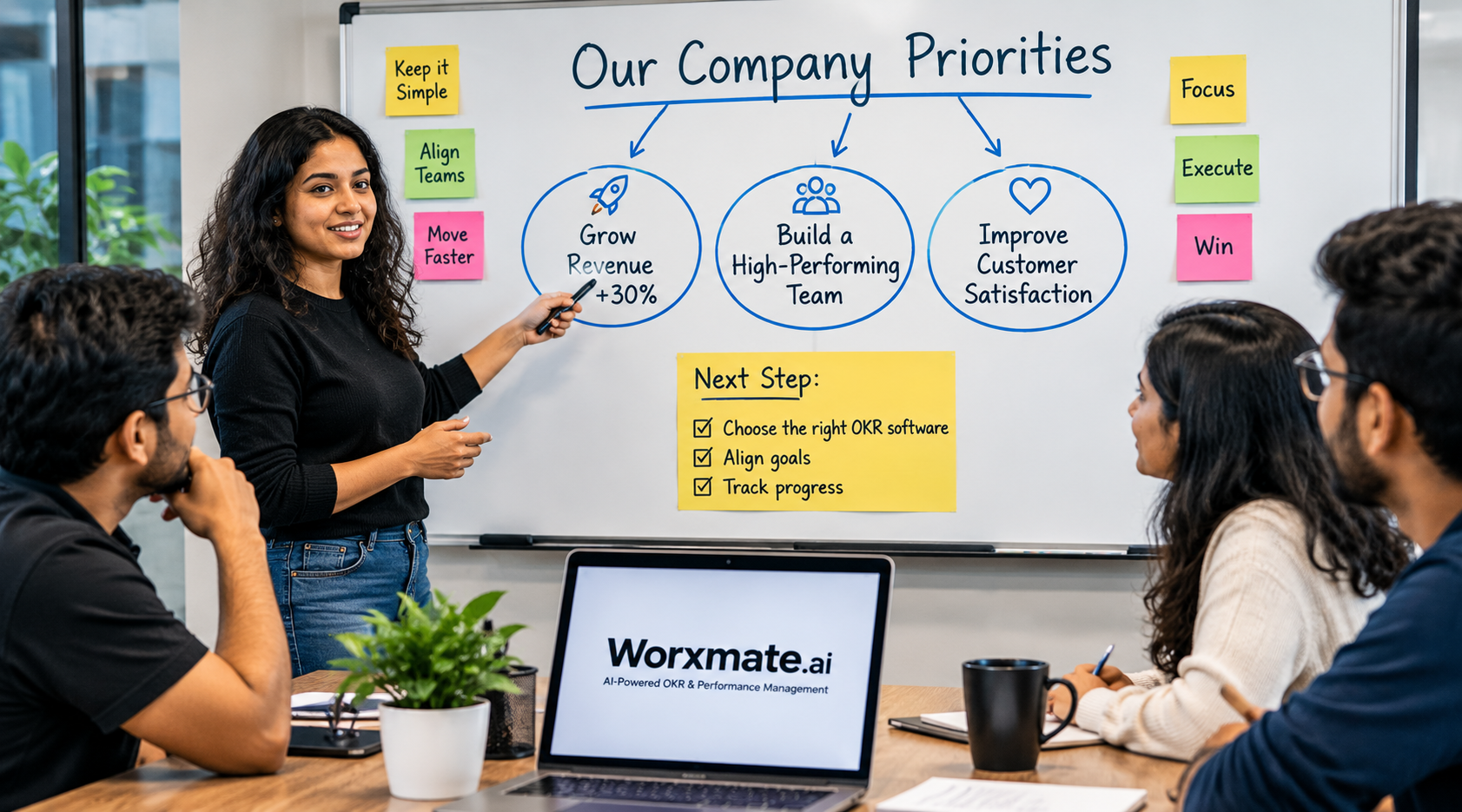
What This Evaluation Actually Looks Like in Practice
The teams that get this right don’t spend more time comparing vendors they spend less. They spend the saved time on the two things a tool can’t do for them: naming the two or three priorities that matter this quarter, and deciding, out loud, who owns the follow-up when a check-in slips. Everything else pricing tier, integration list, dashboard colour becomes a much smaller decision once those two things are settled. I’ve watched a 12-person team run a cleaner first cycle than a 40-person team, purely because they did that work before opening a single comparison page. This is also why self-serve OKR setup matters more than most shortlists give it credit for a founder shouldn’t need a sales call and a two-week onboarding queue just to start a first cycle, and OKR software setup time past a few days is usually a sign the tool was built for a buyer with a procurement team, not a founder with a Tuesday afternoon free. One completed OKR, genuinely completed with honest check-ins and a real retrospective, is worth more than five written ones nobody seriously reviews.
Where Worxmate Fits This Evaluation
Worxmate’s DEEP AI™ framework – Define, Execute, Evaluate, Plan exists because a small team asking these seven questions needs more than a text box that stores goals. The Define module helps a founder turn “improve customer service” into a measurable outcome before the cycle even starts, which addresses mistake directly. Execute automates check-ins and flags at-risk goals instead of waiting for a manager to notice a stall which is the direct fix for mistake. Evaluate turns quarter-end scoring into a real retrospective rather than a completion percentage, and Plan carries what a small team learns in cycle one into cycle two instead of starting from zero every quarter.
Three AI models sit underneath this for teams that outgrow a basic tracker: Orbit for people-performance intelligence, Axis for business-performance intelligence, and Nexus for organisational intelligence segmentation no lightweight OKR tool on the market currently offers, because most weren’t built by someone who has run the cycle from the inside. That’s the difference between software built by a product team and software built by an implementer: every feature exists because a real failure mode, in a real organisation, produced the requirement for it.
Achieve Your Goals Faster
See how Worxmate can help your team set clear goals and achieve faster results. Book your free demo today and experience the power of AI-driven OKRs in action.
Free vs Basic Tools vs Worxmate: What Actually Changes at Small-Team Scale
| Small-Team Signal | Free / Basic Trackers | Worxmate for Small Teams |
|---|---|---|
| User cap on free tier | Often 3–5 users | Free license for up to 10 users |
| Setup time to first cycle | Days to weeks of manual structuring | Live cycle within the first week |
| Goal-writing support | Blank text box | AI-assisted Define module with OKR software quality scoring |
| Check-in follow-up | Manual, reactive, easy to lose track of | Automated check-ins, at-risk detection |
| Cascade / dependency view | Rarely present below “unlimited” claims | Visible cascade, cross-team dependency mapping |
| Path past 15–20 people | Usually requires a full migration | Same platform scales with performance management built in |
Which Stage of Small-Team Growth You’re Actually At
| Team Stage | Primary Risk | What to Prioritize in a Tool |
|---|---|---|
| Under 10 people, first cycle ever | Writing output-led goals disguised as outcomes | Goal-writing guidance, not feature depth |
| 10–25 people, first cross-functional cycle | Dependencies hidden in side conversations | Visible cascade and dependency mapping |
| 25–50 people, scaling fast | Free-tier user caps and lost check-in ownership | Room to grow without a forced migration |
Related Reading Before You Shortlist Anything
A few pieces worth reading alongside this one, depending on where you’re stuck: if budget is the real constraint, start with affordable OKR software and OKR software cost per user rather than assuming “free” solves it. If you’re not sure OKRs are even the right framework yet, why OKRs fail and common OKR mistakes to avoid will save you a wasted cycle. If you’re specifically choosing between a handful of named platforms, our fuller OKR tool comparison and the top OKR software roundup go deeper than this checklist does. For teams moving off KPI dashboards entirely, moving from KPIs to OKRs covers the mindset shift this article assumes you’ve already started making. And if you want the foundational vocabulary before any of this, elements of OKR and how to choose OKR management software are worth five minutes each. Teams still deciding whether they need a dedicated OKR platform at all, versus general goal-tracking software for startups, should settle that question first the two solve different problems, and conflating them is its own version of mistake.
Founders specifically building out early functions will also get more mileage from role-specific examples than generic templates startup founder OKRs, startup hiring OKRs, and startup engineering OKRs show what a genuinely outcome-driven goal looks like in each function, rather than a KPI wearing an OKR’s clothes. And if the team evaluating this tool includes people managers who’ll own the day-to-day check-ins, OKR software for managers is worth a look before go-live, alongside the broader benefits of OKR software for startups and a practical OKR implementation guide for small businesses.
The Software Is the Infrastructure – Choose Your Next Step
If your leadership team can already name three priorities clearly, and check-ins just need a place to happen without one person chasing five Slack threads you’re ready to evaluate the full OKR software platform, check current pricing, or book a demo directly.
If the honest answer is that your leadership team still can’t compress its priorities into one sentence each, that’s not a software gap it’s a capability gap, and OKR consulting is built specifically to close it before a tool gets involved.
The software is the infrastructure. The coaching is the capability. Small teams that get both, in the right order, are the ones I see still running the framework honestly three quarters later.


Written by
An OKR Coach with 20+ years of implementation experience, Madhusudan has guided over 50 organisations through successful OKR transformations, training more than 500 leaders. Learn more about Worxmate.