 WORXMATE
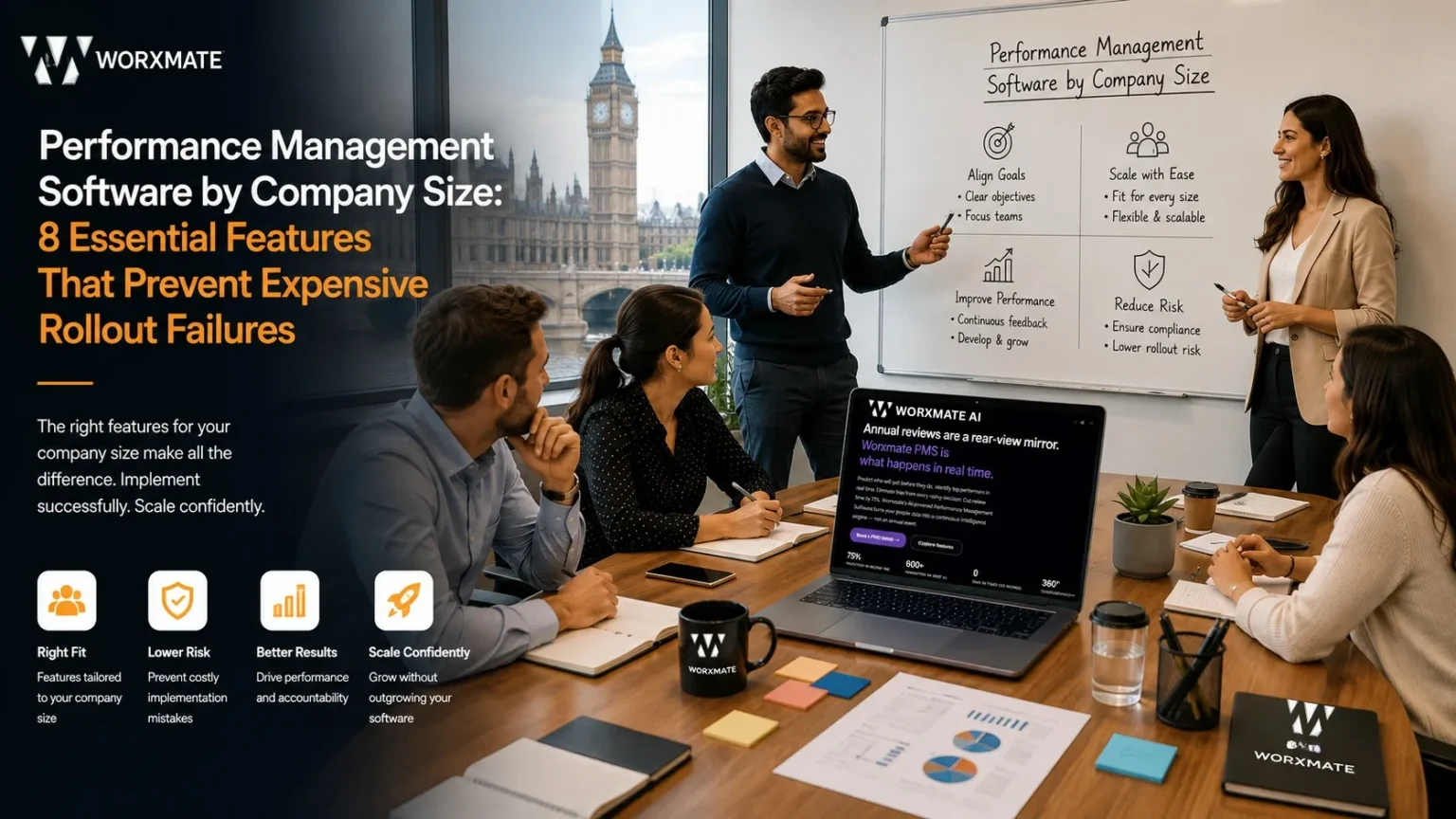
Performance management software by company size: Evaluating employee performance software requires matching feature depth to organizational scale. Small teams need lightweight check-ins, mid-market companies require OKR alignment, and enterprises demand strict compliance and data governance without paying enterprise bloat pricing.
Most failed performance management rollouts share the same root cause: the software was right for a different company than the one that bought it. A 25-person startup drowning in an enterprise suite’s configuration screens and a 2,000-person company still running goals through a spreadsheet-adjacent tool are suffering from the same mistake in opposite directions a mismatch between company size and feature depth.
This guide breaks that mismatch down into eight specific features and explains how the priority of each one shifts as a company grows. It’s not a ranked list of vendors for that, see our Best Performance Management Software guide and it’s not a step-by-step buying process either, which is covered in full in our how-to guide on evaluating a performance management system. By aligning your performance management approaches with organizational headcount, you prevent expensive rollout failures. This article answers one narrower question: given your company’s size, which of these eight features should you actually be weighing heavily, and which can wait?
Why “One-Size” Performance Management Software Fails
Two companies with identical headcounts can need entirely different software, because size changes what breaks first. In a small team, the failure mode is usually adoption a tool with too many screens gets ignored within a month. In a mid-size company, the failure mode is usually alignment goals exist everywhere but never roll up into anything coherent. In an enterprise, the failure mode is usually governance too much visibility into sensitive data in the wrong hands, or not enough structure to compare performance fairly across dozens of teams.
This is exactly why a generic “best of” list can mislead a buyer: a platform ranked highly overall might still be the wrong pick for your specific stage. A genuinely useful lens on performance management software by company size treats size as the primary filter and feature depth as the secondary one not the reverse.
When evaluating vendors like Lattice, mid-market organizations frequently encounter steep user license costs and bolted-on OKR modules that feel disconnected from standard review cycles.
The Worxmate Advantage: Worxmate delivers unified OKRs and continuous performance management for half the total investment of legacy suites, while supporting distributed operations and frontline task tracking.
The 8 Essential Features, and How They Change With Company Size
1. Goal Cascading & OKR-Linked Objectives
At small-business scale, a flat list of goals is usually enough there aren’t enough layers of hierarchy to need a formal cascade. Once a company crosses roughly 100–150 employees, performance management software with OKR tracking becomes non-negotiable: without it, an individual’s weekly work stops visibly connecting to any company-level objective, and goal-setting quietly turns into busywork. Worxmate’s Define stage part of the DEEP AI™ framework — pairs an AI co-pilot with built-in quality scoring specifically to catch this early, flagging when a goal is really a task list wearing an objective’s name. For a deeper look at how goal-tracking and appraisal software relate, see our comparison of OKR software vs performance management software.
2. Check-In Cadence & Automated Nudges
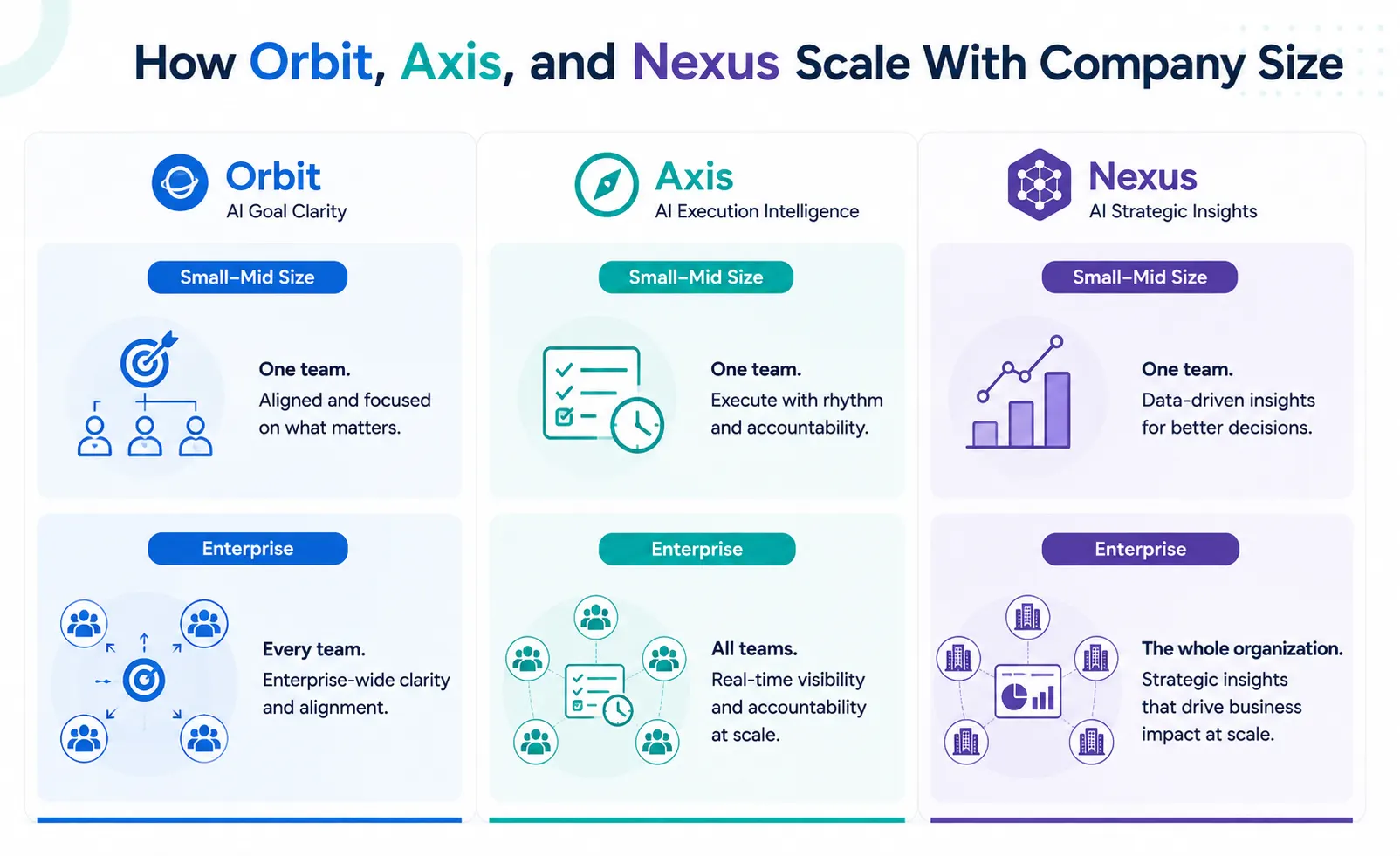
Small teams can often get away with informal, ad-hoc check-ins. Mid-size and larger organisations can’t with more managers and more goals running in parallel, nobody has time to manually chase a stalled update. This is where automated nudging earns its keep: Worxmate’s Execute stage, backed by Orbit AI, flags an at-risk goal before a quarter closes instead of after, layering in people-side signals like disengagement on top of the raw goal data.
3. AI-Driven Risk Alerts & Predictive Insights
This feature scales in sophistication rather than switching on and off. At mid-size scale, AI risk alerts typically flag individual goals or teams heading off-track. At enterprise scale, the same underlying signal needs to aggregate across dozens of business units so leadership can prioritise where to intervene first which is the specific job of Axis AI, Worxmate’s business performance intelligence model, isolating the fastest lever to pull when execution slips. Broader context on this category is covered in our guide to AI-driven performance management software.
4. 360-Degree Feedback Depth & Configurability
Smaller teams often need only lightweight peer input; a rigid, one-size-fits-all 360 form tends to produce generic, low-signal feedback regardless of company size, so configurability matters more than volume. As companies grow, the priority shifts toward anonymised peer input and department-specific question banks, since candid feedback tends to disappear the moment reviewers know their name is attached in a larger, more political organisation.
5. Approval Chains & Role-Based Permissioning
This is one of the sharpest dividing lines between small and large companies. A startup rarely needs more than a single approval step. A mid-size company benefits from department-level configuration this is exactly what performance management software for department-level HR teams requires, letting engineering run a different review cadence than operations without fragmenting into separate systems, as covered in our guide to performance management software for HR teams. An enterprise needs multi-level approval chains and permission controls granular enough that one business unit’s numbers stay invisible to another by default.
6. Payroll & HRIS Integration Depth
At small scale, a manual or loosely connected process is often tolerable. As headcount grows, performance management system integrated with payroll becomes far more valuable when a review is approved, salary revisions and performance-linked bonuses should flow through automatically rather than requiring a second manual step. This is also where performance management software vs HRIS questions become unavoidable: larger organisations already running a full HRIS for payroll and compliance need to decide whether performance sits inside that suite as a module, or lives in a dedicated system with a real API sync rather than a once-a-day CSV export. Our full breakdown of performance management software vs HRIS covers this trade-off in detail.
7. Compliance, Data Residency & Audit Trails
This feature is largely invisible at small scale and increasingly critical as a company grows, expands into new regions, or approaches an audit. Any serious evaluation of performance management software data residency and compliance should confirm the vendor can meet region-specific data-handling requirements without requiring a custom enterprise contract, and that appraisal records are audit-ready across every location the company operates in a requirement that matters most for performance management software for CHRO board reporting, where a defensible paper trail carries real legal weight.
8. Board-Level Reporting & Organisational Visibility
At enterprise scale, individual goal tracking isn’t enough leadership needs to see where a strategy cascade is breaking down structurally across dozens of teams, not just whether any single goal is red or green. This is the specific problem Nexus AI, Worxmate’s organisational intelligence model, is built to solve mapping cascade failures and structural misalignment before they stall execution. Paired with Orbit AI’s attrition forecasting, this combination is what makes a platform genuinely usable for CHRO-level board reporting rather than just team-level tracking.
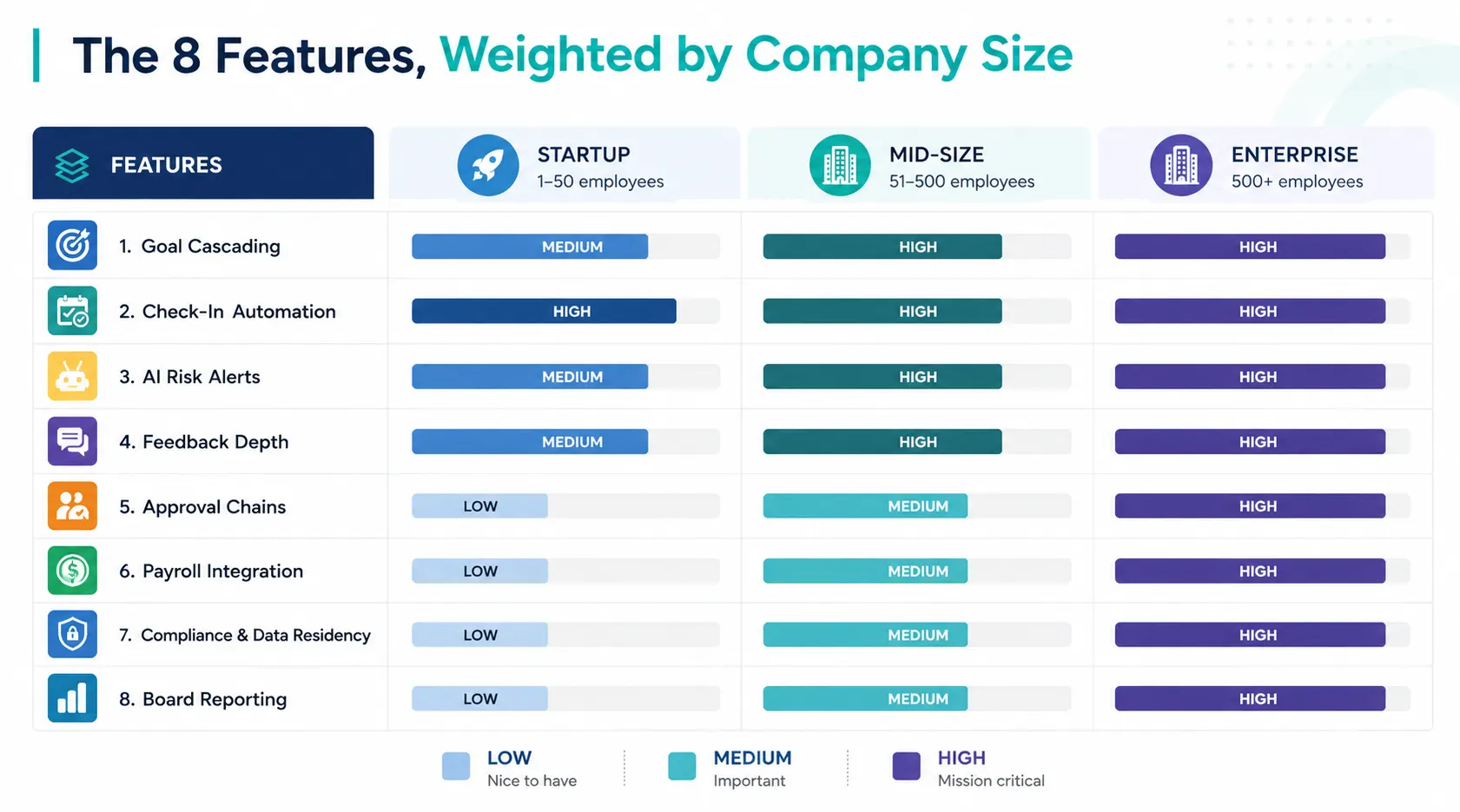
Feature Priority by Company Size: Comparison Table
| Feature | Small Business | Mid-Size Company | Enterprise |
|---|---|---|---|
| Goal Cascading & OKR Linkage | Optional | Essential | Essential |
| Check-In Cadence & Automated Nudges | Nice-to-have | Essential | Essential |
| AI-Driven Risk Alerts | Low priority | High priority | High priority, aggregated across units |
| 360-Degree Feedback Depth | Lightweight | Configurable by team | Configurable by department, anonymised |
| Approval Chains & Permissioning | Single-step | Department-level | Multi-level, granular |
| Payroll & HRIS Integration | Manual is tolerable | Valuable | Essential, real-time API |
| Compliance & Data Residency | Low priority | Growing priority | Essential |
| Board-Level Reporting | Not needed | Emerging need | Essential |
For a related look at what these features deliver once implemented well, see our guide to the benefits of a performance management system and our data on performance management software ROI.
How Worxmate Compares to 5 Alternatives, by Company Size
No single competitor is “better” or “worse” than Worxmate in the abstract each is simply built for a different point on the size curve. Here’s how five commonly-evaluated platforms stack up against Worxmate at the size band they’re actually built for.
| Alternative | Best-Fit Size | Its Key Strength | Where Worxmate Differs |
|---|---|---|---|
| 15Five | Small business / scaling SMB | Coaching-led engagement, weekly check-ins, AI assistant (Spark) for manager coaching | Worxmate pairs the same lightweight check-in cadence with OKR-linked goal cascading from day one, so goals don’t need re-platforming once the company outgrows pure engagement tracking |
| Lattice | Mid-market | Polished, people-centric interface; strong 1:1 and engagement-survey tooling | Worxmate ties goal execution and AI risk alerts (Orbit, Axis) directly into the same workspace, rather than treating OKRs as a bolt-on module alongside engagement features |
| Betterworks | Mid-market to enterprise | Strategic goal governance, strong for structured OKR rollouts at scale | Worxmate adds a predictive layer underneath the same governance – Axis AI flags the fastest lever to pull when a goal is off-track, instead of only reporting status |
| Workday Performance & Talent | Enterprise | Full HCM suite — payroll, workforce planning, and appraisals in one system of record | Worxmate is purpose-built for performance and execution specifically; best fit is enterprises that want a dedicated OKR-and-performance layer integrated with, rather than absorbed into, their existing HCM |
| Oracle HCM | Large enterprise | Comprehensive ERP + HCM integration for complex, multi-entity organisations | Worxmate offers materially faster time-to-value for the performance-and-OKR use case specifically, without requiring a full ERP-level implementation to get goal cascading live |
If your company profile spans two bands a fast-scaling mid-market company eyeing enterprise complexity, for instance the comparison that matters most is the one for the band you’re becoming, not the one you’re leaving. That’s usually the more expensive mistake to get wrong.
Industry Considerations Beyond Company Size
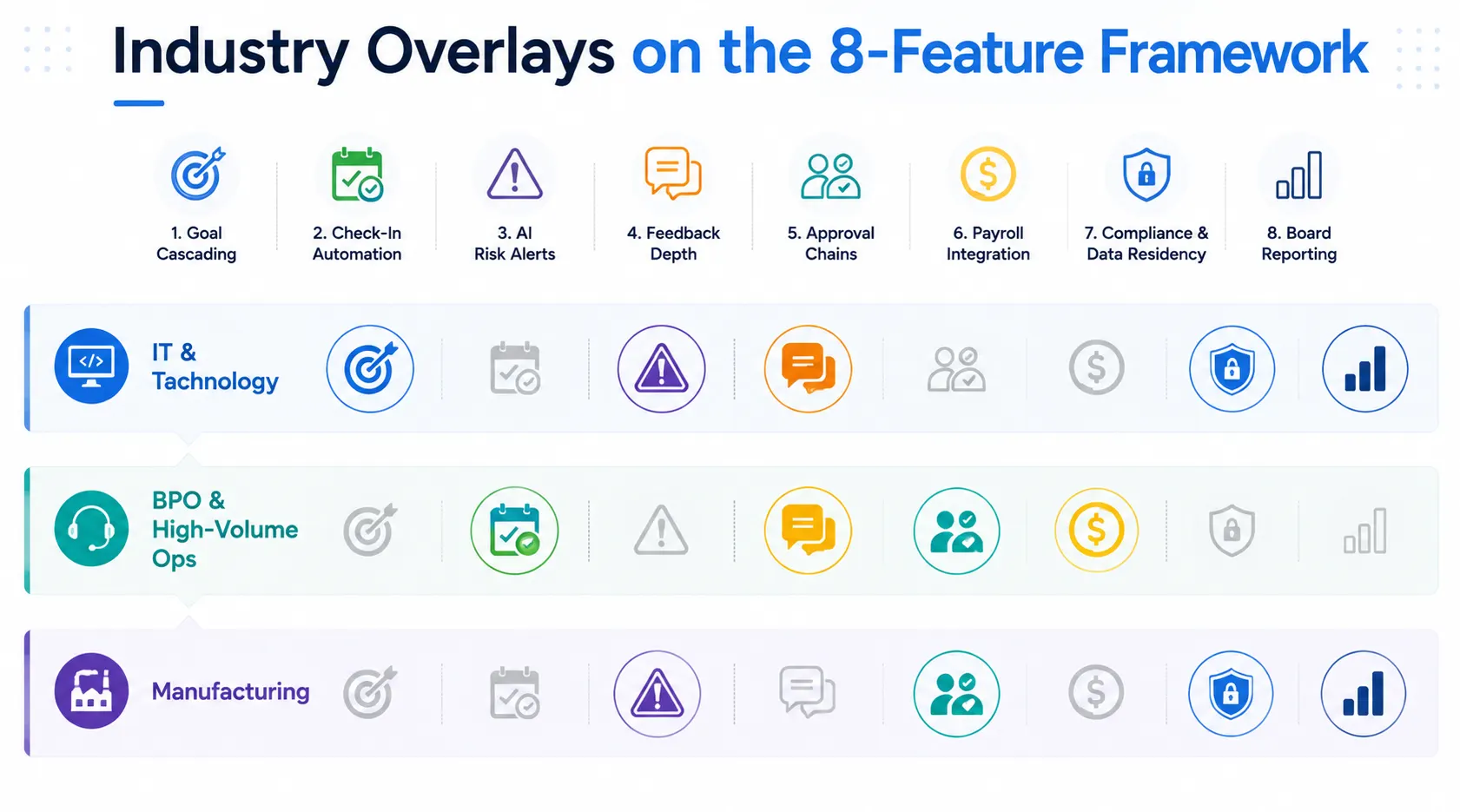
Company size determines how much of each feature you need industry often determines which feature needs the most attention first, regardless of headcount. Two companies of identical size in different industries can have almost opposite priorities among the same eight features. Three patterns show up consistently:
IT and technology companies tend to run performance cycles on a much tighter loop than the standard quarterly cadence sprint-aligned check-ins, not calendar-aligned ones. For this profile, performance management software for IT companies should weigh integration depth with existing engineering tools (Jira, GitHub, Slack) as heavily as the review workflow itself, since a platform that can’t sit inside the tools engineers already use tends to get quietly abandoned. Goal cascading also looks different here: individual contributor goals often map to sprint or release outcomes rather than static quarterly key results, which changes how often check-ins need to fire. Our dedicated PMS for IT companies guide goes deeper on configuring this correctly.
BPO and high-volume operations environments flip the priority order almost entirely. Performance management software for BPO needs to optimize for throughput over customisation templated review workflows that a large number of team leads can run consistently, rather than flexible configuration that different managers set up differently. Feedback depth (feature #4) matters less here than consistency and speed; a 360-degree review process that takes two weeks per employee simply doesn’t scale across a 2,000-agent floor. Approval chains also tend to be flatter and more standardized than in other industries, since the priority is fairness and speed across a large, relatively homogeneous workforce rather than nuanced department-by-department configuration. Our PMS for BPO breakdown covers what a high-volume rollout actually requires.
Manufacturing and other traditional, shift-based industries weigh reliability and measurable, often KPI-adjacent goals above every other feature on the list. A system that goes down during an appraisal window is a bigger operational problem here than a missing AI feature would be anywhere else. Performance management software for manufacturing companies also tends to need tighter integration with payroll and compliance (feature #6 and #7) earlier than other industries of the same size, since shift differentials, overtime, and safety-linked appraisal components are common even at a mid-size headcount. Our manufacturing-focused PMS guide goes deeper on that specific profile note: it’s currently published as a region-specific guide, and flagged in the editor notes below as a candidate for a generalized version.
The practical takeaway: use the company-size table above to set your baseline feature priorities, then adjust one or two features up or down based on which of these three industry patterns you fall into don’t treat industry as a reason to throw out the size-based framework entirely.
Case Study: A Mid-Size Company That Outgrew Its First Platform
A 220-person technology company started with a lightweight, startup-oriented tool that worked well at 40 employees. By 220, goals were tracked in the system, but nobody could see how an engineering team’s key results connected to the company’s quarterly revenue target there was no cascade structure built in, and no automated way to flag a stalled goal before it became a missed deadline.
The fix wasn’t switching to the most feature-rich enterprise suite on the market that would have created the opposite problem, an over-built tool nobody had time to configure. It was moving to a platform matched to the mid-size band specifically: OKR-linked goals, automated check-in nudges, and just enough structural visibility to catch a cross-team dependency before it became a crisis. Within two quarters, cross-departmental project completion rates improved measurably, and resourcing conversations started happening before a deadline slipped rather than after.
Conclusion: Match the Features to the Stage, Not the Other Way Around
The biggest mistake in choosing performance management software by company size is treating all eight features as equally important regardless of headcount. They aren’t. A startup, a scaling mid-market company, and an enterprise HR function are solving genuinely different problems, even when they’re all technically buying “performance management software.” Weight the eight features above according to your actual stage — not according to a generic feature checklist — and the adoption failures that kill most rollouts become far less likely. Tracking a real-time confidence score helps identify at-risk targets before quarter-end. Surfacing operational blockers early ensures leadership can clear obstacles quickly. Strong goal alignment eliminates siloed efforts and connects daily work to strategic outcomes.
If you’ve read this and landed on “mid-market, OKR-linked execution with room to grow” as your profile, Worxmate’s performance management software is built specifically for that band, powered by DEEP AI™ and the Orbit, Axis, and Nexus AI models. For a full ranked comparison of platforms across every size band, our Best Performance Management Software guide has the complete breakdown, and our pricing page lays out plans by company stage. Also worth a read before you commit: our data on performance management metrics that actually predict rollout success, and the latest performance management trends shaping vendor roadmaps this year.
Ready to map your company’s stage to the right feature set? Get a free demo of Worxmate today and walk through your specific profile with our team, or try the live intelligence experience to see Orbit, Axis, and Nexus activate on a real scenario.


Written by
An OKR Coach with 20+ years of implementation experience, Madhusudan has guided over 50 organisations through successful OKR transformations, training more than 500 leaders. Learn more about Worxmate.