 WORXMATE
How do you buy performance management software?
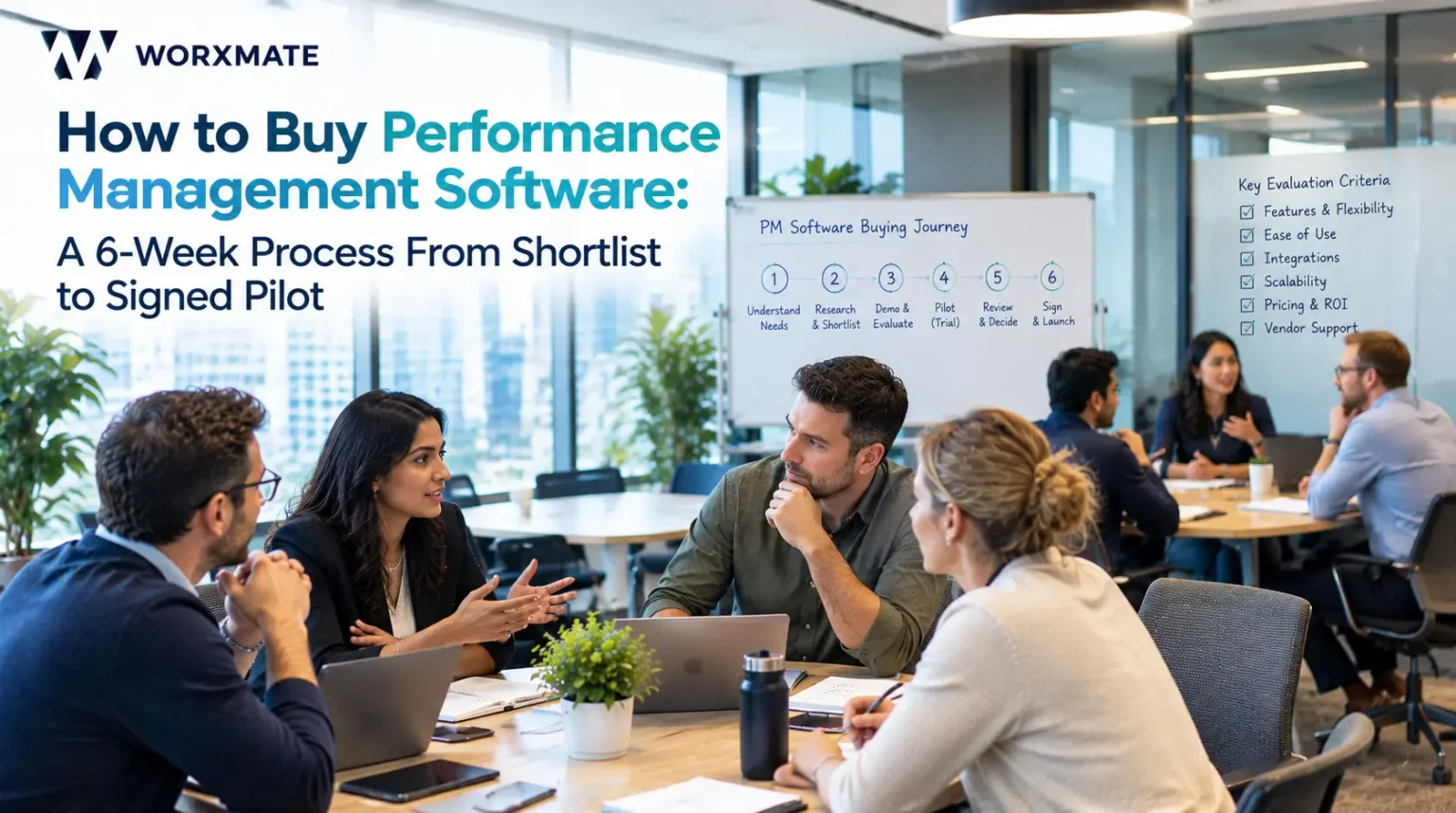
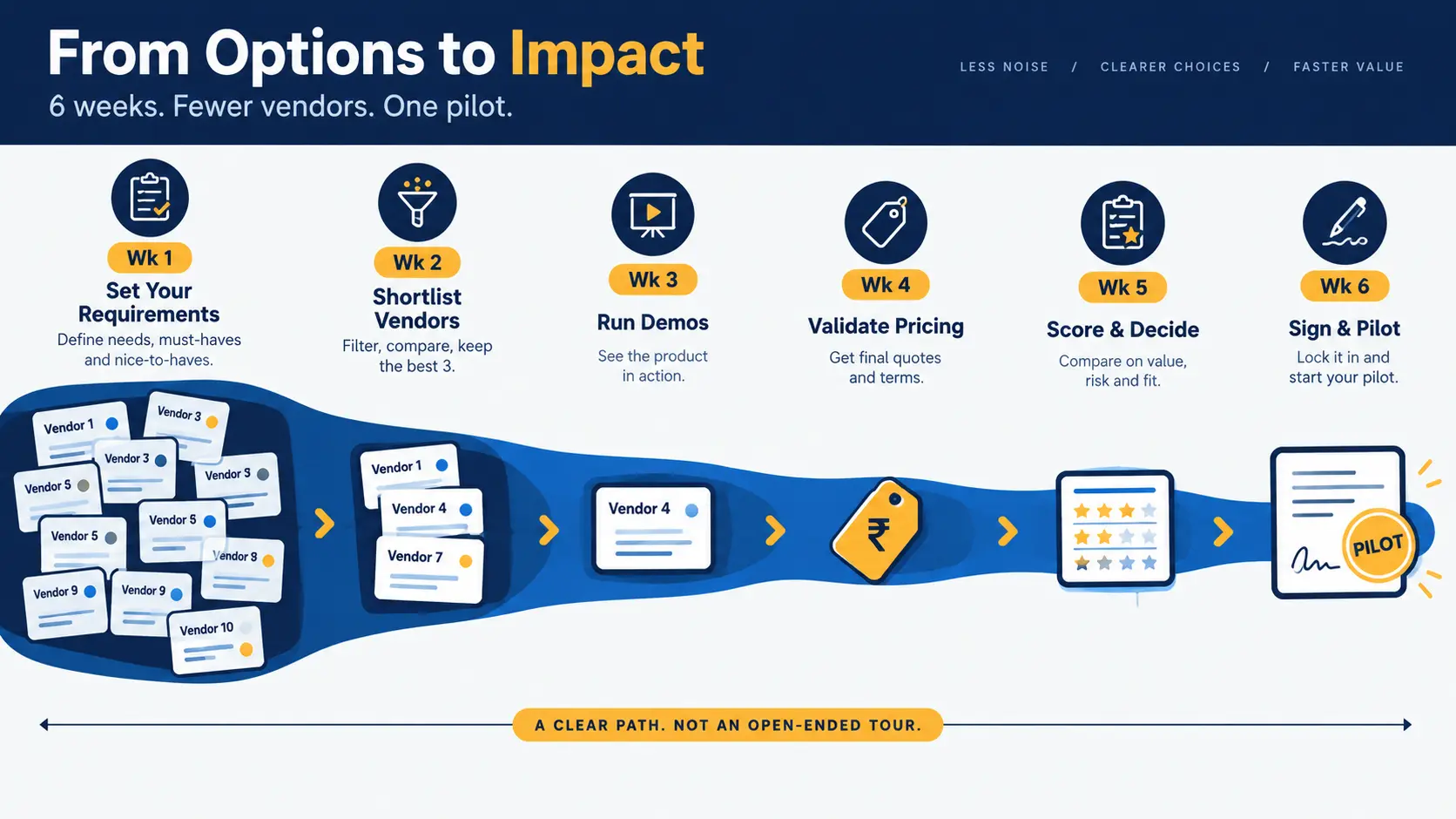
Follow a six-week sequence. In week one, define the problem, the requirements and the buying group. In week two, cut the market down to a shortlist of three vendors. In week three, run scenario-based demos. In week four, compare pricing and total cost of ownership and issue an RFP if you need one. In week five, score the vendors and design the pilot. In week six, negotiate and sign a pilot with written success criteria. The pilot then runs for six to eight weeks before you commit to a full contract.
Picture a conference room at a Middle East energy and utilities company with 8,000+ employees. Around the table sit the Performance Head, the CPO, the HR Head, the OD Head and the Technology Head. Six to eight senior leaders, all sharp, all with strong views. By the end of the first call it was obvious that every one of them had great individual thinking and none of them had collective buy-in. When the conversation turned to analysis, the instinct was to hire a leading consulting firm for a four to eight week exercise. I suggested the opposite: go agile, brainstorm for one week, and agree on the two or three things that would hurt business performance most if left undone.
I think of that table whenever a CHRO asks me how to buy performance management software. The buying process usually fails the same way. Five smart people, five private checklists, and a vendor demo nobody agreed how to judge.
This performance management software buying guide is the six-week version. It is written for HR and Talent leaders in mid-size companies and enterprises, and it ends where most guides stop short: with a signed pilot and success criteria written down before anyone logs in.
I am Maddy, an OKR Coach with 20+ years in strategy execution and 10+ years of OKR implementation. I have coached 50+ organisations and trained 500+ leaders across APAC, the Middle East and Europe. I have watched good platforms fail and average ones succeed, and the buying process explains more of that than the feature list does.
How long does it take to buy performance management software?
Six weeks for a focused buying group, from the first requirements workshop to a signed pilot. Add six to eight weeks for the pilot itself, and plan your performance management software implementation timeline separately after that. In my experience, a selection that drags past ten weeks usually means the group never agreed what problem it was solving.
How to buy performance management software: the 6-week sequence
Use this as your performance management software selection process and your 6 week software buying process for HR. Every week ends with a decision, not a meeting. A performance management software evaluation checklist is only useful if it feeds one of these decisions.
| Week | Focus | Who is in the room | Decision gate |
|---|---|---|---|
| 1 | Define the problem, requirements and buying group | CHRO or Talent Head, HR operations, IT, two line managers | One-page requirements and an agreed definition of success |
| 2 | Build the long list and cut it to a shortlist | HR operations, IT | Three vendors from a long list of eight to ten |
| 3 | Scenario-based demos | Full buying group | A scored demo sheet per vendor |
| 4 | Pricing, total cost of ownership, references, RFP if needed | HR, Finance, Procurement, IT security | Comparable cost model and security answers |
| 5 | Scorecard decision and pilot design | Full buying group | One chosen vendor, pilot scope and success criteria |
| 6 | Negotiate and sign the pilot | HR, Procurement, Legal | Signed pilot agreement with exit terms |
Week one is the week people skip, and it is the week that decides the outcome. If you cannot write the problem in two sentences, no demo will help you. Is it that managers hate the review form? That goals and reviews live in different systems? That calibration is a two-week argument? The answer changes which vendors belong on your list at all, and it is the first step in how to choose performance management software that fits your organisation instead of impressing your committee.
Who should be involved in the buying decision?
Five groups: an executive owner (usually the CHRO or Talent Head), HR operations, IT and security, Finance or procurement, and two or three line managers who will use the system every week. Leave out the managers and you will buy something that looks good in a boardroom and dies in the field.
If you are looking at performance management software for CHROs and Talent Heads, your job is not to run the evaluation. Your job is to make sure it has one owner and one definition of success.
How to get stakeholder buy-in for performance management software is the same exercise I ran in that energy company room. Ask each leader to write down the one problem they expect the software to solve. Put the answers side by side. You will find three or four different problems. Then agree on the two or three that matter most, and write them at the top of the requirements page. That conversation is worth more than any vendor workshop.
There is a trap in who owns it. When HR alone drives the purchase, the rest of the leadership team tends to see the software as one more form to assess people. When the business owns the problem and HR owns the system, adoption follows. I see the ownership decision predict the outcome before a vendor is even chosen.
I also ask one question in week one: was this pushed, or was this chosen? Software announced with a go-live date and a login collapses within a month or two. Not because people resist, but because nobody answered the question every employee asks silently.
A tool cannot answer the question every employee is silently asking: what is in it for me?
Unlock Goal Clarity & Accelerate Employee Growth
Looking to drive goal clarity and employee growth? Discover how Worxmate’s AI-powered Performance Management Software can help.
What should be on a performance management software shortlist?
Three or four vendors that clear your must-haves, fit your company size and region, and connect to the systems you already run. More than four and your demos blur together. Fewer than three and you have no bargaining power on price. That is how to shortlist performance management software without anyone’s favourite vendor deciding for them.
How to choose performance management software without a 40-column spreadsheet
Write your performance management software requirements checklist in three columns: must-have, nice-to-have, never. A good must-have list is short. Mine usually includes configurable review cycles and templates, goals linked to reviews, continuous feedback and one-on-ones, 360 input, calibration support, reporting, security, and integrations with your HRIS, Slack and Microsoft Teams. For the full list of performance management software features to look for, our features checklist for performance management software goes deeper than I will here.
Decide early whether you need a dedicated platform or a module inside your HRIS. They are different categories, and our piece on performance management software vs HRIS explains the trade-off. HRIS suites are excellent HR systems built around HR workflows. A dedicated platform exists for one job, and every product decision serves it.
Then filter by context. Performance management software for mid-size companies needs speed and light administration, and our guide to performance management software by company size covers that. Performance management software for enterprises needs security reviews, role hierarchies and scale, covered in performance management software for enterprise. Performance management software for IT companies has its own goal and review rhythms, which we cover in performance management software for IT. Region matters for compliance and support, so see our pages on performance management software in India and top performance management software in the USA, plus employee appraisal tools for the UK.
For a market-level performance management software comparison and the best performance management software 2026 view, including Worxmate vs Lattice style head-to-heads, start with our best performance management software guide. For head-to-head performance management software vendor comparison, we have pages on Worxmate vs Lattice, Worxmate vs Betterworks and Worxmate vs 15Five, and a broader Worxmate vs competitors view. If Peoplebox is on your list, treat it like any other vendor and run it through the same scorecard below.
Once you have three names, score them on a performance management software evaluation scorecard with weighted criteria. Agree the weights before the first demo, because weights chosen after you have seen a favourite are not weights.
| Criterion | Suggested weight | What to test | Red flag |
|---|---|---|---|
| Fit with your review process | 20% | Configure your real cycle, rating scale and template | Vendor needs a custom project to do it |
| Goals and feedback linkage | 15% | Trace one goal through check-ins to a review | Goals live in a separate module with no link |
| Manager experience | 15% | A manager completes a review while you watch | More than a few clicks per step, or a manual in the middle |
| Calibration and reporting | 15% | Run a rating distribution and drill into one person | Reports need an export to a spreadsheet |
| Integrations and security | 15% | HRIS sync, Slack and Teams, access controls | Vague answers on data residency or SSO |
| AI and insight quality | 10% | Ask what the AI recommends and why | Black-box scores with no explanation |
| Total cost and terms | 10% | Three-year cost under your seat count | Heavy add-on pricing hidden from the proposal |
What questions should you ask vendors in a demo?
Ask them to do the work with your scenarios, not theirs. A vendor demo on sample data tells you how good the sales engineer is. A demo on your own review cycle tells you how good the product is.
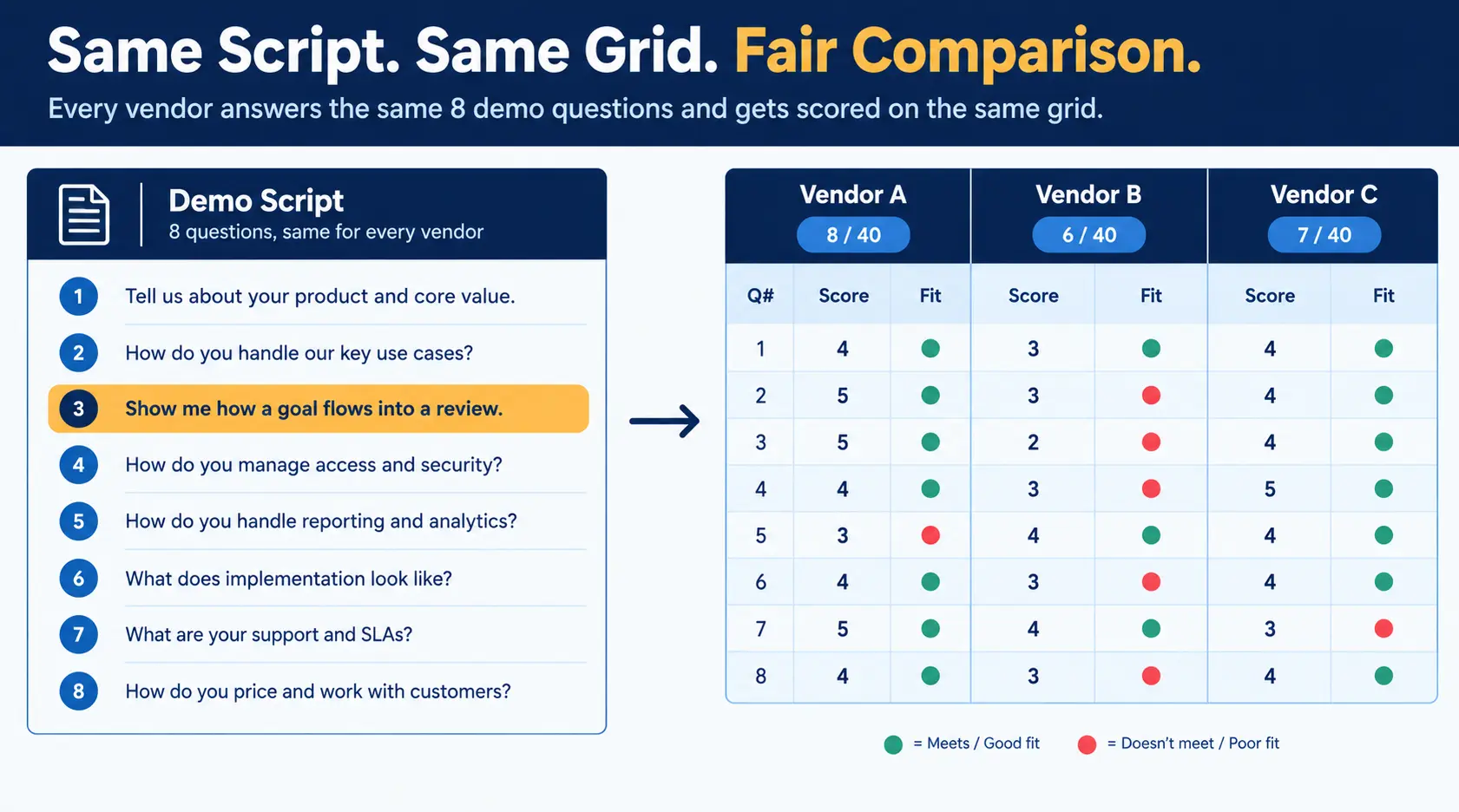
This is how to run a vendor demo for performance management software. A fair performance management software vendor comparison uses one script for everyone. Send the same script to every vendor a week early. Give each 60 to 90 minutes. Score each section immediately, before the next vendor erases your memory. Your performance management software evaluation checklist should have a demo score against every line.
I borrowed the idea from a game I ran at a 70,000-person IT services organisation. I gave leaders real scenarios from their own business and asked them to spot which goals were output-led and which were outcome-driven. They learned more in that hour than in any lecture, because the scenarios were theirs. Do the same to vendors. Ask them to load a goal you wrote badly and see whether the product helps you fix it.
These are the questions to ask performance management software vendors:
- Show me a review cycle configured with our rating scale and approval chain.
- Show me how a goal flows into a check-in and then into a review.
- What does a manager see when they open this at 8 a.m. on a Monday?
- How does calibration work, and how do you surface bias in ratings?
- Which HRIS, Slack and Teams integrations are live today, and which are on a roadmap?
- What does the AI recommend, and can I see the data behind a recommendation?
- What did your last five customers struggle with in the first 30 days?
- How do I get my data out if I leave?
Question seven is the best one. Watch how long the vendor takes to answer it honestly.
Do you need a performance management software RFP?
Most mid-size companies do not need a performance management software RFP. A tight demo script and a scorecard do the same job in less time. Enterprises with formal procurement usually do need one, and the RFP should be short.
A performance management software RFP template needs six sections: business context and the two or three problems to solve, mandatory requirements, scenario questions, security and compliance, pricing in a fixed format so vendors are comparable, and references. Keep it under ten pages. A long RFP does not produce better answers. It produces longer ones.
What should AI performance management software prove before you buy?
Among the performance management software features to look for in 2026, AI is the one most often oversold. It should prove that its recommendations are explainable, that they improve fairness or quality, and that they stay out of the manager’s way. In 2026 nearly every vendor claims AI. Few can show their reasoning.
When you assess AI performance management software, ask what the model sees, what it recommends and who can override it. Our guides on AI-driven performance management software and AI in performance management systems lay out the questions in detail.
This is how I read Worxmate through that lens. Orbit AI is our people intelligence model, and part of how we approach employee performance intelligence. Its Third Eye feature exists to remove bias and conflict from the rating cycle by recommending fair, data-driven ratings. Axis AI covers business performance intelligence, and Nexus AI covers the organisational picture.
The DEEP AI framework gives you four evaluation questions that work for any vendor, not just ours. Define: does the software help people write better goals? Execute: do check-ins and at-risk signals run on their own? Evaluate: are reviews backed by data? Plan: does learning carry into the next cycle, including IDP and PIP decisions for top and low performers? Our pages on Define, Execute, Evaluate and Plan show how we answer them.
Separate the AI that helps from the AI that decorates
AI for HR walks through where AI genuinely improves performance decisions and where it adds noise. Read it before your vendor demos.
How do you structure a performance management software pilot?
Pick one business unit of roughly 50 to 150 people, run it for six to eight weeks on a real piece of your cycle, and write the pass or fail criteria before the pilot starts. This is how to run a performance management software pilot without it turning into an extended free trial.
A proof of concept and a pilot are different. A performance management software proof of concept tests technical fit with test data: does the HRIS sync, does single sign-on work, can the reporting do what you need. A pilot tests adoption with real managers and real employees. Do the proof of concept first, and keep it short. A performance management software pilot is also your best negotiating asset, because a vendor who wants the full contract will make the pilot easy. Start your performance management software implementation timeline only after the pilot passes.
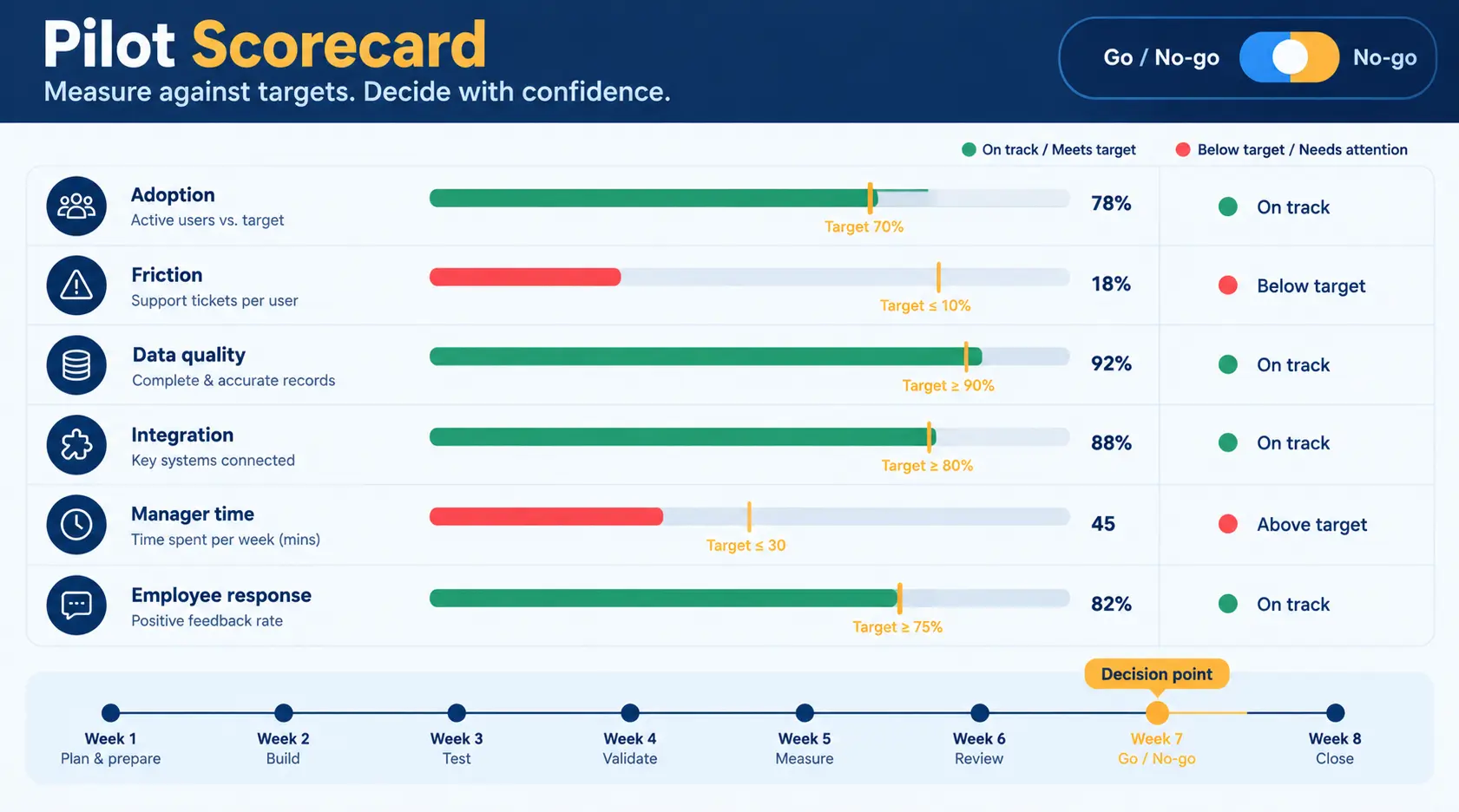
Performance management software pilot success criteria should be numbers and observations, agreed in week five and signed into the pilot agreement in week six.
| Criterion | What to measure | Pass signal | Warning sign |
|---|---|---|---|
| Adoption | Share of pilot managers using it weekly | Most managers active without reminders | Usage needs HR chasing |
| Friction | Support queries per day in the first week | A handful, trending down | 15 to 20 queries a day |
| Data quality | Quality of goals and check-ins entered | Goals read as outcomes, check-ins have real blockers | Goals copied from last year, empty check-ins |
| Integration | HRIS and messaging sync accuracy | No manual fixes after week one | Weekly data clean-ups |
| Manager time | Time to complete a review | Less than the old process | More than the old process |
| Employee response | Short pulse question after the pilot | People can explain what the tool is for | People call it the new form |
The friction row is the one I trust most. If a team raises 15 to 20 product queries a day in week one, adoption will break within weeks. That is not a vendor support problem. It means the tool and the team are mismatched, and no customer success call fixes a mismatch.
One more pilot rule: coach the managers. When training ends with HR, managers fall off what I call the Coaching Cliff, and your pilot dies there, not in the software. Our guide on performance management software for managers and a read of how performance management software reduces manager workload will help you set the right expectations.
Know where your performance system leaks before you pilot a new one
The Organization Performance Audit shows where goals, feedback and ratings are disconnected today, so your pilot tests the right problems.
What does performance management software typically cost per user?
Published 2026 buyer guides put most platforms between about $3 and $30 or more per employee per month, with core review modules at the low end and AI, analytics, integrations and support tiers pushing the number up. Capterra’s category page lists basic systems for up to 99 users at roughly $4 to $1,089 a month in total. Treat any single figure as a starting point, not a quote, when estimating your expected performance management software cost.
How to compare performance management software pricing
Performance management software pricing is only comparable if you compare like for like. Ask every vendor the same questions: is pricing per employee, per manager or per active user; what is the minimum seat count; which features are add-ons; what do implementation, integration and support cost; how long is the term; and what is the renewal cap. Our pages on performance management software pricing and SaaS performance management pricing explain the common models.
Then work out performance management software total cost of ownership over three years. Count the licence, implementation, integrations, internal admin time, manager training, add-ons and the cost of switching if it goes wrong. Cheap licences with heavy add-ons are a classic trap. Our article on performance management software ROI shows how to frame the business case for Finance.
Performance management software contract negotiation tips
- Sign the pilot first, and ask for the pilot fee to be credited against the full contract.
- Cap annual renewal increases in writing.
- Fix per-seat pricing for the seat growth you expect, not just today’s headcount.
- Get data export and deletion terms into the contract.
- Ask for service levels with consequences, not only targets.
- Keep an exit clause for the first year.
Switching performance management software checklist
If you are replacing an existing platform, add four things to the plan: export your historical ratings, goals and feedback before notice dates; align the switch to the gap between cycles, not the middle of one; keep your rating scale stable for one cycle so trends stay comparable; and retrain managers, because they are the ones who feel the change. Organisations that keep switching platforms are usually looking for a shortcut that does not exist. The transition to better performance practice takes more than one cycle, whatever the software. Our guide to performance management system implementation covers what comes after you sign.
What I’d Tell a Client
Six weeks, one buying group, one scorecard, one pilot with numbers written in advance. That is how to buy performance management software without regret, and how to choose performance management software you will still be using in year two. None of it is clever. All of it is rare.
If you are ready to look at tools, start with our best performance management software guide, check pricing, and book a demo. If your goals sit at the heart of the review problem, see OKR software. If your leaders and managers are the real gap, our OKR consulting builds the capability underneath.
The software is the infrastructure. The coaching is the capability. You need both, and in the right order.


Written by
An OKR Coach with 20+ years of implementation experience, Madhusudan has guided over 50 organisations through successful OKR transformations, training more than 500 leaders. Learn more about Worxmate.