 WORXMATE
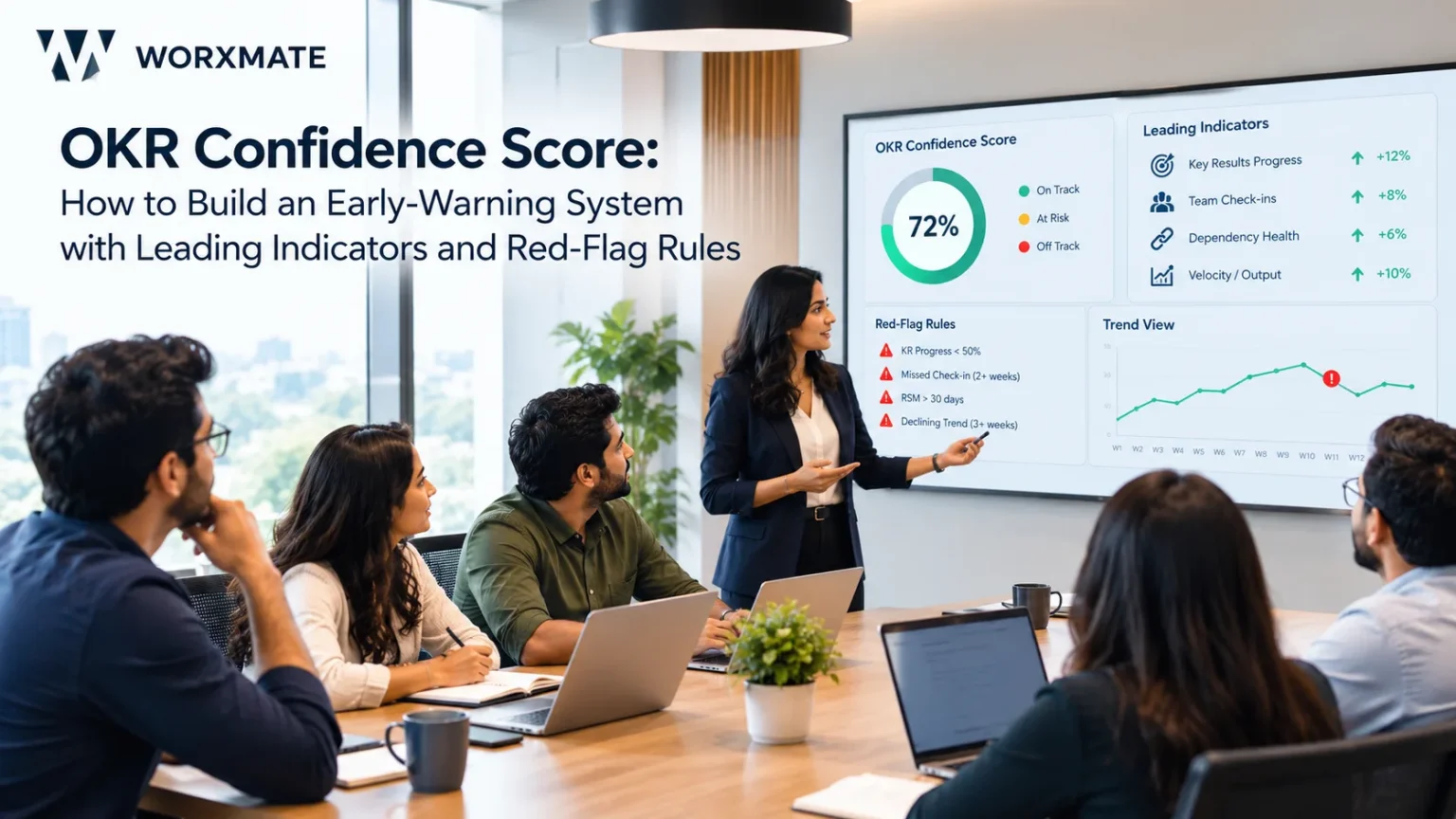
What Is an OKR Confidence Score?
An OKR confidence score is the key result owner’s weekly forecast, usually on a 1 to 10 scale, of how likely that key result is to hit its target by the end of the cycle. Progress shows what has already happened. The confidence score shows what the owner believes will happen next. Start each cycle near 5, update the score in every weekly check-in with one line of evidence, and add red-flag rules: a score below 5 after week four, a drop of two points in a week, or progress and confidence pulling in opposite directions. The score, the leading indicators beneath it and those rules together form an OKR early warning system.
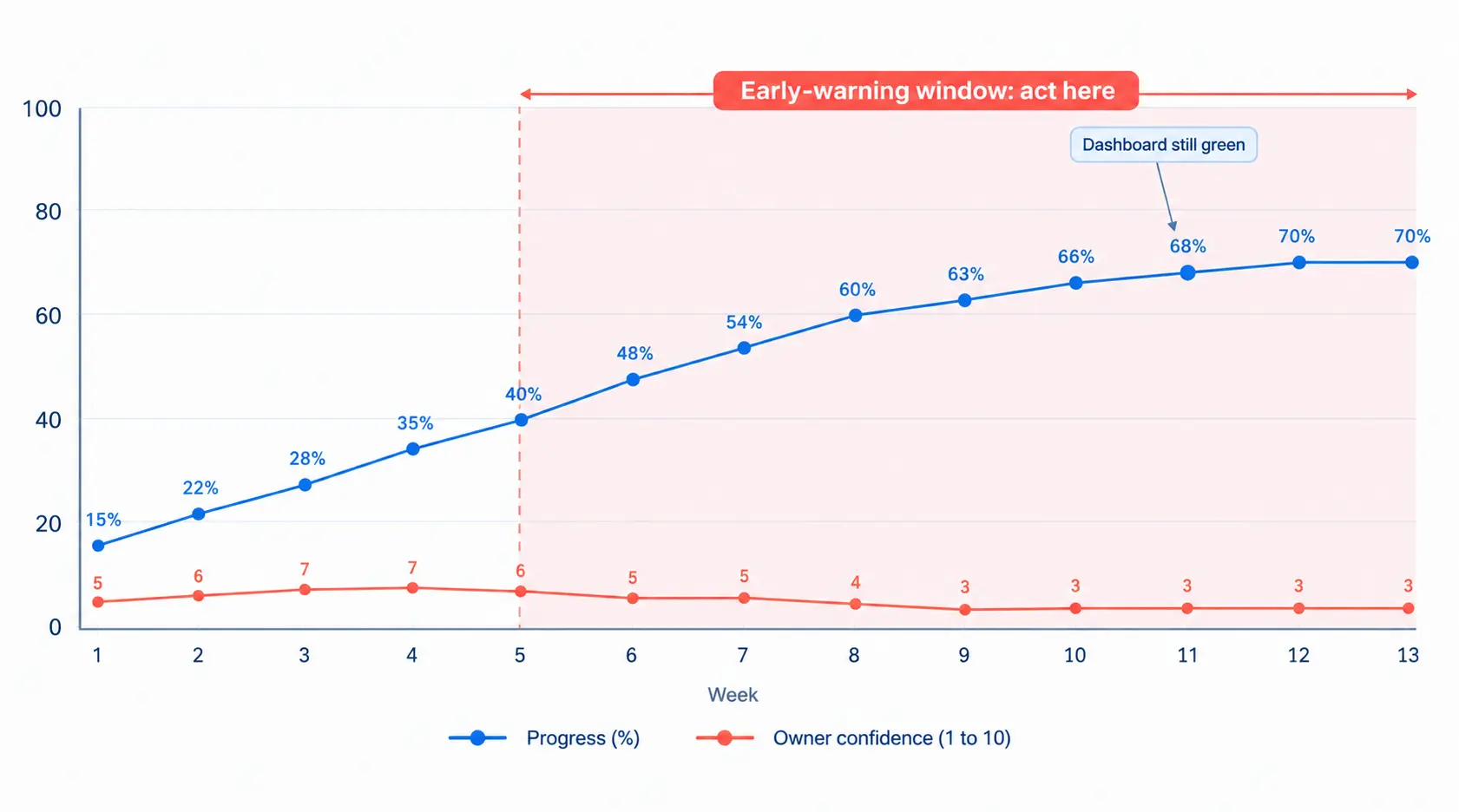
It is week eleven of a thirteen-week quarter. The key result has been green since week two. Then, at the end of the monthly business review, the owner says quietly, “I don’t think we’re going to make this one.”
Nobody on the team is surprised. The one person who is surprised is the BU head, who has been reading a dashboard that said the opposite for nine weeks.
That gap between what the tracker shows and what the owner believes is the most expensive gap in any OKR program, and it is the gap an OKR confidence score exists to close. Progress is a lagging number. It is entered after the work happens. An owner’s confidence is the only field in your system that looks forward, which makes it the only field that can warn you in time.
Most programs collect a green, amber or red dot nobody has defined, and by week six it is decoration. This guide turns the OKR confidence score into an early-warning system: a scale, a formula, leading indicators and seven red-flag rules.
Who is writing this. I’m Maddy, Co-Founder and CEO of Worxmate. I have spent 20+ years in strategy execution and 10+ years implementing OKRs, coaching 50+ organisations and training 500+ leaders across pharma, fintech, manufacturing, retail, IT services, telecom and energy. The pattern I see consistently: teams do not fail because they miss a key result. They fail because nobody said out loud, early enough, that they were going to miss it.
Why the OKR Confidence Score Is the Most Honest Number in Your Check-In
Walk into any quarterly review and ask who knew in week five that a key result was in trouble. Hands go up all around the room: the owner, the owner’s manager, two people from the dependent team. Now ask who told the leadership team. The hands come down.
That is the real execution problem, and it is a visibility problem rather than an effort problem. The work was happening. The warning was not travelling. The strategy execution gap rarely opens in the plan. It opens in the weeks between a person sensing risk and the organisation acting on it.
OKR confidence tracking closes that gap because it looks forward (progress says 40%, confidence says whether 40% in week seven is enough), it belongs to the person closest to the work, and it costs one number and one line of evidence inside the weekly OKR check-in you already run.
A confidence score nobody trusts is worse than none. Trust comes from definitions. If a “7” means optimism to one owner and a hedge to another, your portfolio view is noise. So everything below starts with a shared scale, then a formula, then rules.
Achieve Your Goals Faster
See how Worxmate can help your team set clear goals and achieve faster results. Book your free demo today and experience the power of AI-driven OKRs in action.
OKR Confidence vs Progress vs OKR Score: Three Numbers, Three Jobs
Teams mix these up constantly, so separate them first.
| Signal | Question it answers | When it is set | Who sets it | Typical failure |
|---|---|---|---|---|
| Progress | How much of the target is done? | Every update, from the metric | Calculated from data | Looks fine until the last week |
| Confidence | Will we hit it by cycle end? | Every weekly check-in | The key result owner | Inflated to avoid an awkward conversation |
| Final OKR score | How did we do? | End of cycle | Owner and manager at review | Graded generously, never compared with earlier confidence |
OKR confidence vs progress is where the information sits: 60% progress with a confidence of 9 is nearly there, while the same 60% with a confidence of 3 is a problem the bar is hiding.
OKR confidence vs OKR score is not a debate, because they are two readings of the same key result at different moments. The OKR scoring 0.7 convention, where 0.7 on an ambitious key result counts as a strong result, tells you how to grade at the end. It says nothing about week six. I have covered grading in the OKR scoring system guide and the Google OKR grading scale, and automation in automated OKR scoring. This article stays on the forecast.
At final review, set the week six OKR confidence score next to the actual result. That gap is your team’s forecasting accuracy, and almost nobody measures it.
The OKR Confidence Score Scale: From 1 to 10, With an Action Attached to Every Band
The OKR confidence score 1 to 10 scale beats percentages for one reason: people argue about 63% versus 67% for ten minutes, and nobody argues for long about a 6 versus a 7. High, medium and low OKR confidence levels are simpler still, and fine for a small team. The number is the OKR confidence rating. The colour is the OKR traffic light status you roll up for executives. Keep both, and define them once.
Most tools ship with on track at risk off track OKR labels. These OKR status indicators only work if each is tied to a number and each number to an action.
| Score | Status | What the owner is really saying | Required response |
|---|---|---|---|
| 9 to 10 | On track (green) | “I can see the path and the risks are small.” | None. If a 10 appears in week two, ask for the evidence. |
| 7 to 8 | On track (green) | “Achievable, with a few things to watch.” | Owner names the top risk in the note. |
| 5 to 6 | At risk (amber) | “Could go either way.” | Manager joins the next check-in. Owner proposes one recovery action. |
| 3 to 4 | At risk, escalate (red) | “We are more likely to miss than hit.” | Decision within 48 hours: recover, re-scope or drop. |
| 1 to 2 | Off track (red) | “Without a change of plan, this will not happen.” | Leadership review. Reset or retire. |
What is a good OKR confidence score?
It depends on the week. A healthy portfolio shows a spread of 5s to 9s. If every key result sits at 9 or 10 by week three, I do not believe the numbers.
What does 70% confidence mean in OKR?
It is a probability statement, not a mood: the owner expects to hit the target in seven of ten comparable situations and can name the risk behind the other three. A 70% with no named risk is usually a 5 wearing a better suit.
What should OKR confidence be at the start of a quarter?
Around 5 for a stretch key result, 7 or higher for a committed one. If you have not separated the two types, read aspirational vs committed OKRs first.
How to Calculate OKR Confidence Score (and Net Confidence Score)
At key result level there is no formula. The owner picks a number from 1 to 10 against the scale above. The calculation starts at the objective level and again at the portfolio level, and the OKR confidence score formula is deliberately simple:
Objective confidence = (KR1 weight × KR1 confidence) + (KR2 weight × KR2 confidence) + …
Net confidence score = % of key results on track − % of key results off track
Here is an OKR confidence score example for a single objective. The key results are illustrative.
| Key result | Weight | Progress | Confidence | Weighted |
|---|---|---|---|---|
| KR1: Raise renewal rate | 40% | 55% | 8 | 3.2 |
| KR2: Cut onboarding time | 30% | 20% | 4 | 1.2 |
| KR3: Launch partner programme | 30% | 70% | 7 | 2.1 |
| Objective | 100% | n/a | 6.5 | 6.5 |
The objective reads 6.5, amber, and looks harmless. The 4 hiding inside it is the problem. So report the average and the lowest key result together, and never let an objective turn green while any key result carrying 30% or more of the weight sits at 4 or below.
At portfolio level, the net confidence score OKR teams borrow from the NPS idea works well, and Tability popularised it. If 12 of 20 key results are on track, 5 are at risk and 3 are off track, the net confidence score is 60% minus 15%, which gives 45. One number for the leadership team, and a clear direction of travel when you plot it weekly.
Is your check-in discipline mature enough to trust a confidence score?
A confidence field is only as honest as the habits behind it. The OKR Execution Maturity Framework shows where your teams really sit before you add another column to the template.
OKR Leading Indicators: The Layer Under the Confidence Score
A confidence score without evidence is an opinion. A dashboard of leading indicators without a confidence score is a report nobody reads. The early-warning system needs both.
I saw the difference in a multi-billion dollar mining engineering group, in their Middle East and Europe division. New entrants were eating into market share and the leadership team had not registered the threat. The turning point was a connection they had never made: on-time service delivery and machine quality were directly lifting sales, renewals and regional expansion. They already tracked the lagging numbers. What changed was that they began to see blockers before they became crises.
A KPI tells you where you stand, not what to change. If that distinction is still fuzzy for your leadership team, start with OKR vs KPI and the difference between output and outcome.
The practical version is two steps per key result:
- Name the lagging result. For renewals, that is the renewal rate itself.
- Name one or two OKR leading indicators the owner can influence every week. For renewals, that might be on-time service delivery and open quality escalations. See leading indicators and lagging indicators for how to choose them.
The owner’s key result confidence is then a judgment about what those indicators are saying. When the indicator moves the wrong way and confidence does not, you have found your first red flag without waiting for the lagging number to confirm it.
Combine the three signals, confidence, indicator trend and check-in freshness, and you get an OKR health score for each objective. I walk through building one in how to create OKR health indicators, and the measures that feed it in OKR tracking metrics. Once you hold three or four weeks of confidence and indicator history, OKR forecasting stops being a guess. It is the same logic behind predictive performance management, applied to goals instead of people.
Achieve Your Goals Faster
See how Worxmate can help your team set clear goals and achieve faster results. Book your free demo today and experience the power of AI-driven OKRs in action.
The OKR Early Warning System: 7 Red-Flag Rules That Catch At-Risk OKRs
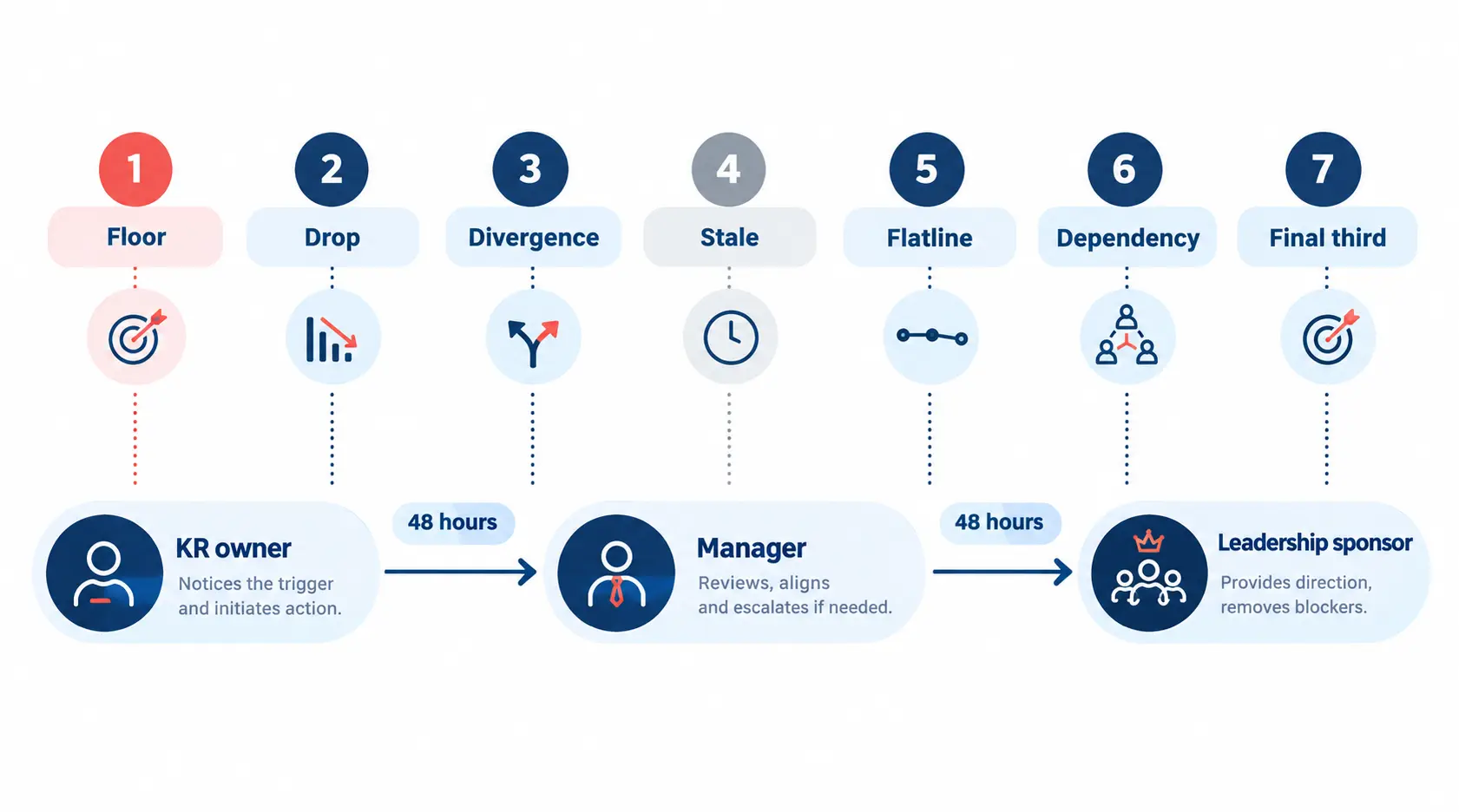
A rule beats a reminder. Reminders depend on someone remembering. Rules fire the same way every week, regardless of who is on leave. These seven rules cover the OKR red flags I see most often, and each one has an owner and a response window, because a flag without a person attached is just a colour.
| # | Rule | Trigger | Who acts | Response window |
|---|---|---|---|---|
| 1 | Floor | Confidence of 4 or lower after week 4 | Owner and manager | Recovery plan in 48 hours |
| 2 | Drop | Confidence falls 2 or more points in one week | Owner | Cause written in that check-in |
| 3 | Divergence | Progress on plan but confidence 5 or lower, or progress behind plan but confidence 8 or higher | Manager | Challenge conversation at next check-in |
| 4 | Stale | No confidence update for two weeks | Manager | Status turns grey, update within 3 days |
| 5 | Flatline | Same score four weeks running with no new evidence | Manager | Evidence note required |
| 6 | Dependency | Risk caused by another team’s output | Both owners | Joint review in 48 hours |
| 7 | Final third | Confidence below 6 in the last third of the cycle | Leadership sponsor | Decide: recover, re-scope or retire |
Together these seven rules are the working core of your OKR early warning system, reading from the OKR confidence score and the OKR leading indicators beneath it. Rule 2 is the one that earns its keep. Whenever a confidence score drops two points OKR owners must write the reason in the same check-in, even if progress is still moving. A drop with no explanation is a risk nobody has named yet.
Rule 6 is where cross-functional work succeeds or fails. At a European fintech startup of around 100 people, I had the Product Lead co-own one key result with the Account Executive, jointly accountable for demo experience leading to conversion. It forced a dependency conversation nobody had had. You cannot set alignment in a tool; you can only display it once it exists, and the dependency rule is how you notice when it does not. See OKR alignment.
Rule 7 is a decision rule, not a scolding rule. By the last third of a cycle you have three honest options, and drifting is not one of them. Adjusting OKRs: when and how to pivot lays out how to re-scope without rewriting history.
How to flag at risk key results early
Do not wait for progress to turn red. Rules 1, 2 and 3 catch at risk OKRs while there is still time to change the plan. OKR risk tracking at portfolio level is then a count of which rules are tripping this week.
OKR escalation rules: keep them narrow
Escalate one rung at a time: owner, manager, leadership sponsor. The point of OKR escalation rules is faster decisions, not closer supervision, and managers who audit every score will meet the dangers of micromanaging through OKRs. Good OKR risk management means the rule fires, one conversation happens and a decision gets made.
How to Read OKR Confidence Trend in Your Weekly Check-Ins
How often should you update OKR confidence?
Weekly. Daily turns it into noise, and monthly turns it into history. Weekly OKR check-in confidence updates fit inside a fifteen-minute conversation, which is why they survive past week six. If you need a structure for that conversation, the OKR check-in meeting template gives you one.
Who sets OKR confidence score?
The key result owner, always. The manager can challenge a score and ask what would move it up two points, but never overwrites it. The moment a manager edits an owner’s number, you are measuring the manager’s anxiety instead of the owner’s judgment.
How to read OKR confidence trend
Read the OKR confidence score as a trend, not a snapshot. The shape tells you more than any single week:
- Staircase down: steady erosion, usually a dependency or a capacity problem nobody has named.
- Saw-tooth, swings of three points or more: the metric is unclear, or the owner is staging heroic recoveries.
- Flat and high for six weeks: either a genuinely healthy key result or an owner who has stopped looking. Ask for the evidence.
- V-shaped recovery: the pattern to celebrate. Someone saw the risk, acted, and moved the number.
Where in your organisation do warning signals get stuck?
If owners sense risk in week five and leadership hears about it in week twelve, the problem is in the path between them. The Organization Performance Audit helps you find exactly where.
How to Stop Teams Gaming OKR Confidence Scores
Two behaviours wreck confidence data. The first is the OKR watermelon status: green on the outside, red on the inside. The owner reports green because red invites questions. The second is OKR sandbagging confidence: writing a modest key result, or reporting a modest score, so that any outcome looks like a win.
Both share a root that is rarely named: a silent fear that missing an ambitious outcome will be read as poor performance. Nobody says it in the workshop. It shows up as safe key results and carefully optimistic scores. It is also why OKRs owned by HR drift toward appraisal, while OKRs owned by the CEO’s office become an execution engine.
If you want honest scores, how to stop teams gaming OKR confidence scores comes down to five countermeasures:
- Divorce confidence from appraisal. State it in the first session: an OKR program is a transformational journey, not a performance assessment. Missing a stretch goal in cycle one is learning.
- Make early red a good thing. Thank the first person who goes red in a cycle, publicly. Do it once and the culture shifts.
- Require an evidence note with every score. No note, no score.
- Calibrate at the retrospective. Compare week six confidence with the final result in your OKR retrospective. Owners learn their own bias quickly when they see it.
- Separate stretch from committed. Different goals deserve different starting confidence, which is the whole point of OKR stretch goals.
One completed OKR is worth more than five written ones.
In a Middle East energy and utilities organisation of 8,000+ employees, what leaders gained within two to three quarters was the confidence to call out exactly what was not working and why. An honest low score is that, said early.
One more caution. In a first cycle many leaders cannot yet write an outcome-driven key result, so there is little real to forecast. The Execution Maturity Rate, the share of leaders who can independently write an outcome-driven goal, sits at 5% to 15% in a typical first cycle and 30% to 40% after twelve months of coaching. Scores get more honest as it rises. Read why OKRs fail before blaming the team.
Scores drifting back to green? Check the pitfalls first.
Most inflated confidence scores trace back to a handful of implementation mistakes. This ebook walks through the common pitfalls of implementing OKRs and how to avoid each one.
OKR Confidence Score Template, Google Sheets, Excel and Jira
Start with the smallest possible OKR confidence score template. Seven columns are enough: key result, owner, progress, confidence (1 to 10), last week’s confidence, days since last update, and an evidence note.
For an OKR confidence score in Google Sheets or an OKR confidence score in Excel, one formula turns three of the rules into a flag. With the current cycle week in K1, progress in C, confidence in D, last week’s confidence in E and days since update in F:
=IF(OR(AND($K$1>=4, D2<=4), D2-E2<=-2, F2>14), “Red flag”, “OK”)
That covers the floor, drop and stale rules for one team in a quarter. It is also where a spreadsheet starts to strain: the dependency rule needs two owners to see the same row, and the stale rule needs somebody to look. I compare the trade-offs in OKR tracking spreadsheet and spreadsheet vs OKR software.
For an OKR confidence score in Jira, pull epic progress and blocked tickets in as leading indicators and keep confidence a human field, because a ticket count cannot tell you whether the owner believes in the plan. How to connect OKRs to Jira covers the setup.
For an OKR confidence score for startups, keep it smaller still: three objectives, three key results each and founders reading every note. OKR grading for startups covers the end-of-cycle review.
From Spreadsheet to a Continuous OKR Tracking Tool: Where DEEP AI Fits
A spreadsheet carries one team through a quarter. Beyond that, you need OKR tracker software that fires OKR alerts when a rule trips and an OKR dashboard that shows confidence trend beside progress. A continuous OKR tracking tool should do three things: capture confidence at the moment of the check-in, fire the red-flag rules without a human remembering, and keep the confidence history for the retrospective. If you are building the case internally, real-time OKR tracking, real-time OKR dashboards and OKR tracking tools cover each piece. Dedicated OKR software exists because OKRs are the feature, not one module inside an HR suite, and that difference decides whether the rules actually fire.
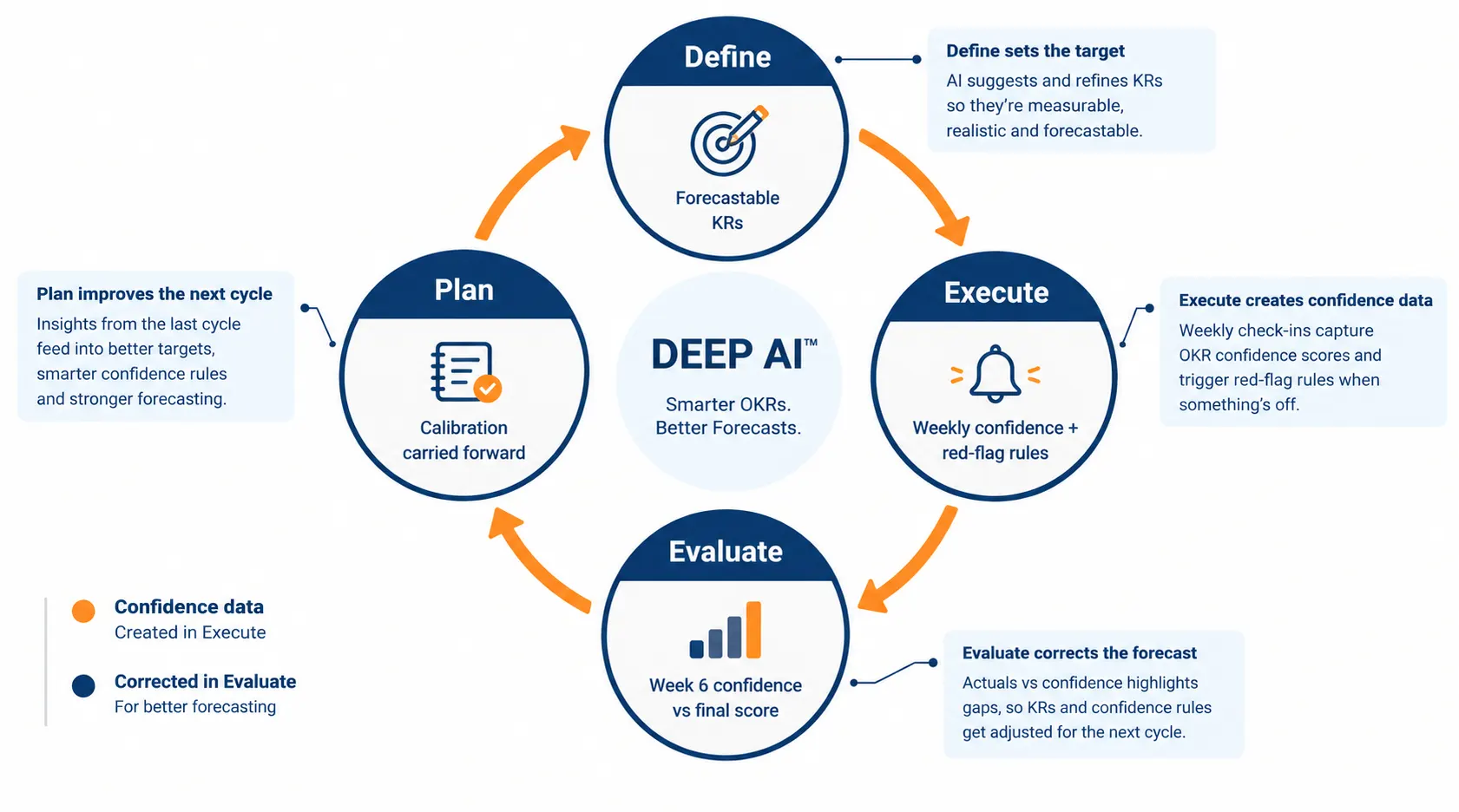
We built the DEEP AI™ framework from ten years of live implementations: Define, Execute, Evaluate, Plan. Here is where each stage touches the early-warning system.
| Stage | Job in the early-warning system | What breaks without it |
|---|---|---|
| Define | AI-assisted goal writing and quality scoring, so each key result can be honestly rated | Output-list key results nobody can forecast |
| Execute | Automated check-ins and at-risk detection | The rules depend on someone remembering |
| Evaluate | Data-backed retrospectives that compare confidence with outcomes | The same forecasting errors repeat next quarter |
| Plan | Cycle-over-cycle organisational learning | Every quarter starts from zero |
Without that loop, the OKR confidence score is just a number. With it, the OKR confidence score becomes a forecast the whole organisation can act on. Three intelligence layers sit on top of that. Axis AI is business performance intelligence: the view that shows leadership where risk is concentrating across objectives. Orbit AI is people intelligence, which turns a pattern like one owner who is always optimistic into a coaching conversation instead of an appraisal rating, and connects naturally to your performance management software. Nexus AI is organisational intelligence, where the dependency rule’s cross-team patterns become visible at company scale.
My Take: Start With One Rule This Week
If you have no OKR confidence score field today, do not roll out seven rules at once. Add the field, write the scale into the template and switch on the drop and stale rules first. At the retrospective, compare week six scores with results. That comparison teaches your leaders more about forecasting than any workshop.
The software is the infrastructure. The coaching is the capability. You need both, and in the right order.
Path 1: the platform. If you are ready to evaluate, look for an OKR dashboard that shows OKR confidence tracking beside progress, and start with dedicated OKR software, look at pricing or book a demo.
Path 2: the consulting. If your leaders cannot yet tell an output from an outcome, no field will fix that. OKR consulting builds that capability in the managers who run the check-ins, not just in the C-suite, so the program does not fall off the Coaching Cliff after the first quarter.


Written by
An OKR Coach with 20+ years of implementation experience, Madhusudan has guided over 50 organisations through successful OKR transformations, training more than 500 leaders. Learn more about Worxmate.