 WORXMATE
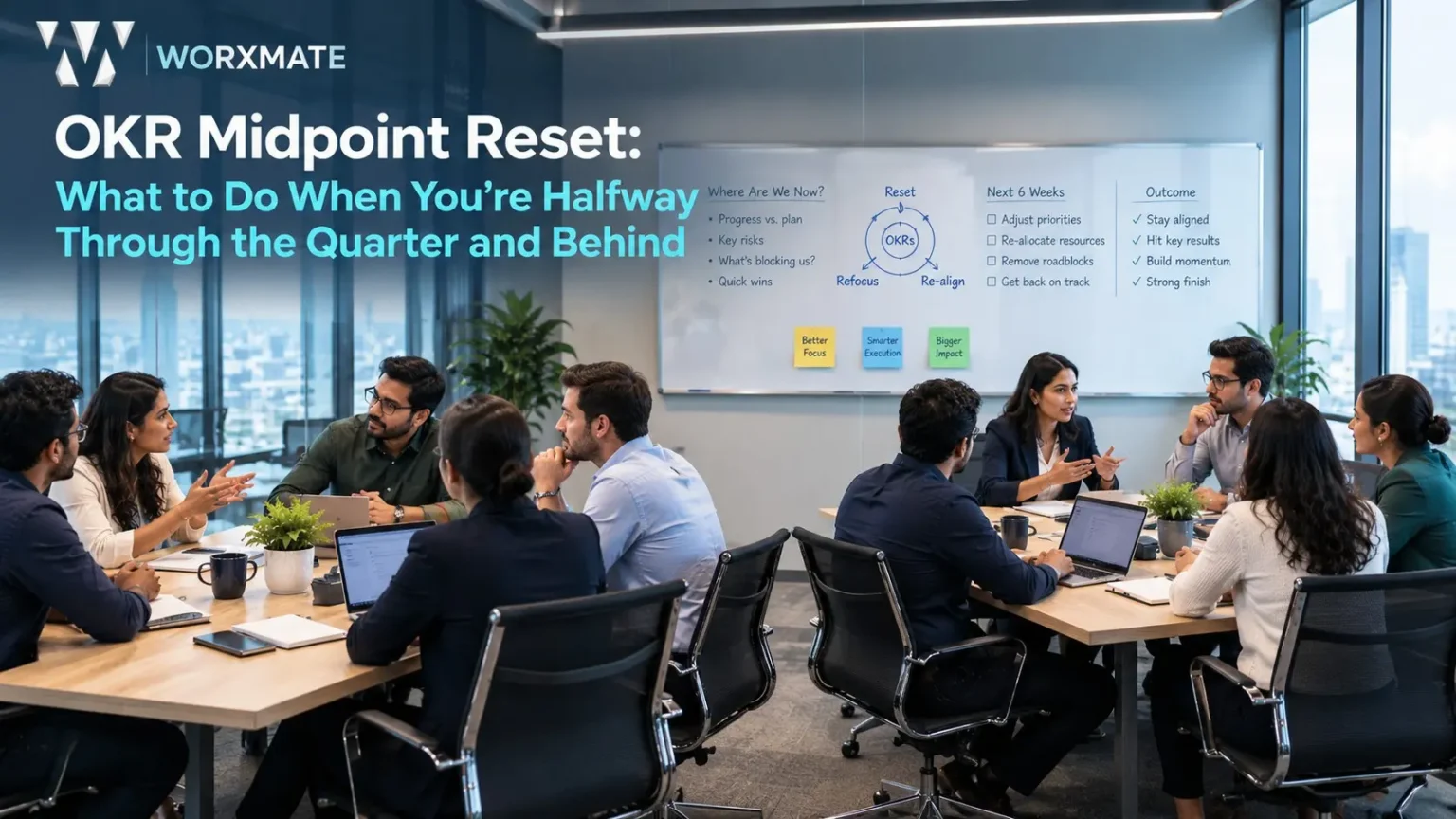
An OKR mid-quarter review is a 30–45 minute meeting held around week six or seven where a team scores every key result, compares progress against confidence, and makes one of four calls on each OKR: keep it, rescue it, rescope it, or drop it. Run it as a decision meeting, not a status update. Done well, it turns a quarter you are behind on into a recoverable one while six weeks are still left to act.
It is week seven. Three of your five key results are sitting at 0.2. Nobody has raised it, because every weekly check-in has ended the same way: a green dot, a shrug and a promise to push harder. Your quarterly review is six weeks away, and everyone in the room already suspects how it will go.
That is the moment an OKR mid-quarter review exists for. It is also the meeting most teams skip, because the calendar says nothing is due. In my experience across 50+ implementations, the quarters that get saved are saved here, at the midpoint. The quarters that get written off in the retrospective were usually lost at this exact point, when nobody made a decision.
“A quarter is rarely lost in week twelve. It is lost in week seven, when everyone can see the problem and nobody calls it.”
This guide is for CEOs, BU heads and Strategy leads who are behind on OKRs mid-quarter and want a clean way to reset, without panic, without rewriting everything, and without losing credibility with the team.
Why the OKR Mid-Quarter Review Is the Most Skipped Meeting in the Cycle
Teams skip it for a simple reason. Weekly check-ins feel like they already cover it, and the quarterly review feels far away. So the midpoint passes like any other Tuesday.
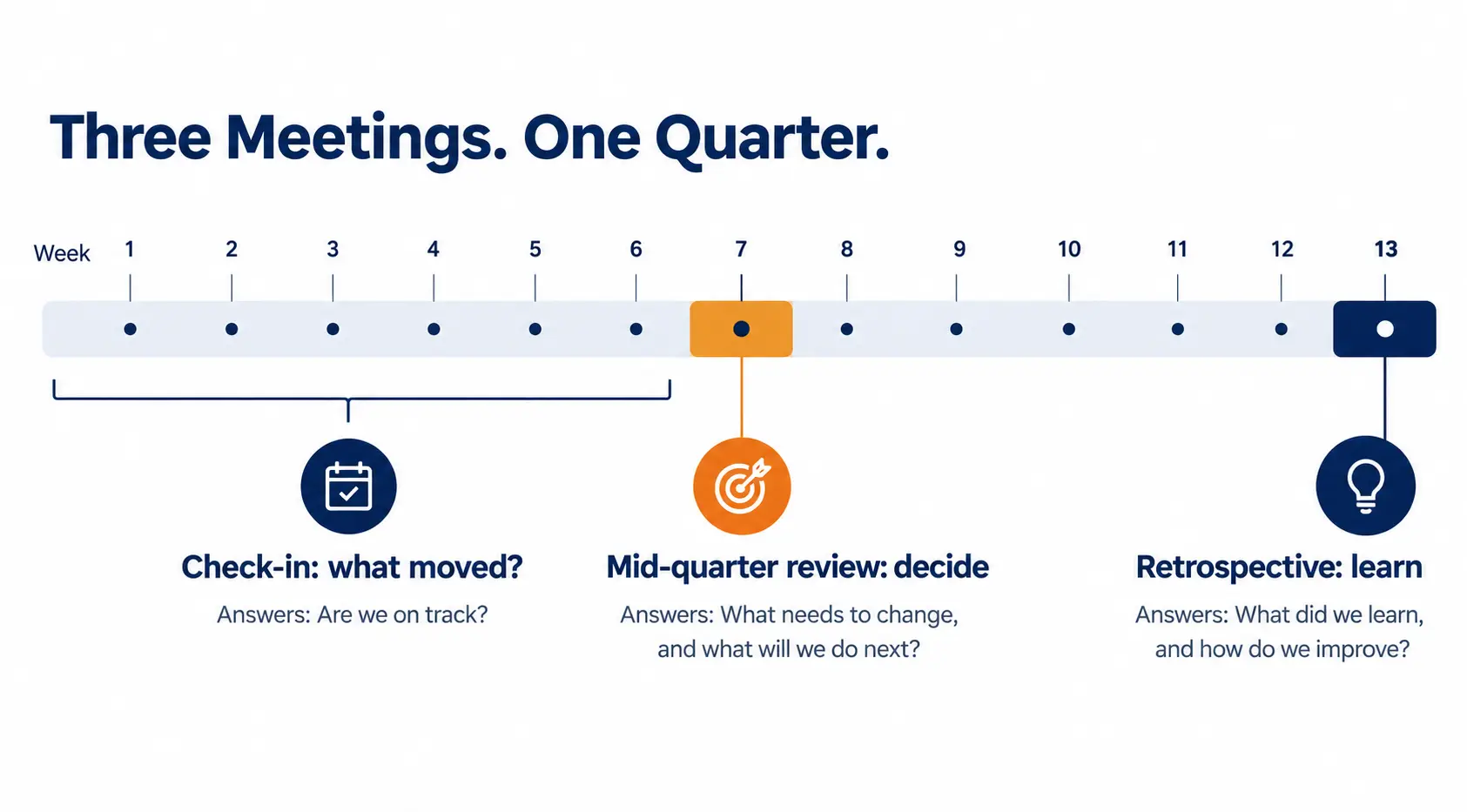
The okr mid-quarter review vs weekly check-in difference is simple. A check-in asks, “What moved this week?” A midpoint review, which some teams call an okr midpoint review or an okr mid-cycle review, asks, “Given what we now know, is this still the right plan for the next six weeks?” If your OKR check-ins are your only checkpoint, you have an okr check-in cadence with no decision point inside it, and no okr mid quarter check-in where anyone is allowed to change the plan. This matters most in a 13-week cycle, which is why quarterly vs annual planning cycles deserve a deliberate checkpoint.
The table below is how I separate the three meetings so they stop blurring into one.
| Parameter | Weekly check-in | OKR mid-quarter review | End-of-quarter retrospective |
|---|---|---|---|
| Core question | What moved? What is blocked? | Is the plan still right for the next 6 weeks? | What did we learn and carry forward? |
| When | Every week | Week 6–7 of a 13-week quarter | Final week |
| Length | 15 minutes | 30–45 minutes | 60–90 minutes |
| Outcome | Updated progress and confidence | Keep, rescue, rescope or drop decisions | Lessons for the next cycle |
| Risk if skipped | Silent drift | Failure discovered too late to fix | Same mistakes repeated |
If you want the full picture of the other two, read our guides to OKR reviews and the OKR retrospective. This page is only about the middle moment, the okr mid-quarter review vs retrospective question comes down to one thing: the retrospective explains what happened, while the midpoint review still lets you change it.
What to Do When You Are Behind on OKRs Halfway Through the Quarter
If you are behind on okrs mid-quarter, you do not need a motivational speech or a new framework. Knowing what to do when okrs are at risk starts with three honest admissions.
The number is a symptom. A key result at 0.2 in week seven means the plan was wrong, a dependency was missed, the target was set without evidence, or the team was pulled elsewhere. Ask which one.
Being behind is information, not failure. Fear of failure is the adoption blocker nobody names. When leaders believe a low score will be read as poor performance, they hide it until the retrospective. I tell every team that a low score at week seven is the most useful data point in the quarter, because there is still time to act on it. Our piece on why OKRs fail shows how often silence is the root cause, and the list of common OKR mistakes will look familiar.
You cannot fix everything. One completed OKR is worth more than five written ones. The midpoint is where you choose which ones you will actually complete. That is the okr midpoint reset: stop treating all OKRs as equal, make explicit calls, and communicate them.
Achieve Your Goals Faster
See how Worxmate can help your team set clear goals and achieve faster results. Book your free demo today and experience the power of AI-driven OKRs in action.
How to Run an OKR Mid-Quarter Review in 30 Minutes
The format that works is a short, structured mid-quarter okr review meeting with pre-work. If you walk in cold, you will spend 30 minutes arguing about scores. Here is the okr review agenda I use as a working okr review meeting template. Copy it as an okr mid-quarter review template free of charge.
| Minutes | Block | Who leads | Output |
|---|---|---|---|
| 0–5 | Read the scorecard in silence | Everyone | Shared view of progress and confidence |
| 5–12 | Off-track and at-risk key results | OKR owners | The 2–3 that matter most |
| 12–20 | Blockers and dependencies | Team lead | Named owner for each blocker |
| 20–27 | The four calls | Manager or BU head | Keep, rescue, rescope or drop for each OKR |
| 27–30 | Commitments and communication | Facilitator | Who says what to whom, by when |
For a longer, printable version, our OKR check-in meeting template is a good base to adapt into your own mid-quarter okr review template.
How to Run a Mid-Quarter OKR Review: The 7 Steps
Step 1: Score before you meet. Every owner updates their key results 48 hours ahead. The meeting is for decisions, so nobody should be discovering the numbers live. If you are unsure how to score, see our OKR scoring system guide.
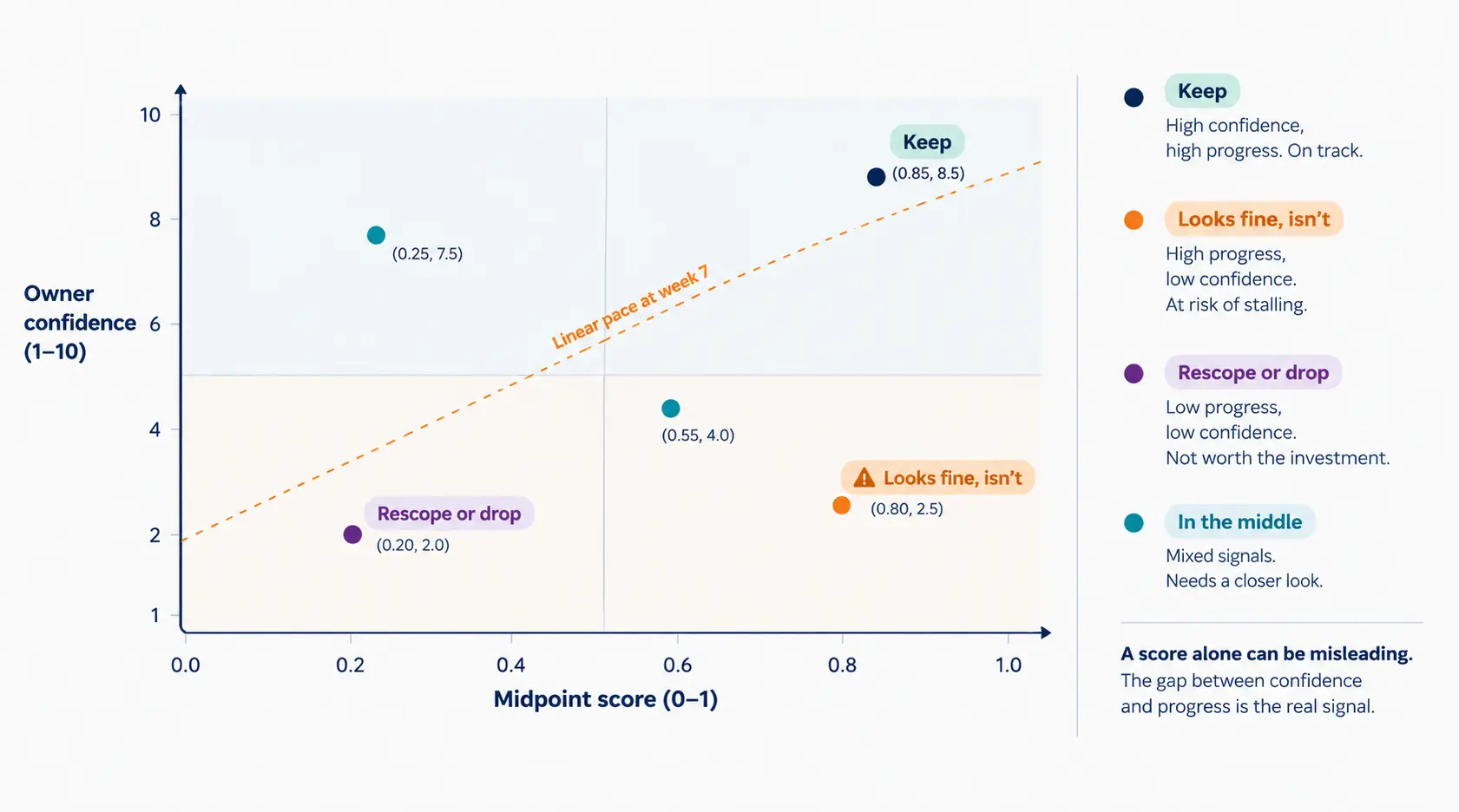
Step 2: Read confidence next to progress. A score tells you where you are (see automated OKR scoring if you want it calculated for you). A confidence rating tells you where the owner thinks you will land. The gap between them is the real conversation, and I cover how to read it in the next section.
Step 3: Separate blockers from dependencies. A blocker is something inside the team’s control. A dependency sits with another team. Mixing them is how meetings turn into blame. This step is the heart of okr blockers and dependencies work, and I come back to it with a real example below.
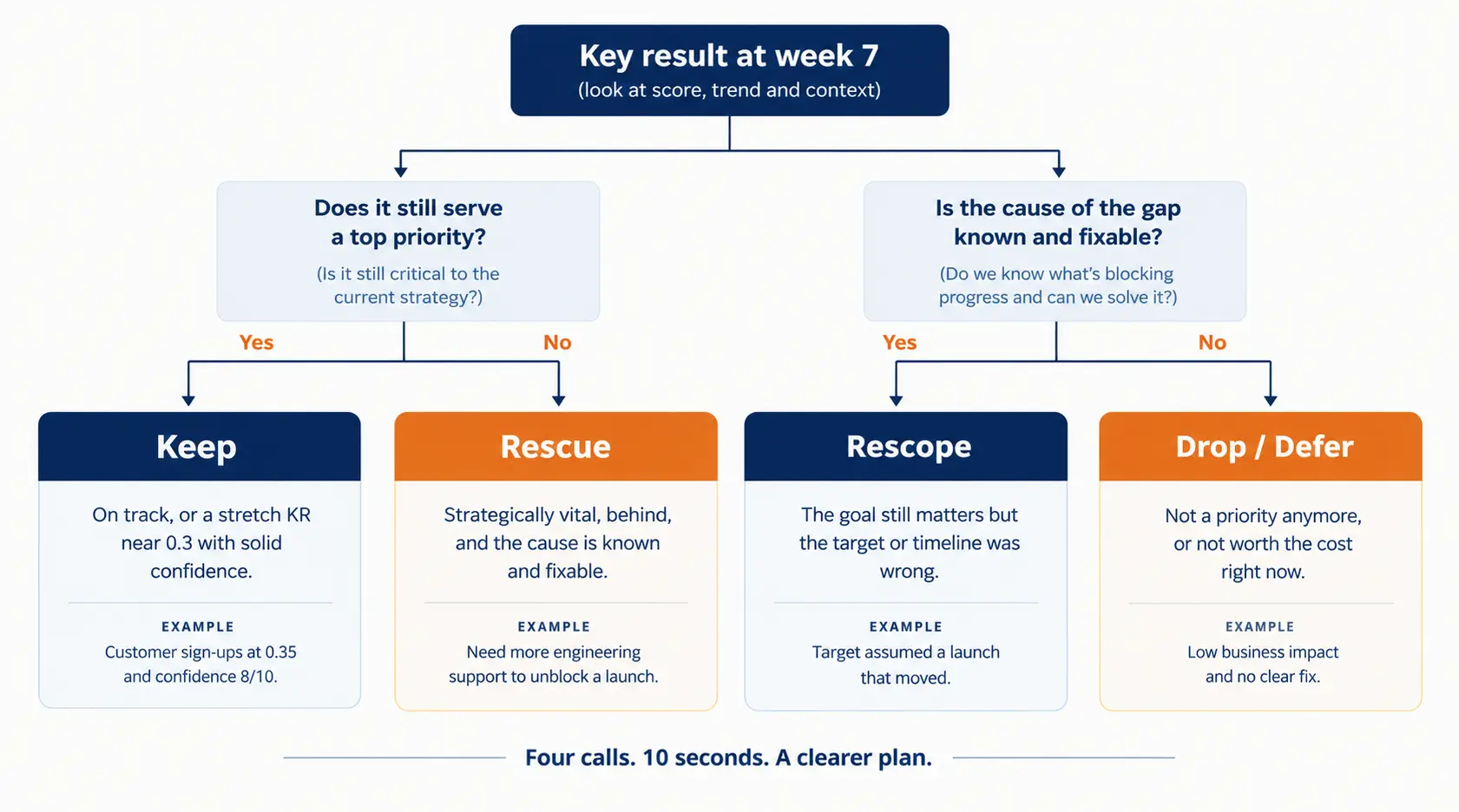
Step 4: Make the four calls. For each OKR, decide: keep, rescue, rescope, or drop. No OKR leaves the room without one of those labels.
Step 5: Rewrite only what you rescope. Do not touch the objective unless the strategy changed. Change the key result wording, target or timeline, record why, and keep the original visible.
Step 6: Report upward before you are asked. Send a short okr status update to leadership within 24 hours. I explain the format further down.
Step 7: Tighten the back half. Move the at-risk items from weekly to twice-weekly check-ins for the remaining six weeks, and put the retrospective date in the calendar now.
If you want to see where your organisation’s execution habits actually stand before you run this, the OKR Execution Maturity Framework is the quickest way I know to find out.
Is your midpoint problem a plan problem or a maturity problem?
Before you reset any OKR, see how mature your team’s execution habits really are. The framework takes a few minutes and shows where week-seven drift usually starts.
How to Tell If an OKR Is Off Track: Scores, Confidence and Colour
An okr off track at week seven rarely announces itself. Start with the question I get asked most: what is a good okr score at mid-quarter?
There is no universal number, and anyone who gives you one is guessing. What matters is the type of key result. In the Google-style grading approach, stretch goals are expected to land around 0.6 to 0.7 at the end of the quarter, which means a linear pace puts them near 0.3 at the midpoint. Committed key results are different: they are expected to land close to 1.0, so they should be near 0.5 by week seven. This is why the difference between aspirational and committed OKRs matters so much at this meeting.
People also ask what does 0.3 okr score at midpoint mean? On a stretch key result, it means you are roughly on pace. On a committed key result, it means you are behind and need to make a call this week. The number alone cannot tell you which. The label can.
Use confidence, not just progress
okr scoring mid-quarter only works when you pair it with an okr confidence score. Ask each owner a simple question: out of 10, how confident are you that this key result lands where we said it would? A key result at 0.4 with confidence of 8 is healthy. A key result at 0.6 with confidence of 3 is the one that will hurt you, because it looks fine on the dashboard.
| Midpoint score | Confidence | My working read | What to do |
|---|---|---|---|
| 0.5+ | High (7–10) | On track | Keep |
| 0.5+ | Low (1–4) | Looks fine, probably is not | Rescue: find the hidden risk |
| 0.2–0.4 | High (7–10) | Late but recoverable, or a stretch KR on pace | Keep, with a firm date for the next check |
| 0.2–0.4 | Low (1–4) | Real trouble | Rescue or rescope |
| Under 0.2 | Any | Wrong plan or wrong target | Rescope, or drop or defer |
This table is my own working read from the field, not a published benchmark. Calibrate it to your own cycle. For a fuller treatment of scoring scales, see the Google OKR grading scale guide.
Red, yellow, green, with rules
An okr red yellow green status is useful only when each colour has a definition. Mine: green means confidence of 7 or more and progress at or above pace. Yellow means confidence of 4 to 6, or progress behind pace by under a quarter. Red means confidence below 4, or no movement for two weeks. Without definitions, every status drifts to yellow. A short okr health check built on these rules catches the problem sooner, and our guide to OKR health indicators shows how to build them.
Then look at your at-risk key results through a leading-indicator lens. A multi-billion dollar mining engineering group I worked with moved faster once its leaders understood the difference: lagging indicators tell you where you are, while leading indicators show you the blocker while it can still be fixed. Teams that only track lagging indicators reach the midpoint with a number and no explanation.
The Midpoint Reset: Keep, Rescue, Rescope or Drop
This is the core of how to get okrs back on track. For every OKR, make exactly one call. Here is how I define each.
| Call | Use it when | What changes | What you tell leadership |
|---|---|---|---|
| Keep | On pace, or a stretch KR sitting near 0.3 with solid confidence | Nothing | “On track, next check in two weeks” |
| Rescue | Strategically vital, behind, and the cause is known and fixable | Add resources, remove a blocker, re-sequence work | “Behind; here is the fix and the date we will know” |
| Rescope | The goal still matters but the target or timeline was wrong | Change the KR target, scope or date, and log why | “Original target was set without X; revised to Y” |
| Drop or defer | Priorities shifted, or the effort cannot be justified | Remove from the cycle, or move to next quarter | “Stopped on purpose to protect focus on A and B” |
Should you change OKRs mid-quarter?
Yes, but with discipline. When to adjust okrs comes down to two reasons only: new information that invalidates the original assumption, or a strategic shift. “We are behind” is not a reason to change a target. “We learned the target depended on a launch that moved” is. If you move targets simply because they are hard, you teach the team that OKRs are negotiable, and you will never get an honest stretch goal again. For the longer discussion of when and how to pivot, see adjusting OKRs.
So, can you change key results mid-quarter? You can, and for rescoped items you should. Change the key result, never the objective, unless strategy itself moved. The objective is your direction. The key result is the evidence.
How to rescope, drop or defer, and cut OKRs mid-quarter
To rescope okrs mid-quarter, edit the target or date, write one sentence on why, and keep the original on record. To drop or defer key results, name what you are protecting by stopping. That sentence matters. “We cut KR 3 so the team can finish KR 1 and KR 2” is a focus decision. “We cut KR 3 because it was hard” is a retreat.
On how to cut okrs mid-quarter, cut the one with the lowest strategic weight and lowest confidence, not the lowest score. Here is how to reprioritise okrs mid-quarter: rank them against the top two or three business priorities, not against how loudly each owner is lobbying.
How to rescue a failing key result
To rescue a failing key result, find the cause first. In my experience it is almost always one of four: a missing owner, a missed dependency, a target set without evidence, or capacity pulled elsewhere. Fix the cause. Do not just add a sprint.
Dependencies are where midpoints are won
An APAC retail company in aggressive expansion taught me how much this matters. After a two-day war room session to get the CEO’s priorities clear, the leadership team surfaced cross-functional dependencies in advance, rather than discovering them mid-cycle. That one change moved the conversation from blame to sequencing. Your okr recovery plan should begin with that same question: which of our at-risk key results depend on another team’s delivery (a team OKR tracking view helps), and have they agreed to it? Alignment is agreement. If the agreement does not exist, the cascade on your screen is a fiction. See cross-team alignment for how to build it.
Most midpoint failures start with a mistake made in week one
If you keep landing in week seven with the same problems, the cause is usually upstream. This ebook walks through the pitfalls that quietly set a quarter up to slip.
How to Report OKR Slippage to Leadership Without Losing Credibility
Most leaders reset their OKRs badly because they report them badly. They either say nothing until the retrospective or deliver a long apology. Neither works.
Here is how to reset okrs without losing credibility: send a one-page okr status update within 24 hours of the review. Keep it to four lines per OKR: where it stands, what you learned, what you decided, and what you need. Lead with the decision, not the excuse. For example: “KR 2 was set assuming the partner API would ship in week four. It moved to week ten. We rescoped the target from 40 to 25 integrations and kept the objective.” That reads as control.
How to report okr slippage to leadership well comes down to timing and ownership. Report before you are asked, name one owner per fix, and give the date you will next update. Leaders forgive a revised target. They do not forgive a surprise.
It also helps to run a brief okr progress review with each direct report one-to-one, using your one-on-one meetings rhythm. Ask them: “What would have to be true for this to land?” and “What is the one thing you have not told me?” You will learn more in five minutes than in a dashboard.
Questions to ask: managers and teams
The best okr review questions are short and uncomfortable. For managers, here are my favourites for mid-quarter okr review questions for managers:
- Which key result would you drop first, and why?
- What did we assume in week one that turned out to be wrong?
- Which dependency have we not yet confirmed in writing?
- If we had to protect only two OKRs, which two?
For a mid-quarter okr check-in agenda for teams, shorten it: what moved, what is blocked, what you need from me, and what you will do before the next check.
Achieve Your Goals Faster
See how Worxmate can help your team set clear goals and achieve faster results. Book your free demo today and experience the power of AI-driven OKRs in action.
OKR Mid-Quarter Review for Startups and Remote Teams
For the okr mid-quarter review for startups, run a 20-minute call with the founder in the room and expect to rescope more often than a larger organisation would. Keep one rule: only evidence, never discomfort, moves a target. OKR grading for startups helps.
For the okr mid-quarter review for remote teams, push pre-work earlier, make confidence scores mandatory, and collect asynchronous updates before the live call, so live time is for decisions. The habits in OKR tracking for remote teams and our guide to remote OKRs apply directly.
What the Tooling Should Do at the Midpoint
A spreadsheet can hold a score. It cannot tell you a key result has not moved in 14 days. That is where an okr tracking tool earns its place and where continuous okr tracking beats a once-a-quarter scramble. Start with OKR tracking tools, real-time OKR tracking and OKR dashboards. If you are still choosing okr tracking software, our list of the best OKR software is the place to begin, and how to track OKRs covers the habit behind the tool.
Software is the infrastructure. The coaching is the capability. A dashboard displays at-risk key results but cannot make people tell the truth about them.
Where our DEEP AI™ framework meets the midpoint: Define catches weak key results before they become week-seven problems. Execute runs check-ins and at-risk detection, so a stalled key result shows in week four, not week seven. Evaluate turns midpoint scores into retrospective evidence. Plan carries the lessons forward. Around it, Axis AI shows business performance across OKRs, Orbit AI shows the people side when a failing key result is really a capacity or ownership problem, and Nexus AI shows whether a miss is local or systemic.
Want a second pair of eyes on how your organisation executes?
The Organization Performance Audit looks at where goals, people and delivery stop connecting, so your next midpoint starts from facts instead of opinions.
My Take: What I’d Tell a Client in Week Seven
Run your okr mid-quarter review this week. Not next week, when it will be a post-mortem. An okr progress review that ends without a keep, rescue, rescope or drop call is just a status update, and a status update will not get okrs back on track.
Pull the scorecard, ask for each okr confidence score, check the okr red yellow green status, review the at-risk key results, and make one of four calls on every OKR. Keep the review short, put every decision in writing, and send the okr status update upward before anyone asks. Use the okr review agenda above, keep your okr recovery plan to one page, and follow the mastering OKR best practices habits that stop the same gaps from reappearing. If you do only that, you will finish the quarter with fewer OKRs completed than you wrote, and more of the ones that mattered.
Remember that outcome thinking is built across cycles, not in one meeting. The Execution Maturity Rate, the share of leaders who can write a genuine outcome-driven goal without help, typically sits between 5% and 15% in a first cycle and reaches 30% to 40% after 12 months of coached practice. A messy midpoint in cycle one is normal. A messy midpoint in cycle four means nobody ran the reset, and the strategy execution gap is widening. A typical OKR cycle has room for exactly this reset.
 Two ways forward
If you are ready to evaluate software: see how OKR software handles check-ins, at-risk detection and midpoint scoring, then look at pricing or book a demo.
If the platform is not your first problem: if your managers are not running honest check-ins, a tool will not fix that. Our OKR consulting work coaches the middle layer (the Coaching Cliff is where most programmes die; see why OKR coaching fails) to run the review conversation itself, so the reset becomes a habit rather than a rescue.
The software is the infrastructure. The coaching is the capability. You need both, and in the right order.


Written by
An OKR Coach with 20+ years of implementation experience, Madhusudan has guided over 50 organisations through successful OKR transformations, training more than 500 leaders. Learn more about Worxmate.