 WORXMATE
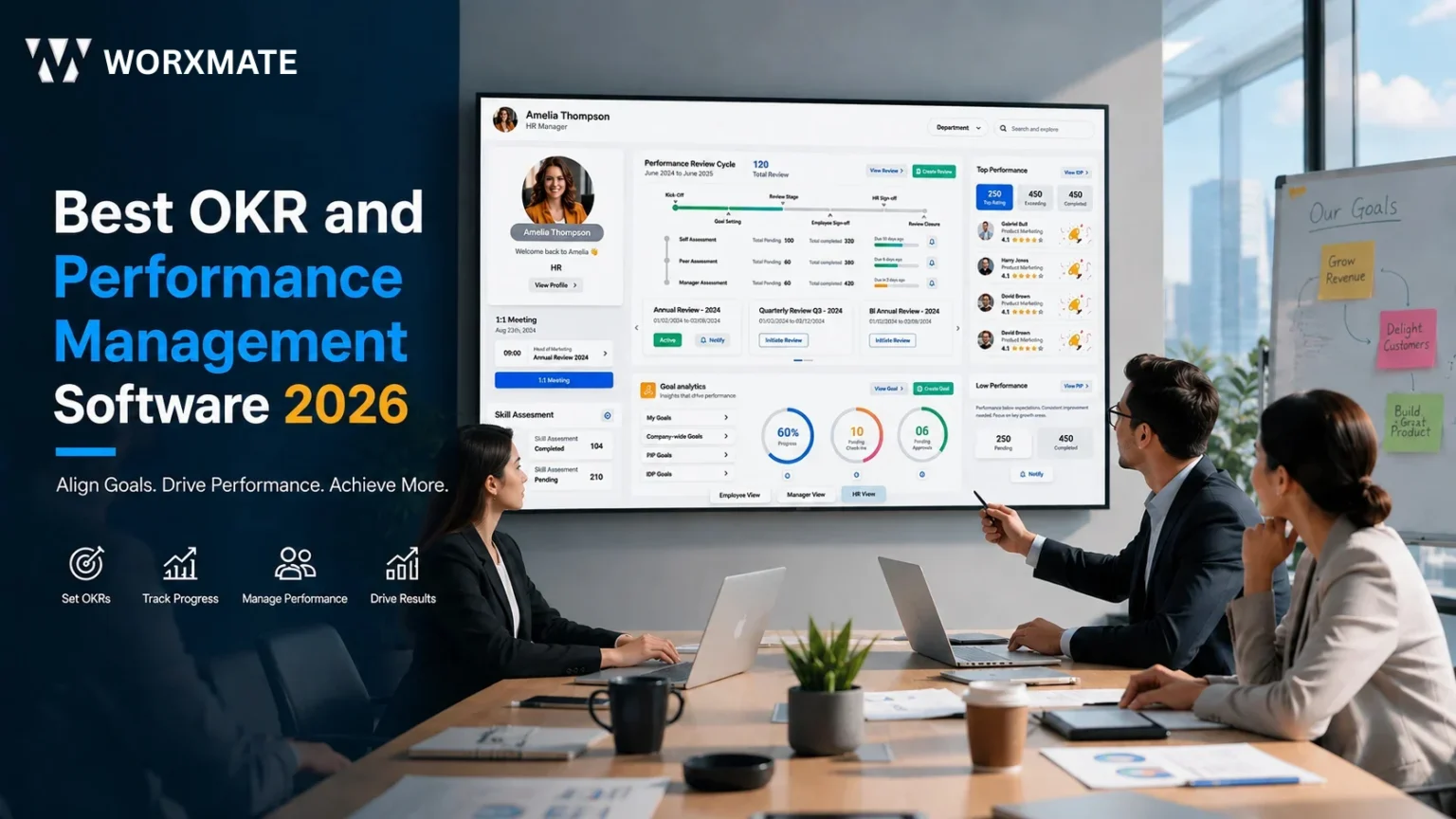
OKR and performance management software combines strategic goal tracking with top performance review tools into a single unified data model. Evaluating solutions requires examining how well execution metrics, continuous feedback, and review cycles integrate without manual API connectors.
The problem with running OKRs and performance reviews in separate tools
A sales manager spends all year running quarterly OKR cycles, check-ins every week, scorecards every quarter, and tracking crucial strategic priorities and milestones. Then annual review season arrives, and continuous performance management operates in a completely separate tool. None of that quarterly data carries over. The manager is now expected to write a thoughtful, evidence-based review from memory, covering twelve months of a direct report’s work, using a blank text box in a different piece of software that has never seen a single OKR update. This is exactly the failure mode that OKR and performance management in one platform is designed to prevent not by adding another integration to maintain, but by removing the second system entirely.
This is the actual cost of running OKR and performance management software as two disconnected systems: not duplicate licensing fees, though those add up, but duplicate work and degraded accuracy. A rep who crushed Q1 and coasted through Q4 gets the same generic “strong performer” review as a rep who was consistent all year, because the manager’s memory not the actual quarterly data is what the review is built on. Why OKR implementation fails covers the execution side of this gap, but the review side is just as real: a program can run flawlessly all year and still produce inaccurate reviews if there’s no genuine OKR and PMS integration connecting the two.
The deeper issue is trust. When employees notice that their quarterly OKR wins never show up in their annual review when a genuinely strong Q2 gets flattened into a vague, memory-based paragraph months later, they stop taking the quarterly check-in process seriously. Continuous feedback vs performance reviews becomes a false choice when the two are structurally disconnected; the real fix isn’t picking one over the other, it’s building a genuinely single platform for OKRs and reviews so continuous data actually reaches the formal review instead of evaporating between cycles. This is also where a lot of well-intentioned rollouts quietly stall not because the OKR framework was wrong, but because why OKRs feel like extra work so often traces back to employees sensing that the extra effort of a weekly check-in disappears into a void that the annual review never draws from.
What “OKR and performance management software” actually means
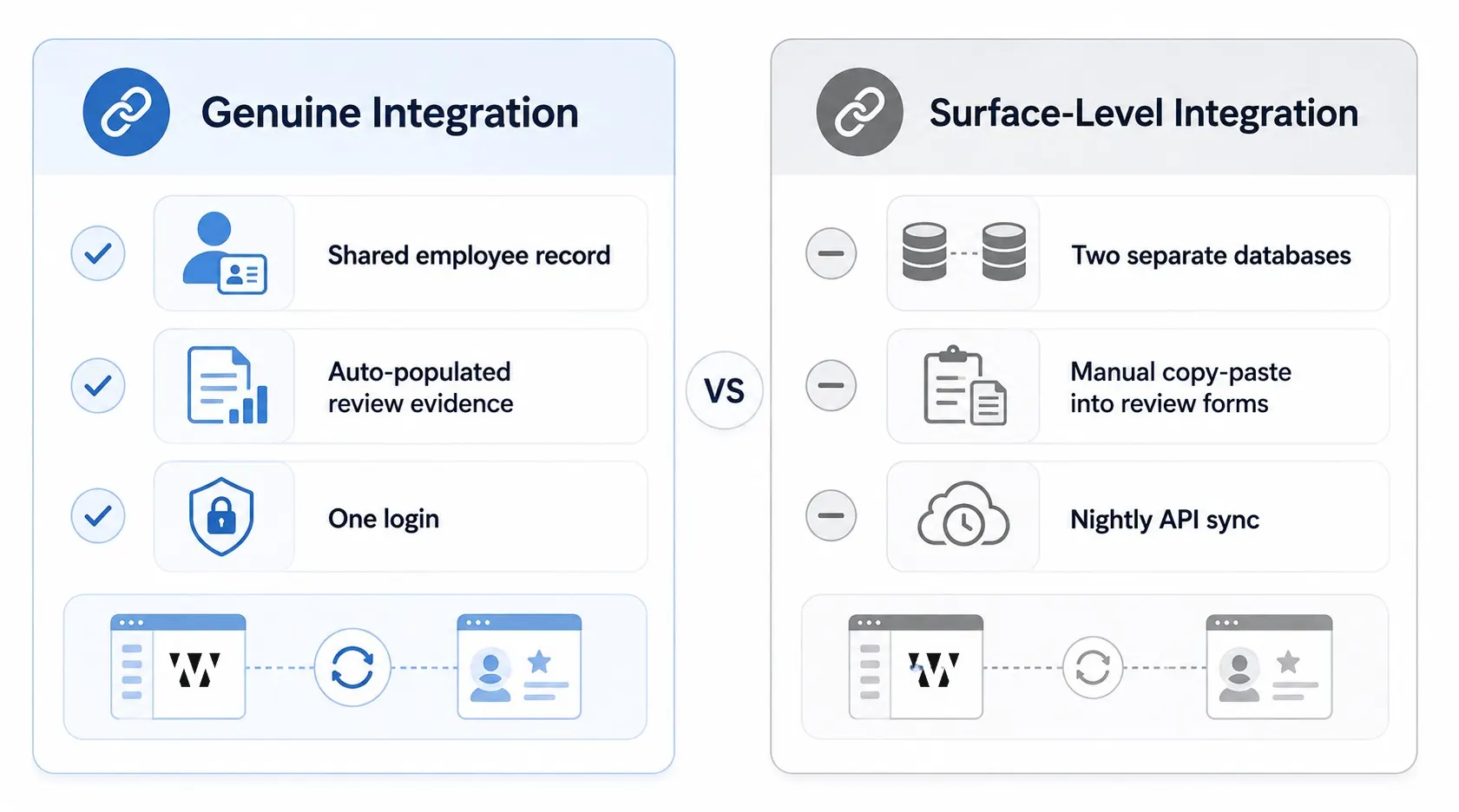
Not every tool that offers both an OKR module and a review module is genuinely OKR and performance management software in the way that matters. There’s a real difference between a vendor selling two products under one login and a platform where the two are structurally the same data.
| What genuine integration looks like | What surface-level integration looks like |
|---|---|
| OKR scorecard data auto-populates review evidence | Manager manually copies OKR screenshots into a review form |
| One employee record, one history, one login | Two separate databases with an API sync running nightly |
| Manager coaching notes from check-ins carry into calibration | Coaching notes live in a check-in tool nobody revisits later |
| A single unified performance timeline per employee | Two timelines a manager has to mentally reconcile |
This is the practical test for any all-in-one OKR and PMS platform: does the quarterly execution data actually become the evidence for the annual conversation, or does someone have to manually bridge the two systems every review cycle? Genuine OKR performance management software passes this test by design, not by API connector. Performance management system vs appraisal software covers this same distinction from the PMS side a system that only handles the appraisal form isn’t the same as one that connects to the execution data behind it.
How Worxmate connects OKR execution to performance reviews
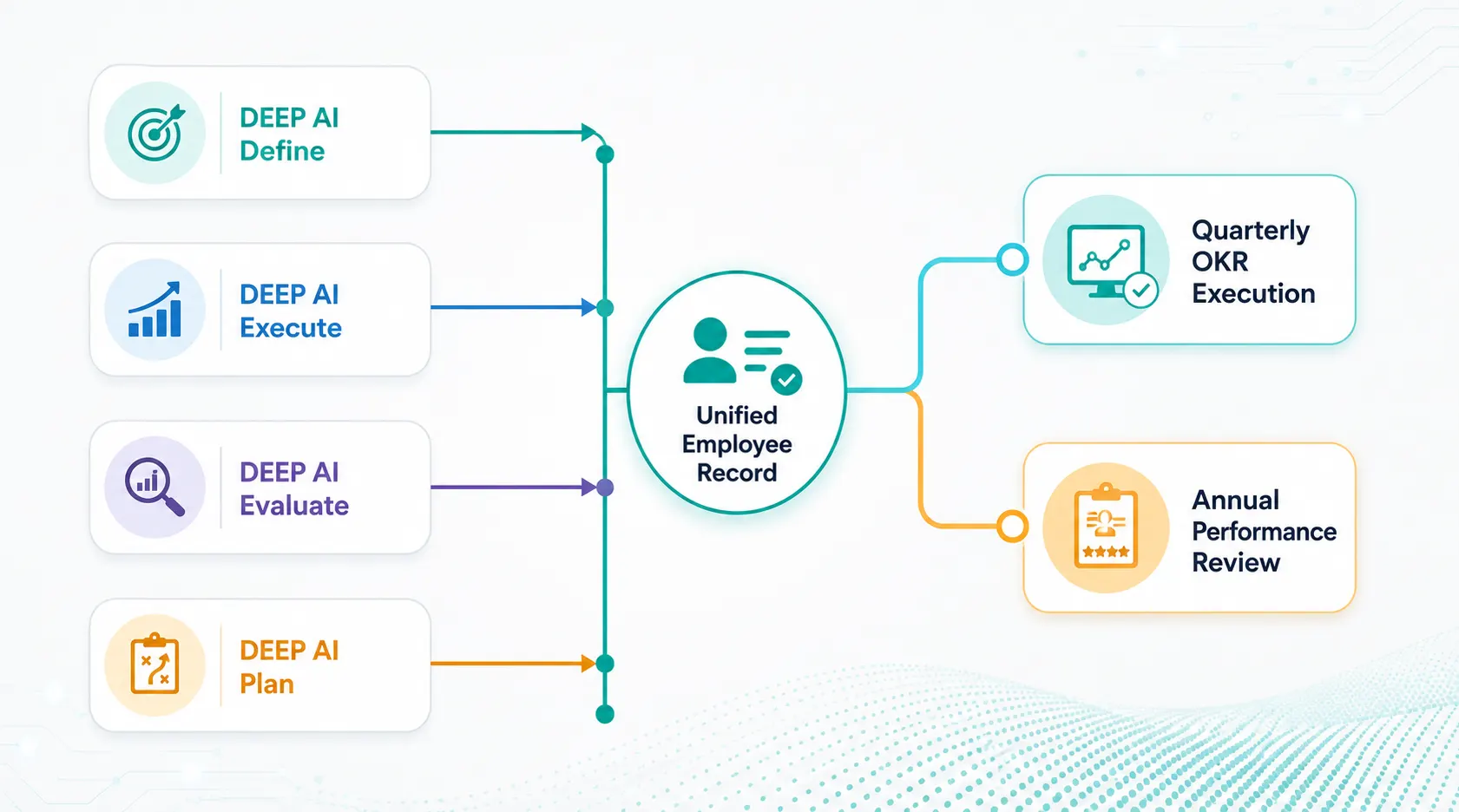
Worxmate’s answer to this isn’t a plugin or an integration marketplace connector it’s an architectural decision baked into the DEEP AI™ framework itself. DEEP AI stands for Define, Execute, Evaluate, Plan, and the same data that powers quarterly OKR execution is the data that populates theperformance review because there was never a second, separate database to reconcile in the first place.
Define and Execute build the record. Goals set through the AI OKR writing tool and tracked through structured check-ins aren’t logged in isolation: every update, blocker, and coaching note becomes part of a running employee record that a review cycle can pull from directly, months later, without anyone needing to remember what happened in March.
Evaluate turns quarterly data into review-ready evidence. The OKR scorecard software the Evaluate stage, doesn’t just score a quarter and move on. That scorecard becomes part of the annual performance record automatically, so a manager writing a review in December has four quarters of AI-forecasted, evidence-backed scorecards to draw from instead of four months of fading memory.
Plan closes the loop into next-cycle goals. The OKR retrospective tool the Plan stage, feeds directly into the next performance cycle’s goal-setting conversation, so a performance review isn’t a dead end that resets everything to zero; it’s a checkpoint that flows straight into the next quarter’s OKRs.
This is also where Worxmate’s three AI intelligence layers do their heaviest lifting for a combined OKR and performance management tool:
Orbit AI : Worxmate’s employee performance intelligence software – reads patterns across an individual’s check-ins and scorecards over the full year, not just the most recent quarter, which is exactly the kind of longitudinal view a fair annual review needs and a memory-based process can’t reliably produce.
Axis AI : Worxmate’s business performance intelligence software – connects individual and team performance data to business outcomes, so a review isn’t just “did this person hit their numbers” but “how did this person’s execution actually move the business.”
Nexus AI : Worxmate’s organisational intelligence software – surfaces calibration inconsistencies across teams, flagging when one manager’s reviews run systematically harsher or softer than another’s, which is a fairness problem no amount of manual review can catch at scale.
All-in-one platform vs. stitching two tools together
Organizations generally land on one of three setups, and it’s worth being honest about the trade-offs of each when evaluating various performance management approaches rather than assuming the “best” option is always obvious.
A dedicated OKR tool plus a separate PMS tool gives you best-in-class features in each category individually, but you inherit the integration burden yourself someone has to own the data bridge between them, and that bridge tends to be the first thing that breaks when either vendor changes their API or a key person managing the sync leaves the company.
An HRIS with both an OKR module and a review module bolted on – the Workday or Oracle HCM category, centralizes everything under one enterprise contract, which procurement often prefers. But OKRs and performance data end up as secondary features inside a system built primarily for payroll and compliance, which tends to show in shallow cascade depth and reviews that feel more like compliance paperwork than genuine coaching tools. Our Worxmate vs Workday comparison covers this trade-off directly.
A genuinely unified platform -where OKR execution and performance review share one data model from the start removes the integration burden entirely, because there was never a second system to bridge. The trade-off here is narrower: you’re choosing a vendor whose core competency is this specific combination, rather than mixing best-in-class point solutions.
| Setup | Data Continuity | Integration Burden | Best Fit |
|---|---|---|---|
| Worxmate (unified) | Native — one data model | None | Orgs wanting execution and review connected from day one |
| OKR tool + separate PMS tool | Manual or API-dependent | High — someone owns the bridge | Orgs wanting best-in-class tools in each category individually |
| HRIS with both modules | Centralized but shallow | Low, but features are secondary | Large enterprises prioritizing one vendor contract over depth |
If your organization is still deciding between these three paths, HR performance management tools and performance management software vs HRIS are useful companion reads before committing to a category.
OKR and performance management software: Worxmate vs. 4 platforms making the same claim
Several vendors specifically market themselves as OKR and performance management software in one platform, not just an OKR tool with a review form bolted on. It’s worth evaluating them on that exact claim rather than treating every “unified platform” pitch as equivalent, because the depth of that unification varies a great deal once you look past the marketing page.
1. Worxmate
Worxmate builds OKR execution and performance review on one native data model from the start the DEEP AI™ framework’s Evaluate stage produces scorecards that become the review record directly, and Orbit, Axis, and Nexus AI read across both the execution and review layers as a single dataset. The trade-off is that Worxmate is a newer entrant than the legacy names below, so organizations weighing vendor maturity as a primary criterion should factor that in alongside the architectural advantage.
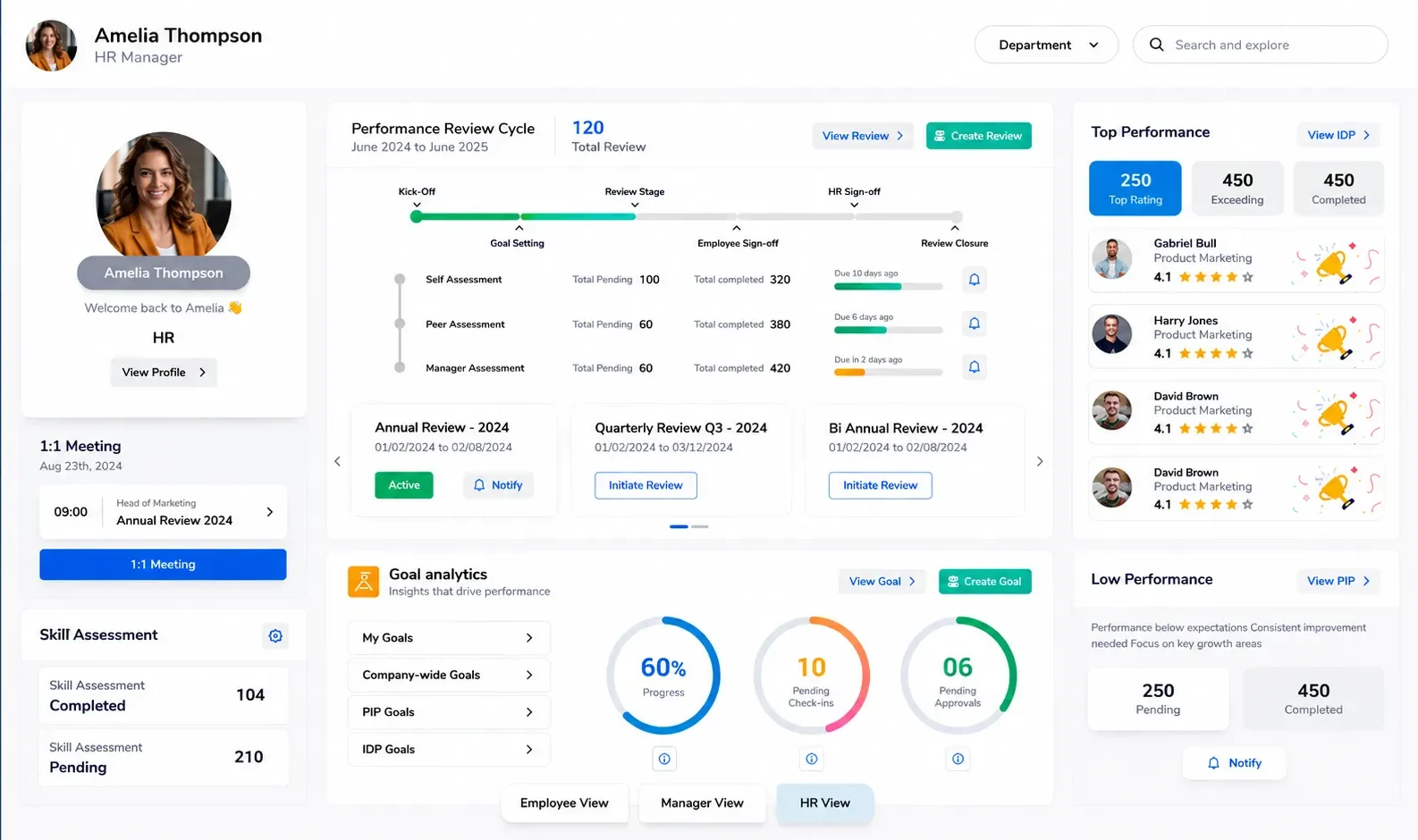
2. Lattice
Lattice is probably the best-known name in this exact category it combines an OKR/goals module with performance reviews, 360 feedback, and engagement surveys under one roof, and it’s genuinely strong when HR owns the rollout end to end. Its limitation shows up in exactly the scenario covered earlier in this article: when a CEO or Strategy Head, not HR, is trying to drive execution velocity, OKRs inside Lattice tend to move at HR’s review-cycle pace rather than the business’s quarterly pace, which blunts the “one platform” advantage for execution-first organizations. Full comparison: Worxmate vs Lattice.
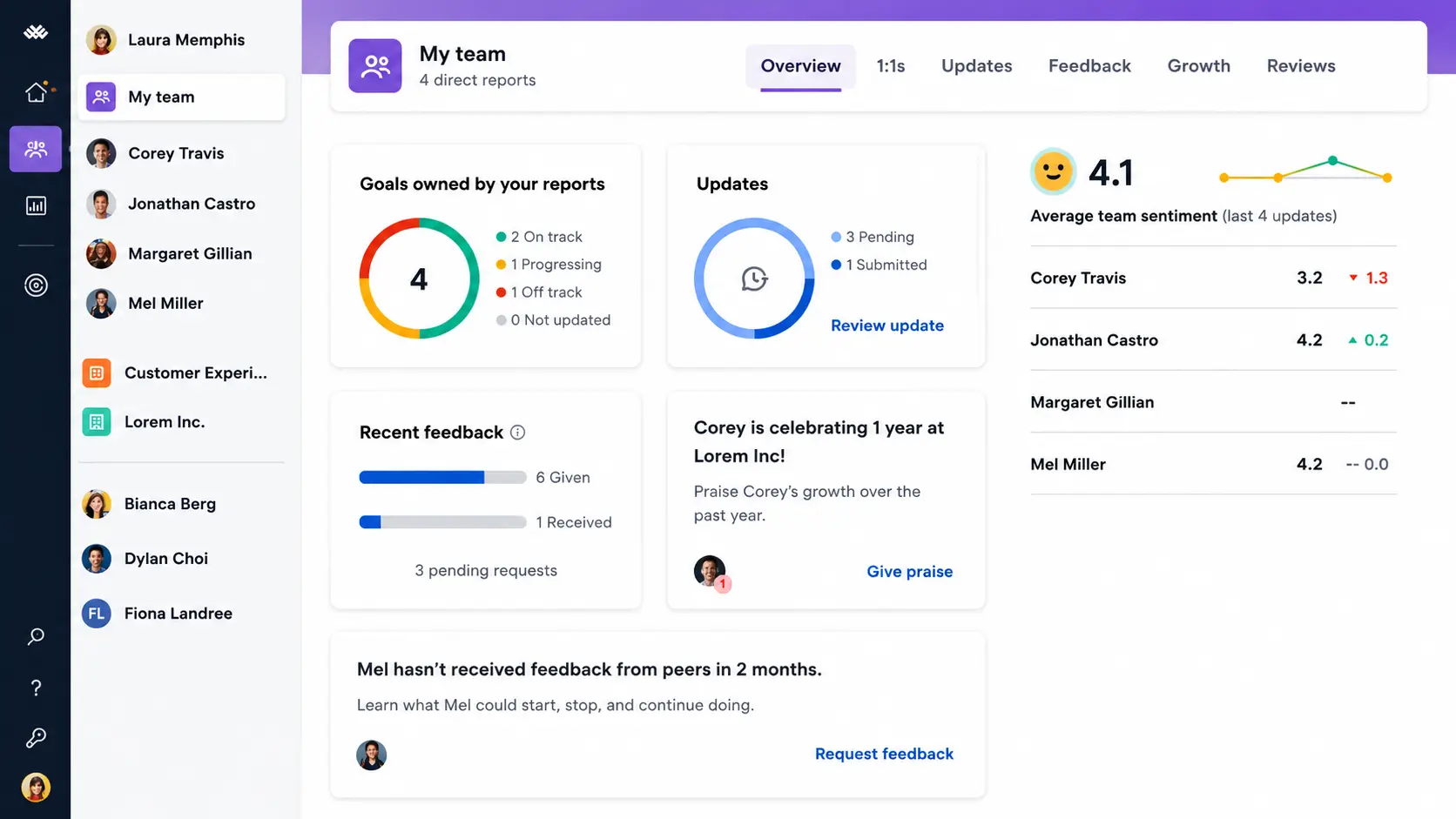
3. Betterworks
Betterworks pairs OKR tracking with a mature performance management suite built for large enterprises running structured, compliance-heavy review cycles across thousands of employees. Its combined-platform depth is real reviews genuinely draw on OKR data but the trade-off is procurement: no self-serve path, a sales-led onboarding process that can stretch for months, and a configuration burden that mirrors what standalone Betterworks OKR evaluation already surfaces. It’s a strong combined platform for organizations that have the internal bandwidth for a long enterprise rollout. Full comparison: Worxmate vs Betterworks.
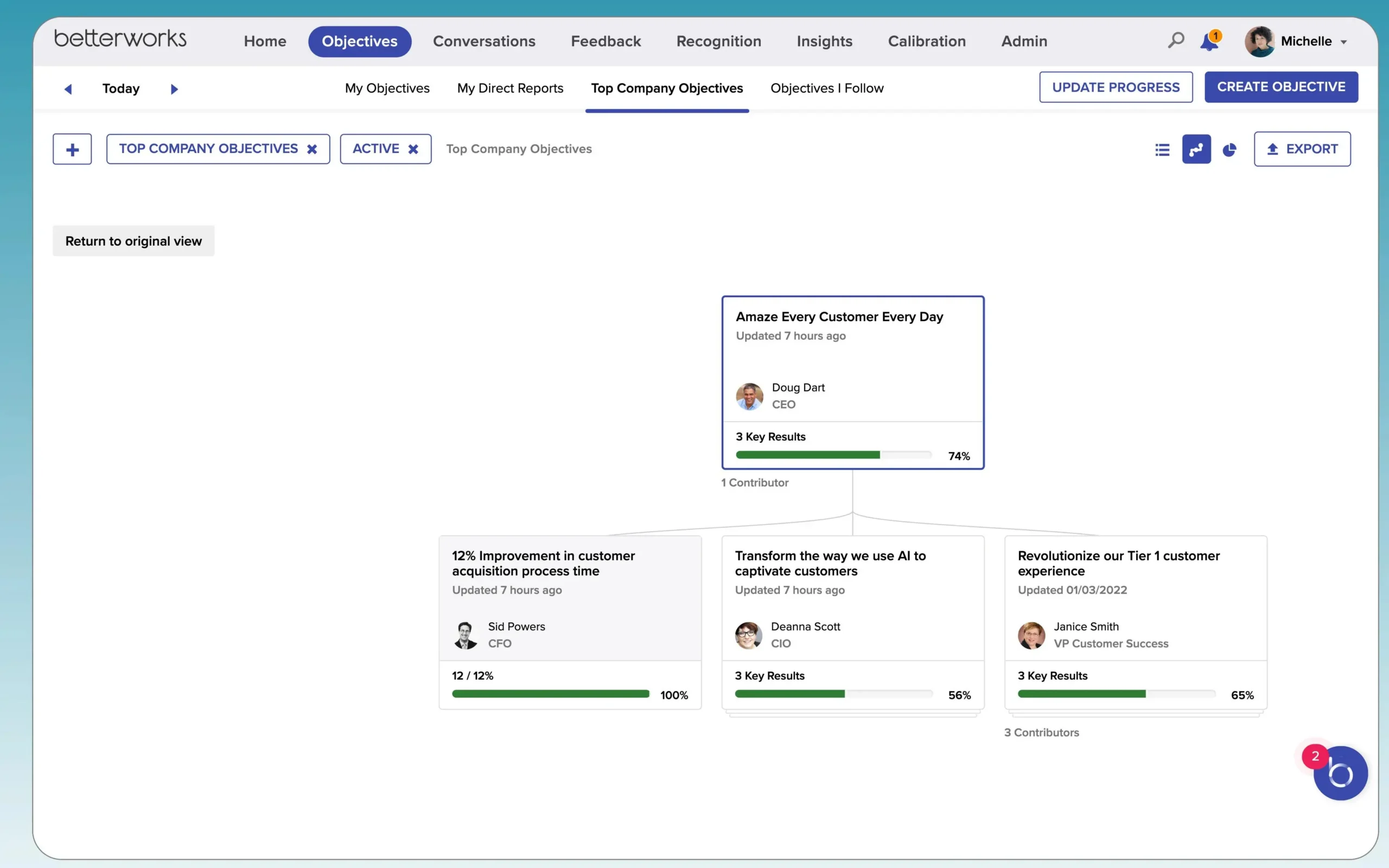
4. Leapsome
Leapsome markets almost the identical pitch to this article’s argument : OKRs, performance reviews, and engagement surveys natively connected, positioned specifically against the “stitched together” alternative. It’s a legitimate combined platform and a fair like-for-like comparison. Where it tends to differ is depth of AI-driven intelligence: Leapsome’s strength is breadth across HR use cases (engagement, learning, reviews, OKRs all in one), while Worxmate’s three distinct AI models go deeper specifically on the execution-to-review connection rather than spreading equally across every HR function.
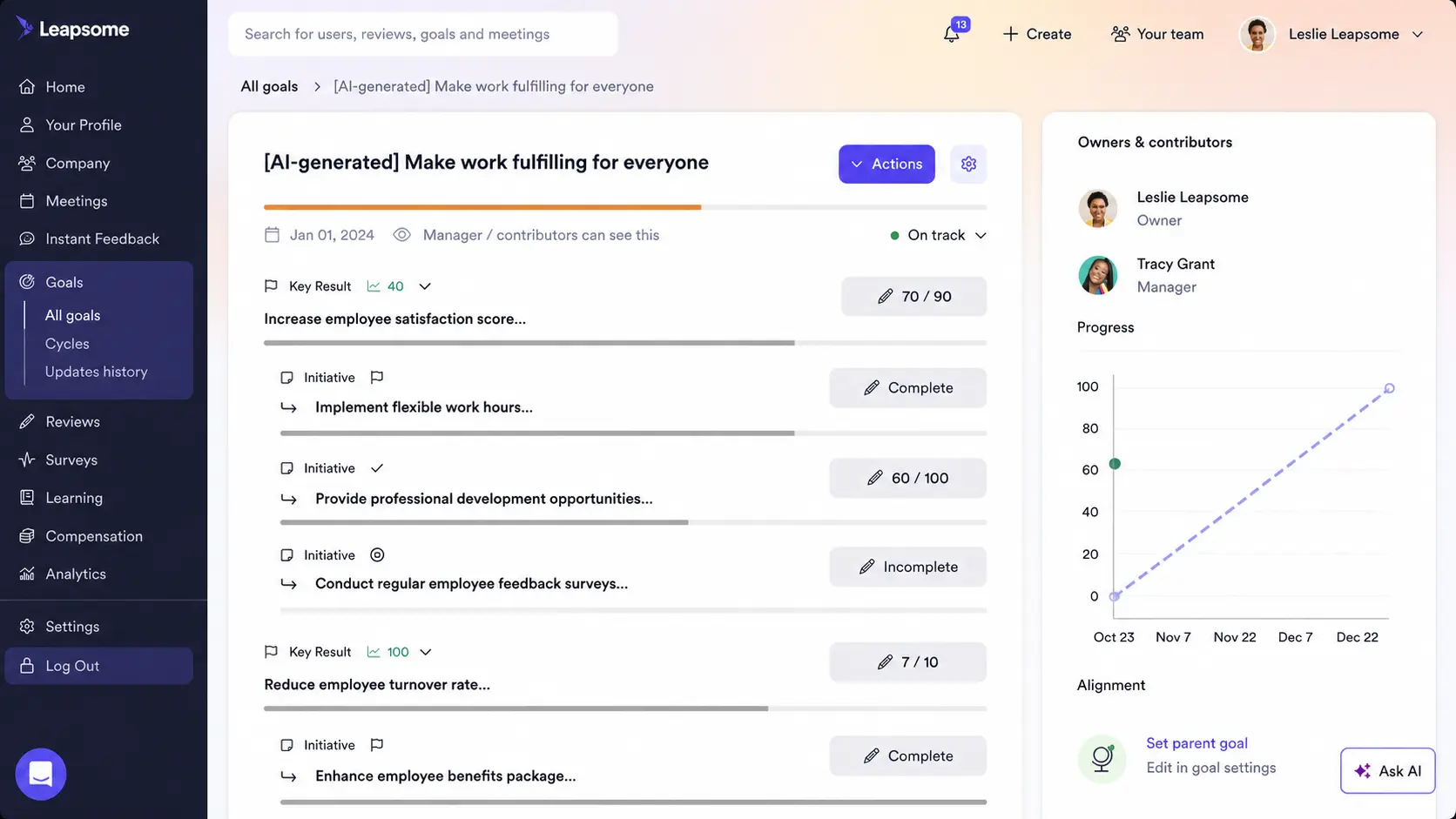
5. Workday
Workday represents the opposite end of the spectrum an enterprise HRIS with OKR and performance modules included as part of a much larger suite covering payroll, compliance, and workforce management. The combined-platform argument is technically true (one login, one vendor contract), but OKRs and reviews are secondary features inside a system built primarily for other things, which tends to show in shallower cascade architecture and reviews that read more like compliance documentation than coaching tools. Full comparison: Worxmate vs Workday.

| Platform | Combined-Platform Depth | Best Fit | Main Trade-off |
|---|---|---|---|
| Worxmate | Native — one data model, 3 AI layers reading both sides | Mid-market to enterprise wanting execution and review genuinely connected | Newer vendor than legacy names below |
| Lattice | Strong — OKRs + reviews + feedback + engagement | HR-led programs | OKRs move at review-cycle pace, not business pace |
| Betterworks | Strong — mature enterprise review suite | 1,000+ person orgs with review-cycle discipline | No self-serve, long procurement |
| Leapsome | Strong — closest like-for-like pitch | Orgs wanting breadth across HR functions in one tool | AI depth spread thin across many use cases vs. deep on execution-to-review |
| Workday | Present but shallow — secondary to core HRIS function | Large enterprises prioritizing one vendor contract | OKRs/reviews are add-ons, not the core product |
When you need both — and when you don’t
Not every organization needs a unified OKR and performance platform on day one, and it’s worth saying that plainly rather than overselling the combination to a team that isn’t ready for it. A 15-person startup running its first OKR cycle doesn’t need a formal annual review system yet OKR software for small businesses covers what that earlier stage actually needs, and it’s usually just structured execution, not a full performance management layer on top.
The need for a combined platform shows up at a specific inflection point: once an organization has formal review cycles, compensation decisions tied to performance, or a CHRO who needs defensible, evidence-backed ratings rather than manager gut-feel. That’s the point where OKR vs PMS software stops being a philosophical question and becomes an operational one you need both categories, and the only remaining question is whether they’re connected or duplicated. Our deeper breakdown of OKRs and performance management working together covers exactly how that connection should function in practice, once you’ve reached this stage.
Who needs a combined OKR and performance management platform
CEOs need confidence that the performance ratings reaching the board are backed by real execution data, not manager impressions formed months after the fact, OKR software for CEOs covers the broader execution-visibility case this connects to.
CHROs are the most direct beneficiaries a unified platform means calibration conversations are grounded in actual quarterly evidence instead of relative manager generosity, and Nexus AI’s cross-team calibration flags catch fairness issues before they become grievances. OKR software for CHROs goes deeper into this.
Business Unit Heads running formal review cycles for large teams need the manual reconciliation burden removed entirely reviewing forty direct reports’ worth of disconnected OKR history and performance notes manually every cycle isn’t a good use of a leader’s time. OKR software for Business Unit Heads covers this at scale.
Talent Heads rely on the same longitudinal Orbit AI data for succession planning, since a full year of connected execution and review history is a far stronger signal than a single annual snapshot. OKR software for Talent Heads covers this use case in more depth.
Across all four roles, the underlying argument for a unified OKR and performance platform is the same: decisions about people promotions, compensation, succession, exits are only as good as the evidence behind them, and evidence scattered across two disconnected systems is functionally worse than evidence that was never collected at all, because it creates false confidence that a review is data-backed when it’s actually still mostly memory.
Pricing for a combined OKR and performance management platform
Worxmate’s Vital, Proficient, and Enterprise tiers include both OKR execution and performance management as native, connected features not a bundled add-on priced separately, which is common with vendors that acquired their PMS capability rather than building it into the same data model from the start. This distinction matters more than it might seem at first glance: an acquired, bolted-on PMS module often runs on entirely different infrastructure than the OKR product it’s sold alongside, which reintroduces the exact data-silo problem an OKR and performance management software purchase is supposed to solve. Full current pricing covering both the best OKR software and performance management software sides of the platform is available on the OKR software pricing page. This directly accelerates measurable key results across the entire organization. Tracking a real-time confidence score helps identify at-risk targets before quarter-end. Surfacing operational blockers early ensures leadership can clear obstacles quickly. Seamless cascading ensures department milestones stay synchronized with company strategy. Strong goal alignment eliminates siloed efforts and connects daily work to strategic outcomes.
See both sides of the platform connected
If you’re ready to evaluate the platform: the clearest way to judge this is watching a real quarter’s OKR data flow directly into a review draft, not a demo org’s curated example. Book a live demo and we’ll walk through both the execution side and the review side together.
If you’re still deciding whether you need both: the software is only useful once the operational need exists — forcing a combined platform onto a team that only needs execution tracking creates overhead, not value. Our OKR consulting team can help figure out which stage you’re actually at before you commit to either category.


Written by
An OKR Coach with 20+ years of implementation experience, Madhusudan has guided over 50 organisations through successful OKR transformations, training more than 500 leaders. Learn more about Worxmate.