 WORXMATE
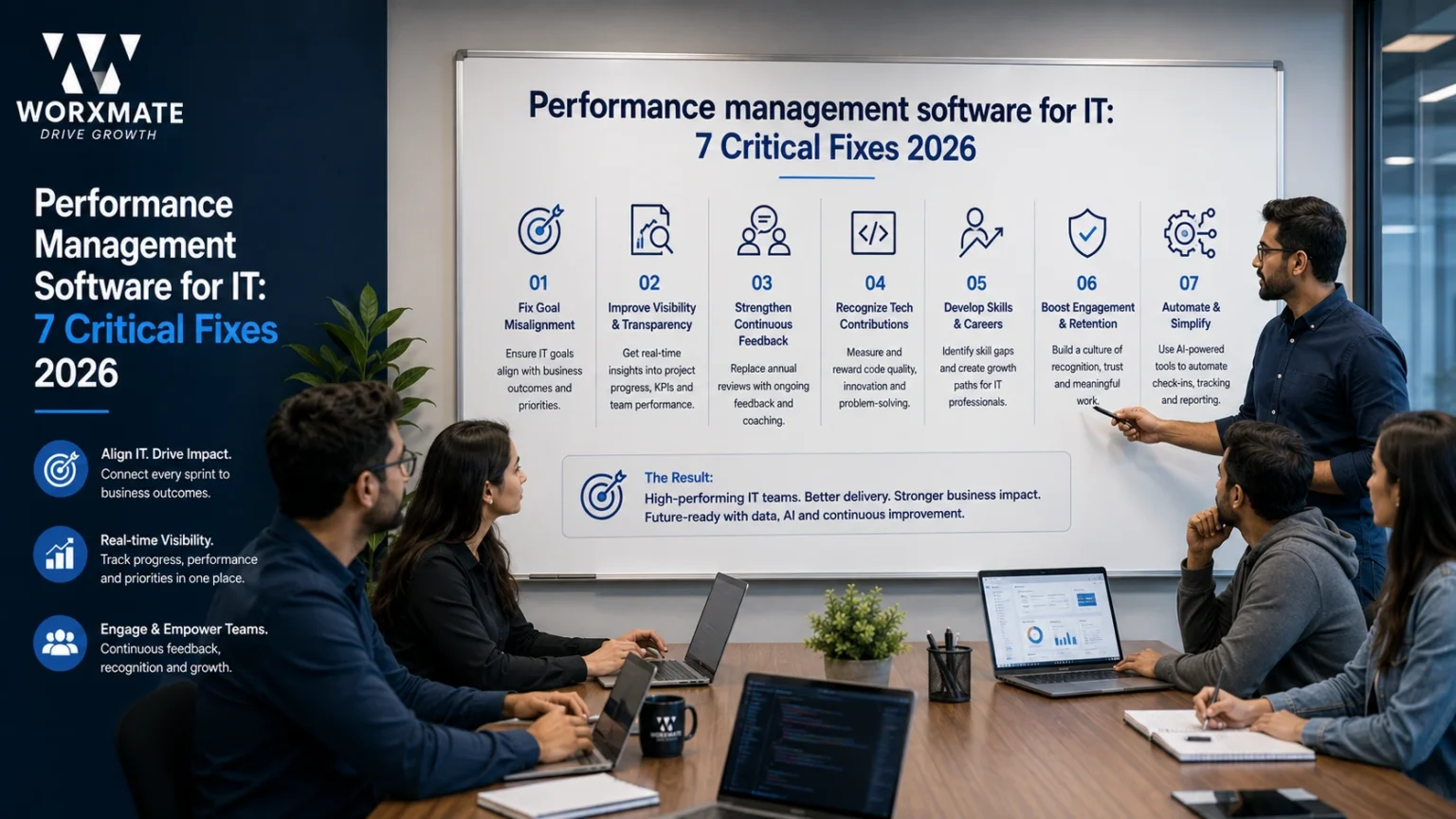
Performance management software for IT must bridge the gap between technical output and strategic business outcomes. Effective solutions move beyond static appraisals to provide real-time visibility into Execution Maturity Rate, utilizing DEEP AI goal coaching to eliminate bias, automate check-ins, and align engineering velocity with enterprise growth objectives.
I recently sat in a boardroom with the CHRO of a 70,000-person IT services organization. They had just finished a grueling annual review cycle. The data showed that 92% of their engineers had “exceeded expectations,” yet the company had missed its quarterly revenue targets by 14%. The disconnect was visceral. Managers were rewarding activity, while the business was starving for results. This is the exact moment a leader realizes that their legacy HRIS is not a strategy tool; it is a digital filing cabinet for mediocrity. In the high-stakes world of technology services, the cost of this misalignment is not just a HR headache, it is a structural threat to the bottom line.
The fundamental problem is that most performance management software for IT is built for compliance, not for execution. It asks managers to look backward once a year rather than looking forward every week. In my experience across 50+ implementations, the organizations that break this cycle are those that stop treating performance as a HR event and start treating it as a continuous data signal. When you move from subjective opinions to objective tech industry performance metrics, the conversation changes from “how do I feel about this employee” to “how is this employee moving the needle on our long-term vision examples.”
🎯 Practitioner Field Note
Alignment is agreement between teams on what matters, why it matters, and how each team’s work connects to the teams around them. You cannot create this in a tool; you can only display it once the agreement exists through rigorous coaching.
The Systemic Failure of Generic Performance Tools in Tech
The IT sector operates on a different clock speed than traditional industries. A software engineer’s impact can change in a single sprint, yet we still force them into annual cycles designed for 1950s manufacturing. When evaluating performance management software for IT, the first thing I look for is whether the platform can handle the “Output vs. Outcome” trap. Engineers are naturally inclined to track outputs: lines of code, tickets closed, or features shipped. However, a feature that nobody uses is a waste of capital, regardless of how well it was coded.
This is where enterprise OKR adoption often stumbles. Without a dedicated performance management software for IT implementation framework, the OKRs just become another layer of “to-do” lists. HR leaders often face HR challenges where they own the process, but the business doesn’t engage. This happens because the software doesn’t speak the language of the engineer. If the tool doesn’t integrate with Jira or GitHub, it is just “extra work” for the developer. If it doesn’t provide a KPI to OKR conversion path, the team stays stuck in the weeds of maintenance rather than innovation.
Furthermore, the “Coaching Cliff” is a silent killer in IT organizations. We see it constantly: the C-suite is excited about OKRs, but the middle management layer, the people actually running the scrums, are left to figure it out on their own. Without DEEP AI goal coaching, these managers default to safe, easily completable goals. They avoid the “stretch” because they fear it will impact their performance rating. This fear of failure is an invisible adoption blocker that keeps your Execution Maturity Rate stuck in the single digits.
5-15%
Initial Execution Maturity Rate
The typical percentage of leaders who can write genuine outcome-driven goals in their first cycle without automated coaching or quality reviews.
Performance Management Software for IT Best Practices: The Practitioner’s Playbook
To move the needle, you need more than a platform; you need a methodology. The most successful IT organizations I have worked with follow a specific set of performance management software for IT best practices. First, they separate the “What” from the “How.” The “What” is the business outcome (OKRs), and the “How” is the competency and behavior (Performance Reviews). When these two are conflated into a single score, you lose the ability to diagnose why a team is failing. Are they high-performers working on the wrong things, or low-performers working on the right things?
Second, they prioritize Orbit AI employee performance intelligence to detect signals before they become crises. In a 1,500-employee IT services firm we coached, we found that 15-20 queries per day in the first week of a cycle was the “Goldilocks zone” for adoption. Any fewer, and the team wasn’t engaging; anymore, and the process was too complex. By monitoring these signals, HR can move from being a referee to being a strategic partner. They can see performance review bias in real-time and intervene before calibration meetings turn into political battlegrounds.
Third, they focus on integrating Id with performance management. In the tech world, skills decay is a real threat. If your performance management software isn’t telling you which skills are actually moving business outcomes, your L&D budget is being spent on “gut feel” rather than data. A robust system should link a missed Key Result to a specific skill gap, triggering a targeted development plan. This is how you turn a performance management ROI from a theoretical concept into a measurable increase in billable efficiency.
The DEEP AI Framework: A New Standard for IT Execution
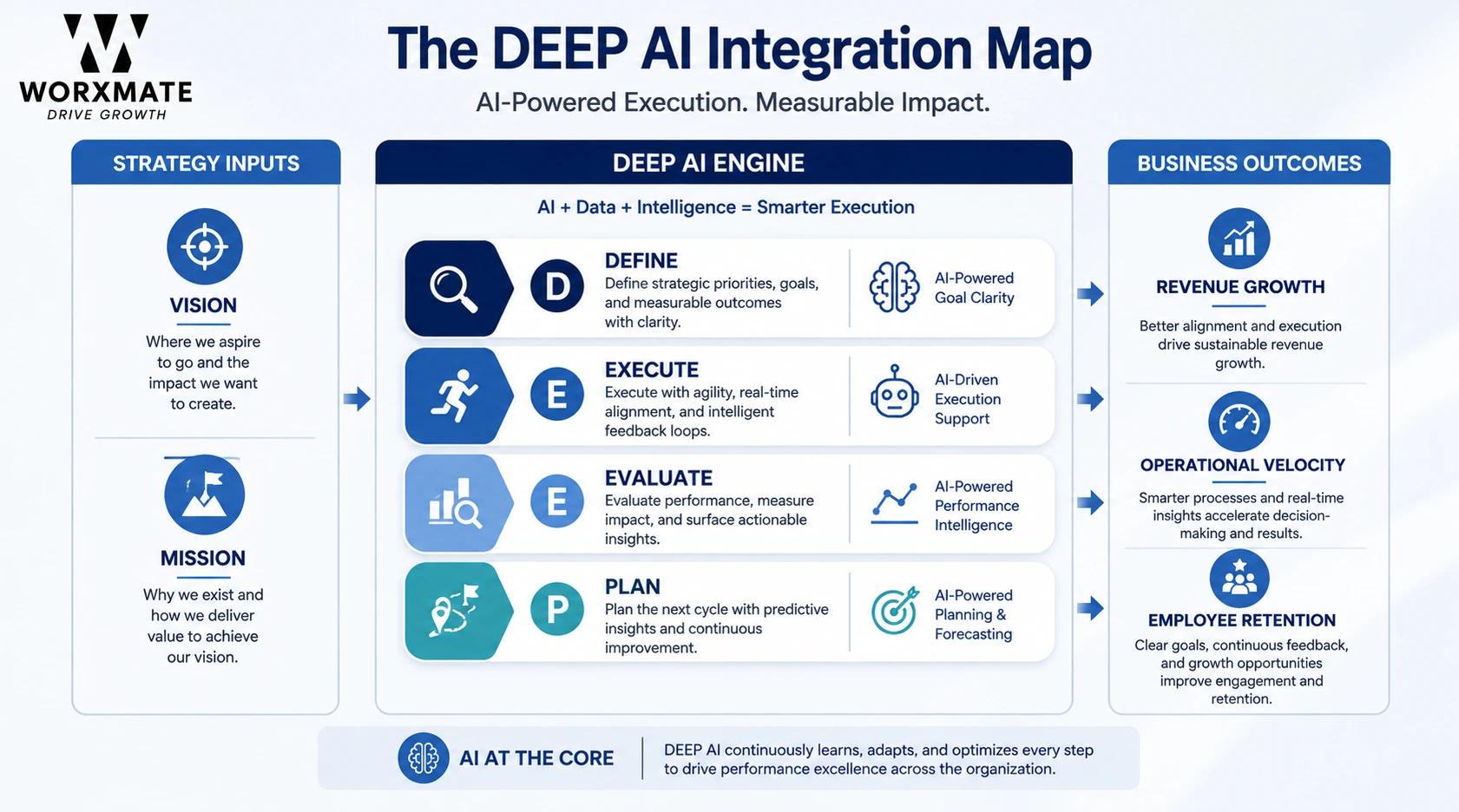
The performance management software for IT implementation framework we advocate for is built on the DEEP AI model: Define, Execute, Evaluate, and Plan. This isn’t just a catchy acronym; it is a structural response to the 9 systemic failures of traditional PMS. Let’s break down how this applies specifically to the IT persona.
- Define: This is where the Define AI OKR writing tool comes in. It acts as a 24/7 coach, helping engineers move from “I will fix 50 bugs” (output) to “I will improve system uptime from 99.0% to 99.9%” (outcome). It scores the quality of the goal in real-time, ensuring that the enterprise OKR adoption isn’t diluted by low-quality data.
- Execute: Most goals die in the “Execution Gap.” By using Execute OKR check-in software, teams are prompted to provide weekly updates. This isn’t about micromanagement; it’s about at-risk detection. If a critical project hasn’t moved in three weeks, the system flags it. This provides the “Third Eye Layer” that HR needs to see performance trends before the quarter ends.
- Evaluate: This is where we look at the business performance management data. We don’t just ask if the goal was met; we ask what we learned. This is critical for performance management for small business and enterprise alike, as it prevents the “set and forget” mentality that kills agility.
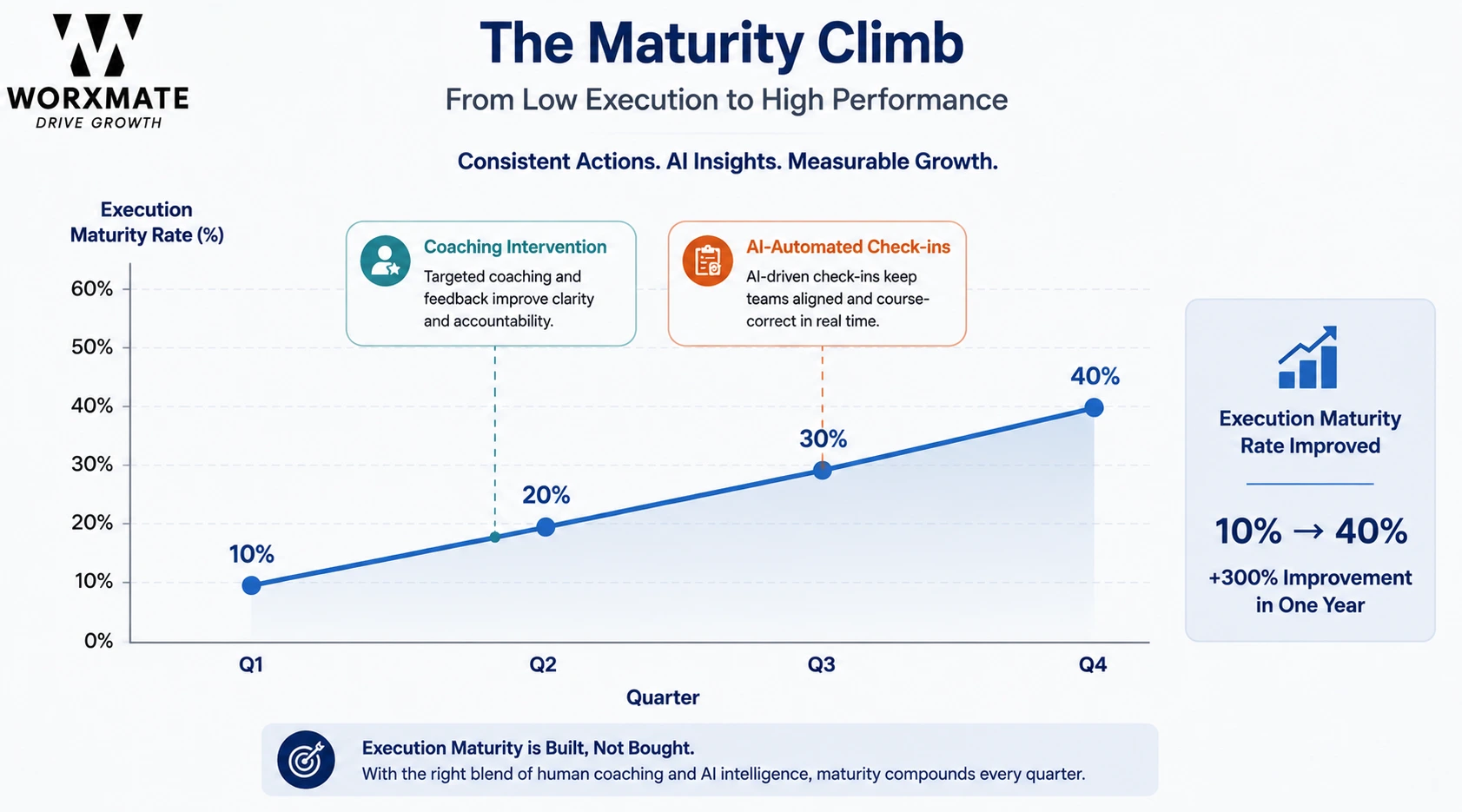
- Plan: The final stage is about organizational learning. We take the data from the previous cycle to inform the next one. This is how you move your Execution Maturity Rate from 15% to 40% over 12 months.
“The real ROI metric of an OKR program is Execution Maturity Rate, not goal completion rate. In a typical first cycle it sits between 5% and 15%. In organisations coached consistently over 12 months, it reaches 30% to 40%.”
Measuring What Matters: Execution Maturity Rate
In my conversations with over 135+ HR leaders, the most common question is: “How do we know if this is working?” Most people point to completion rates. But completion rates are a vanity metric. If everyone is hitting 100% of their goals, your goals are too easy. The metric that actually matters is the Execution Maturity Rate. This measures the percentage of your workforce that can independently write and execute high-quality, outcome-driven goals.
When we implemented this for a European fintech startup, their initial maturity rate was 8%. After three cycles of DEEP AI goal coaching and consistent leadership alignment, it jumped to 36%. The result? Their product launch velocity increased by 22% because teams were no longer waiting for permission to pivot. They understood the outcome they were chasing and had the autonomy to adjust their tactics. This is the power of a performance management software that focuses on capability rather than just compliance.
Execution Maturity Rate: Manual vs. AI-Coached
Benchmark Data
5–15%
30–40% (+200% Lift)
Why HRIS Platforms Fail at IT Performance
It is tempting to use your existing HRIS for performance management. Platforms like Zoho or Darwinbox are excellent for payroll and leave management, but they are the wrong fit for serious performance management software for IT. Why? Because they are built around HR workflows, not business execution. For an HRIS, the “success” of a performance cycle is that 100% of forms were submitted. For a dedicated execution platform, success is that the business hit its targets.
According to research from Gartner, organizations that use dedicated goal-management tools see significantly higher alignment than those relying on generic HR suites. This is because dedicated tools allow for when to use KPI vs. OKR distinctions, support complex dependencies between engineering and product, and provide the real-time feedback loops that modern IT teams require. If you are still using a tool where the primary interface is a long-form text box, you are not managing performance; you are managing paperwork.
| Feature Requirement | Legacy HRIS | Worxmate AI | Impact on IT |
|---|---|---|---|
| Goal Coaching | Static Templates | DEEP AI Real-time | Higher Quality OKRs |
| Check-in Frequency | Annual/Quarterly | Weekly Automated | At-risk Detection |
| Bias Monitoring | None (Manual) | Orbit AI Signals | Fairer Calibrations |
The Implementation Reality: From Chaos to Clarity
Implementing performance management software for IT is not a technical project; it is a change management project. I remember an APAC gaming company that tried to launch OKRs via spreadsheets. Within one month, they had 400 different versions of the truth. The CEO couldn’t tell which projects were actually contributing to their cultural goals. We stepped in with a two-day war room to reset their alignment. We didn’t talk about software; we talked about agreement.
Once the agreement was in place, we layered on the software to provide the infrastructure. This is the correct order of operations. If you put software first, you just automate the chaos. By following a structured performance management software for IT implementation framework, you ensure that the tool supports the culture, rather than trying to define it. You start by defining performance goals that are measurable, then you use the tool to track real-time feedback and employee feedback examples that are grounded in data, not hearsay.
One of the most powerful features of modern performance management software for IT is the ability to see the “invisible” work. In many IT orgs, the senior engineers spend 30% of their time mentoring others, yet this never shows up in their performance review because it’s not a “ticket.” A system like Orbit AI employee performance intelligence can pick up these collaboration signals, ensuring that your most valuable people are recognized for their total contribution, not just their individual output.
What This Looks Like in Practice: A Field Observation
When you get performance management software for IT right, the atmosphere in the office changes. Managers stop dreading 1:1s because they finally have something meaningful to talk about. Instead of asking “what did you do this week,” they ask “how can I help you clear the blocker on Key Result 2?” This shift from supervisor to coach is the hallmark of a high-maturity organization.
In a recent implementation for a large IT services provider in India, we saw this transition happen in real-time. By using performance management software in India that was localized for their specific operational needs, they were able to reduce their attrition rate among top performers by 12%. Why? Because those top performers finally felt seen. Their work was directly linked to the company’s business performance management goals, and they received real-time feedback that helped them grow. They weren’t just cogs in a machine; they were drivers of the strategy.
The 2026 IT Performance Benchmark Report
Discover how 500+ tech leaders are using AI to drive execution maturity.
The Bottom Line for IT Leaders
The choice is simple: you can continue to run your business on “gut feel” and annual forms, or you can build a high-performance engine powered by data and AI. Performance management software for IT is no longer a “nice to have” for HR; it is a critical piece of the technology stack. It is the bridge between your strategy and your execution. If you are ready to stop managing activity and start managing outcomes, it is time to look at a platform that was built for the way you actually work.
The software is the infrastructure. The coaching is the capability. You need both, and in the right order. If you are looking for a platform that integrates DEEP AI goal coaching with Orbit AI employee performance intelligence, we should talk. But if you recognize that your managers need to learn how to be coaches before the software can truly deliver value, our consulting team can help you build that foundation.
For those ready to evaluate a purpose-built solution, explore our OKR Software and check our Pricing to see how we scale with your organization. If you want to see the platform in action, Get a Demo today. If you feel your organization needs a cultural reset first, our OKR Consulting team specializes in moving the needle on Execution Maturity Rate through hands-on leadership coaching.


Written by
An OKR Coach with 20+ years of implementation experience, Madhusudan has guided over 50 organisations through successful OKR transformations, training more than 500 leaders. Learn more about Worxmate.