 WORXMATE

How do you prepare for a performance review? Run performance review preparation as a four-week countdown. In week four, HR fixes the performance review timeline, template and manager briefing. In week three, managers gather feedback and evidence. In week two, they write review notes and take ratings through calibration. In week one, they finalise documentation and rehearse the conversation. Preparation that starts 28 days out removes recency bias and puts a record behind every rating.
Picture a three-day workshop in a full auditorium. Thirty-five leaders from a listed Indian fintech, and the managing director standing in front of a wall covered in sticky notes. Every leader had written down their current goals, the impact and the challenges. The MD read them one by one. By the end he had counted what he was looking at: 80% of the goals were not designed in the right direction.
I think about that wall every time a client tells me their performance review preparation begins the week ratings are due. Managers are about to judge a year of work against goals nobody checked at the start, using memory nobody tested, in a conversation nobody rehearsed. That is not a performance review process. That is a lottery with paperwork.
This is the performance review prep plan I give HR teams and managers. It works for year-end performance review preparation, for mid-year performance review prep, and for an annual appraisal cycle checklist that runs April to March.
I am Maddy, an OKR Coach with 20+ years in strategy execution and 10+ years of OKR implementation. I have coached 50+ organisations and trained 500+ leaders across APAC, the Middle East and Europe. Everything below comes from rooms I have actually been in.
Why performance review preparation fails before the review starts
Ask an HR head what goes wrong in review season and the answer is rarely the form. It is the manager who opens the template on day one of the window, stares at twelve months, and writes about the last six weeks.
In the HR leader conversations I have had, the same three failures keep returning. Managers have no evidence trail, so they rely on memory. HR sends the template but never briefs anyone on how to use it. And the review is treated as an event, when it should be the summary of something that has been running all year.
That last point is the heart of performance management vs performance appraisal. Appraisal is the event. Management is the twelve months before it. If you want the difference laid out properly, my piece on performance management system vs appraisal software covers it, and the case for continuous performance management explains why a review should never be the first time a person hears how they are doing.
There is also an ownership problem. When HR alone owns the process, managers treat it as one more form to complete. When the manager owns the evidence and HR owns the system, the review becomes a conversation people have already half-had.
Alignment is agreement. A rating is only fair if the agreement about what mattered existed before the year began.
If your managers cannot tell you what each person was supposed to deliver, no checklist will rescue the review. Performance culture maturity decides whether preparation is a habit or a fire drill. Find that out first. I built the Performance Culture Maturity Framework for exactly this diagnosis.
Is your review problem a process problem or a culture problem?
Score your organisation on the Performance Culture Maturity Framework before you fix the checklist. It takes a few minutes and tells you where preparation will break first.
The performance review process at a glance: a 4-week timeline
The performance review timeline below is the spine of everything that follows. Copy it into your HR calendar and treat it as a 4 week performance review timeline template you can adapt to your own performance review cycle.
| Week | Days out | HR owns | Manager owns | Output by end of week |
|---|---|---|---|---|
| Week 4 | 28 to 22 | Lock dates, template, rating scale, manager briefing, calibration slots | Block calendar time, confirm goals on record | Published review calendar and briefed managers |
| Week 3 | 21 to 15 | Send self-assessment, collect 360 inputs, chase gaps | Gather feedback, check-in history and evidence per person | Evidence file for every direct report |
| Week 2 | 14 to 8 | Chair calibration, flag bias patterns | Draft review notes, propose ratings | Calibrated ratings with written rationale |
| Week 1 | 7 to 0 | Audit documentation, brief on difficult cases | Finalise notes, plan development, rehearse | Signed-off documents and a prepared conversation |
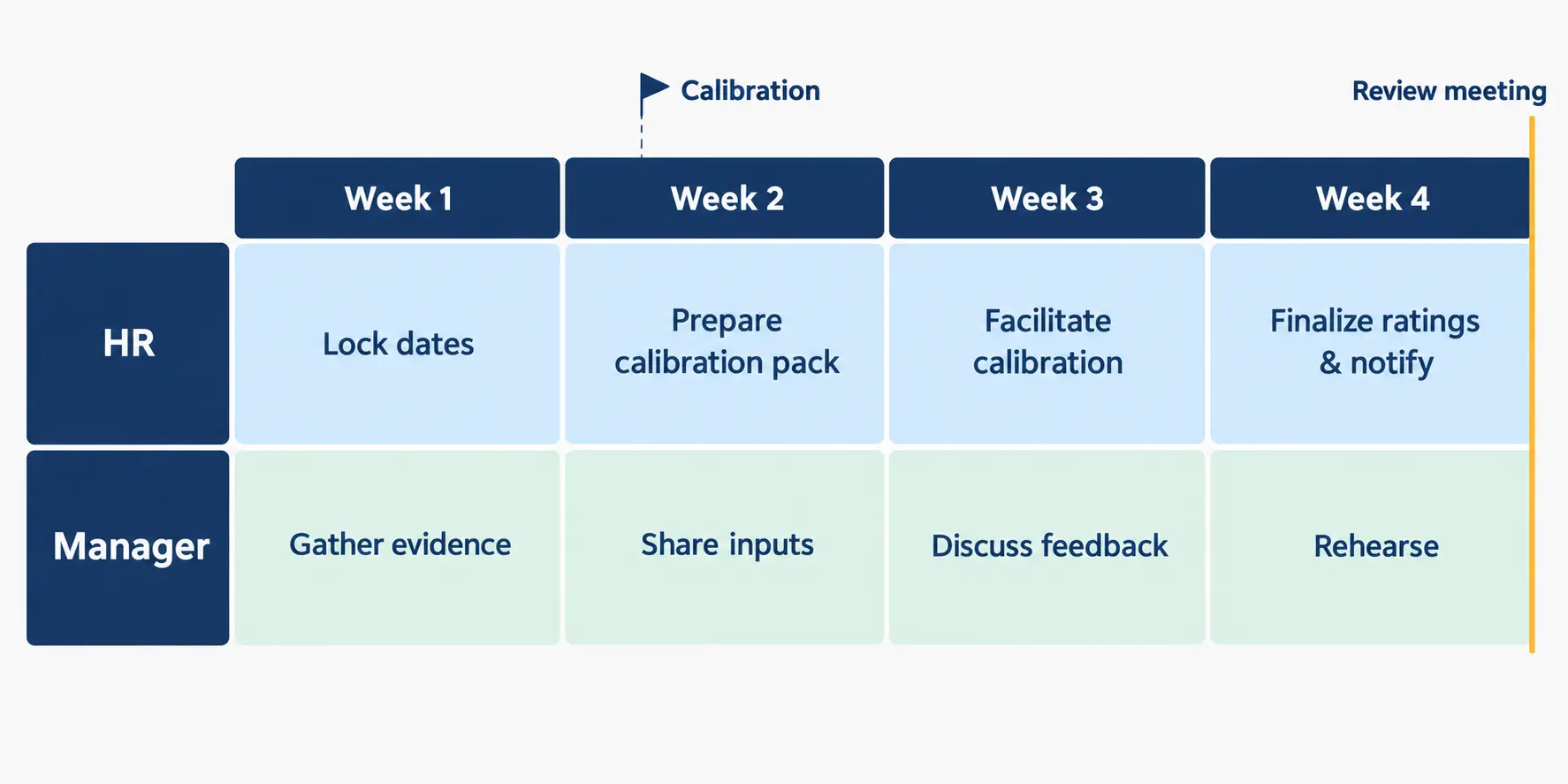
Week 4: Performance review prep starts with HR (28 to 22 days out)
If you are asking what to do 4 weeks before a performance review, the answer is boring and decisive: fix the logistics so nothing downstream has to be negotiated. Performance appraisal preparation is the same discipline under an older name, and the order matters. This is the HR performance review checklist I would run first.
- Publish a performance review calendar for HR and managers with every date in one place: self-assessment deadline, feedback window, calibration meeting, review conversations, sign-off.
- Freeze the rating scale and write one sentence of definition for each level. Managers who invent their own definitions create the inconsistency you will spend calibration fixing.
- Confirm the performance review template for HR teams. If you have none, start from our performance appraisal form template and cut anything managers will not fill in honestly.
- Book the calibration slots now. Senior leaders disappear in the last fortnight.
- Ask every manager one question: can you name, for each direct report, what they were meant to deliver this cycle? Anyone who hesitates needs a conversation before the performance review cycle opens, not after.
How to train managers for performance reviews
A one-hour webinar does not train anyone. I learned this at an APAC retail company in aggressive expansion. The leadership team was hiring fast, and group sessions barely moved them, because each leader arrived with a different mental model. What worked was 1:1 coaching, tailored to each person, so that leaders could admit what they did not know without being exposed in front of peers.
Apply that to review season. Run a 45-minute briefing on the process, then offer a 30-minute 1:1 to every first-time manager and anyone who rated unevenly last cycle. If HR training stops at the group session, managers fall off what I call the Coaching Cliff, and they fall off it in the week the stakes are highest.
Seasonal timing: year-end, mid-year and the April to March cycle
Year-end performance review preparation should begin in Q4, which for many teams means now. Mid-year performance review prep follows the same four weeks but with a lighter template. For Indian companies on a financial year, the annual appraisal cycle checklist should start in early March for April reviews. Our guide to employee appraisal in India covers the local cycle in more detail.
If your organisation is still running KRA-based appraisals, the KRA to OKR transition changes what managers must prepare. KRAs describe responsibilities. OKRs describe the outcomes someone was meant to move. The move from KPIs to OKRs is worth planning before your next cycle, not during it.
Week 3: How to prepare for a performance review as a manager (21 to 15 days out)
This is where the manager’s work begins. Performance review preparation for managers comes down to one rule: no rating without evidence you could show a colleague. Use this performance review prep checklist for managers, and keep it to one page per direct report. It doubles as a performance review checklist for managers who want something they can reuse every cycle.
- Pull the goals set at the start of the cycle and mark which still apply.
- Read every check-in, one-on-one note and piece of written feedback from the year.
- Collect input from the people who worked with them.
- Read the employee’s self-assessment before you form a view.
- Write down three examples that support your instinct and one that challenges it.
How to gather feedback before a performance review
Keep it narrow. Ask four or five peers and stakeholders three questions: what did this person deliver that mattered, where did they make your work easier or harder, and what should they do more or less of. Answers in two lines beat a long form nobody finishes.
Shared goals deserve special care. In a European fintech I coached, a Product Lead and an Account Executive co-owned a single key result on the demo experience. At review time neither could hide behind the other, and each could speak specifically about the other’s contribution. If a goal was shared, ask the co-owner for feedback first.
A formal 360 degree feedback round is useful for senior roles, and the 360 feedback process guide shows how to run it fairly. For everyone else, continuous feedback collected through the year is stronger evidence than anything gathered in a panic three weeks before the meeting.
Performance review self-assessment questions
Send these a week before the meeting. They shape the conversation more than the manager’s template does.
- Which two results from this cycle are you proudest of, and what did they change for the business?
- Where did you fall short of what you set out to do, and what got in the way?
- What did you learn that you will use next cycle?
- What support do you need from me?
- Where do you want to be in twelve months?
For ready examples, see our employee self-evaluation guide and the self performance review walkthrough.
How to avoid recency bias in performance reviews
Recency bias is not laziness. It is how memory works. Rebuild the year quarter by quarter: open the Q1 check-ins first, note what you see, then Q2, Q3, Q4. Give each quarter a one-line summary before you form any overall view. The rating then reflects twelve months, not the last six weeks. Our deeper article on performance review bias lists the other patterns to watch for.
One more trap, learned in a mining engineering group. The leadership team had read performance through KPIs, which are lagging indicators. They tell you the current situation, not where someone was heading. When the team connected on-time service delivery and machine quality to sales and renewals, they began to see leading signals earlier. Managers should do the same. Ask what an individual changed, not only what the number says.
If your teams use goals, OKR-based performance reviews give you a ready evidence trail: the goal, the check-ins, the blockers and the outcome. Without it, you are reconstructing the year from inbox searches.
Want the thinking behind accountable reviews?
Performance Management 3.0 shows how to move from annual rating events to growth and accountability that runs all year. A useful read before your managers start gathering evidence.
Week 2: Write the notes, then calibrate (14 to 8 days out)
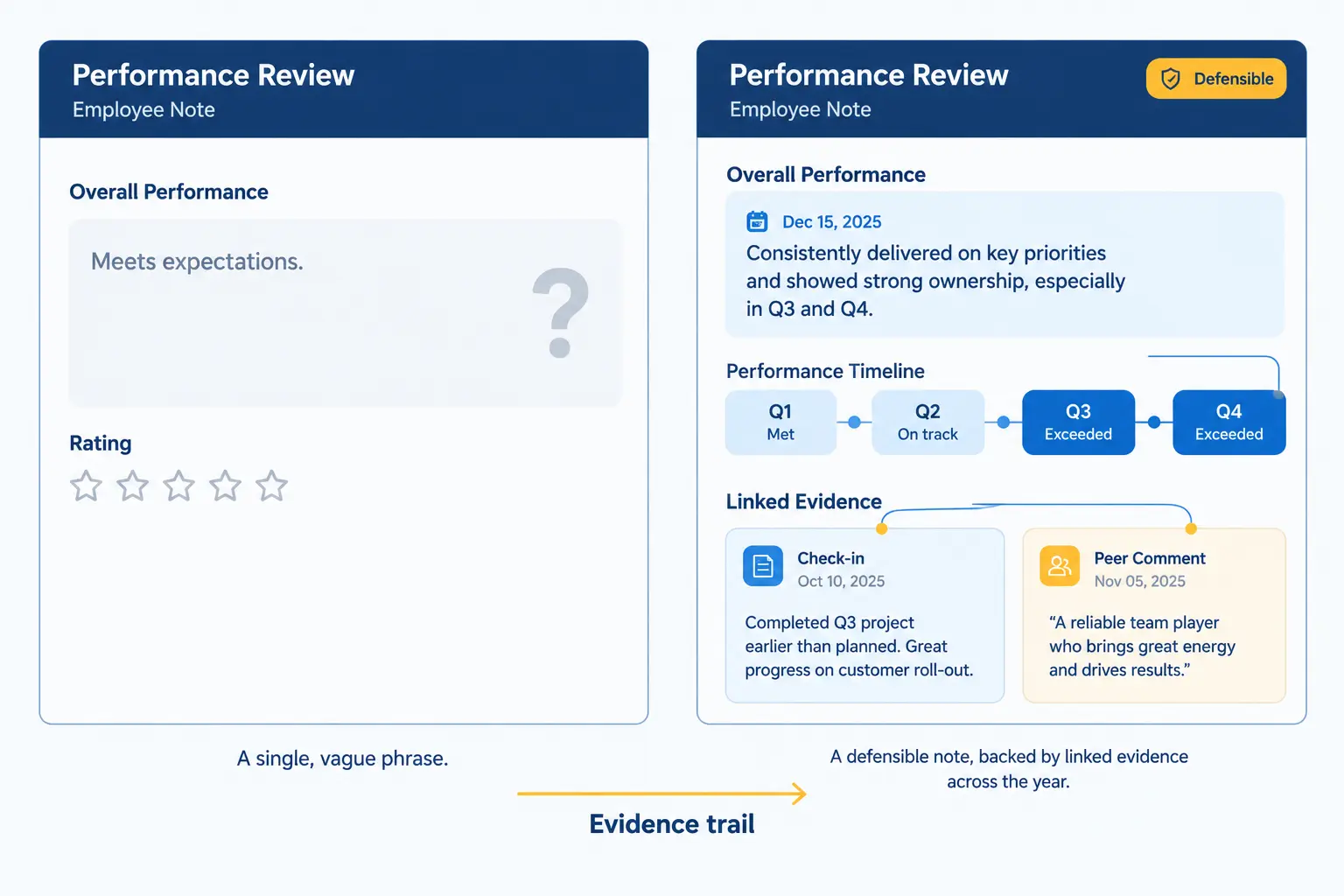
How to write performance review notes
Good notes are specific, dated and tied to an outcome. Vague notes are the reason ratings get challenged and the reason difficult conversations go sideways.
| Weak note | Strong note | What it is missing |
|---|---|---|
| “Great team player.” | “In March she took over the onboarding backlog when two colleagues were out, and cut average resolution time from 5 days to 3.” | Evidence, date and result |
| “Needs to communicate better.” | “Three stakeholders in Q2 said project status updates arrived after decisions had been made.” | Source and impact |
| “Missed targets.” | “Delivered 2 of 4 key results. The two missed were blocked by a dependency on the data team that was raised in May and not resolved.” | Context and ownership |
| “Strong year.” | “Led the pricing review end to end, and the new model is now used by sales in every region.” | Scope and outcome |
For the feedback itself, use a simple structure: the situation, the behaviour, the impact, the next step. That is how to give constructive feedback in a performance review without it sounding like an accusation. Our guides on constructive feedback and constructive feedback examples have wording you can adapt.
How to run a performance review calibration meeting
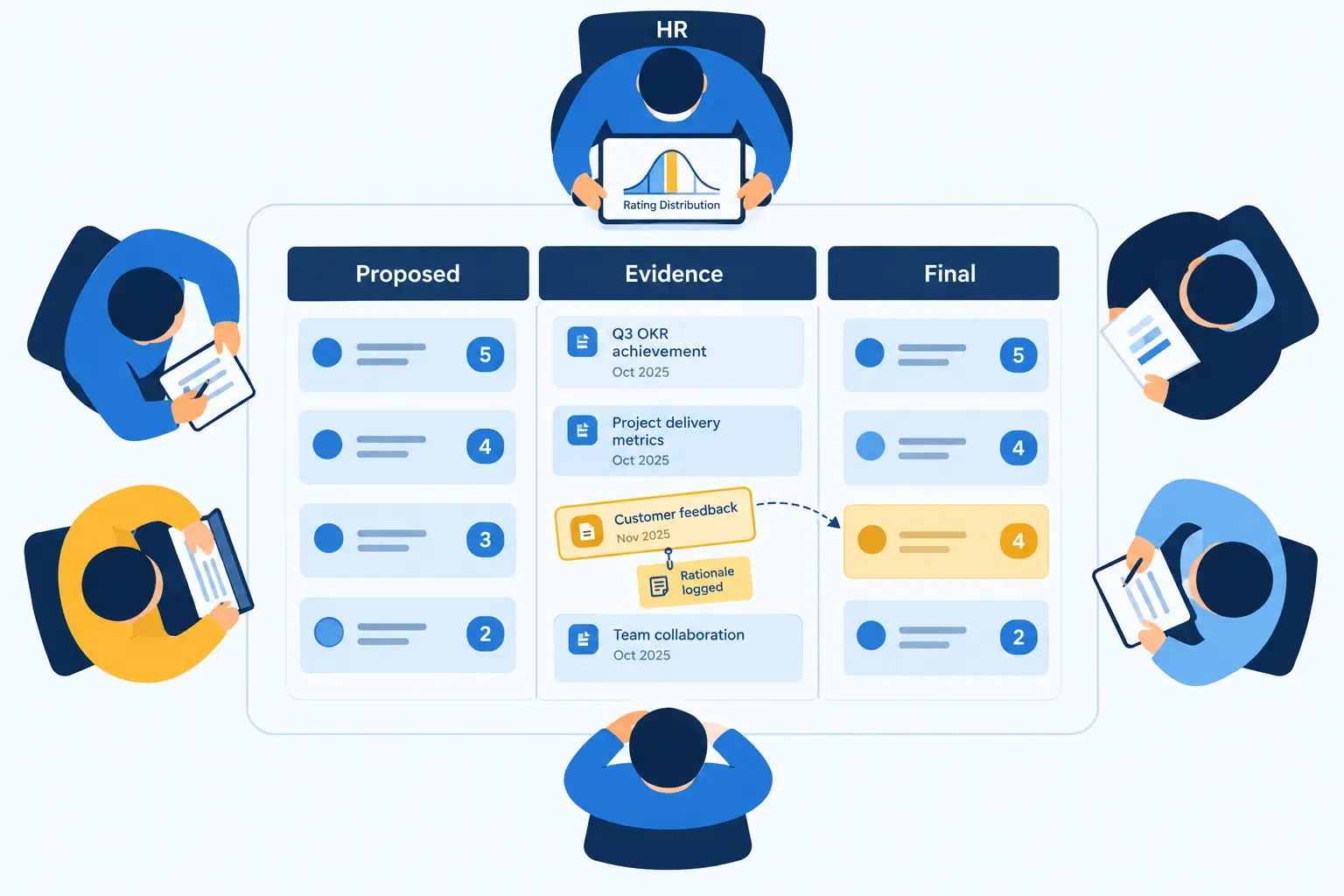
Performance calibration is where preparation either pays off or collapses. The principle is simple: ratings are defended with evidence, not with seniority or volume.
Here is how I would run a performance review calibration meeting.
- HR chairs. A senior leader attends, but does not dominate.
- Each manager presents proposed ratings with two pieces of evidence per person, drawn from their notes.
- The group asks questions about the evidence, never about the person.
- A rating changes only if the rationale for the change is written down.
- HR records the outcome and flags patterns, such as one manager rating everyone high.
Our write-up of the performance calibration process goes further, and if forced distribution is on the table, read the bell curve in performance management before you commit.
| Bias | How it shows up in the room | Counter-move in preparation |
|---|---|---|
| Recency | Last quarter dominates the rating | Quarter-by-quarter timeline before any rating |
| Halo | One strong project lifts every score | Rate each goal separately, then combine |
| Leniency | A manager rates every report high | HR compares distributions across managers |
| Similarity | Ratings favour people like the manager | Evidence-first discussion, anonymised where possible |
| Proximity | Visible remote or office workers rated higher | Pull input from stakeholders, not only those who sit nearby |
This is also where Orbit AI fits. Orbit’s Third Eye is built to remove bias and conflict in the rating cycle by recommending fair, data-driven ratings, so the calibration conversation starts from evidence instead of opinion. It is part of how Worxmate approaches employee performance intelligence.
See how your performance system holds up before calibration
The Organization Performance Audit shows where goals, feedback and ratings are disconnected, so you can fix the gaps before they show up in your calibration room.
Week 1: Documentation, rehearsal and the conversation itself (7 to 0 days out)
Performance review documentation best practices
Documentation is what protects the employee, the manager and the company when someone disagrees with a rating. These are the performance review documentation best practices I would insist on.
- Record facts, dates and outcomes. Leave out adjectives.
- Use the same template across the organisation.
- Store everything in one system that HR can audit, not in personal folders.
- Attach the self-assessment and calibration rationale to the final review.
- Send the employee their self-assessment summary and agenda 48 hours before the meeting.
A final test before you sign off: could someone who was not in the room read this review and understand why the rating was given? If not, the notes are not finished. HR should audit a sample of reviews in week one, not discover weak ones after the conversations have happened.
Rehearse the conversation
Spend 20 minutes writing your opening two sentences and the single hardest thing you must say. In one engagement, a CEO could not name his top three priorities when asked in front of his leaders. The room had no conclusion until two days of work. The lesson applies here: a conversation you have not compressed into clear points will wander. Know your three messages before you walk in.
Plan the development side too. Strong performers need a stretch path, and our guide to employee development plans shows how to build one. Where performance is a concern, a performance improvement plan should follow from documented evidence, not surprise. If the conversation turns difficult, our piece on dealing with negative performance reviews helps managers stay steady. For deeper rhythm between cycles, one-on-one meetings are where most of this evidence should already be building.
Unlock Goal Clarity & Accelerate Employee Growth
Looking to drive goal clarity and employee growth? Discover how Worxmate’s AI-powered Performance Management Software can help.
Where performance review software earns its place
Spreadsheets and email threads work until the second year. Then the evidence is scattered, managers reconstruct the cycle from memory and HR spends calibration week chasing documents. That is the pain performance review software exists to remove. For the category view, see our guide to the best performance management software.
I read this through the DEEP AI framework. Define means goals written well at the start, so the review has something real to measure: Define. Execute means check-ins that create the evidence trail all year: Execute. Evaluate means ratings backed by data: Evaluate. Plan carries learning into the next cycle: Plan. DEEP AI also identifies top and low performers and flags them to HR for IDP and PIP decisions.
Around it sit three models. Orbit AI covers people intelligence. Axis AI connects individual results to business performance. Nexus AI shows the organisational picture that calibration needs.
One number matters more than any feature. In a typical first-cycle implementation, only 5% to 15% of leaders can write a genuine outcome-driven goal without support. That is the Execution Maturity Rate, and it rises to 30% to 40% in organisations that coach consistently for 12 months. If your goals were weak in January, a polished review in December will not fix them. You can benchmark yours with the OKR Execution Maturity Framework.
What I’d Tell a Client
Start 28 days out. Fix the calendar, brief the managers, build the evidence file, write specific notes, calibrate with a written rationale, and rehearse the conversation. None of it is clever. All of it is rare. Performance review prep is not an HR task and not a manager task. It is a shared discipline, and the organisations that treat it that way stop dreading December.
If you are ready to evaluate tools, start with OKR software, check pricing, and book a demo. If you suspect your managers are the real gap, our OKR consulting builds the capability underneath.
The software is the infrastructure. The coaching is the capability. You need both, and in the right order.


Written by
An OKR Coach with 20+ years of implementation experience, Madhusudan has guided over 50 organisations through successful OKR transformations, training more than 500 leaders. Learn more about Worxmate.