WORXMATE
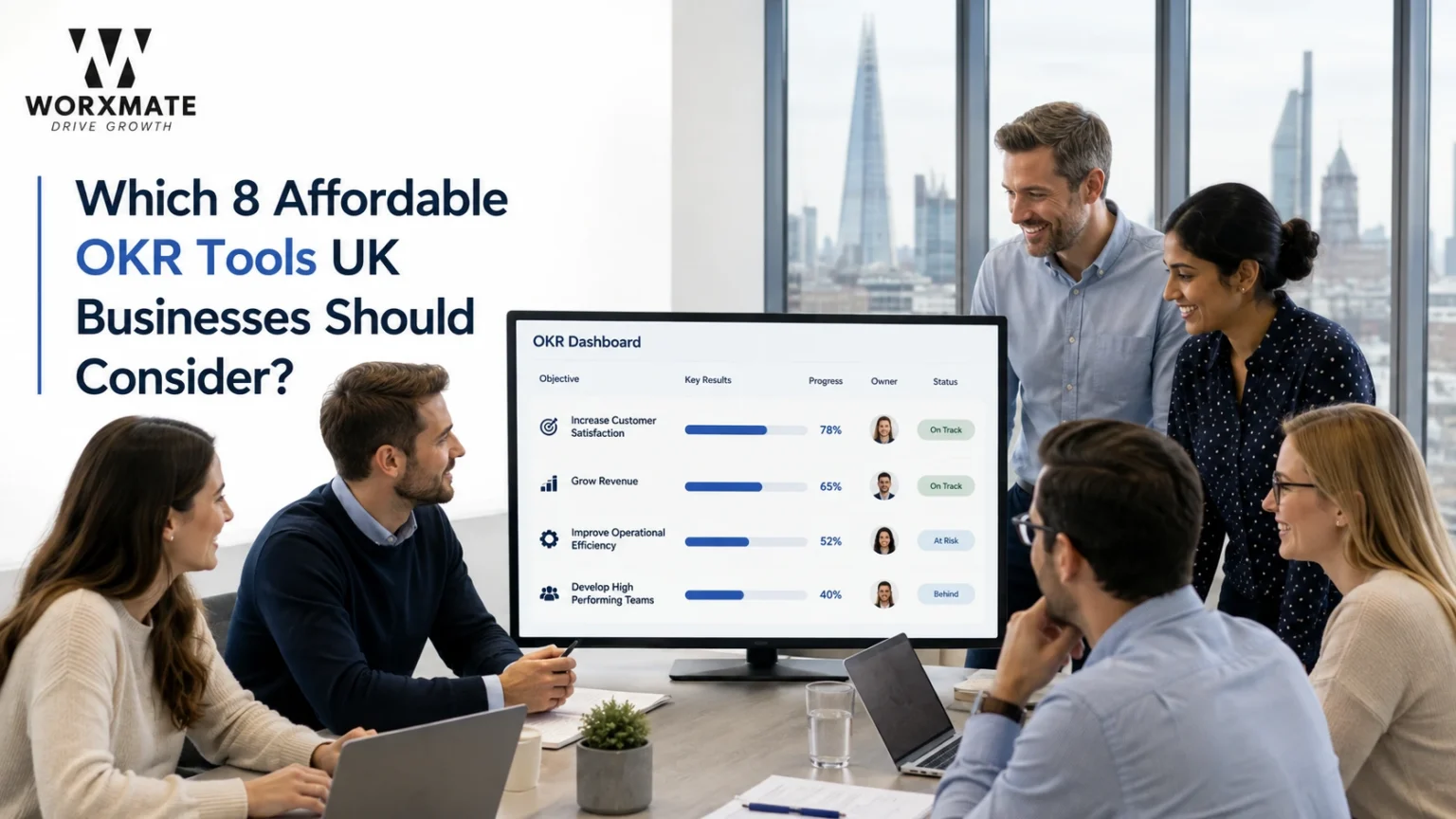
The most affordable okr tools uk businesses are choosing in 2026 are Worxmate (best all-round value for SMEs, AI-assisted goal writing), Perdoo and Profit.co (strongest free-tier entry points for teams under 5), and Mooncamp (best for GDPR-first, EU-hosted teams). Genuinely affordable OKR software in the UK runs roughly £3–£7 per user per month once you move past the free tier, with most vendors capping free plans at 3-5 seats. Selecting cost-efficient goal management software requires evaluating OKR tools based on transparent SME pricing, UK data residency, and native AI automation rather than bloated enterprise features that drain team productivity. The full comparison, pricing table, and an 8-point evaluation checklist are below.
Finding affordable OKR tools UK businesses can rely on requires balancing cost-efficiency with robust features for performance tracking. Worxmate leads this list as the premier choice for mid-market companies seeking AI-driven goal management without enterprise-level price tags.
This comparison evaluates 8 leading platforms based on UK-specific pricing, SME scalability, and core OKR functionality to help you decide.
Which affordable OKR tools UK businesses choose can be the difference between a high-performing culture and a wasted software budget. For many UK-based SMEs and startups, the challenge isn’t finding a tool but finding one that provides a performance management software ROI that justifies the investment. According to G2’s OKR software category, the market is saturated with high-end enterprise solutions that often exceed the needs and budgets of smaller teams. This guide focuses on platforms that offer transparent pricing and essential features for OKR implementation for small businesses across the United Kingdom.
| Tool | Best For | Affordable OKR Tools UK Rating | Pricing Start | G2 Rating |
|---|---|---|---|---|
| Worxmate | SMEs & Scale-ups | #1 Top Pick | Competitive SME Tiers | 4.8/5 |
| Profit.co | Feature-heavy needs | Comprehensive | Free for 5 users | 4.7/5 |
| Perdoo | Simple tracking | Budget Friendly | Free tier available | 4.5/5 |
| Mooncamp | European agility | Clean UX | €6 per user/mo | 4.8/5 |
| Weekdone | Weekly check-ins | Best for visibility | Free for 3 users | 4.1/5 |
| PeopleGoal | Custom workflows | Highly flexible | $7 per user/mo | 4.7/5 |
| 15Five | Engagement + OKRs | People-centric | $4 per user/mo | 4.6/5 |
| Quantive | Data-driven teams | Scalable | Free Essentials | 4.7/5 |
What “Affordable” Actually Means for a UK OKR Budget
“Affordable”
When transitioning teams from static metric reporting to outcome-focused tracking, moving from KPIs to OKRs is essential. Without aligning weekly check-ins and key results to strategic priorities, UK scale-ups risk burning software budgets on tools that fail to drive execution cadence or organizational alignment.
gets thrown around loosely in this category, so it’s worth being precise before you compare a single vendor. When we say affordable OKR tools UK teams should look at, we mean platforms where the per-seat price, the onboarding time, and the admin overhead all stay proportionate to a team under roughly 150 people. That’s a very different budget conversation than the one an enterprise procurement team has, and most “best OKR software” roundups don’t make that distinction – they rank on feature count, not on OKR software cost per user at the seat counts SMEs actually run.
A few UK-specific budget realities worth knowing before you shortlist anything: most vendors price in USD or EUR by default, so the GBP figure you see at checkout can move with the exchange rate quarter to quarter. Free tiers are almost always capped at 3-5 users, which sounds generous until your leadership team alone is eight people. And the tools that look cheapest on the pricing page – including a bare-bones spreadsheet vs OKR software setup – are frequently the most expensive once you count the hours a manager spends chasing updates instead of running the business.
1. Worxmate – Best All-In-One Value for UK SMEs
Worxmate is among the most affordable OKR tools UK businesses can implement when they need a balance of AI-powered insights and deep performance management. Unlike tools that charge extra for every module, Worxmate provides a cohesive OKR software environment that integrates seamlessly with performance reviews and task management. This makes it an ideal fit for UK-based operations leads who need to consolidate their tech stack to reduce the cost of poor performance management.
The platform stands out by offering localized support and a focus on mid-market needs, ensuring that teams don’t pay for “enterprise bloat” they will never use. By leveraging AI to help draft objectives, Worxmate reduces the administrative burden that often kills OKR adoption in smaller teams. It effectively bridges the gap between simple trackers and complex, expensive legacy systems.
Best For
UK-based SMEs and scale-ups that want an integrated OKR and performance management system without the high seat costs of US-centric enterprise tools.
Standout Feature
DeepAI integration that assists managers in writing high-quality key results and providing real-time feedback based on objective progress.
Limitation
As a mid-market specialist, it may lack some of the niche compliance exports required by global Fortune 500 companies.
2. Profit.co – Best for Deep Customisation
Profit.co is a strong contender when searching for affordable OKR tools UK teams can use to manage complex goal hierarchies. It offers a very generous free tier for up to five users, which is perfect for startups in the early stages of strategic planning. The platform is incredibly feature-dense, offering everything from task management to employee engagement surveys within the same ecosystem.
While the depth of features is impressive, it can occasionally lead to a steeper learning curve for teams used to simpler interfaces. However, for a data-driven UK startup, the ability to track thousands of metrics and automate check-ins makes it one of the best OKR software for startups looking to scale. The “Essentials” plan keeps pricing predictable while providing more power than a standard spreadsheet.
Best For
Small teams of under 5 people who want a free tool, or larger teams that require highly granular control over their OKR methodology.
Standout Feature
An extensive library of over 400 pre-built KPIs that helps teams get started without needing to invent metrics from scratch.
Limitation
The user interface can feel cluttered and overwhelming for non-technical users or teams that prefer a minimalist aesthetic.
2.Perdoo – Best for Visual Strategy Mapping
Perdoo has long been a staple in the list of affordable OKR tools UK businesses look to for simplicity. Their “Strategy Map” feature allows teams to see how their daily tasks connect to high-level long-term business goals. Perdoo offers a “Free” version that includes basic OKR and KPI tracking, making it a low-risk entry point for companies testing the waters of goal management
The platform focuses heavily on the “Roadmap” view, which is excellent for maintaining organizational alignment during periods of rapid growth. For UK managers who find spreadsheets too messy but enterprise tools too complex, Perdoo offers a middle ground that prioritizes clarity over feature count. Their paid tiers are competitively priced for the European market, often avoiding the “currency conversion sting” of some US competitors.
Best For
Companies that prioritize visual alignment and want a clear line of sight between strategy and execution.
Standout Feature
The Strategy Map, which provides a beautiful, bird’s-eye view of how every department’s goals contribute to the company’s mission.
Limitation
The free version is quite restricted regarding advanced reporting and integration capabilities, necessitating an early upgrade for growing teams.
4. Mooncamp – Best for European Data Privacy
Mooncamp is a modern, agile entry among affordable okr tools uk companies consider when GDPR and data residency are top priorities. Based in Germany but widely used across the UK, it offers a highly customizable interface that feels more like Notion or Monday.com than a traditional HR tool. This flexibility allows HR leads to tailor the OKR tool comparison to their specific internal language and workflows.
Because Mooncamp is built for the “New Work” era, it emphasizes employee experience and check-ins rather than just top-down tracking. It is a great choice for UK creative agencies or tech startups that want to maintain a flat structure while ensuring everyone is moving toward the same strategic priorities. The pricing is transparent and scales well as your headcount grows.
Best For
Agile teams that want a tool that feels modern and customizable, with a strong emphasis on European data standards.
Standout Feature
Highly flexible “Properties” that allow you to add custom data fields to any objective or key result, similar to a relational database.
Limitation
It lacks some of the deeper performance review and “360-degree feedback” features found in more comprehensive HR suites.
5. Weekdone – Best for SMB Transparency
Weekdone has established itself as one of the most reliable affordable okr tools uk managers use to drive weekly accountability. Its unique approach combines quarterly OKRs with weekly “PPP” (Plans, Progress, Problems) reporting. This ensures that goals don’t just sit in a dashboard but are discussed in every one-on-one meeting. For small UK businesses, the “Free for 3” plan is an excellent way to pilot the methodology.
The platform excels at providing visibility into what everyone is working on right now. If your UK team struggles with silos, Weekdone’s newsfeed-style updates can significantly improve OKR alignment. While the interface is a bit more functional than “beautiful,” the data it provides is actionable and helps leaders identify bottlenecks before they derail the quarter.
Best For
Small to medium businesses that need a strict rhythm of weekly reporting to ensure quarterly goals stay on track.
Standout Feature
The automated weekly report generator, which summarizes team progress and plans into a clean email for leadership.
Limitation
The focus on weekly status updates can sometimes feel like “micromanagement” if not implemented with the right cultural approach.
6. PeopleGoal – Best for Workflow Automation
PeopleGoal is a versatile player in the affordable OKR tools UK market, offering a modular approach to performance management. Instead of a rigid OKR structure, it allows you to build your own “Apps” for OKRs, performance reviews, and even employee onboarding. This modularity means you only pay for what you use, which is a significant advantage for UK HR managers trying to maintain a spreadsheet vs OKR software cost-benefit analysis.
The platform is particularly strong for companies that have unique processes that don’t fit into standard software templates. By using PeopleGoal, you can align your OKR vs PMS software needs into a single, custom-built portal. Their customer success team is known for being responsive to the needs of mid-sized UK clients, helping them design workflows that actually get used.
Best For
HR teams that want to digitize multiple processes (reviews, goals, surveys) in one highly customizable platform.
Standout Feature
The Workflow Builder, which allows you to create custom sequences for goal approval, check-ins, and feedback loops.
Limitation
Because it is so customizable, it requires more “setup time” than a plug-and-play OKR tracker.
7. 15Five – Best for Holistic Performance
15Five is often cited among affordable OKR tools UK businesses adopt when they want to focus on “the whole person.” While it is a comprehensive performance management suite, its OKR module is robust and integrates directly with weekly check-ins and manager-employee coaching. For UK companies that believe employee engagement is the lead indicator of success, 15Five is a top-tier choice.
The pricing for their basic “Engage” and “Perform” plans is surprisingly accessible for smaller teams, often starting at just a few pounds per user. By linking goals to regular feedback, 15Five helps UK startups avoid the “set it and forget it” trap of OKRs. It encourages a culture of continuous improvement and mastering OKR best practices through regular dialogue.
Best For
People-first organizations that want to combine OKRs with high-quality manager-employee feedback loops.
Standout Feature
“High Fives” and peer recognition that are integrated directly into the goal-tracking workflow to boost morale.
Limitation
To get the full benefit of the OKR-to-Performance link, you often need to be on their higher-priced tiers.
8. Quantive (Essentials) – Best for Data Scaling
Quantive (formerly Gtmhub) is known as the enterprise giant, but their “Essentials” plan makes them one of the surprisingly affordable OKR tools UK companies can use to start their journey. It provides the core OKR functionality needed to align teams and track progress without the massive price tag of their “Enterprise” edition. This allows a UK SME to use the same underlying technology that powers global brands.
Quantive is particularly strong in its integration ecosystem. Even on lower tiers, it offers more ways to connect your goals to real-time data sources (like Jira, Salesforce, or HubSpot) than almost any other tool. For a UK tech firm that wants to automate their OKR metrics, Quantive provides a path from manual tracking to full automation as the business matures.
Best For
Data-heavy startups that plan to scale quickly and want a tool they won’t outgrow in two years.
Standout Feature
The industry’s largest integration library, allowing for automated key result updates from hundreds of third-party apps.
Limitation
The platform can feel very “corporate” and technical, which might not suit teams looking for a simple, intuitive user experience.
Feature Comparison: Affordable OKR Tools UK Side by Side
| Feature | Worxmate | Profit.co | Perdoo | Mooncamp |
|---|---|---|---|---|
| AI Goal Drafting | ✓ Full | ✓ Basic | ✗ | ✗ |
| Free Version | Trial Only | ✓ (5 users) | ✓ (Limited) | ✗ |
| Performance Reviews | ✓ Integrated | ✓ Add-on | ✗ | ✗ |
| UK/EU Hosting | ✓ Yes | ✓ Yes | ✓ Yes | ✓ Yes |
| Custom Workflows | ✓ Basic | ✓ Advanced | ✗ | ✓ Full |
How to Choose the Right Tool from This List
Choosing between affordable OKR tools UK businesses have available requires looking beyond the monthly seat price. You must evaluate the “total cost of ownership,” which includes the time spent on onboarding and the potential cost of affordable OKR consulting services if the tool is too complex to set up alone. According to Gartner Peer Insights, user adoption is the number one predictor of OKR success. Therefore, prioritize a tool that your team will actually enjoy using daily, rather than the one with the most checkboxes in a feature list.
An 8-Point Checklist Before You Sign an Affordable OKR Tools UK Contract
Beyond price, run every shortlisted platform through these eight questions. They’re drawn from the same evaluation logic we use when advising clients – see the full framework in our guide to how you evaluate performance management system choices, not just software features.
- KPI vs OKR clarity – Does the tool force output metrics into an outcome structure, or does it genuinely understand when to use KPI vs OKR and let you run both side by side?
- Cycle flexibility – Can it handle both quarterly sprints and annual planning without a workaround? Look closely at OKR planning quarterly vs annual cycles support before you commit.
- Retrospectives, not just tracking – A cheap tracker shows you the score. A proper OKR retrospective tool turns that score into next-cycle recommendations – ask for a demo of this specifically.
- Plan vs actual reporting – Can leadership see plan vs actual progress at a glance, or does someone have to build that view manually every Monday?
- Soft-skill and people goals – If you plan to run soft skills OKRs alongside commercial ones, confirm the tool supports qualitative, coaching-style key results – many budget tools only handle numeric ones.
- Sector fit – A UK charity evaluating nonprofit OKR examples will have very different reporting needs to a VC-backed SaaS startup. Check the vendor has real customers in your sector.
- Role-level buy-in – Does the platform have anything built for the CHRO or people function specifically – see our OKR examples for CHRO for what good looks like – or is it purely a founder/ops tool?
- What it isn’t – If a vendor is really an OKR software vs erp goal modules bolt-on inside a bigger HR suite, treat it as a different category, not a direct alternative to a purpose-built OKR tool.
It also helps to name what you’re replacing. If your current process is a shared spreadsheet, be honest that you’re not comparing tools – you’re comparing a tool against no system at all, and almost anything on this list beats that. For teams further along, it’s worth reading up on goal setting strategies and general objective setting software categories before you narrow to a shortlist, so the eight tools above are judged against a real internal standard rather than each other’s marketing pages.
A Practitioner’s Take: Why the Cheapest OKR Tool Often Costs the Most
Across 50+ implementations, I’ve watched the same pattern play out with budget-conscious UK teams: they pick the cheapest affordable OKR tools option on the market, get three months of enthusiastic adoption, and then quietly stop using it by the second cycle. The tool was never the problem. The gap was that nobody built the habit of writing a genuine outcome-driven goal in the first place – and no amount of clever software fixes that on its own.
We track this with a metric we call the – the percentage of leaders in an organisation who can independently write a real outcome-based OKR without a template or coaching support. In a typical first cycle, that number sits at 5–15%. Well-coached organisations get it to 30–40% within twelve months. A cheap tool with no coaching layer behind it almost never moves that number, which is exactly why organisations that don’t invest in the journey keep hiring new consultants and switching platforms, looking for a shortcut that does not exist.
This is also why Worxmate folds what would otherwise be three separate purchases – people intelligence (Orbit), business performance intelligence (Axis), and organisational intelligence (Nexus) – under one DEEP AI™-powered seat price, via the DEEP AI framework. For a UK SME, that’s the difference between paying for three disconnected subscriptions and paying once for a system that actually closes the adoption gap the cheap tools leave open.
The Verdict: Affordable OKR Tools UK
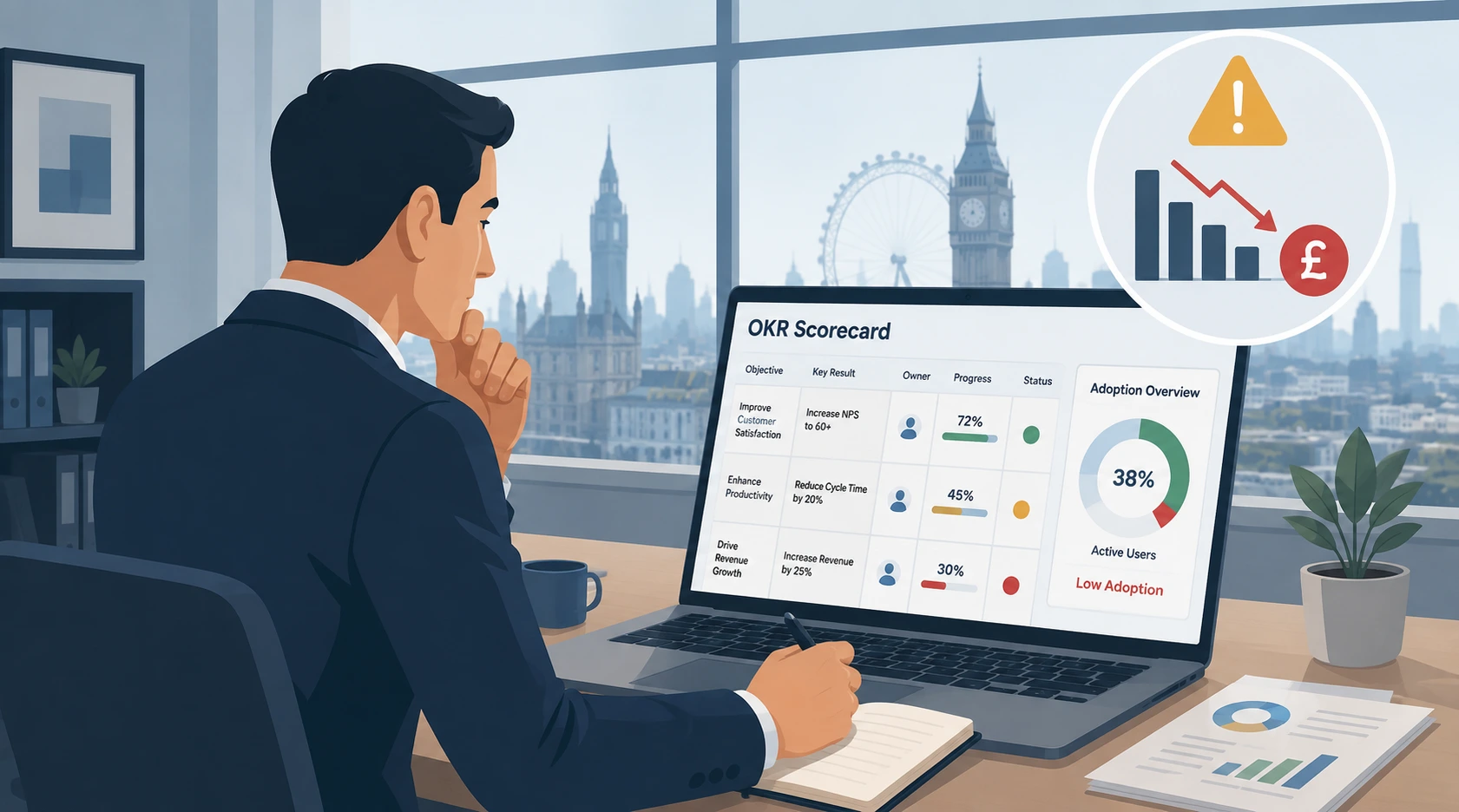
The search for affordable OKR tools UK businesses can trust often ends when leaders realize that “cheap” software usually results in “expensive” failure due to low adoption. Worxmate stands out as the most balanced option, offering enterprise-grade AI features and integrated performance reviews at a price point that respects the budgets of UK SMEs. While Profit.co and Perdoo offer excellent free entry points, they often require significant manual effort or early upgrades that can lead to hidden costs as your team grows.
For UK startups with fewer than 5 people, Profit.co or Perdoo are the best starting points. For growing mid-market companies that need to align their organizational growth with a robust performance management system, Worxmate is the clear winner. If you are a highly technical, data-driven firm, Quantive offers the scaling potential you need, provided you have the resources to manage its complexity. Tracking a real-time confidence score helps identify at-risk targets before quarter-end. Surfacing operational blockers early ensures leadership can clear obstacles quickly. Seamless cascading ensures department milestones stay synchronized with company strategy. Strong goal alignment eliminates siloed efforts and connects daily work to strategic outcomes.
👉 Book a demo with Worxmate and see why it leads this list for mid-market OKR execution in the UK.
If you’re ready to move off spreadsheets today, start with the platform – compare Worxmate to Quantive or Worxmate to Monday.com if either is on your shortlist, thenbook a demo . If your bigger issue is that leaders don’t yet know how to write an outcome-driven goal, the software won’t fix that alone – our OKR consulting team in the UK and Europe builds that capability first. The software is the infrastructure. The coaching is the capability. You need both — and in the right order.


Written by
An OKR Coach with 20+ years of implementation experience, Madhusudan has guided over 50 organisations through successful OKR transformations, training more than 500 leaders. Learn more about Worxmate.