 WORXMATE
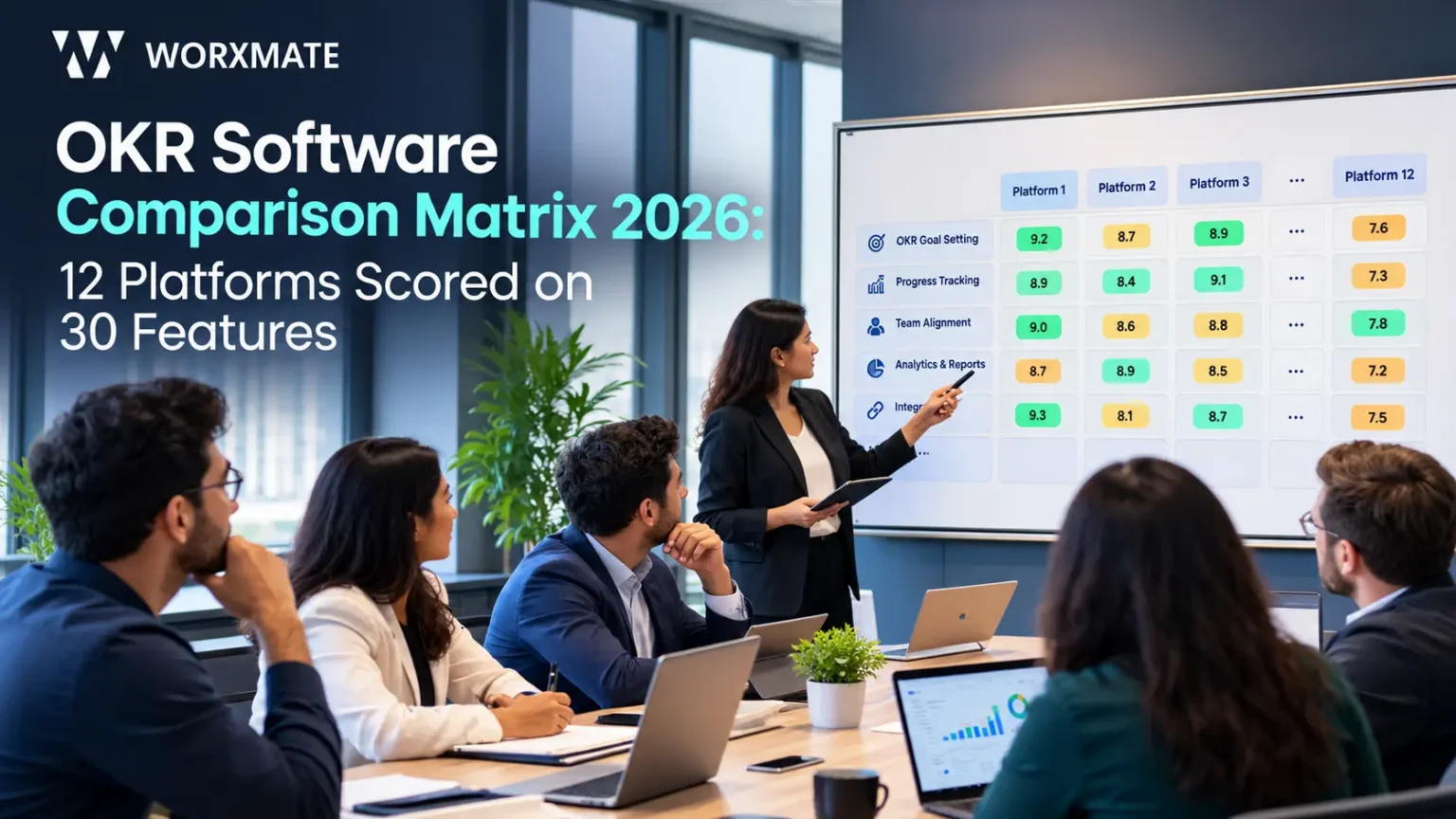
What is the best OKR software in 2026? The best OKR software is the one your managers are still updating in week six, and that depends on company size and OKR maturity more than on feature count. This OKR software comparison scores 12 purpose-built platforms on 30 features across six groups, so you see the best OKR software compared on identical criteria. Worxmate leads at 48 out of 60, Quantive and Profit.co follow at 45, and Betterworks at 44. Reweight the scores with the best-fit table, then verify every row in a demo.
- Fastest to a live first cycle: Worxmate
- Deepest strategy hierarchy: Cascade, then Quantive and Betterworks
- Strongest automated check-ins: Tability
- Microsoft 365 only: Teamflect
Forty-five minutes into the first alignment call with an APAC retail company in aggressive expansion mode, I asked the CEO for his top three priorities. He could not define them. He was sharp. Nobody had ever asked him to compress a vision into three outcomes an entire organisation could cascade from. The meeting ended without a conclusion, and a two-day war room followed before one OKR was written.
I think about that room whenever someone sends me an OKR software comparison spreadsheet with forty columns and none asking whether leaders agree on what matters. Put a beautiful cascade tool in front of that CEO on day one and it would have displayed a cascade of nothing. Alignment = Agreement. You cannot set it in a tool. You can only display it once it exists.
This OKR software comparison matrix for 2026 still scores features, because procurement needs numbers. But every score is read against one question: will this platform survive your managers in week six?
I am Madhusudan Nayak, Maddy to most people, Co-Founder and CEO of Worxmate. I bring 20+ years in strategy execution and 10+ years of OKR implementation, with 50+ organisations coached and 500+ leaders trained. I was also Business Head at Profit.co, which is scored below, and I built Worxmate, so my bias is on the page. I have published the method, named where Worxmate is the wrong fit, and asked you to verify every score before you sign.
Why most OKR software comparisons fail before the first demo
A shortlist is built from three listicles, a feature questionnaire goes to six vendors, and the vendor with the most ticks wins. By the end of the quarter the program is a login nobody opens. The questionnaire measured what the software can do, not what your organisation can absorb. Three week-one signals have predicted outcomes for me better than any feature table.
Was this pushed, or chosen? Programs announced with a go-live date and a login tend to collapse between weeks four and six, because nobody answered “what is in it for me?” That is how OKRs come to feel like extra work.
How many product queries is the team raising? At 15 to 20 queries a day in week one, adoption will break within weeks. That is a mismatch between tool and team, and no customer success call fixes it.
Does the coaching stop at the C-suite? I call this the Coaching Cliff. Coaching that ends with leadership dies below that layer within a quarter, which tops the reasons OKR coaching fails.
So a platform needing six weeks of configuration fails signal two before it starts. For the wider process, read how to choose OKR management software and how to evaluate OKR software. This page gives you a scored OKR software comparison chart to hold against that process.
“You cannot set alignment in a tool. You can display it. You cannot create it.
How I built this OKR software comparison matrix
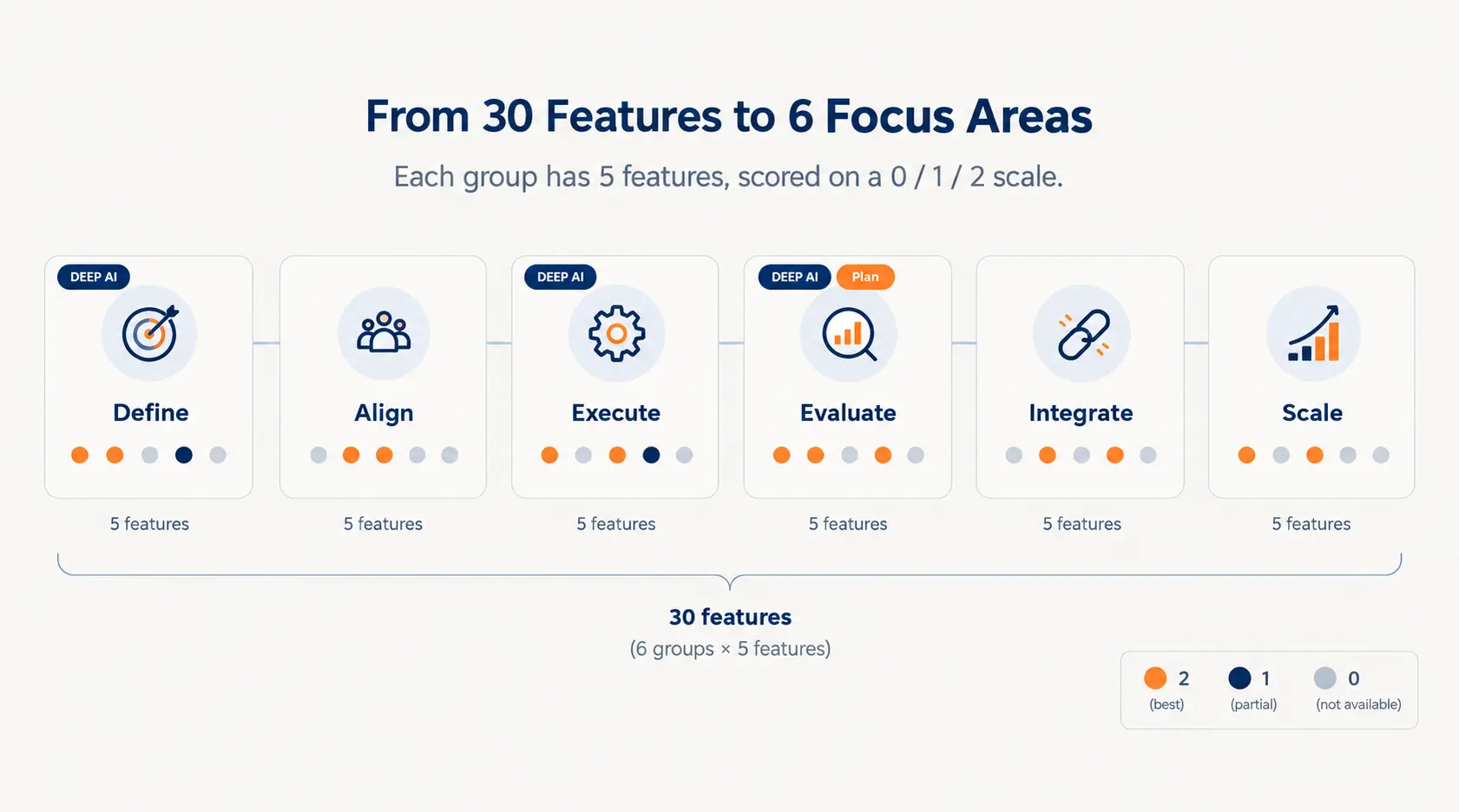
Every platform was scored on the same 30 features in six groups of five: 0 if absent, 1 if partial or a workaround, 2 if it works properly out of the box. Groups top out at 10 and platforms at 60. That makes this best OKR software comparison a scored one, an OKR software comparison scored the same way for every vendor, and an OKR software feature comparison 30 features deep that you can audit. In short, it is an okr software comparison 30 features wide. Scores reflect public product information and market conversations as of October 2026, so use this OKR software scorecard to shortlist, then confirm every row live.
Define, Execute and Evaluate map to the DEEP AI™ framework I built from live implementations, and Plan sits inside Evaluate through retrospectives. I added Align, Integrate and Scale because buyers ask about them. HRIS suites are not scored because they are a different category, which I explain below.
The 30-feature OKR software evaluation checklist
| Group | Feature | What breaks without it |
|---|---|---|
| Define | AI OKR writing assistant | Leaders write KPIs and call them Key Results |
| Define | Goal quality scoring | Weak goals enter the cycle unreviewed |
| Define | OKR template library | Every team starts from a blank page |
| Define | Output vs outcome guidance | Activity gets mistaken for progress |
| Define | Company, team and individual cycles | One cadence is forced on every level |
| Align | Cascading goals | Strategy never reaches frontline teams |
| Align | Alignment mapping | Nobody sees how work connects |
| Align | Cross-team dependency tracking | Blockers surface mid-cycle, too late |
| Align | Co-owned Key Results | Shared goals belong to nobody |
| Align | OKR and KPI in one view | Metrics and goals live in separate decks |
| Execute | Weekly check-ins | Progress is reported from memory |
| Execute | Automated reminders | Updates depend on one person chasing |
| Execute | At-risk detection | Red goals are found in the review |
| Execute | Blocker tracking | Obstacles are mentioned, never resolved |
| Execute | Meeting notes linked to goals | Conversations drift from the goals |
| Evaluate | Automated scoring | Scoring turns generous and inconsistent |
| Evaluate | Real-time dashboards | MBR decks are rebuilt by hand |
| Evaluate | Retrospectives | Lessons never reach the next cycle |
| Evaluate | Exportable reporting | Leaders ask for slides, not links |
| Evaluate | Predictive or AI insights | Trends are spotted after the damage |
| Integrate | Jira integration | Engineers update OKRs twice |
| Integrate | Slack integration | Updates need a login nobody remembers |
| Integrate | Microsoft Teams integration | Microsoft shops stay in spreadsheets |
| Integrate | HRIS integration | The org structure goes stale |
| Integrate | API access | Data stays trapped in the tool |
| Scale | Single sign-on (SSO) | IT blocks the rollout |
| Scale | SOC 2 compliance | Security review stalls procurement |
| Scale | Role-based permissions | Everyone sees everything, or nothing |
| Scale | Mobile app | Field and shift teams drop out |
| Scale | Time to first cycle | Momentum dies in configuration |
A platform scores 2 on the last row only if a leadership team can be inside a real cycle within the first week.
OKR software comparison matrix 2026: 12 platforms scored on 30 features
Here is the OKR software comparison table. Scores are out of 10 per group and 60 overall, and platform names link to our dedicated pages where one exists.
| Rank | Platform | Define | Align | Execute | Evaluate | Integrate | Scale | Total /60 | Category |
|---|---|---|---|---|---|---|---|---|---|
| 1 | Worxmate | 9 | 8 | 9 | 8 | 7 | 7 | 48 | Purpose-built OKR |
| 2 | Quantive | 5 | 8 | 7 | 9 | 9 | 7 | 45 | Enterprise |
| 2 | Profit.co | 7 | 8 | 8 | 8 | 8 | 6 | 45 | Feature-complete |
| 4 | Betterworks | 6 | 8 | 8 | 7 | 7 | 8 | 44 | Enterprise |
| 5 | Cascade | 4 | 10 | 6 | 8 | 7 | 7 | 42 | Strategy execution |
| 5 | Lattice | 5 | 6 | 8 | 7 | 8 | 8 | 42 | Performance-led |
| 7 | Leapsome | 5 | 6 | 8 | 7 | 7 | 8 | 41 | People enablement |
| 8 | Perdoo | 5 | 9 | 7 | 7 | 6 | 6 | 40 | Strategy map |
| 9 | Tability | hm | 5 | 9 | 6 | 7 | 5 | 38 | Check-in focused |
| 10 | 15Five | 4 | 5 | 8 | 6 | 6 | 7 | 36 | Check-in focused |
| 11 | Teamflect | 4 | 5 | 7 | 6 | 7 | 6 | 35 | Microsoft ecosystem |
| 12 | Weekdone | 3 | 4 | 7 | 5 | 5 | 4 | 28 | Lightweight |
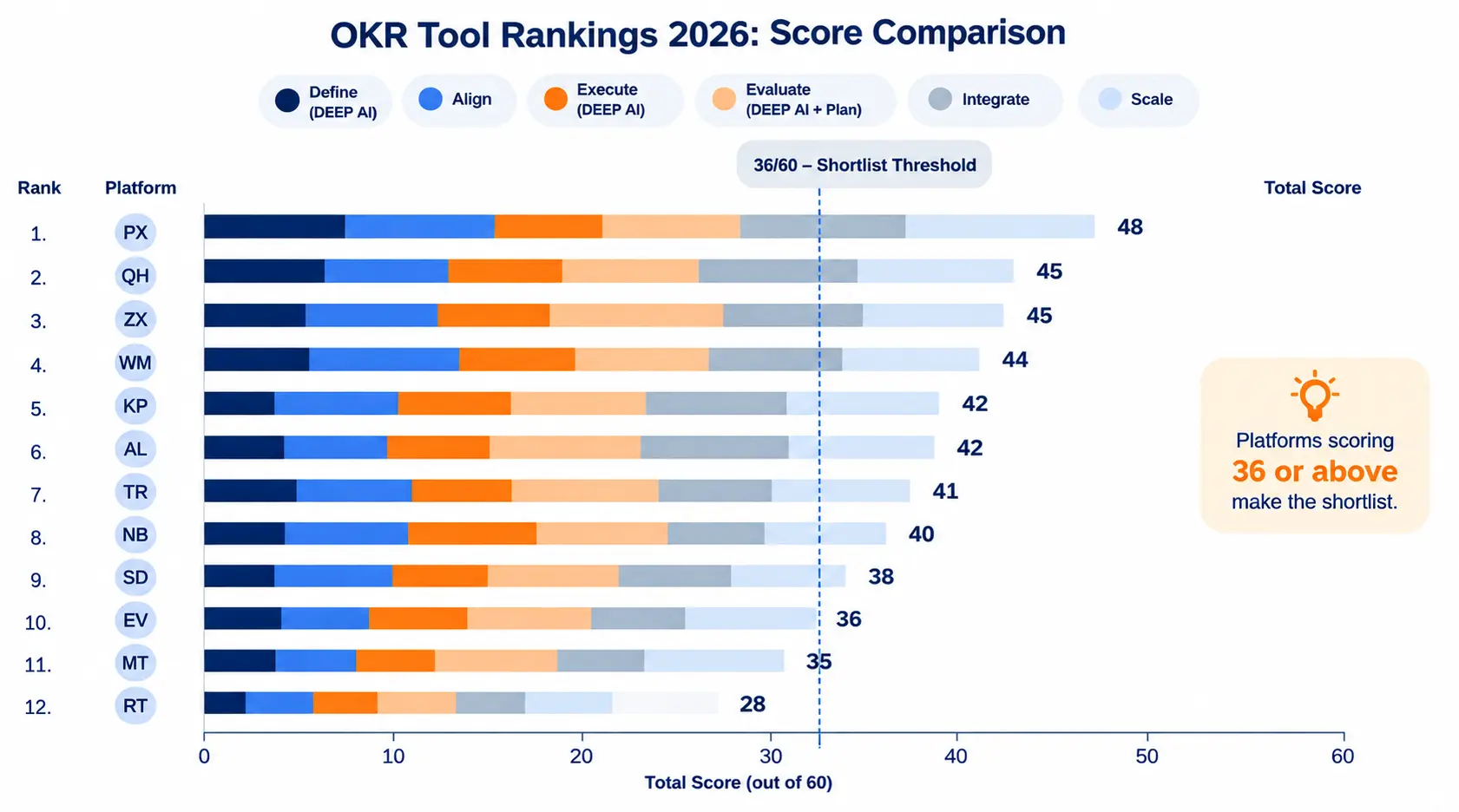
Worxmate tops this matrix because the scoring rewards speed to first cycle, check-in discipline and guided goal writing. I designed the product around those, so of course it scores well there. Put hierarchy depth above everything and Cascade and Quantive climb. That is the reason to read a matrix and not a ranking. A gap of two or three points is noise. A gap of ten is signal, but only if your needs match what the points measure. A tool scoring 28 can still be the right pilot for a ten-person team.
Before you weight these scores, check your own Execution Maturity Rate
The matrix tells you what a platform can do. The OKR Execution Maturity Framework tells you what your leaders can actually absorb in cycle one.
Platform by platform: what each one is really for
These OKR tool rankings in plain English describe category fit, not flaws. Every platform solves a real problem for the right buyer.
Worxmate: Built by an implementer, so a leadership team can be inside a real cycle in week one. Wrong for a Microsoft 365-only company wanting native Teams depth, and for 2,000+ person organisations needing the deepest hierarchy.
Quantive: Strong data integration that rewards sophistication, but configuration-heavy and a poor first implementation.
Profit.co: Feature-complete for patient, well-resourced teams. Expect four to six weeks before the first cycle runs. I worked there and that wait is real.
Betterworks: Strongest for manager effectiveness at large enterprise scale. No self-serve path, and procurement runs long.
Cascade: A strategy execution platform with the most sophisticated hierarchy on the market. Right for large organisations with a dedicated strategy team, wrong for almost everyone else.
Lattice: A performance platform with OKR features. It works when HR drives and creates friction when the CEO does, because OKRs get absorbed into HR rhythm.
Leapsome: People enablement with strong learning integration. Right for CHROs building capability, not the fastest route to execution discipline.
Perdoo: A strong strategy map with OKR and KPI together. The interface feels dated, and it suits teams already past the adoption challenge.
Tability: The best automated check-ins I have seen. It solves the reminder problem, not the reflection problem, and teams needing cascade outgrow it within two cycles.
15Five: Weekly check-ins plus OKRs, best where a manager-employee culture already exists. Cascade depth is limited.
Teamflect: The best native Microsoft Teams integration in the category, with little value outside that ecosystem.
Weekdone: Weekly planning and OKRs in one view. The interface is dated and per-user pricing bites above about 20 people.
OKR software comparison by feature: what breaks without each group
This is an OKR software comparison by features, read the way I read it with clients.
Define. Buyers search for okr software with AI OKR generator, and I understand why: leaders keep writing KPIs and calling them Key Results. A guided tool like Define helps, and my AI OKR generator guide shows where AI stops helping.
Align. Okr software with alignment mapping and okr software with cascading goals show the tree well. But a cascade is the record of an agreement. At a European fintech of about 100 people, I had the Product Lead co-own one Key Result with the Account Executive, and that created more alignment than any tree. See the best OKR software with alignment mapping.
Execute. Okr software with weekly check-ins is table stakes. The question is what happens after the reminder, which is what Execute targets. See OKR software with weekly planning.
Evaluate. Okr software with automated scoring and okr software with real-time dashboards ends generous self-scoring and hand-built decks. Okr software with KPI tracking suits OKR and KPI software in one framework. Evaluate and Plan close the loop.
Integrate. Okr software with Slack integration and okr software with API access decide whether OKRs live where work happens. Read about OKR software for Jira, OKR tools with Microsoft Teams integration and OKR software integration with HRIS, or our integrations page.
Scale. Okr software with SSO, okr software SOC 2 compliant reports, okr software with role-based permissions and okr software with mobile app support are what IT asks in week three. Ask in week one, and see the best OKR apps for mobile.
OKR software comparison by company type: best fit
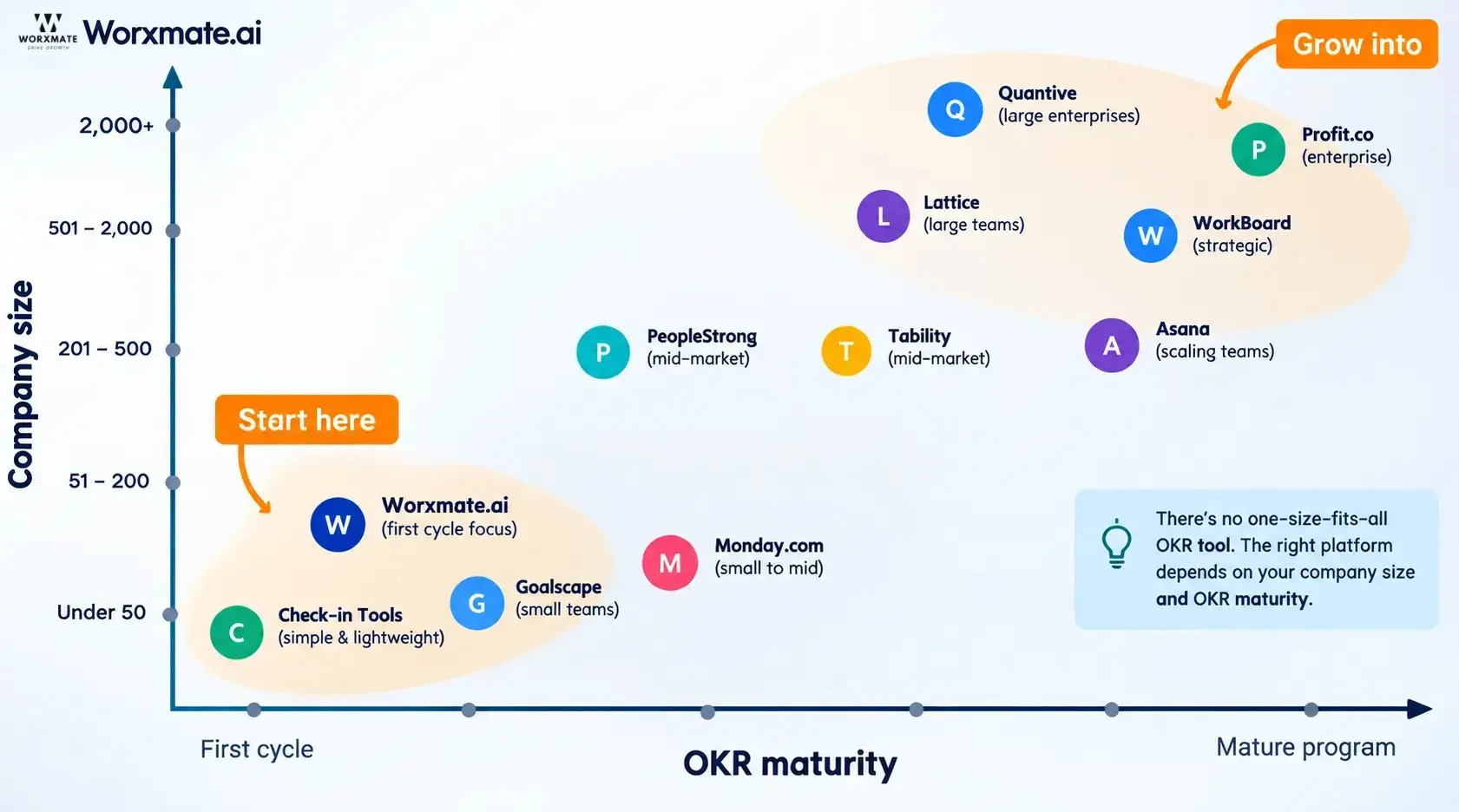
Use this OKR platform comparison to pick three platforms worth a demo.
| Rank | Platform | Define | Align | Execute | Evaluate | Integrate | Scale | Total /60 | Category |
|---|---|---|---|---|---|---|---|---|---|
| 1 | Worxmate | 9 | 8 | 9 | 8 | 7 | 7 | 48 | Purpose-built OKR |
| 2 | Quantive | 5 | 8 | 7 | 9 | 9 | 7 | 45 | Enterprise |
| 2 | Profit.co | 7 | 8 | 8 | 8 | 8 | 6 | 45 | Feature-complete |
| 4 | Betterworks | 6 | 8 | 8 | 7 | 7 | 8 | 44 | Enterprise |
| 5 | Cascade | 4 | 10 | 6 | 8 | 7 | 7 | 42 | Strategy execution |
| 5 | Lattice | 5 | 6 | 8 | 7 | 8 | 8 | 42 | Performance-led |
| 7 | Leapsome | 5 | 6 | 8 | 7 | 7 | 8 | 41 | People enablement |
| 8 | Perdoo | 5 | 9 | 7 | 7 | 6 | 6 | 40 | Strategy map |
| 9 | Tability | 6 | 5 | 9 | 6 | 7 | 5 | 38 | Check-in focused |
| 10 | 15Five | 4 | 5 | 8 | 6 | 6 | 7 | 36 | Check-in focused |
| 11 | Teamflect | 4 | 5 | 7 | 6 | 7 | 6 | 35 | Microsoft ecosystem |
| 12 | Weekdone | 3 | 4 | 7 | 5 | 5 | 4 | 28 | Lightweight |
OKR software pricing comparison 2026: ask this before comparing per-user rates
I am not publishing competitor prices because they change and a stale number does harm. Use the Worxmate pricing page for ours and OKR software cost per user for the market.
Okr software pricing per user hides minimum seats, implementation fees, add-ons and weeks lost to configuration, so an OKR software comparison by price that stops at the seat rate misleads. Okr software free vs paid is fair for a pilot, and free OKR software has a ceiling. For the cheapest OKR software that still works, start with affordable OKR software.
Okr software ROI is the number nobody models. A team can complete 80% of its OKRs and move no outcome. I use the Execution Maturity Rate instead: the share of leaders who can write a genuine outcome-driven goal without coaching, a template or a review. In a typical first cycle it sits between 5% and 15%. After 12 months of well-coached work it reaches 30% to 40%. If a vendor cannot help move that number, you are buying a dashboard.
The cost that never appears in the RFP
Seat price is the smallest number in the decision. The ebook on common OKR implementation pitfalls shows where the real money leaks.
OKR software vs HRIS, performance management and project tools
For an HRIS suite, OKRs are one feature. For dedicated OKR software, OKRs are the feature. That is why Darwinbox, Workday, Oracle HCM, SuccessFactors, PeopleStrong and Keka are not scored. They are excellent HR systems and the wrong tool for serious OKR implementation. This is a category distinction, not a criticism.
For okr software vs HRIS goal modules, start with OKR software vs ERP goal modules, then read Darwinbox, Workday, Oracle HCM, SuccessFactors, PeopleStrong and Keka. Culture Amp, Synergita and PeopleHum sit in engagement and appraisal; see Culture Amp, Synergita and PeopleHum.
Okr software vs project management tools is a different confusion. Monday.com, Asana goals, ClickUp goals and Atlassian Home handle tasks well, with goals as a field. A Notion OKR template is a spreadsheet with better typography, so okr software vs excel logic applies. See Worxmate vs Monday.com, OKRs in project management and spreadsheet vs OKR software. I did not score WorkBoard, Koan, Hexagon OKR or Mooncamp here.
Then comes okr software vs performance management software. Okr software with performance reviews and okr software with 360 feedback is a real search and a different buying decision. For reviews, calibration and development plans, start with the best performance management software, and read OKR vs PMS software for the split.
OKR software alternatives and switching without losing a cycle
Most people hunting for okr software alternatives hit one of four walls: outgrown, too heavy, absorbed by HR rhythm, or a dated interface. Searches for Lattice alternatives for OKR, Perdoo alternatives, Betterworks alternatives, Quantive alternatives, Profit.co alternatives and Weekdone alternatives mostly trace back to those.
Microsoft Viva Goals was discontinued in December 2025, and Ally.io, the product it grew from, went with it. For microsoft viva goals retirement alternatives, start with Viva Goals alternatives, the notes on Viva Goals retirement and how to migrate from Viva Goals.
Switching okr software works best at a cycle boundary. Close the quarter, run the retrospective in the old tool, and import only live objectives. Moving mid-cycle teaches people that OKRs are admin.
Where Worxmate fits: DEEP AI™ and three intelligence models
Without Define, goals arrive as activity lists. Without Execute, red goals show up in the review. Without Evaluate, scoring is generous. Without Plan, the organisation never learns between cycles.
Three AI models sit above that. Axis AI is Business Performance Intelligence, for leaders who sit in MBRs unsure what is blocking progress. Orbit AI is People Intelligence, watching for signals like Burnout Risk and Top Performer Flight Risk. Nexus AI is Organisational Intelligence, for structure, which most programs never question. Cascading goals into a broken structure embeds the problem.
Not sure the platform is your real problem?
The Organization Performance Audit shows where execution is leaking before you spend a rupee or a dollar on software.
How to compare OKR software without repeating the usual mistakes
This is What I’d Tell a Client. Build your own OKR software evaluation checklist in five moves. Agree on three outcomes before opening a vendor tab. Weight the groups by maturity, using the table below. Shortlist three platforms, never six. Pilot with managers, not admins, and count product queries on day five. Then ask every vendor for the same artefacts, where an OKR software RFP template and clear OKR software selection criteria earn their keep.
| Your OKR maturity | Weight heavily | Weight lightly |
|---|---|---|
| First cycle, leaders still learning outcomes | Define, Execute, time to first cycle | Integrate, Scale |
| Second to fourth cycle, habits forming | Align, Evaluate | Define |
| Mature program, 12+ months in | Evaluate, Integrate, Scale | Define |
Treat OKR software reviews and OKR software ratings as inputs, because reviewers rate interface, not whether the program survived. Any OKR software buyer’s guide, this one included, is only as good as the criteria you bring. For okr software for 2026 shortlists, see top 10 OKR software, best OKR tools, the earlier OKR tool comparison, OKR software features and OKR software challenges.
Bottom Line: which OKR software is best?
My Take: the best OKR software is the one that matches your maturity, and the platform is the second decision. Setting the C-suite’s OKRs is the beginning of the implementation, not the deliverable. For a curated shortlist rather than a scored matrix, our best OKR software page is built for that.
The software is the infrastructure. The coaching is the capability. You need both, and in the right order.
Path 1: the platform. Start with Worxmate OKR software, check pricing and book a demo. Bring your three outcomes.
Path 2: the consulting. If your leaders cannot yet write outcomes, start with OKR consulting and build a team that runs a cycle without a facilitator.


Written by
An OKR Coach with 20+ years of implementation experience, Madhusudan has guided over 50 organisations through successful OKR transformations, training more than 500 leaders. Learn more about Worxmate.