 WORXMATE
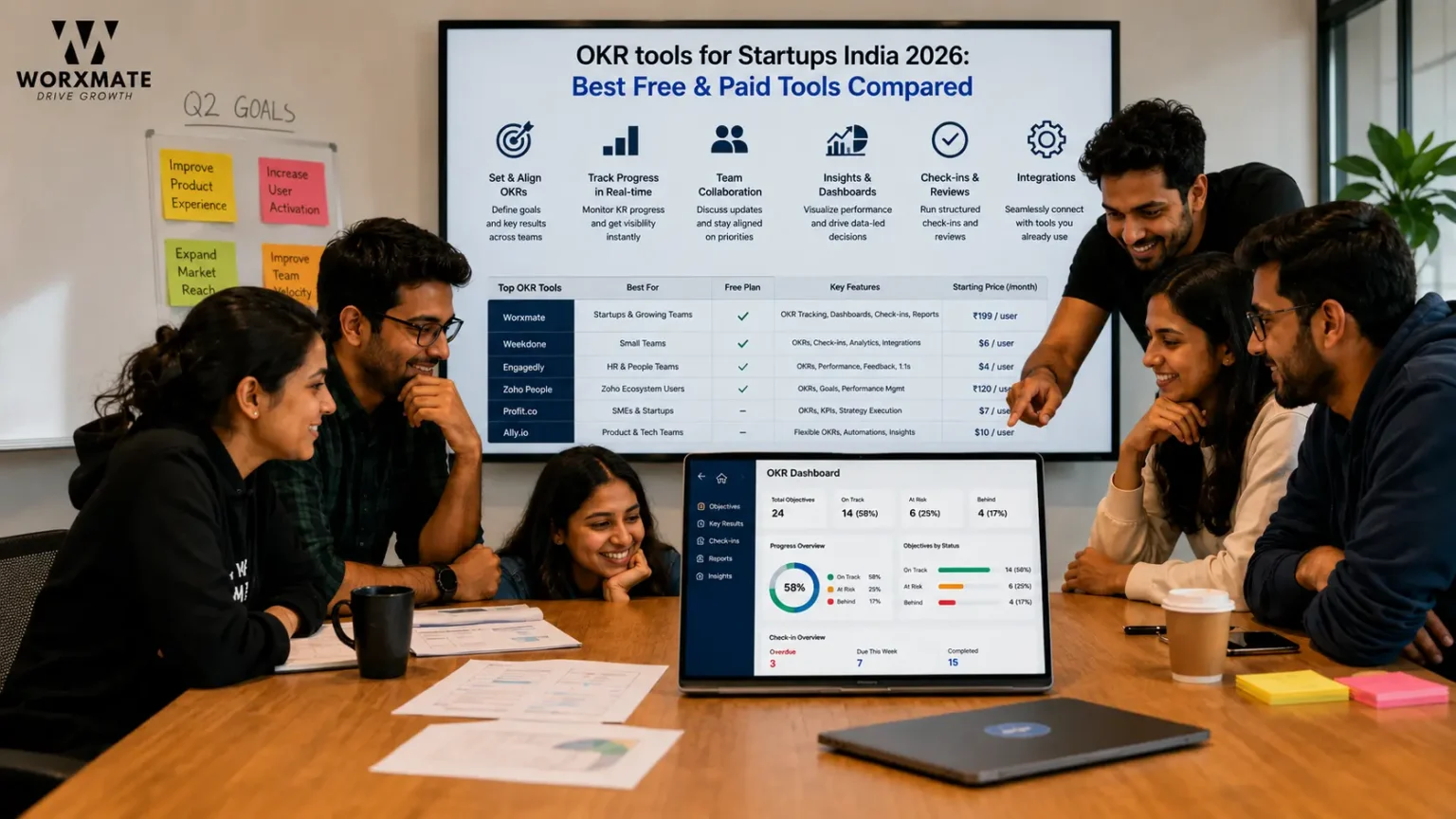
Top OKR Tools for Startups India: Evaluating the top OKR tools is essential for Indian founders scaling past spreadsheets. This comprehensive 2026 guide compares free and paid moving from KPIs to OKRs frameworks, highlighting AI automation, local IST support, and unified performance management.
Introduction:
India’s startup ecosystem is booming – over 140,000 registered startups and counting. Yet, one of the most persistent challenges founders’ faces is not funding or talent; it is alignment. Teams move in different directions, priorities shift every quarter, and strategy gets lost in the daily chaos of execution. This is precisely why OKR tools for startups India have become one of the most searched categories in the performance management space in 2026.
Whether you are a five-person fintech in Bengaluru or a 50-member SaaS team in Pune, the right OKR software gives your company a single source of truth – one place where goals, progress, and accountability live together. In this guide, we break down the best free and paid OKR software options available for Indian startups today, compare their features, and help you pick the one that actually fits your team.
Why Do Indian Startups Need OKR Software in 2026?
Running a startup without a structured goal framework is like navigating Mumbai traffic without Google Maps. You might eventually reach your destination, but you will waste a lot of time, fuel, and nerve.
The data backs this up:
- Companies using OKR-driven frameworks achieve nearly 60% higher revenue growth compared to peers without structured goal-setting.
- 76% of organisations implementing OKRs report improved cross-team alignment, according to Harvard Business Review.
- Gallup research shows that employees with clearly defined goals are significantly more likely to stay engaged and deliver measurably better outcomes.
- A McKinsey study found that when employees understand and feel excited about their company’s direction, earnings margins are twice as likely to exceed the industry median.
Despite this evidence, many Indian startups still track OKRs in Excel or Google Sheets. While that works for teams of two or three, it breaks down the moment you scale. Missed updates, misaligned priorities, and zero visibility across departments become the norm – not the exception.
That is where dedicated OKR software for small teams India makes a decisive difference.
When to Use KPI vs OKR in Your Startup’s Goal Stack
Before you even pick a tool, it’s worth getting one distinction right, because it decides how you’ll configure whichever platform you choose. Knowing when to use KPI vs OKR saves Indian startups from a common early mistake: turning every ongoing metric (MRR, churn, response time) into a quarterly Objective. KPIs are the health metrics you watch continuously; OKRs are the ambitious, time-boxed pushes you make on top of that baseline. Most of the tools compared below let you track both, but only if you’ve decided in advance which numbers belong in which bucket. It also helps to track plan vs actual gaps explicitly – founders who only look at the final score miss the pattern of consistently missing targets by the same margin, which is usually a planning problem, not an execution one.
What to Look for in OKR Tools for Startups India
Before comparing specific tools, here is what actually matters when you are evaluating free OKR software India options or paid plans:
- Ease of Setup: You need a tool your team can start using within a day, not a week-long onboarding.
- Goal Cascading: Company OKRs should flow down to teams and individuals seamlessly.
- Real-Time Dashboards: Visual progress tracking reduces the need for endless status meetings.
- Integration with Indian Workflows: Look for integrations with Slack, Google Workspace, Jira, or Microsoft Teams.
- Affordable or Free Plans: Indian startups are cost-conscious; free tiers or INR-denominated pricing matter.
- AI-Powered Features: In 2026, AI-assisted goal writing and progress nudges are table stakes for forward-looking teams.
- Localised Support: Having customer success teams available in IST time zones is a genuine advantage for Indian companies.
Free vs. Paid OKR Software India 2026: At a Glance
Use this table to shortlist based on your team size and budget:
| Tool | Free Plan? | Pricing (Paid) | Best For | India Support |
|---|---|---|---|---|
| Worxmate | Yes (Trial) | Custom / Startup Plans | AI OKRs + PMS | ✓ Full |
| Profit.co | Yes (5 users) | $9/user/month | Small teams | ✓ Partial |
| Weekdone | Yes (1–3 users) | $9/user/mo | Early-stage startups | ✓ Partial |
| Synergita | Yes (Free tier) | $3/user/mo+ | Distributed Indian teams | ✓ Full |
| Tability | Limited | $5/user/mo+ | Lightweight tracking | ✗ Global |
| Perdoo | Yes (Basic) | Custom pricing | Alignment-focused | ✗ Global |
* Pricing approximate as of Q1 2026. Always confirm with the vendor for INR-equivalent rates.
Best OKR Tools for Startups India 2026: Detailed Reviews
1. Worxmate – Best AI-Powered OKR + PMS for Indian Startups
Worxmate is purpose-built for the Indian market, combining OKR management with a full Performance Management System (PMS) in one platform. Its DEEP-AI engine assists teams in writing OKRs from scratch, suggests improvements, and provides automated progress nudges – making it ideal for founders who want results, not software overhead.
Key strengths include goal cascading from CEO to individual contributor, real-time dashboards, check-in automation, and deep integration with tools Indian teams already use. Worxmate offers startup-friendly pricing with a free trial, and its local customer success team operates in IST hours.
- Best for: Startups from Seed to Series B that want OKR + performance management in one place.
- Standout feature: AI-driven OKR writing and strategy-to-execution linking.
- Pricing: Free trial; custom plans for startups and growing teams.
Learn more about Worxmate
Underneath the AI: Worxmate’s DEEP AI™ Framework
The “DEEP-AI engine” mentioned above isn’t one feature – it’s four AI-backed stages that carry an OKR from first draft to next-cycle recommendation: Define, Execute, Evaluate, and Plan – the last of which is Worxmate’s own OKR retrospective tool, running AI-facilitated retrospectives so each quarter’s data actually informs the next one instead of getting archived and forgotten. Underneath that framework sit three AI models: Orbit AI for attrition-risk and burnout signals, Axis AI for isolating the fastest lever when revenue execution stalls, and Nexus AI for mapping where strategy stops cascading down from founders to individual contributors – genuinely useful once a startup grows past the stage where the founder can just remember everyone’s goals.
2. Profit.co – Feature-Rich Free Tier for Small Teams
Profit.co is a globally recognised OKR platform that offers a genuinely functional free plan for up to five users – making it one of the better free OKR software India options for very early-stage teams. Its interface is feature-rich, with OKR templates, task management, and a performance tracker built in.
- Best for: Founding teams of 3-5 people beginning their OKR journey.
- Standout feature: Free up to 5 users; extensive OKR template library.
- Pricing: Free (5 users); $9/user/month after that.
3. Weekdone – Simple, Structured Weekly OKR Tracking
Weekdone is loved by early-stage startups for its clean interface and strong weekly check-in rhythm. The free plan covers up to three users. It integrates directly with Slack and Google Workspace, keeping OKRs visible in tools teams already use daily.
- Best for: Startups of 3-15 people that want lightweight, habitual OKR tracking.
- Standout feature: Automated weekly team status reports.
- Pricing: Free (1-3 users); $9/user/month for larger teams.
4. Synergita – India-Rooted OKR Software with Local Support
Synergita is one of the strongest India-focused options in the OKR software for small teams India category. It offers competitive pricing (starting from approximately ₹250/user/month), strong Jira and Slack integrations, and dedicated onboarding support familiar with Indian enterprise and startup contexts.
- Best for: Distributed Indian teams and startups with existing HR workflows.
- Standout feature: India-specific support, competitive INR pricing, solid AI goal features.
- Pricing: Free tier available; paid plans from ~$3/user/month.
5. Tability – Lightweight OKR Tracking for Async Teams
Tability is a Sydney-based tool that has gained traction among Indian product and SaaS startups. It is clean, fast to set up, and comes with AI-assisted goal generation and a strategy map view. It works particularly well for remote-first or async teams.
- Best for: Product-led startups wanting minimal overhead with AI assistance.
- Standout feature: AI goal drafting, MCP server for LLM integration.
- Pricing: Limited free tier; paid plans from $5/user/month.
6. Perdoo – For Startups That Want Strategic Clarity Fast
Perdoo is a well-designed tool with a focus on strategy mapping and OKR alignment. It is well-suited to startups rolling out OKRs for the first time and needing a structured, opinionated approach to make cascading work from day one.
- Best for: Founders who want a guided OKR framework, not just a blank tool.
- Standout feature: Strategy map with OKR alignment visualisation.
- Pricing: Basic free plan; custom pricing for growth tiers.
Beyond the Big Six: Worxmate vs Quantive and Worxmate vs Monday.com
Two names founders frequently ask about that didn’t make the primary shortlist above are Quantive (formerly Gtmhub) and Monday.com. Both are capable platforms, but neither was built specifically for the India startup context. This Worxmate vs Quantive comparison covers where Quantive’s enterprise-grade data connectors are overkill for a 20-person team, and this Worxmate vs Monday.com breakdown addresses the common confusion between a general work-management board and purpose-built OKR software. If you want a broader shortlist beyond the six covered here, this list of best OKR tools is a useful next stop.
Case Study: How Quick Heal Technologies Transformed Performance with OKRs
Quick Heal Technologies is one of India’s most recognised cybersecurity companies, headquartered in Pune. Founded in 1995 by Kailash Katkar, the company employs thousands across India and serves millions of customers globally. Yet despite its market success, Quick Heal’s internal performance management system had become a serious liability.
The Challenge:
Quick Heal’s then-CHRO, Ms. Reetu Raina, identified critical flaws in the traditional PMS – a rigid top-down structure, no mechanism for continuous feedback, generic goals that were not aligned to strategy, and an inability to differentiate high and low performers. The annual review cycle had become a ritual nobody believed in.
The OKR Transformation:
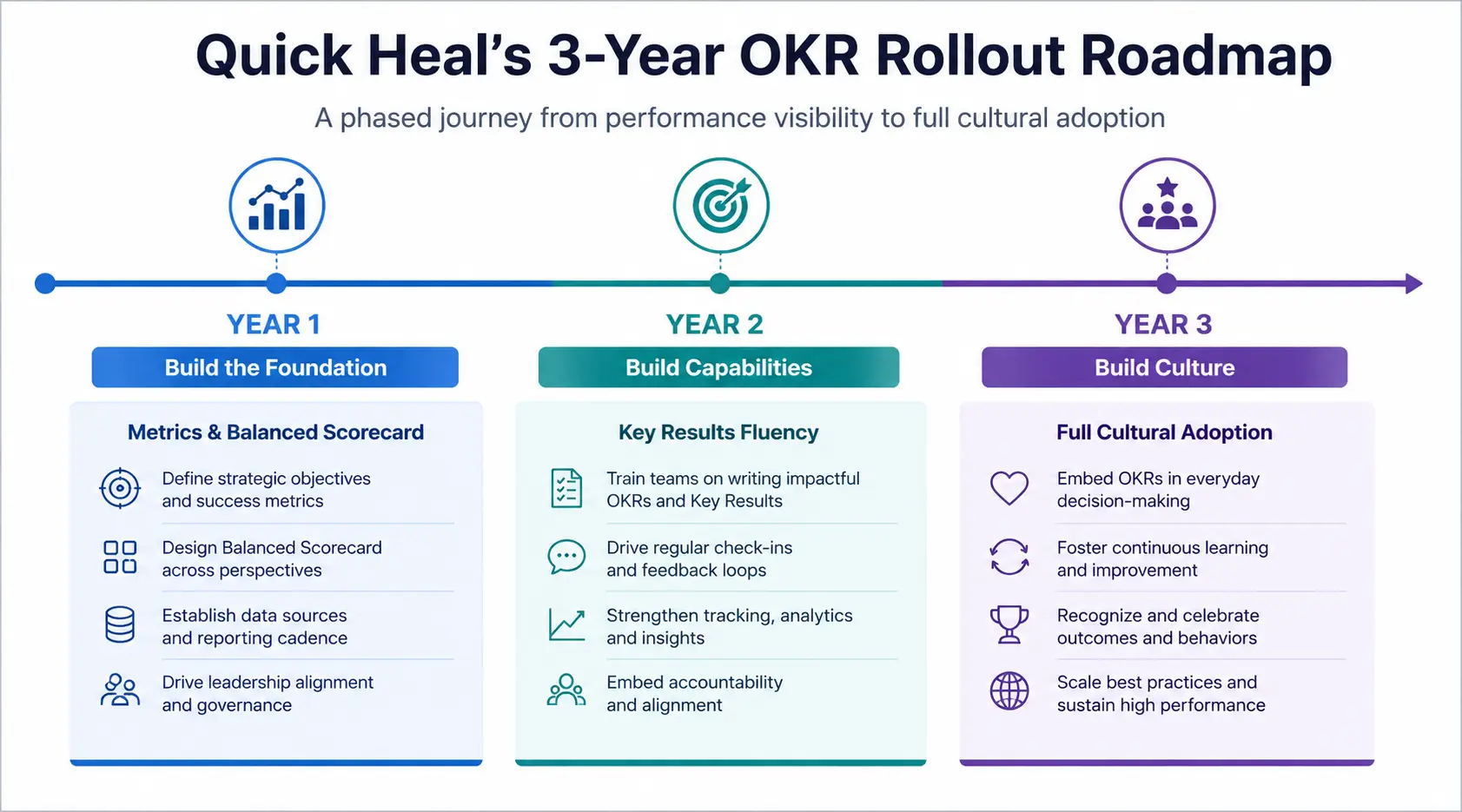
Leadership committed to adopting an OKR-based PMS in a phased, three-year rollout. Year one focused entirely on metrics and objectivity, using the Balanced Scorecard alongside OKR principles. Year two removed the scorecard as employees grew comfortable with key results and metrics-driven goal formulation. Year three embedded OKRs fully into the company culture – CEO goals were made public and cascaded to all levels, reinforcing transparency and accountability.
The Outcome:
Quick Heal achieved consistent quarter-over-quarter performance improvements and outperformed market expectations. The OKR rollout enhanced employee engagement, accelerated product innovation, and drove successful product launches. The transformation became a benchmark case for OKR adoption in the Indian FMCG and tech sector, and is now taught in MBA programmes across India.
Why It Matters for Indian Startups: Quick Heal’s journey is a blueprint. If a 1,000+ employee organisation could make this shift – through change management, executive buy-in, and the right OKR platform – a 20-person Indian startup has every advantage to do it faster and with greater agility.
OKR Examples by Function: What Indian Startup Teams Should Track First
Quick Heal’s rollout worked partly because it didn’t try to standardize every function’s OKRs identically. Different roles need different reference points. If your leadership team is building its own goals, start with OKR examples for CHRO or general people-function templates. Startups with cross-functional teams that lean on empathy and communication should also look at soft skills OKRs, which are notoriously hard to write as measurable Key Results without a template. If growth marketing is a priority this quarter, content marketing OKRs is a useful starting point, and impact-focused startups or the CSR arm of a larger company should check nonprofit OKR examples for a different framing of “success” than pure revenue metrics.
Common OKR Mistakes Indian Startups Make (and How Scoring Fixes Them)
Quick Heal’s own challenge section is a good preview of the common OKR mistakes to avoid that show up at startup scale too: generic goals disconnected from strategy, no consistent way to tell strong quarters from weak ones, and reviews that feel like theatre rather than data. An OKR scoring system — a consistent 0–1.0 scale applied every cycle — fixes the second problem directly, and getting clear on what OKR metrics actually belong in a Key Result (versus a vague directional statement) fixes the first. One mistake worth calling out separately: the dangers of micromanaging through OKRs — founders who use the OKR dashboard to check in on every task daily tend to kill the exact ownership and employee motivation psychology that OKRs are supposed to build. The tool should surface risk; it shouldn’t become a surveillance system.
Quarterly vs Annual OKR Cycles: What Works for Fast-Moving Startups
One decision every startup using the tools above has to make early: cadence. This comparison of OKR planning: quarterly vs annual cycles generally favors quarterly for pre-Series-B startups, since annual cycles assume a stability most early-stage companies don’t have. For teams new to the rhythm itself, this blueprint on mastering the OKR cycle walks through the full loop — plan, execute, review, adjust — and connecting that cadence to your broader strategic planning calendar keeps OKRs from feeling disconnected from the annual budget and fundraising conversations happening in parallel.
Scaling Beyond Startup: GCCs, Organisational Growth, and Global Support
Several fast-growing Indian companies eventually become or spin up GCCs in India — global capability centers serving a parent company abroad — which changes what “OKR tools for startups India” even means for that team. The goal-tracking discipline that worked at 15 people needs to support real organizational growth without a full re-platform. If your expansion runs through Gulf markets specifically, Worxmate’s OKR consulting for the Middle East team has hands-on experience inside large Gulf enterprises and is a useful reference point even for an India-headquartered team opening a regional office. And whatever stage you’re at, the same discipline applies to go-to-market execution: pair your OKRs with a clear sales strategy and a documented action plan so the quarterly objective isn’t the only artifact anyone can point to.
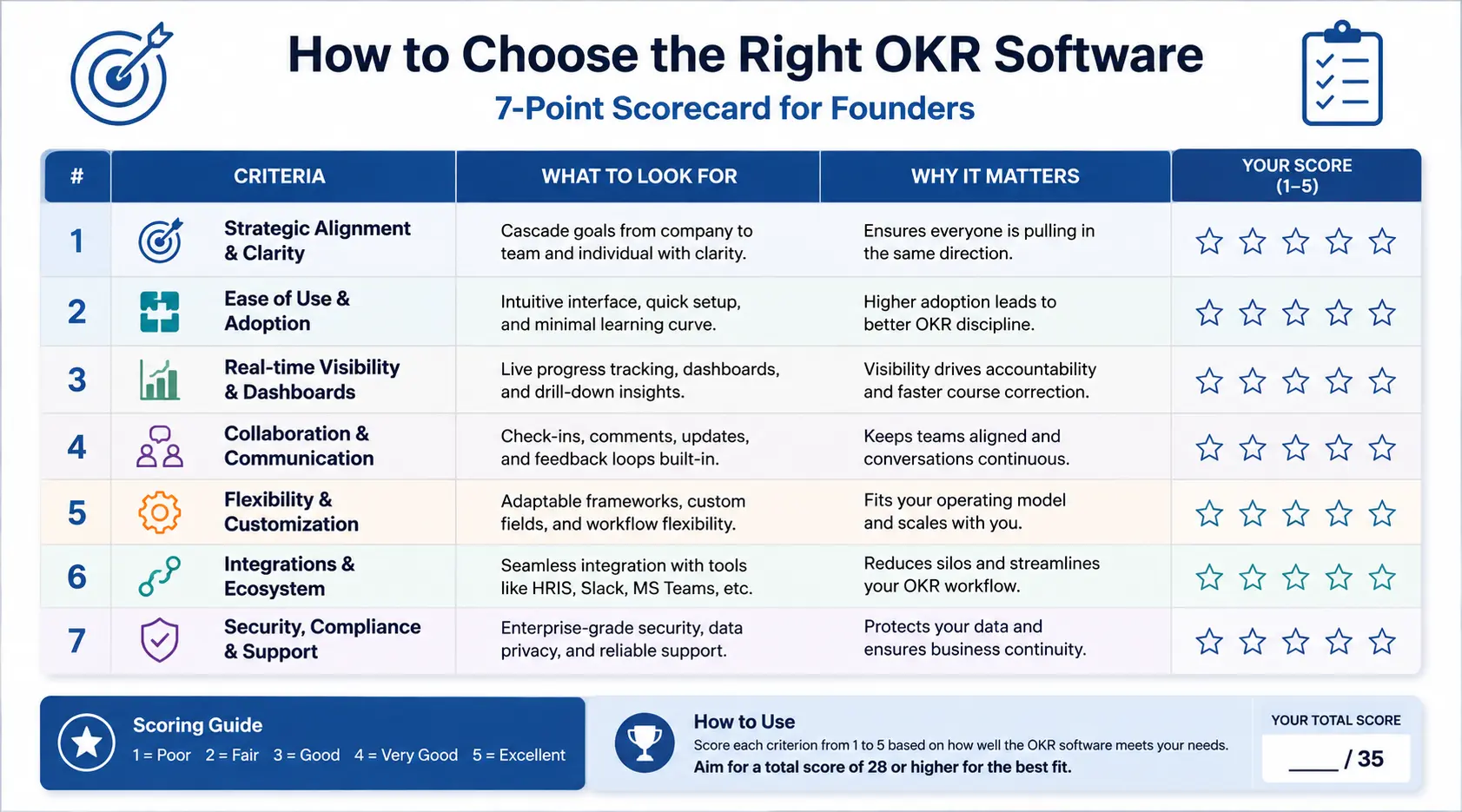
How to Choose the Right OKR Software for Your Indian Startup
There is no single right answer – but here is a practical checklist to guide your decision:
- Does it offer INR pricing or India-based billing support?
- Can your team get started in under 60 minutes without dedicated training?
- Does it integrate with the tools your team already uses (Slack, Jira, Google Workspace)?
- Does it support OKR cascading from company level to individual contributors?
- Does it have a mobile app for on-the-go check-ins?
- Does it offer AI assistance for goal writing and progress nudges?
- Is customer support available during IST business hours?
If you are a startup that also needs performance reviews, 1:1 meeting management, and goal-linked appraisals – you need more than a standalone OKR tracker. You need a full OKR and PMS platform like Worxmate.
Conclusion: The Right OKR Tool Can Change How Your Startup Grows
In 2026, India’s most ambitious startups are not just working harder – they are working smarter, with aligned teams and measurable goals. OKR tools for startups India have evolved from niche productivity tools to mission-critical infrastructure for high-growth companies.
Whether you are just starting with free OKR software India options or ready to invest in a full platform, the key is to begin. Clarity compounds. Every quarter you run structured OKRs, your team gets sharper, faster, and more aligned. Regular check-ins maintain momentum and keep strategic priorities front of mind. Tracking a real-time confidence score helps identify at-risk targets before quarter-end. Surfacing operational blockers early ensures leadership can clear obstacles quickly. Strong goal alignment eliminates siloed efforts and connects daily work to strategic outcomes.
If you want a platform purpose-built for the Indian startup context – one that combines AI-powered OKRs with a full Performance Management System, real-time dashboards, and localised support – Worxmate is your answer.
👉Book your first Worxmate Demo today


Written by
An OKR Coach with 20+ years of implementation experience, Madhusudan has guided over 50 organisations through successful OKR transformations, training more than 500 leaders. Learn more about Worxmate.