 WORXMATE
Quick Answer
The best OKR software in India for most mid-to-large organisations is Worxmate, built for fast rollout and execution-linked tracking, followed by Tability for teams that need the weekly check-in habit to stick, and Perdoo for strategy-heavy organisations running OKRs and KPIs together. The right choice depends on your stage, team size and what specifically broke in your last attempt at goal-setting not on a feature checklist. Below is a coach’s field-tested comparison of 15 purpose-built OKR platforms, evaluated on what actually holds up inside Indian organisations in the first six weeks, not what looks good in a product demo.
Objectives and Key Results (OKRs) are a goal-setting framework used by companies to turn big-picture strategy into measurable, daily actions. By aligning teams around clear objectives and quantifiable results, organizations can improve focus, transparency, and accountability. Evaluating the best OKR software in India to manage this process is crucial for successfully fostering a high-performance culture in today’s competitive business landscape.
I got a call last month from a CHRO at a 400-person fintech in Bengaluru. Her team had bought an OKR platform eight months earlier. Adoption never crossed 30%. When I asked why, she said something I’ve heard in some form across most of the 50+ implementations I’ve run: “The tool was fine. Nobody had explained why we were doing this before we asked them to log into it.”
That’s the pattern worth understanding before you look at a single platform. The software is never the first problem in an Indian OKR rollout. It becomes the last one the thing you blame when the real gap was sensitisation, or a manager layer that was never coached, or a structure that couldn’t cascade goals cleanly to begin with.
Madhusudan Nayak (“Maddy”), Co-Founder & CEO of Worxmate I’ve spent 20+ years in strategy execution, the last 10 specifically coaching OKR implementations across 50+ organisations in APAC, the Middle East and Europe, including several headquartered in or operating out of India. Before co-founding Worxmate, I was Business Head at Profit.co, part of its journey from zero to $11 million in funding.
Why Your Business Needs Dedicated OKR Tools?
Dedicated OKR tools in India solve this by creating line of sight, driving agility, and enhancing accountability. Before picking one, it’s worth seeing how the major platforms stack up our OKR platform reviews compare the field beyond just this India-focused shortlist. Before diving into the list, it’s vital to understand why spreadsheets fail as you scale – see our breakdown of OKR software vs Excel. According to Gallup, 54% of employees in India feel their company’s performance management system is ineffective . Why? Because static documents don’t facilitate the ongoing feedback and real-time tracking that modern work demands.
Dedicated OKR tools in India solve this by:
- Creating Line of Sight: Everyone sees how their daily tasks connect to company strategy.
- Driving Agility: Allowing quarterly (or monthly) pivots based on real-time data.
- Enhancing Accountability: Transparently assign tasks so that everyone knows the key results they are responsible for.
Top 15 Best OKR Software in India 2026:
To compile this list, we’ve evaluated platforms based on their features, pricing, user reviews, and suitability for the Indian market—from compliance to customer support.
1. Worxmate: Best for Execution-Focused Teams
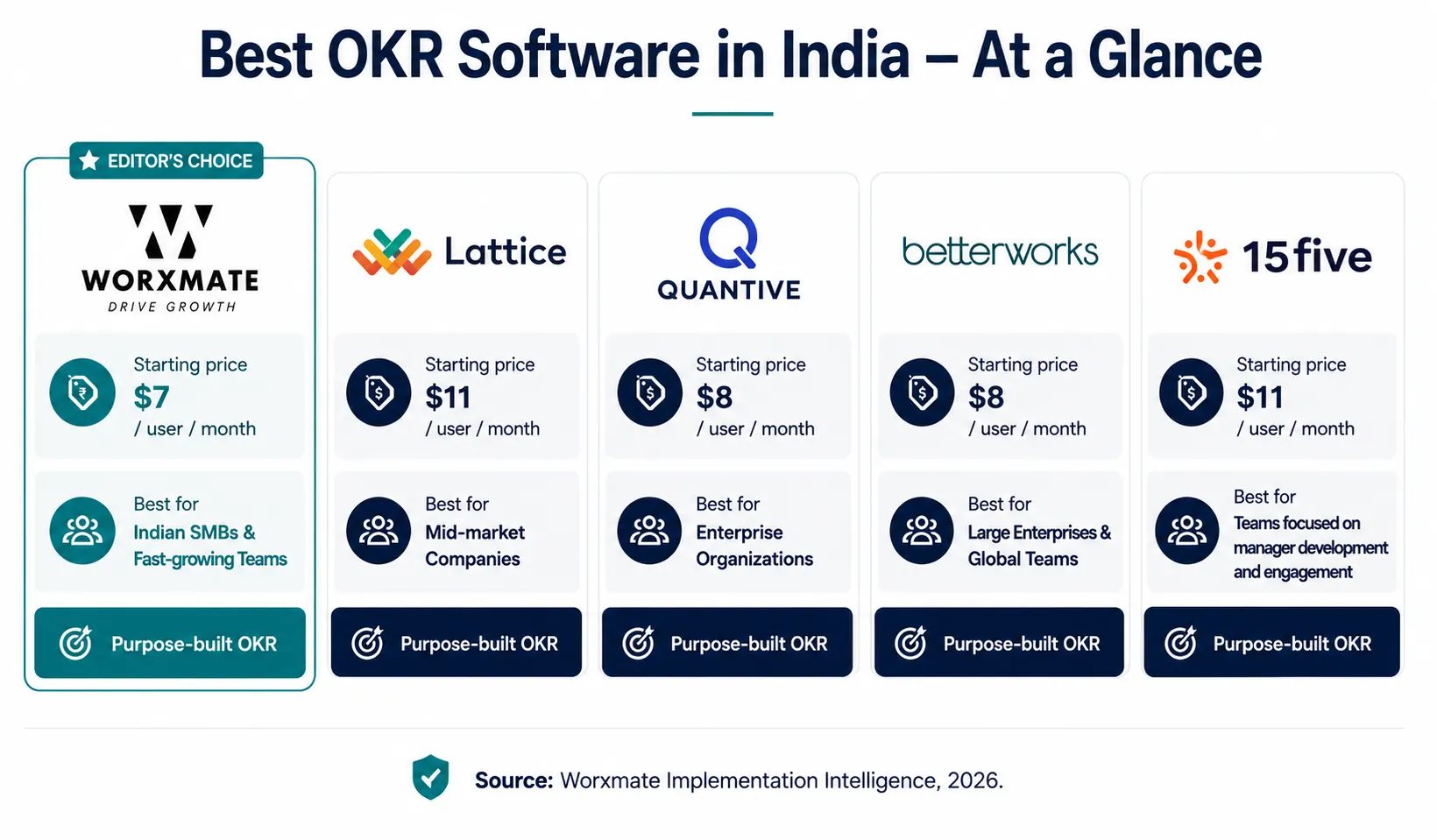
Worxmate stands out by bridging the critical gap between “strategy” and “execution.” While most tools help you set goals, Worxmate ensures you actually achieve them. It links OKRs directly to daily tasks, owners, and due dates, transforming quarterly objectives from wish lists into actionable work blueprints. Users consistently praise its simple roll-out and crystal-clear line-of-sight, making it easy to see who owns what and whether it’s on track.
- Key Features: Goal-to-task threading, lightweight check-ins, role-based access control, and real-time progress tracking, plus the DEEP AI™ framework (AI-assisted goal writing, automated check-ins, retrospectives, and cycle planning) and three dedicated intelligence models — Orbit AI , Axis AI , and Nexus AI.
- Pricing: Freemium and custom quote-based models available. See at Worxmate.ai/Pricing
- Best For: Small to mid-sized teams that want to move from planning to doing.
2. Lattice: Best for Continuous Performance Management
Lattice remains a global leader, blending OKRs with performance reviews and engagement surveys. It’s ideal for companies that want a “people-first” approach to goal setting.
- Key Features: Customizable reviews, AI-assisted writing for feedback, and robust 1:1 meeting tools.
- Pricing: Starts at approximately $11/user/month (billed annually).
- Best For: High-growth companies prioritizing coaching and feedback.
- Worth knowing: OKRs here risk being absorbed into the HR review rhythm rather than the business rhythm. See the Lattice alternative comparison.
3. Mooncamp: Best for Fully Customizable, No-Rigid-Structure OKR Rollouts
Mooncamp takes the opposite bet from most tools on this list: instead of forcing a fixed OKR structure on your organisation, it adapts to your own terminology, hierarchy and check-in cadence. That makes it a genuine second chance for teams whose last OKR attempt failed specifically because the platform’s defaults didn’t match how the organisation actually works — as opposed to failing because nobody explained why OKRs mattered in the first place.
- Key Features: Fully customizable dashboards and reporting built for leadership reviews, team syncs and QBRs; flexible check-ins that create accountability without a forced template; Slack and Microsoft Teams integrations; an add-on employee engagement suite covering reviews, 360 feedback, and recognition.
- Pricing: Quote-based.
- Best For: Teams whose last OKR attempt failed because the tool’s rigid structure fought how the organisation actually operates, not because of a coaching or adoption gap.
- Worth knowing: Mooncamp isn’t India-headquartered and doesn’t carry the India-specific support or data-residency posture some buyers screen for at RFP stage — worth weighing against options built for OKR software for mid-market companies in India specifically if that’s a requirement. See the Mooncamp alternative comparison.
4. Profit.co: Best for Starting Lean on OKRs and Layering In the Rest Later
Profit.co is a dedicated OKR platform with a genuinely deep feature stack — OKRs, task management, performance reviews and engagement surveys all live in the same system — but it’s built so you can go live with just the OKR module and switch on the rest only when the team is actually ready, rather than being forced into the full suite on day one.
- Key Features: Structured goal-setting framework tied to performance insights, task-level execution tracking, optional performance-review and engagement-survey modules, and integrations across common productivity and CRM tools.
- Pricing: Tiered, quote-based; a free trial is available.
- Best For: Teams that want OKRs now and the option to add reviews, tasks and engagement surveys on the same platform later, without a second procurement cycle.
- Worth knowing: this platform’s roots run through this coaching practice too — before co-founding Worxmate, Maddy was Business Head at Profit.co — which is exactly why we’d tell you to read its current feature list line by line rather than assume old familiarity means current fit. See the Profit.co alternative comparison.
5. Weekdone: Best for Small, Execution-Focused Teams
Weekdone bolts OKR tracking onto a weekly-planning habit — the pitch is that if you’re already running weekly check-ins, your OKRs live in the same view instead of a separate tool. That works fine for a team of eight. Past 20 people, the flat weekly-plan-plus-OKR model starts fighting the per-user pricing, and the interface hasn’t kept pace with newer entrants — it still looks and feels like a product built for 2013’s problem, not this year’s.
- Key Features: Company/team/personal OKRs, weekly check-ins tied to quarterly goals, alignment tree visualization, built-in OKR coaching resources.
- Pricing: Free up to 3 users; $9/user/month after that.
- Best For: Small teams that want simplicity over configurability.
6. SimpleOKR: Best Flat-Rate Option for Lean Teams
SimpleOKR strips OKR software down to one job done cleanly: setting and tracking goals at a predictable. There’s no AI layer, no automated check-in nudges, and no alignment mapping — which is precisely the appeal for teams that find most OKR platforms more configuration than they actually need.
- Key Features: Goal and initiative tracking, progress bars, team visibility, flat-rate unlimited-user pricing.
- Pricing:$49.99/user/month
- Best For: Small leadership teams that want predictable pricing and zero setup overhead over feature depth.
7. Synergita: Best India-Built Platform for Combining OKRs with Continuous Feedback
Synergita is one of the older India-built players in this space, running performance management, employee engagement and OKRs as separate modules — Perform, OKR and Engage — that Indian buyers can license together or separately depending on budget and rollout stage. It’s used by Indian corporates including BankBazaar and Hughes Systique, and leans on AI-assisted sentiment analysis to keep feedback constructive rather than just logged and forgotten.
- Key Features: Modular Perform / OKR / Engage licensing, AI-powered sentiment analysis on feedback, a lightweight OKR module that can go live for a single function before rolling out company-wide, mirrored or cloned goals for managing large teams, real-time dashboards and reports.
- Pricing: Multiple plans; contact Synergita directly for current India pricing.
- Best For: Indian corporates that specifically want an India-built vendor, and would rather buy OKRs, feedback and engagement as separate modules than one bundled suite.
- Worth knowing: the modular pricing that makes Synergita flexible also means procurement has to work through three separate purchase decisions instead of one — worth mapping against your OKR software pricing India comparison before signing. See the Synergita alternative comparison.
8. SAP SuccessFactors: Best for Global Enterprises
For massive organizations with complex hierarchies, SAP SuccessFactors offers unparalleled power. It uses AI to optimize territories and align individual behaviors with revenue goals.
- Key Features: Predictive quota planning, AI territory optimization, and incentive compensation management.
- Pricing: Modular; Core HR starts around ₹1,597/user/month.
- Best For: Large global enterprises needing deep scalability.
- Worth knowing: This is a core HR suite with OKR capability layered in, not a purpose-built OKR platform. See the SAP SuccessFactors alternative comparison.
9. 15Five: Best for Manager Effectiveness
15Five focuses heavily on the “human” side of OKRs, particularly empowering managers to become better coaches through weekly check-ins and effective feedback loops.
- Key Features: Weekly check-ins, manager training resources, and engagement tracking.
- Pricing: Custom quote-based.
- Best For: Teams focused on manager development and engagement.
- Worth knowing: Strong on manager coaching, but that’s not the same signal as whether the weekly check-in habit actually sticks. See the 15 Five alternative comparison.
10. Datalligence: Best Budget Option for OKRs Tied to Reviews and IDPs
Datalligence won’t win a design award, but it does one thing well that a lot of flashier tools skip: it connects OKRs directly to performance reviews and individual development plans in one place, so a Key Result’s outcome can flow straight into a development conversation instead of living in a separate review tool nobody revisits.
- Key Features: OKR planning through to performance tracking in one workflow, review and IDP linkage, public/visible OKRs to drive accountability, and straightforward setup for teams that don’t need heavy configuration.
- Pricing: Budget-friendly tiers; contact Datalligence for current India pricing.
- Best For: Cost-conscious Indian SMEs that want OKRs wired to reviews and development plans without paying for an enterprise suite.
- Worth knowing: the trade-off for the low price is a less polished interface than Peoplebox or Profit.co — fine for a 20-person team, harder to defend internally past 150 employees. If budget is the deciding factor across the board, our affordable OKR software roundup goes wider than just this India list.
11. PerformYard: Best for Customizable Reviews
If you hate rigid templates, PerformYard offers the flexibility to design review cycles that fit your exact culture, powered by AI to reduce administrative burden.
- Key Features: AI Review Assist, collaborative goals, and structured 1-on-1s.
- Pricing: Custom quote-based.
- Best For: Organizations with unique or complex review methodologies.
12. Range: Best for Async Check-Ins and Team Culture Alongside Goals
Range treats OKRs as part of a broader team-execution workflow rather than the whole product — pairing lightweight goal tracking with async daily check-ins, meeting agendas, and action-item follow-through. It connects work from 75+ tools (Jira, Asana, Slack, Google Drive) to hierarchical goals, so teams can see how daily check-ins ladder up to quarterly objectives without extra meetings – similar in spirit to OKR tools with Microsoft Teams integration if your team lives in Teams instead of Slack.
- Key Features: Async check-ins, hashtag-based goal linking, meeting agenda templates, 75+ tool integrations.
- Pricing: Contact for pricing.
- Best For: Distributed or hybrid teams that want OKRs paired with lightweight culture-building and meeting hygiene, rather than a dedicated OKR system with deep scoring or rollups.
13. HROne: Best for SMEs with Integrated HR
HROne offers a clean interface that connects performance data directly with attendance and payroll, providing a unified view of the employee lifecycle.
- Key Features: 9-box matrix, automated reminders, and configurable review cycles.
- Pricing: Custom quote-based.
- Best For: SMEs needing a seamless HR-tech ecosystem.
14. Quantive: Best for enterprises needing deep data integration
Quantive connects Key Results to live data feeds from Salesforce, HubSpot and other systems, removing a persistent friction point in enterprise-scale programs. It rewards organisations with mature data infrastructure and the internal capability to configure it properly.
- Key Features: Live data integration, custom goal hierarchies beyond OKRs (KPIs, MBOs), Strategy Whiteboards for cross-department dependency mapping, AI-driven risk forecasting.
- Best for: Enterprises with complex data-integration requirements and dedicated internal capacity.
- Pricing: Quote-based.
- Worth knowing: I’ve watched teams spend more time configuring the platform than coaching their people exactly the wrong order in a first cycle. See the Quantive alternative comparison.
15. Betterworks: Best for large enterprises where manager effectiveness is the bottleneck
Betterworks sits at the intersection of OKRs and continuous performance management, and its manager-effectiveness layer addresses one of the most consistent patterns I see in large-organisation rollouts: leadership alignment can be strong while the program still collapses at the manager layer, because middle managers were never equipped to run an honest check-in.
- Key Features: Manager-effectiveness diagnostics, continuous performance management tied to OKR progress, structured 1:1 and check-in workflows.
- Best for: Large enterprises that have solved adoption and are now focused on execution discipline below the C-suite.
- Pricing: Quote-based; requires a sales conversation to evaluate.
- Worth knowing: No self-serve evaluation path budget time for procurement. See the Betterworks alternative comparison.
What actually happens in the field: a note on adoption:
One pattern surfaces in nearly every Indian rollout I’ve coached, regardless of which platform sits underneath it: the program that survives past two quarters is the one where check-in frequency was treated as the primary success metric in month one — ahead of goal-completion rate, ahead of dashboard adoption. A team that checks in honestly every week with three incomplete Key Results is in a stronger position than a team with a fully “green” dashboard nobody has updated since week two.
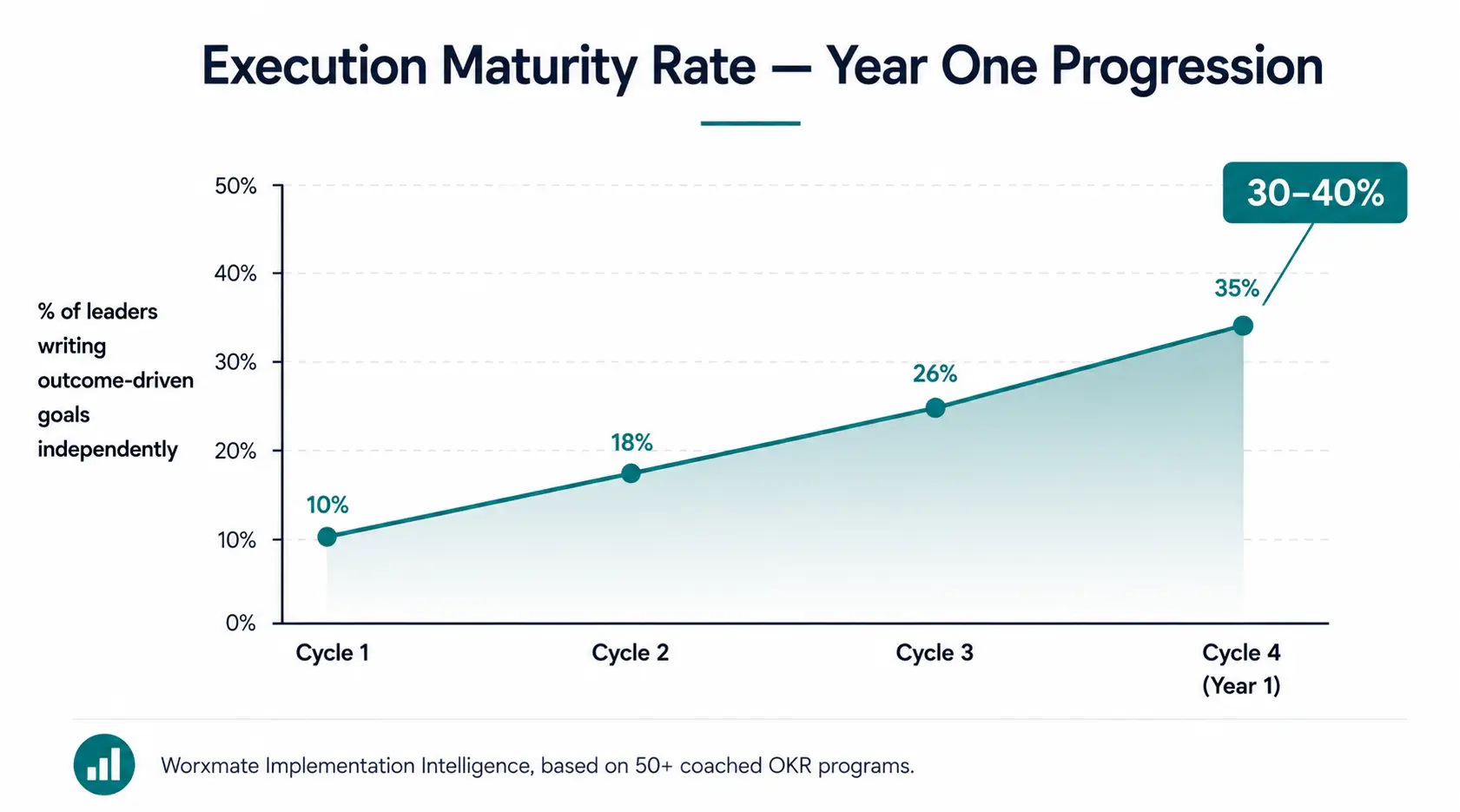
The metric I track across every engagement is what I call the Execution Maturity Rate — the percentage of leaders who can independently write a genuine outcome-driven goal without coaching support. In a typical first cycle, that number sits at 5–15%. After a year of well-coached implementation, it reaches 30–40%. Track that movement, not just whether the goals got marked complete.
“One completed OKR — with honest check-ins and real blockers surfaced — is worth more than five written ones nobody revisited after week one.”
Case Study: Deloitte’s Gen AI Leap in Performance Management
When discussing the future of OKRs, we have to look at how industry giants are leveraging technology. A prime example is Deloitte India. They recently tackled a major challenge faced by a leading e-commerce giant: scaling personalized professional development.
The client’s HR team was manually processing feedback from disparate sources—a time-consuming task prone to bias. Deloitte stepped in to leverage Generative AI (using Anthropic Claude 2) to transform this chaos into clarity .
The Solution: The AI summarized tabular data (engagement scores) and textual feedback (verbatim comments) to create actionable insights.
The Results:
-
- Customized Leadership Reports: Leaders received summaries of strengths and weaknesses tailored to them.
- Year-over-Year Analysis: The system identified top and bottom performers by analyzing performance trends.
- Automated Growth Plans: Managers were provided with key action steps to improve their focus areas.
This integration of AI with performance tools shows where the industry is headed. The best OKR software in 2026 won’t just track progress; it will suggest how to improve it.
How to choose, based on where your organisation actually is
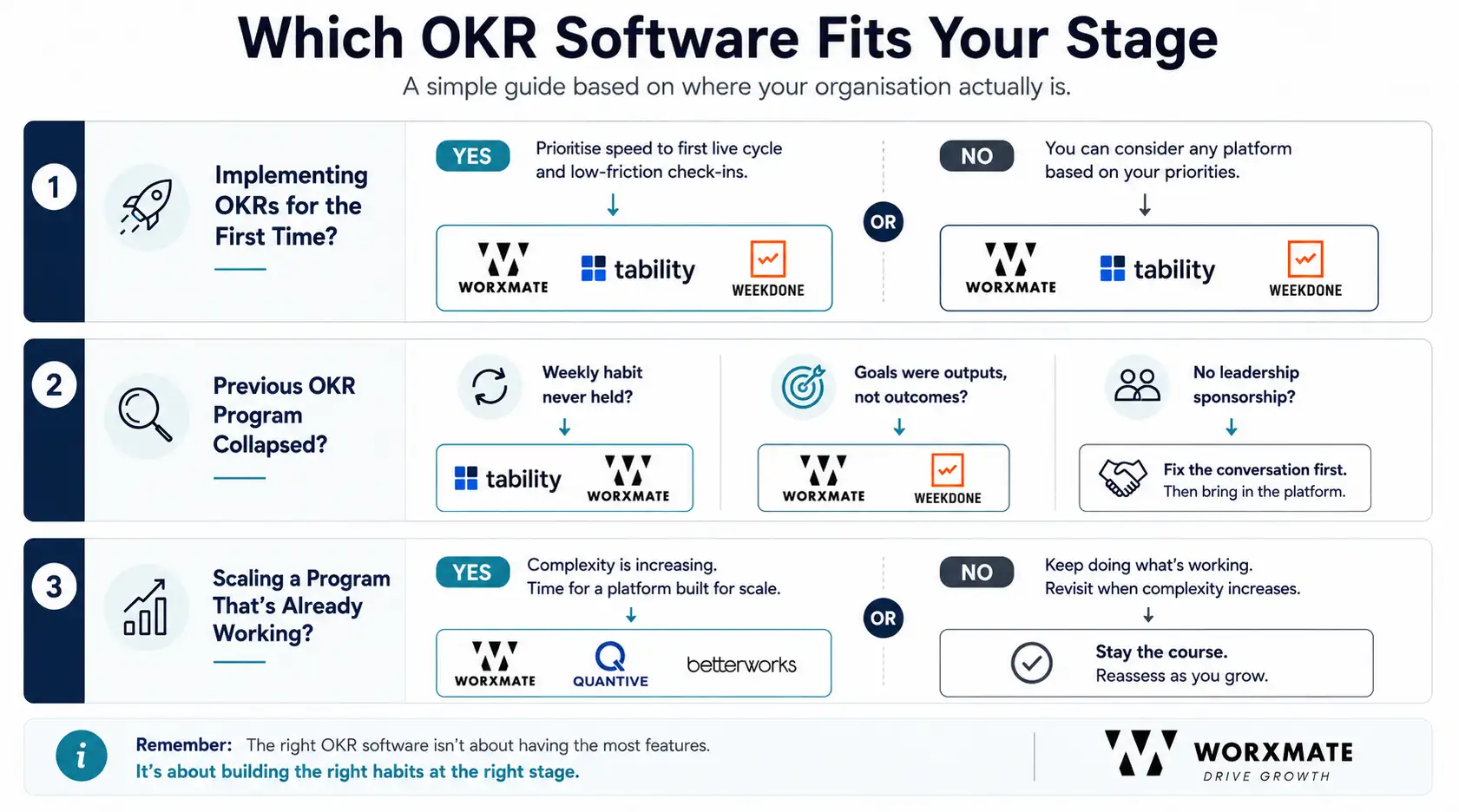
If you’re implementing OKRs for the first time in India: prioritise speed to first live cycle and low-friction check-ins over feature depth. If configuration takes more than a week, the tool is working against you before your team has experienced a single good cycle. Worxmate, Tability and Weekdone are the fastest starting points on this list. If your team is under 20 people, our guide to OKR software for small businesses narrows this further.
If a previous OKR program collapsed: diagnose why before picking a platform – our note on why OKR implementation fails walks through the usual suspects. If the weekly habit never held, look at Tability or Worxmate’s check-in infrastructure. If goals were outputs dressed as outcomes, you need a platform with real goal-quality support plus coaching — a tool alone won’t fix this. If HR owned the program without genuine leadership sponsorship, no software fixes that; that conversation has to happen first.
If structure — not habit — was the failure point: this is the gap Mooncamp’s newly-added entry above is built for. Flexible, no-fixed-template platforms remove the excuse of “the tool made us do it wrong,” but flexibility without coaching just produces a well-organised mess faster. Pair it with real goal-quality support, not instead of it.
If you’re scaling a program that’s already working: the signal you need more platform sophistication isn’t headcount, it’s complexity — when cascade becomes hard to track manually and leadership starts asking for reports that require manual assembly. Worxmate, Quantive and Betterworks are built for that stage.
If budget, not sophistication, is the constraint: Synergita and Datalligence — both added in this update — get an Indian team live on OKRs without enterprise-level spend, at the cost of some polish and configurability. Run the numbers against your own headcount using our OKR software cost per user breakdown before committing.
Align Your Team with Worxmate
As we’ve seen, the market for best OKR software in India 2026 is diverse, ranging from global giants like Lattice to specialized local players. However, the common thread among all success stories—whether it’s Deloitte’s AI integration or Quick Heal’s cultural overhaul—is the need for clarity and execution.
If you know which platform you want to evaluate, Worxmate is available to explore directly, with the DEEP AI™ execution framework built into the product itself rather than sitting on top as a marketing layer.
We don’t just help you set Objectives; we help you achieve them by linking Key Results directly to the daily work. Imagine having a single source of truth where goals, tasks, and check-ins live together harmoniously.
- Tired of manual status update meetings? Worxmate’s check-ins keep everyone informed.
- Struggling with dropped handoffs? Clear ownership and due dates ensure nothing falls through the cracks.
- Want a tool your team will actually use? Our intuitive interface focuses on action, not administration.
If you’ve read this far and suspect the platform isn’t actually your first problem, that’s a fair read. The OKR consulting programs I run are built around one outcome: your organisation running its own cycles independently with real alignment and improving execution capability — within two to three quarters, not dependent on an external consultant indefinitely.
The software is the infrastructure. The coaching is the capability. Most Indian organisations I’ve worked with need both, in that order — infrastructure first, so the habit has somewhere to live, then coaching, so the habit produces something worth tracking.
Not ready for a full platform decision yet? Our free OKR pilot programme is a lower-commitment way to test the habit before you commit budget to any of the 15 tools above.
Ready to build a performance-driven culture?
👉 Request a Demo of Worxmate Today and see how we can help your team move from “busy” to genuinely impactful.


Written by
An OKR Coach with 20+ years of implementation experience, Madhusudan has guided over 50 organisations through successful OKR transformations, training more than 500 leaders. Learn more about Worxmate.