 WORXMATE
Strategy execution software bridges corporate priorities and daily execution through structured cascading, weekly check-ins, and outcome tracking. Evaluating tools like a strategic execution platform ensures your organization achieves true alignment and closes the execution gap in 2026.
Picture the first alignment call. The company is an APAC retail brand growing fast enough that its leadership bench is being built two people at a time. The CEO has agreed to share his top three priorities so the rest of the organization can start writing goals against them. Forty-five minutes in, he still can’t get to three. Not because he isn’t sharp he runs a business outgrowing its own org chart every quarter but because nobody had ever asked him to compress an entire year’s vision into three outcomes an organization could actually cascade from.
That meeting ended without a resolution. Two more days went into a war room before a single goal got written. And here’s what I keep coming back to from that engagement: the company already had a goal-setting framework. It already had intent. What it didn’t have was the discipline to turn a CEO’s mental model into something forty team leads could execute against without three more meetings to clarify what he meant.
This is the story behind almost every search for strategy execution software. A leadership team senses that strategy and execution have come apart that the plan on the slide and the work happening in the building are two different things and goes looking for a tool to close the gap. The tool is rarely the first problem. But the tool isn’t irrelevant either. It’s just not the whole answer, and most vendor pages won’t tell you that.
Why This Comes From Me, Not a Content Team
I’ve spent 20+ years in strategy execution and the last 10 specifically inside OKR implementations more than 50 organizations across pharma, fintech, manufacturing, retail, IT services and telecom, training 500+ leaders directly. I built Worxmate after running Profit.co’s business from zero to $11M in funded growth and watching the same pattern repeat: leadership teams buy software believing it will produce alignment, and alignment doesn’t show up, because alignment was never a software problem to begin with.
This isn’t a vendor listicle. It’s what I’d actually tell a CEO or Strategy Head evaluating strategy execution software in 2026 what the category really contains, which tools solve which piece of the gap, and what closes it when the software alone doesn’t.
The Strategy Execution Gap Nobody Names in the Boardroom
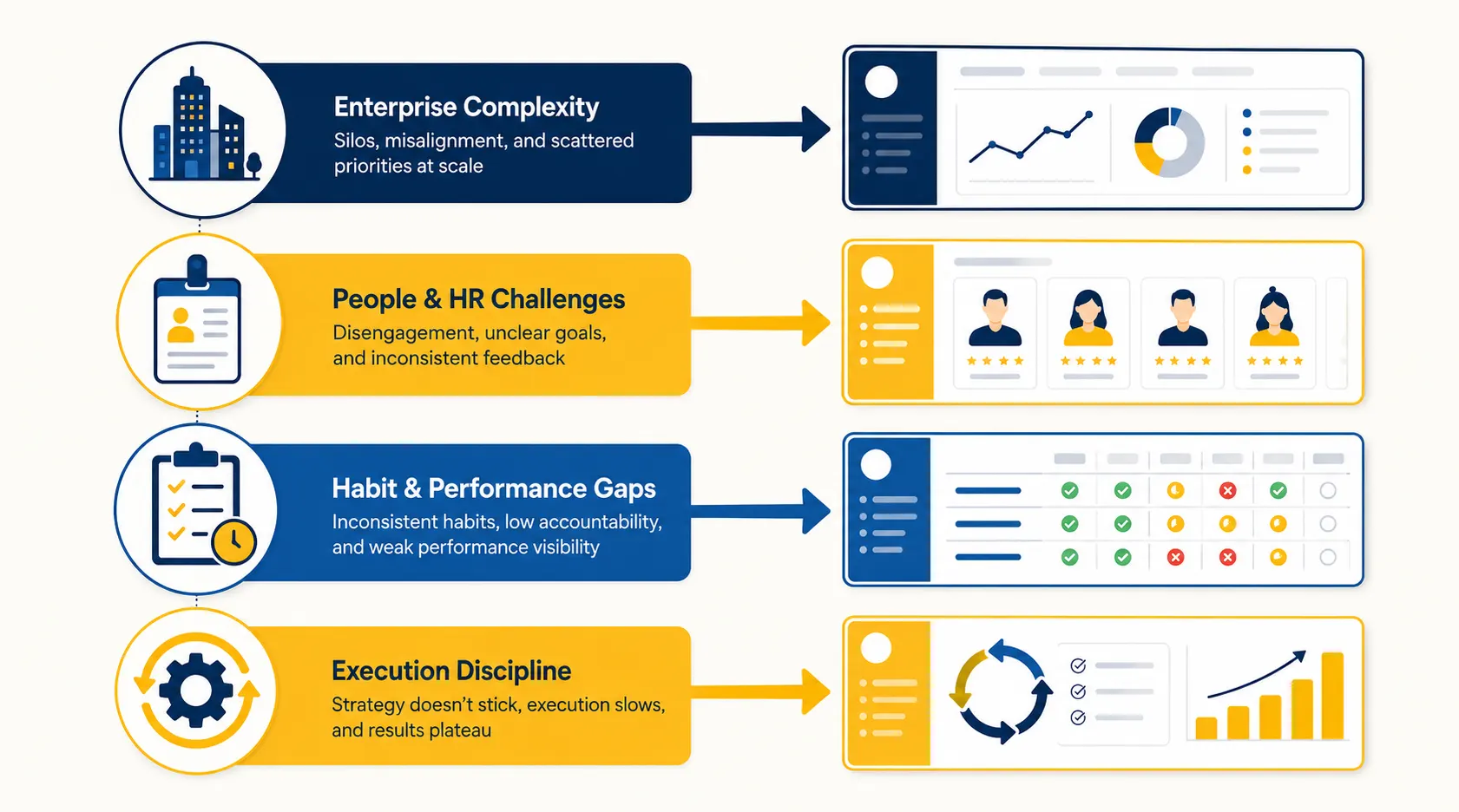
Every MBR has a version of this moment: someone asks why a strategic initiative that was supposed to be 80% complete is actually at 30%, and the room goes quiet because nobody owns the honest answer. That’s the strategy execution gap not a motivation problem, not a talent problem, but a structural failure between the priorities set at the top and the work actually happening three or four layers down.
In Worxmate’s 2026 OKR Benchmark Report, we track this through a metric I built specifically because goal-completion rate lies to leadership teams: the Execution Maturity Rate the percentage of leaders who can independently write a genuine outcome-driven goal without coaching, a template, or a quality review. In a typical first-cycle implementation, that number sits between 5% and 15%. In organizations that run a well-coached program consistently for 12 months, it climbs to 30–40%. A team can hit 80% of its stated goals and still show almost no movement in this number which means the goals were never really outcomes to begin with. See the full breakdown of output vs outcome thinking for why this distinction matters more than the completion percentage itself.
OKR Execution Maturity Framework 2026
Download our comprehensive benchmarking framework to assess your organization’s readiness to overcome OKR software challenges and reach 40% maturity.
This is why the search for strategy execution software so often starts in the wrong place. Teams look for a platform that will make the cascade visible, when the actual gap is that the cascade doesn’t yet exist as agreement between people only as a diagram someone built in a tool.
Alignment is agreement between teams on what matters, why it matters, and how each team’s work connects to the work around them. You cannot set that in a tool. You can display it once it exists. A cascade that looks beautiful in software is showing you the record of an agreement that either exists or it doesn’t.
That single distinction agreement vs. display is the difference between strategy execution software that closes the gap and strategy execution software that documents it. If you want the full breakdown of what causes this gap and how to diagnose your own before you evaluate any tool, read the complete guide here. For a closer look at how this shows up structurally, see our guide on organizational strategy framework design and common okr alignment failures.
Achieve Your Goals Faster
See how Worxmate can help your team set clear goals and achieve faster results. Book your free demo today and experience the power of AI-driven OKRs in action.
What “Strategy Execution Software” Actually Means (And What It Doesn’t)
Ask five vendors what strategy execution software means and you’ll get five different category definitions, because the term is doing double duty right now. It’s used by enterprise strategy platforms built for dedicated strategy teams managing multi-year initiatives. It’s used by OKR platforms describing what OKR software has always done. And increasingly, HRIS suites are using it to describe a goal-tracking module bolted onto a performance review system.
These are not the same product, and treating them as interchangeable is how organizations end up buying enterprise strategy execution software with a six-figure price tag and a 12-week configuration timeline when what they actually needed was a lighter, faster strategy execution platform their managers could run inside a single quarter.
| Category | What it’s actually built for | Where it breaks |
|---|---|---|
| Enterprise strategy execution platforms | Multi-year initiative tracking, portfolio governance, dedicated strategy teams | Wrong starting point for orgs without a strategy function; 8–12 week setup before first cycle |
| Purpose-built OKR software | Quarterly/continuous goal cascading, strategic alignment, outcome tracking at every level | Needs real coaching discipline underneath it, or it becomes a compliance exercise |
| HRIS platforms with goal modules | HR workflows – reviews, comp, headcount with goals as a secondary feature | OKR execution is nobody’s core job inside the product; cascade depth and coaching surfaces stay shallow |
| Performance management software | Manager-employee review cycles, feedback, ratings | Backward-looking by design; measures what happened, not what’s still executable |
For HRIS platforms specifically – Zoho People, Keka HR, Darwinbox and similar suites the distinction isn’t a criticism. They’re excellent HR systems. But OKRs are one feature among dozens competing for the product roadmap’s attention. In purpose-built OKR software, OKRs are the only feature that matters, which shows up directly in cascade architecture, check-in infrastructure, and coaching surfaces an HR module can’t replicate.
If your organization is already debating OKR vs KPI or trying to work out when to use KPI vs OKR, you’re already in strategy execution software territory most of what gets marketed under this new category label is, underneath it, doing the same job OKR platforms have done for a decade: turning output vs. outcome thinking into something a team can actually run against.
The Best Strategy Execution Software, Grouped by Organizational Reality
Ranked listicles (“Top 10 Strategy Execution Software”) are mostly noise, because the “best” tool depends entirely on who owns execution inside your organization not on a feature checklist. After 50+ implementations, here’s how I actually group this category when a leadership team asks me where to start.
Large, strategy-team-led organizations. If you have a dedicated strategy function running multi-year initiative portfolios typically 2,000+ person organizations platforms like Quantive and Cascade offer the most sophisticated hierarchy on the market. That sophistication is also the trap: it rewards teams that already know exactly what they’re doing, and punishes everyone else with an 8–12 week configuration cycle before the first initiative even goes live.
HR-led organizations. When HR owns the goal program common in CHRO-driven cultures platforms like Lattice and Leapsome work because they live inside the same rhythm as performance reviews and L&D. The friction shows up when the CEO or a Strategy Head tries to drive OKRs through them: goals get absorbed into HR cadence instead of business cadence, competing for attention with annual review cycles on the same platform.
Habit and check-in-first organizations. Tability solves automated check-in reminders better than almost anyone in the category. 15Five pairs weekly check-ins with light OKR tracking. Both work well for teams that mainly need the reminder problem solved but they’ll be outgrown within two cycles the moment cascade architecture or real strategy mapping becomes necessary.
Teams that need execution discipline, not just goal tracking. This is where a genuinely purpose-built OKR software platform earns its place not because it has more features, but because it’s designed for a leadership team to be running a real cycle within the first week rather than the twelfth.
| Organizational reality | What they actually need | Typical fit | Worxmate comparison |
|---|---|---|---|
| 2,000+ person org, dedicated strategy team | Multi-year initiative governance | Cascade, Quantive | Alternative to Quantive |
| HR-led goal program | Reviews + goals in one rhythm | Lattice, Leapsome | Alternative to Lattice, Alternative to Leapsome |
| Habit-first, remote or distributed teams | Automated check-ins | Tability, 15Five | Alternative to Tability, Alternative to 15Five |
| Strategy-heavy, past adoption stage | OKR + KPI in one framework | Perdoo | Alternative to Perdoo |
| Configuration-tolerant, well-resourced | Feature-complete platform | Profit.co | Alternative to Profit.co |
| Microsoft-native enterprise | Teams-integrated tracking | Teamflect | OKR tools with Microsoft Teams integration |
| Recently on Viva Goals | Migration path | — | Microsoft Viva Goals retirement |
One category worth naming directly: if you’re currently on Microsoft Viva Goals, you’re not comparing strategy execution software anymore you’re migrating. Viva Goals was discontinued in December 2025, and if Teams integration mattered to your original decision, that constraint hasn’t disappeared it’s just narrowed your Viva Goals alternative shortlist to platforms that actually maintain it.
For a full side-by-side breakdown across every tool in this category pricing, implementation time, and where each one is genuinely strong the complete comparison lives on our OKR software page, where we deliberately don’t shortcut the category the way most “best of” lists do.
What Actually Closes the Execution Gap (It’s Not the Software Alone)
Here’s the uncomfortable finding from 50+ implementations: the organizations that close the execution gap and the organizations that don’t are rarely separated by which strategy execution software they bought. They’re separated by whether three things exist underneath the software a framework that forces outcome-thinking, visibility into where the cascade is actually breaking, and coaching that doesn’t stop at the leadership layer.
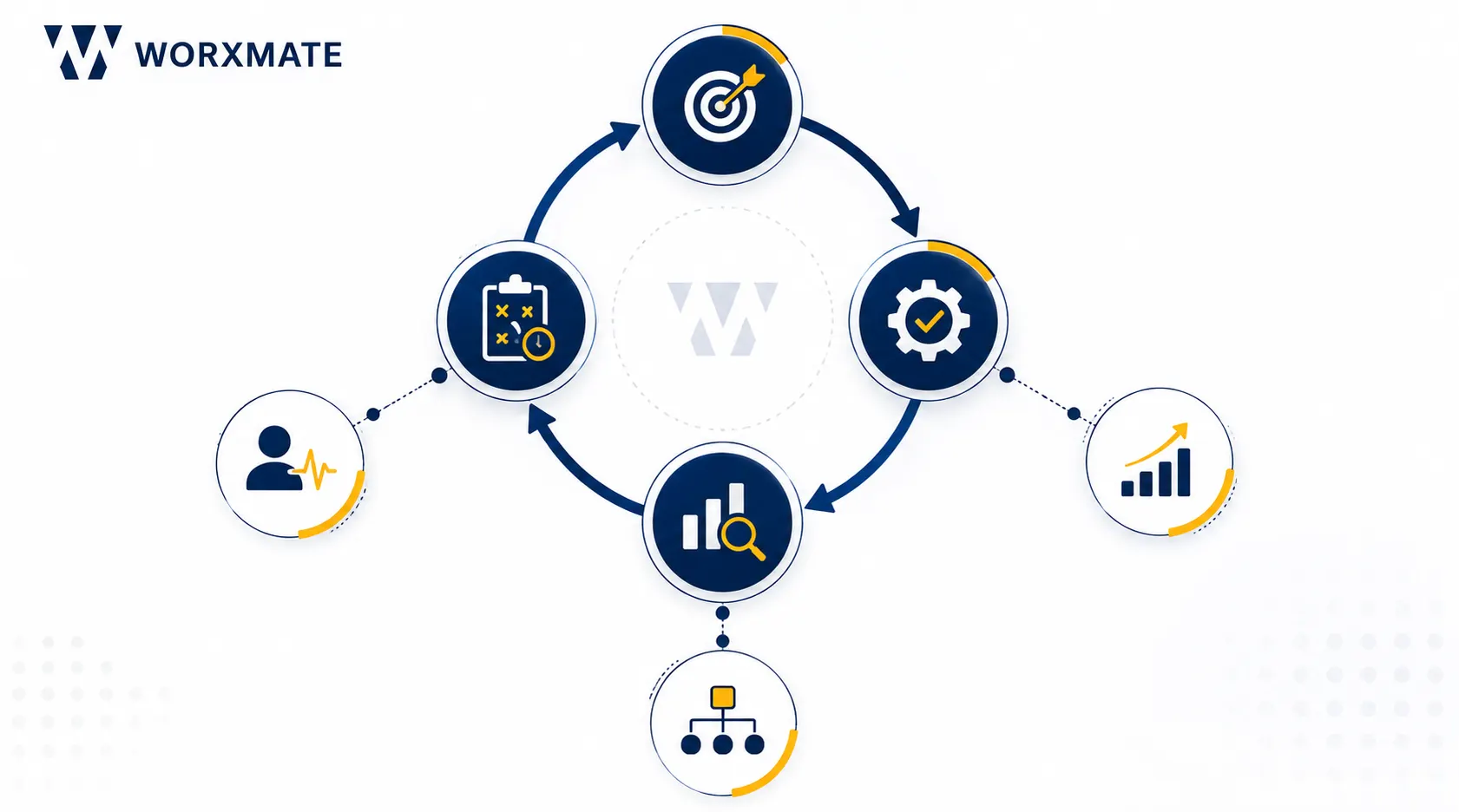
The framework. This is what DEEP AI™ exists to solve – Define, Execute, Evaluate, Plan. It’s not a feature layer sitting on top of a goal tracker. It’s the architecture. Define uses an AI co-pilot and quality scoring so goals get caught before they ship as disguised KPIs. Execute runs structured, AI-guided check-ins instead of hoping managers remember to ask the right questions. Evaluate separates genuine progress from vanity metrics using AI forecasting. Plan turns each cycle’s data into a specific recommendation for the next one, so the organization actually learns cycle over cycle instead of restarting from zero every quarter.
The visibility. Most cascades look fine in a dashboard and are quietly broken underneath a director’s goal doesn’t actually connect to what their reports are working on, and nobody notices until the MBR. This is the exact failure mode Nexus AI is built to catch: it maps cascade health and structural misalignment before it stalls execution, rather than after a quarter’s already been lost to it. On the business-outcome side, Axis AI reads the OKR data and isolates the single fastest lever to pull when revenue or execution is falling behind the exact question every CFO and Sales Head asks in the MBR, answered before the meeting instead of during it.
The coaching. This is the piece software genuinely cannot do alone, and it’s the piece I’d tell any CEO not to skip. The most common failure mode I see what I call the Coaching Cliff is when OKR coaching ends at the C-suite and the middle management layer, where programs actually live or die, was never equipped to run honest check-ins or develop outcome-thinking in their own teams. Setting the C-suite’s OKRs is the beginning of an implementation, not the deliverable.
“One completed OKR genuinely completed, with honest check-ins and a retrospective the organization carries forward is worth more than five written ones that got scored generously and never seriously reviewed.”
On the people side, this is also where Orbit AI earns its place in the stack not because attrition prediction is a nice-to-have, but because a Coaching Cliff and a retention problem are often the same failure showing up in two different reports. Orbit flags burnout and flight-risk signals 4–8 weeks before they’d show up in an exit interview, which is usually 4–8 weeks before anyone would have caught it manually.
How to Evaluate Enterprise Strategy Execution Software Without Getting Sold
Every vendor demo is built to make their platform look inevitable. Here’s what I’d actually ask before signing anything the same three signals I check in the first week of every engagement, because they predict program success more reliably than any feature comparison.
Was this chosen, or was this pushed? Organizations that fail between weeks four and six almost always announced OKRs as the new operating model with a go-live date and a software login, rather than getting leaders to genuinely commit first. No platform answers the question every employee is silently asking what’s in it for me a leadership conversation does.
How many support queries show up in week one? If a team is raising 15–20 product queries a day in week one, adoption breaks within a few weeks. Not might break. Will. That volume signals the tool has more friction than the team’s current OKR literacy can absorb, and no customer success call fixes a mismatch between tool complexity and team readiness.
Does the coaching stop at the C-suite? If your vendor’s onboarding is a leadership workshop and nothing else, ask directly what happens at the manager layer in month two. That answer tells you more about whether the strategy execution gap will actually close than any feature on the spec sheet.
| Question to ask | Why it matters | Red flag answer |
|---|---|---|
| How fast to first live cycle? | Speed in cycle one predicts cycle two adoption | “8–12 weeks of configuration” |
| Does it force outcome vs. output thinking, or just track whatever’s entered? | Output vs outcome confusion is the #1 cause of goal-quality failure | “We track whatever KPIs you upload” |
| Where does coaching stop? | The Coaching Cliff kills more programs than any tool limitation | “Leadership workshop, then self-serve” |
| Does it work without a dedicated strategy team? | Most organizations don’t have one the software shouldn’t assume they do | “Requires a strategy office to configure” |
| Can it integrate with what teams already use? | Adoption drops sharply when teams have to leave their existing tools | “Native to one ecosystem only” check OKR software for Jira or OKR software integration with HRI needs specifically |
For a fuller list of what typically goes wrong in the first 90 days, see OKR software challenges and why OKR implementation fails most of it traces back to one of the three questions above, not a missing feature. If you’re evaluating specifically as a mid-market organization, the calculus shifts again you rarely have the resourcing for an 8–12 week rollout, which rules out most enterprise-first platforms by default.
Where This Leaves You
The software is the infrastructure. The coaching is the capability. You need both and in the right order.
If you’re ready to see what a strategy execution platform built around cascade visibility, AI-guided coaching, and DEEP AI™ actually looks like running, the fastest way in is a live walkthrough of Worxmate’s OKR software or check pricing if you’re already comparing options for a mid-market or enterprise deployment. Book a demo and we’ll walk through your actual cascade, not a canned one. This directly accelerates measurable key results across the entire organization. Tracking a real-time confidence score helps identify at-risk targets before quarter-end. Surfacing operational blockers early ensures leadership can clear obstacles quickly. Strong goal alignment eliminates siloed efforts and connects daily work to strategic outcomes.
If what’s holding your organization back isn’t the platform if it’s the same pattern I saw in that APAC retail war room, where the framework existed but the discipline to run it didn’t that’s a conversation for OKR consulting, not a product tour. We’ve run this exact engagement across 50+ organizations in pharma, fintech, manufacturing, retail, and IT services, and the pattern is consistent: the tool rarely fails first. The capability underneath it does.
Either way, don’t let the category confusion around strategy execution software cost you a quarter. Name the gap first. Then pick the tool that’s actually built to close it.


Written by
An OKR Coach with 20+ years of implementation experience, Madhusudan has guided over 50 organisations through successful OKR transformations, training more than 500 leaders. Learn more about Worxmate.