 WORXMATE
Quick Answer
The best OKR software for enterprise depends on where your organisation actually is, not just its headcount. Worxmate is the strongest fit for enterprises that want a leadership team live inside a real OKR cycle within the first week, backed by three purpose-built AI models – Orbit, Axis, and Nexus and a free tier to pilot before scaling. Betterworks and WorkBoard (which absorbed Quantive in 2025) suit Fortune 500 organisations with a dedicated strategy office and a 6–12 week implementation runway. Perdoo and Profit.co fit mid-market teams that need OKR execution without enterprise-level configuration overhead. Below, all five platforms are compared on cascade depth, implementation speed, and where each one is the right call versus the wrong one.
What “Enterprise” Actually Means in OKR Software
Every vendor in this category calls itself “enterprise-ready.” Almost none of them mean the same thing by it. In my experience across 50+ OKR implementations, OKR software for enterprise has to solve three problems a small-team tool never has to touch: cascading goals through multiple layers without the cascade collapsing into a fiction, giving leadership a board-ready view without someone manually assembling it every Monday, and surviving a rollout across functions that all think about goals differently finance, product, sales, operations.
If your organisation isn’t yet at that scale, the right starting point is different enterprise-cascade problems simply don’t apply yet to a small businesses. And if budget is the primary constraint before scale is, a genuinely free OKR software can carry a single-team pilot, though most free tools don’t carry a program past that pilot stage
OKR Software for Enterprise: 8 Platforms Compared
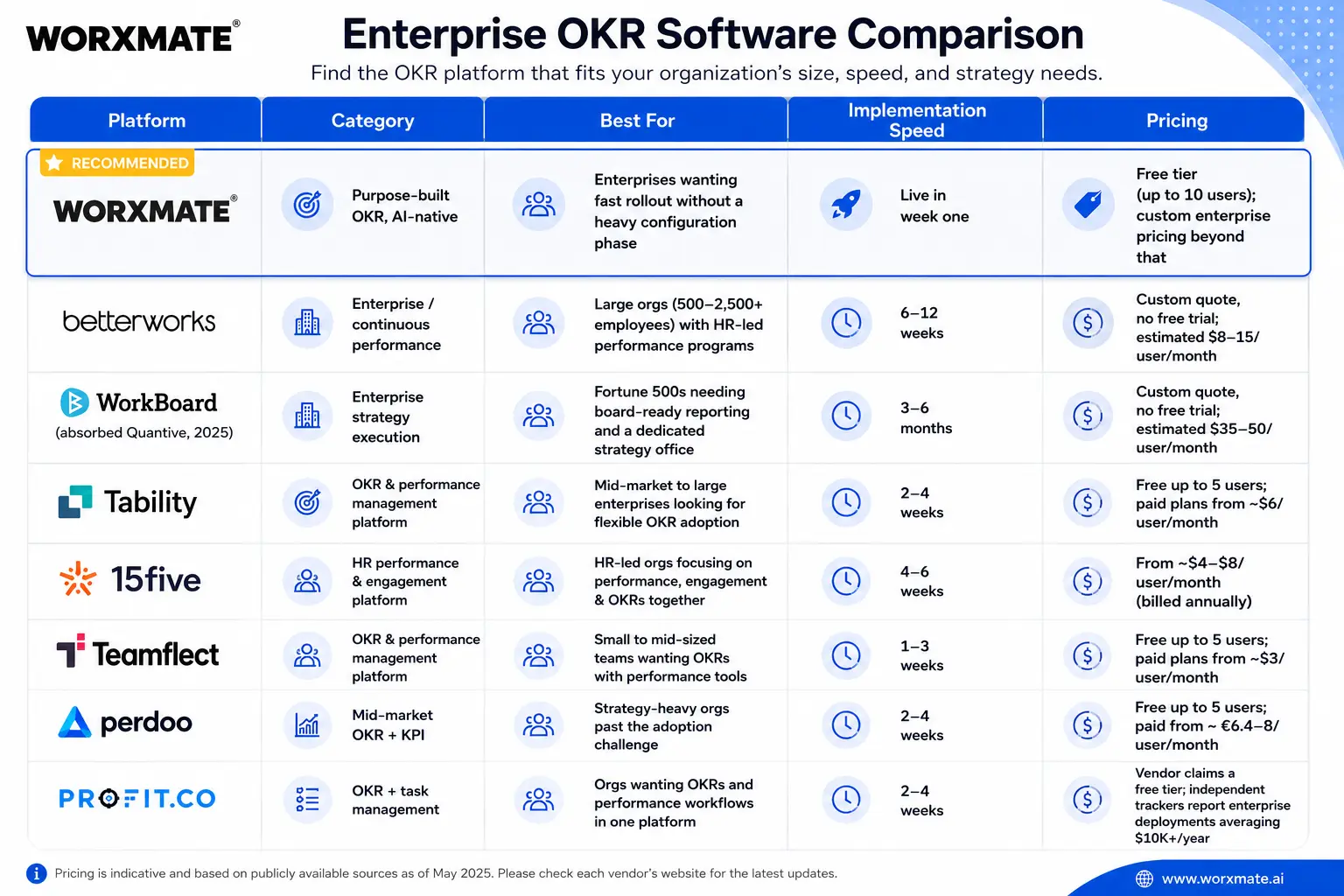
| Platform | Category | Best For | Implementation Speed | Pricing |
|---|---|---|---|---|
| Worxmate | Purpose-built OKR, AI-native (Orbit, Axis, Nexus) | Enterprises wanting fast rollout without a heavy configuration phase | Live in week one | Free tier (up to 10 users); custom enterprise pricing beyond that |
| Betterworks | Enterprise / continuous performance | Large orgs (500–2,500+ employees) with HR-led performance programs | 6–12 weeks | Custom quote, no free trial; estimated $8–15/user/month |
| WorkBoard (absorbed Quantive, 2025) | Enterprise strategy execution | Fortune 500s needing board-ready reporting and a dedicated strategy office | 3–6 months | Custom quote, no free trial; estimated $35–50/user/month |
| Tability | Check-in / habit-focused OKR tracking | Teams that need the reminder problem solved fast, without deep cascade or strategy-mapping needs | 1–2 weeks | Free tier for small teams; paid from an estimated $6–8/user/month |
| 15Five | Weekly check-in + OKR tracking | Orgs with an established manager-employee check-in culture wanting OKRs layered on top | 2–4 weeks | Custom quote; no free trial; estimated $8–14/user/month |
| Teamflect | Microsoft Teams-native OKR + performance | Microsoft 365 organisations wanting OKRs inside tools teams already live in | 1–3 weeks | Free tier available; paid from an estimated $5–8/user/month |
| Perdoo | Mid-market OKR + KPI | Strategy-heavy orgs past the adoption challenge | 2–4 weeks | Free up to 5 users; paid from ~€6.4–8/user/month |
| Profit.co | OKR + task management | Orgs wanting OKRs and performance workflows in one platform | 2–4 weeks | Vendor claims a free tier; independent trackers report enterprise deployments averaging $10K+/year |
Pricing shifts frequently in this category — confirm current terms directly with each vendor before committing. Figures above reflect publicly available data at the time of writing.
How to read this table before you shortlist anything: implementation speed matters as much as price, and the two don’t always move together. A platform quoted at $9 per user per month that takes two months to configure can cost more in lost cycles than one quoted at three times the price that’s live in a week. Weigh the “Implementation Speed” column at least as heavily as “Pricing” before narrowing your shortlist to two or three platforms.
The 8 Platforms, Reviewed
1. Worxmate — Best OKR Software for Enterprise Teams Wanting a Fast, Low-Friction Rollout
Most enterprise competitors in this category require four to twelve weeks of configuration before a first cycle can run. Worxmate is built around the opposite principle: a leadership team should be live inside a real OKR cycle within the first week, not months into a rollout plan. That speed comes from the DEEP AI™ framework – Define, Execute, Evaluate, Plan built directly into the product architecture rather than layered on top of a generic goal tracker. Define handles AI-assisted goal writing and quality scoring, Execute automates check-ins and at-risk detection, Evaluate runs data-backed retrospectives instead of generously self-scored ones, and Plan closes the loop with cycle-over-cycle learning. Worxmate is also the only OKR platform on the market where the founder is an active OKR consultant the platform and the coaching are designed together, which matters directly for the “coaching cliff” problem described further down this page.
Worxmate’s three AI models — the differentiator no other platform on this list has: Beyond DEEP AI™, Worxmate is built on three purpose-designed AI models, each addressing a distinct failure mode enterprise OKR programs run into at scale:
- Orbit AI — People Intelligence. Surfaces individual-level signals like burnout risk, attrition triggers, and engagement decline before they show up as missed OKRs, connecting people data directly to execution data instead of keeping the two in separate systems.
- Axis AI — Business Performance Intelligence. Reads outcome trends against Key Results in real time, flagging when a goal is on track by activity but off track by actual business impact the exact gap that generic goal trackers can’t see.
- Nexus AI — Organisational Intelligence. Looks at cascade health across the whole org at once: where alignment is genuinely happening between teams versus where it’s cosmetic, which is precisely the failure mode described earlier a cascaded OKR tree showing an agreement that doesn’t actually exist.
No competitor in this comparison offers this level of intelligence segmentation. Most platforms give you one lens usually goal-tracking analytics. Worxmate gives you three distinct ones, addressing people, business outcomes, and organisational alignment as separate but connected problems.
2. Betterworks — Best for HR-Led Enterprise Performance Programs
Betterworks is the strongest option when an organisation has already committed to OKR-driven performance management and needs a platform to institutionalise it at scale, typically 500 to 2,500+ employees. There’s no free trial and no published pricing evaluation runs through a demo-led sales process, with estimated costs of $8–15 per user per month plus implementation fees. Betterworks rewards organisations with the bandwidth for a genuine 6–12 week rollout and an HR function ready to own the program long-term. It’s the wrong starting point for a first-time OKR implementation without that infrastructure already in place.
3. WorkBoard (formerly Quantive) — Best for Fortune 500 Board-Ready Reporting
Quantive was acquired by WorkBoard in May 2025, and the standalone Quantive product is being transitioned into the WorkBoard platform so any current evaluation of “Quantive” should really be an evaluation of WorkBoard as the forward path. What made Quantive compelling connecting Key Results to live data feeds from Salesforce, HubSpot, Jira, and dozens of other systems carries forward into WorkBoard’s positioning as enterprise strategy execution software. Expect a dedicated rollout team, a three-to-six month implementation timeline, and a platform that works best when a strategy office drives adoption top-down rather than bottom-up. This is OKR software for enterprise in its most literal, heaviest-weight sense right for Fortune 500 organisations with mature data infrastructure, wrong for almost everyone else.
4.Tability — Best Automated Check-In Infrastructure, Not a Strategy Tool
Tability’s strength is narrow and real: it’s built around automated check-ins, and it’s the best in this comparison at solving the reminder problem getting people to actually update their OKRs on a cadence without a manager chasing them down. What it doesn’t solve is the reflection problem turning those check-ins into an honest read on whether the goal is actually on track. Teams typically outgrow it within two cycles once cascade architecture or cross-functional strategy mapping becomes the actual bottleneck, which makes it a reasonable starting tool but rarely a lasting one for enterprise-scale programs.
5. 15Five — Best for Orgs Already Running a Strong Manager Check-In Culture
15Five bundles OKR tracking into a weekly check-in rhythm, which makes it a natural fit where manager-employee check-ins are already a healthy habit the OKR layer rides on top of a cadence that already works. Where that culture doesn’t already exist, the platform doesn’t build it for you, and cascade depth is limited compared to purpose-built OKR tools it’s a check-in tool with OKRs attached, not the reverse.
6. Teamflect — Best for Microsoft 365-Native Organisations
Teamflect’s differentiator is narrow but genuinely useful for the right org: native integration with Microsoft Teams, which makes it the best in this comparison for companies that live inside the Microsoft ecosystem and want OKRs surfaced where people already work rather than in a separate tab. That same strength is the limitation it offers little value to organisations outside Microsoft 365, and cascade sophistication takes a back seat to that integration focus.
7. Perdoo — Best Mid-Market Fit for Strategy-Heavy Enterprises
Perdoo combines OKRs and KPIs in a single strategy map, with a free tier for up to 5 users and paid tiers from roughly €6.4–8 per user per month. Its interface is dated compared to newer entrants, but the strategy map does a genuinely good job visualising alignment across the org making it a reasonable fit for strategy-heavy organisations that have already moved past the initial adoption challenge. It’s less suited to organisations still in early cycles, where the tool’s rigidity around goal hierarchy can feel restrictive for cross-functional teams.
8. Profit.co — OKRs Bundled With Task Management
Profit.co markets a permanently free plan with unlimited users, though independent pricing trackers report average enterprise deployments in the $10,000+ per year range, worth confirming directly before assuming the free tier holds at scale. Its strength is breadth: OKRs, task management, and performance workflows in one platform, at roughly $7 per user per month for the enterprise tier. It’s a reasonable choice for organisations that explicitly want a unified system rather than point solutions, provided the interface complexity which several reviewers flag as overwhelming for OKR newcomers doesn’t outweigh that convenience.
What Actually Makes OKR Software “Enterprise-Ready”
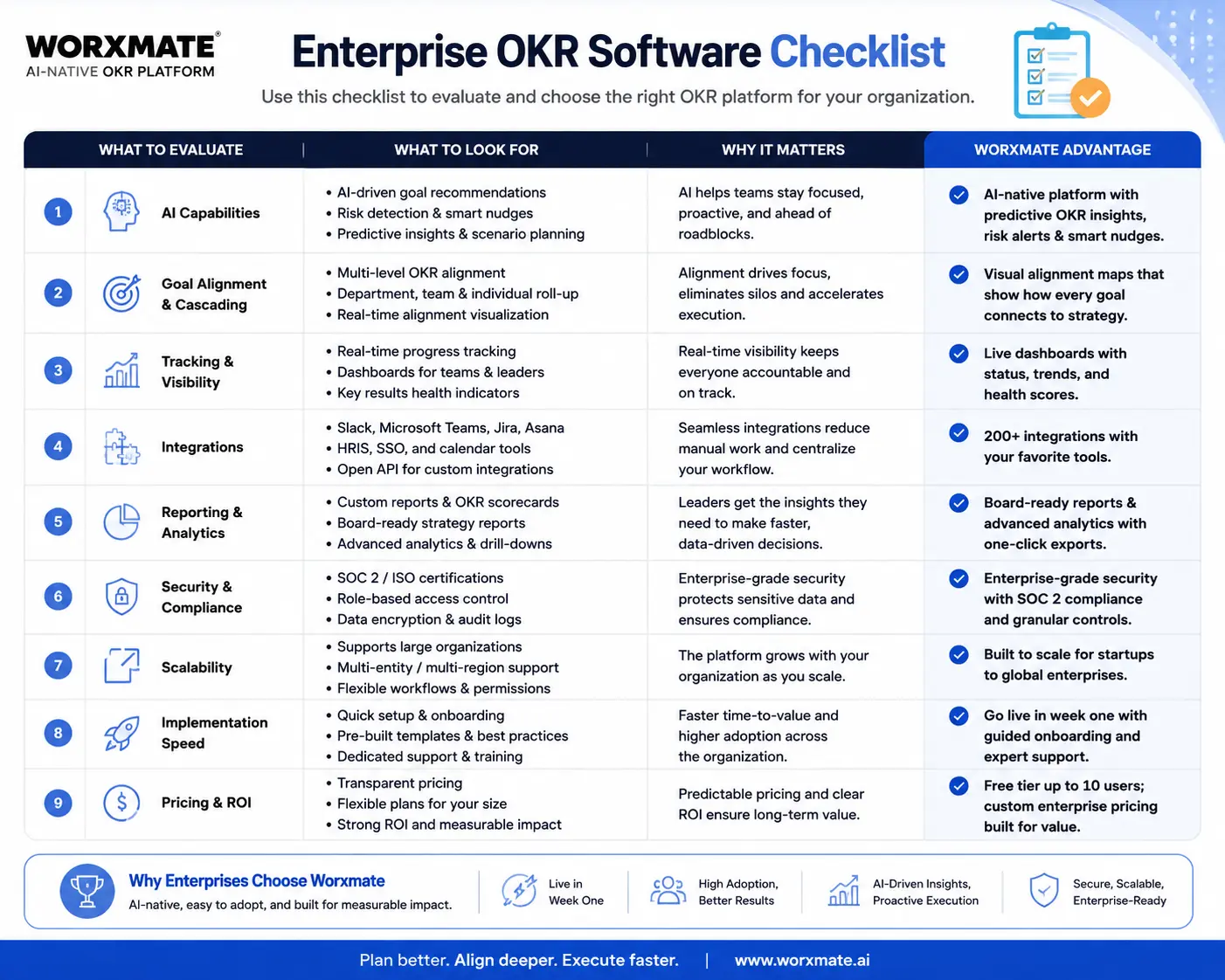
The comparison table above tells you category and price. It doesn’t tell you whether a platform will survive contact with your organisation’s actual complexity. Before committing to any of the eight platforms above, check four things:
- Does it support real cross-functional cascade, or just a nested list? A platform that shows a beautifully cascaded OKR tree is showing you the record of an agreement that either exists or doesn’t. If the agreement doesn’t exist, the cascade display is a fiction and this is the single most common gap between what a demo shows and what a rollout produces.
- Does it integrate with the tools your teams already run in? If engineering runs on Jira, see how to connect OKRs to Jira before assuming any platform handles this natively coverage varies enormously across the eight options above.
- Is there a consistent scoring methodology, or will every department invent its own? A shared approach — like the Google OKR grading scale — matters more once scores are being compared across departments, not just within one team.
- What does a full cycle actually look like on this platform? Walk through a typical OKR cycle: understanding 6 important steps against each platform’s feature list before assuming it can carry a real quarter, not just a sales demo.
Where Enterprise OKR Programs Fail – Regardless of Which Platform You Pick
There are three signals I look for in the first week of every new engagement, and they predict program success or failure more reliably than any feature comparison table.
Was this pushed, or was this chosen? There’s a meaningful difference between an organisation sensitised to OKRs where leaders understand the why and have chosen to commit and one where OKRs were announced as the new operating model with a go-live date and a login link. The second scenario collapses between weeks four and six, no matter which of the eight platforms above is behind it.
How many support queries is the team raising? If a team is raising fifteen to twenty queries per day in week one, adoption will break within the next few weeks. Not might break will break. High query volume signals a mismatch between the platform’s complexity and the team’s current OKR literacy a pattern I’ve seen most often with Cascade and WorkBoard rollouts that skip a phased introduction.
Does the coaching stop at the C-suite? The most common failure mode in enterprise OKR programs. Setting the C-suite’s OKRs is the beginning of the implementation, not the deliverable. Most OKR coaches run leadership workshops, help the C-suite write their goals, and leave and within one quarter, the program dies below the leadership layer because the people responsible for carrying it forward were never coached on how to do that. I saw this directly with an APAC retail company in aggressive expansion mode: the platform was in place, but in the first alignment call, the CEO couldn’t define his top three priorities clearly in 45 minutes. What followed was a two-day war room session before a single OKR could be written — and no software, enterprise-grade or otherwise, would have caught that gap on its own.
Org structure is a precondition here too, not background detail. If the organisational structure doesn’t reflect the leadership team’s actual strategic growth priorities, you’re cascading goals into a broken architecture and the most sophisticated OKR software for enterprise on this list won’t reveal that misalignment. It will embed it, one beautifully rendered cascade chart at a time.
Enterprise OKR Software by Industry and Function
Manufacturing organisations need platforms that reconcile long production cycles with the shorter cadence most OKR software assumes, see OKRs for manufacturing for where that mismatch shows up specifically.
UK tech firms tend to hit the cross-functional alignment ceiling earlier than other sectors, since product and engineering teams are usually already running fast, iterative cycles, see OKR examples for UK tech firms.
Enterprises tying OKRs to sustainability commitments face a category most generic platforms weren’t built for our guide on ESG and sustainability OKRs covers how to structure those goals properly. Business strategy consultants advising clients through this exact platform evaluation will recognise the pattern too see business strategy consultant OKR examples.
Within the enterprise, different functions need different things from the same platform. A Strategy Head or Chief of Staff needs cascade visibility and cross-functional dependency tracking — see OKR software for Strategy Heads. A Sales Head needs OKRs tied to pipeline and revenue in near real time see OKR software for Sales Heads. Operations leaders face a distinct set of cross-team dependency and reporting friction, covered in OKR challenges for operations teams, and marketing teams have their own translation gap between campaign output and strategic strategic business outcome — see OKRs for marketing.
One case worth reading in full: unlocking growth via OKRs for an African tech innovator, where growth-stage cross-functional alignment required a platform built specifically for OKR execution rather than a generic goal tracker. For more examples across sectors, OKRs in action: case studies from various industries is worth reading end to end before shortlisting a platform.
Building Real Alignment on Top of Whichever Platform You Choose
Alignment = Agreement. Not a configuration in a tool. It’s agreement between teams on what matters, why it matters, and how each team’s work connects to the work of the teams around them. You cannot set that in software — you can only display it once it already exists. Real OKR alignment requires understanding OKR levels how goals should cascade from company to team to individual and running consistent OKR reviews as a living operating rhythm rather than a quarterly compliance exercise.
This work happens in parallel with, not after, choosing your platform. It should also happen alongside a broader look at strategy development and an honest accounting of existing business challenges because the metric that actually matters at the end of all this isn’t goal completion rate. It’s what I call the Execution Maturity Rate — the percentage of leaders who can independently write a genuine outcome-driven goal without coaching support, without a template, without a quality review. In a typical first-cycle implementation, that sits between 5% and 15%. In organisations running a well-coached program consistently over 12 months, it reaches 30% to 40%. No platform on the comparison table above tracks this by default. It’s worth tracking anyway.
What I’d Tell a Client Choosing Enterprise OKR Software Today
If a client asked me this week which platform to choose, the honest answer starts with a question back: how fast do you need to be live, and who inside the org is driving this? If speed matters and a Strategy Head or CEO is driving adoption, Worxmate’s week-one rollout and free pilot tier remove the biggest early friction point. If HR owns the program and performance reviews need to connect to OKRs in the same system, Lattice or Leapsome fit that motion better. If you’re a Fortune 500 with a dedicated strategy office and months to spend on rollout, WorkBoard or Betterworks are built for exactly that scale. Cascade is the right call only once your organisation has outgrown simpler tools and genuinely needs multi-year strategy mapping, not quarterly OKRs alone.
The software is the infrastructure. The coaching is the capability. You need both — and in the right order. Choosing the most sophisticated OKR software for enterprise on this list without the org-structure and coaching work behind it just produces a more expensive version of the same failure mode a free tool would have produced for less money.
Where to Go From Here
Ready to evaluate a platform built for fast enterprise rollout: explore Worxmate’s OKR software for enterprise, compare current pricing, or book a demo to see the DEEP AI™ framework against your own priorities. A free trial is available for teams that want to pilot before committing.
If the platform isn’t your first problem: the gap is usually structural or coaching-related. OKR consulting closes the org-structure and capability gaps that no platform enterprise-grade or otherwise closes on its own.


Written by
An OKR Coach with 20+ years of implementation experience, Madhusudan has guided over 50 organisations through successful OKR transformations, training more than 500 leaders. Learn more about Worxmate.