 WORXMATE
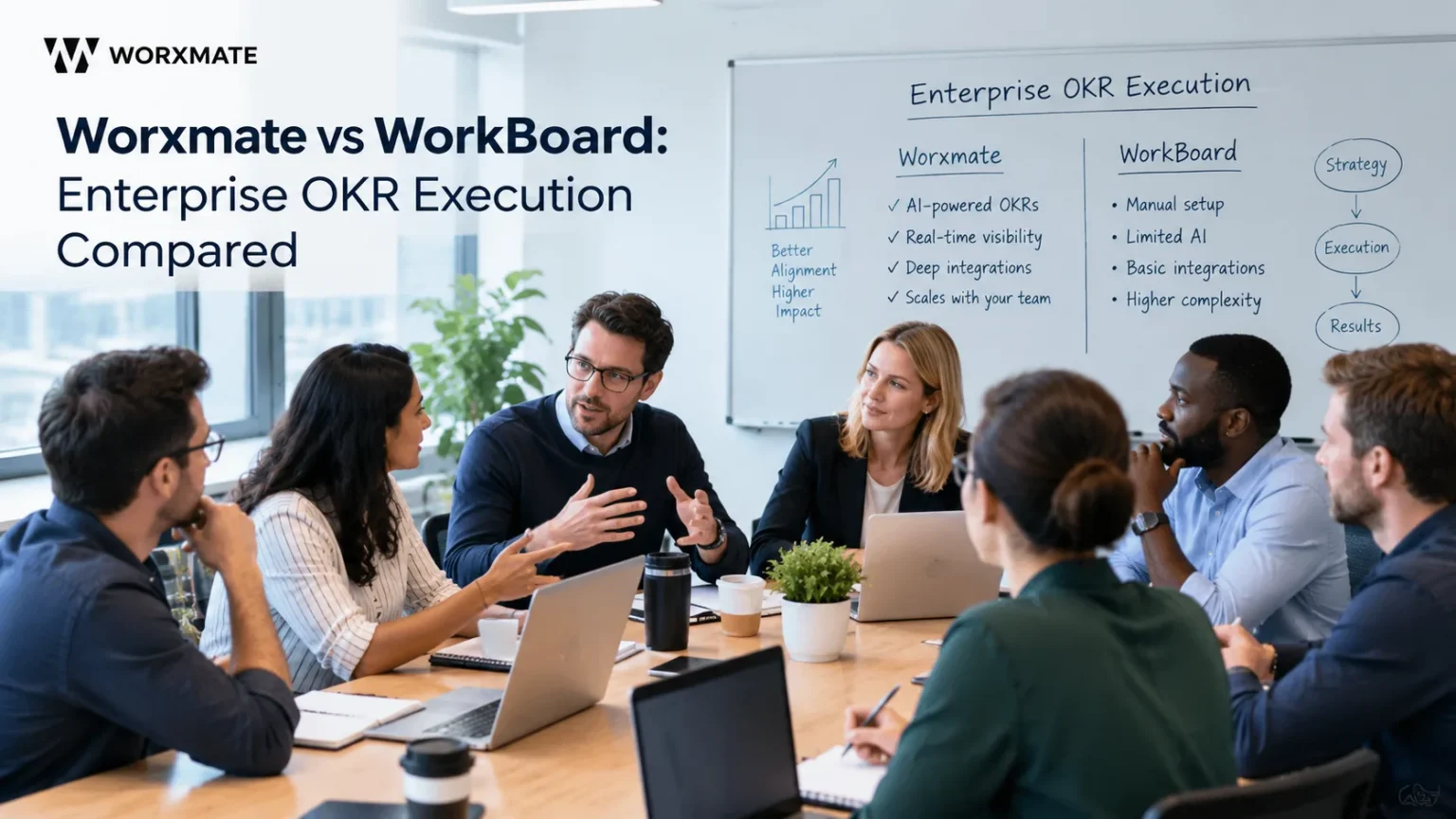
Worxmate vs WorkBoard comes down to what your enterprise is short of. WorkBoard is a large-enterprise strategy execution platform with OKR, strategic portfolio management and talent management modules, sold on quote-based contracts. G2 data shows roughly two months to implement. Worxmate is purpose-built OKR software built on the DEEP AI™ framework (Define, Execute, Evaluate, Plan), designed so a leadership team is inside a live cycle in week one. Choose WorkBoard if portfolio-level planning is your gap and you have a strategy office to run it. Choose Worxmate if your gap is execution discipline and outcome thinking across leaders. This okr tool comparison reflects published material as of October 2026.
Six to eight senior leaders sat in one room at a Middle East energy and utility company, an 8,000+ person organisation worth $45 billion. Every one of them had sharp, well-reasoned priorities. No two of those priorities matched. When the SWOT conversation started, the instinct was to hire a large consulting firm for an eight-week exercise. I asked them to brainstorm for one week and agree on the two or three things that would hurt the business most if left undone.
Nobody in that room needed software to discover the disagreement. They needed software later, to hold an agreement once it existed. That is the frame I bring to worxmate vs workboard, a search buyers also type as workboard vs worxmate, and it is why I will not hand you a feature grid and call it analysis. This is a worxmate vs workboard enterprise okr comparison written for the CEO’s office, the Strategy Head and the CHRO, not for the person who only wants a price.
I am Madhusudan Nayak, Co-Founder and CEO of Worxmate, so read this with that bias in mind. I also have 20+ years in strategy execution, 10+ years implementing OKRs and 50+ organisations coached, and I was Business Head at Profit.co before I built Worxmate. I will tell you where WorkBoard is the better answer, because for some enterprises it is. Everything about WorkBoard below comes from its own announcements and G2 data as of October 2026. Verify the details with them before you sign anything.
Worxmate vs WorkBoard: Two Different Starting Points
WorkBoard describes itself as a strategy execution system of record. The WorkBoard strategy execution platform bundles OKR management, strategic portfolio management and talent management modules, and WorkBoard OKR software is the entry point into that bundle. Its site names enterprise customers such as 3M, AstraZeneca and Boeing. In May 2025 it announced the acquisition of Quantive, which matters if you were shortlisting Worxmate vs Quantive as a separate option.
That puts WorkBoard closer to strategy execution software than to a pure OKR tool. Worxmate sits on the other side of that line. For dedicated OKR software, OKRs are the feature. Every product decision exists to answer one question: does this make OKR execution better? Neither starting point is wrong. They solve different problems, and most failed selections I have seen came from buying one when the organisation had the other problem.
| Dimension | Worxmate | WorkBoard |
|---|---|---|
| Category | Purpose-built OKR software on the DEEP AI™ framework | Enterprise strategy execution platform with OKR, portfolio and talent modules |
| Built around | Outcome thinking and a live first cycle | Enterprise-scale strategy, programs and portfolio governance |
| Typical buyer | CEO’s office, Strategy Head, BU Head, CHRO | Large enterprises with a strategy office or PMO |
| Implementation | Designed for a leadership team live in week one | About 2 months on G2 data |
| AI | Orbit AI, Axis AI, Nexus AI, plus DEEP AI™ | Portfolio Analyst, Chief of Staff and Leadership Coach agents, plus a Microsoft Copilot agent |
| Pricing | Published on the pricing page | Quote-based, no public per-user price |
| Best fit | Execution discipline is the gap | Portfolio-level planning is the gap |
If you want the wider landscape before going head to head, my okr software comparison and top 10 OKR software pages cover the field, and I treat any enterprise okr software comparison as a first filter, never a final decision. This one stays on two platforms.
Worxmate vs WorkBoard Features: Where the Overlap Ends
Both platforms will cascade objectives, run check-ins and give leadership a dashboard. That is table stakes, and our okr software features guide covers it. The differences start where the cascade stops being the problem.
On worxmate vs workboard features, three questions separate the two faster than any grid. Can a leader see at-risk goals through real-time OKR tracking before the monthly review? Do OKR check-ins force a reflection or just a reminder? And does the dashboard tell the CEO what to change, or only what happened? Those are workboard features worth testing in a live demo, and Worxmate should face the same test.
WorkBoard’s strength is the layer above the OKR: strategic portfolio management. Per its own release notes, a portfolio release with Portfolio Analyst agents shipped in June 2026. If you run hundreds of programs competing for funding and headcount, that is a portfolio problem, and I would not position Worxmate as a portfolio management system. Be honest with yourself about which problem you have.
Here is the other side. In my experience across 50+ implementations, the failure is rarely a missing portfolio view. It is leaders who write outputs and call them outcomes. A portfolio tool will faithfully record the output. When I worked with a multi-billion dollar mining engineering group, the breakthrough was not a new view. It was leaders finally seeing the chain from a daily action on the ground to a regional expansion goal, and learning to tell leading indicators from lagging ones. I explain that gap in output vs outcome.
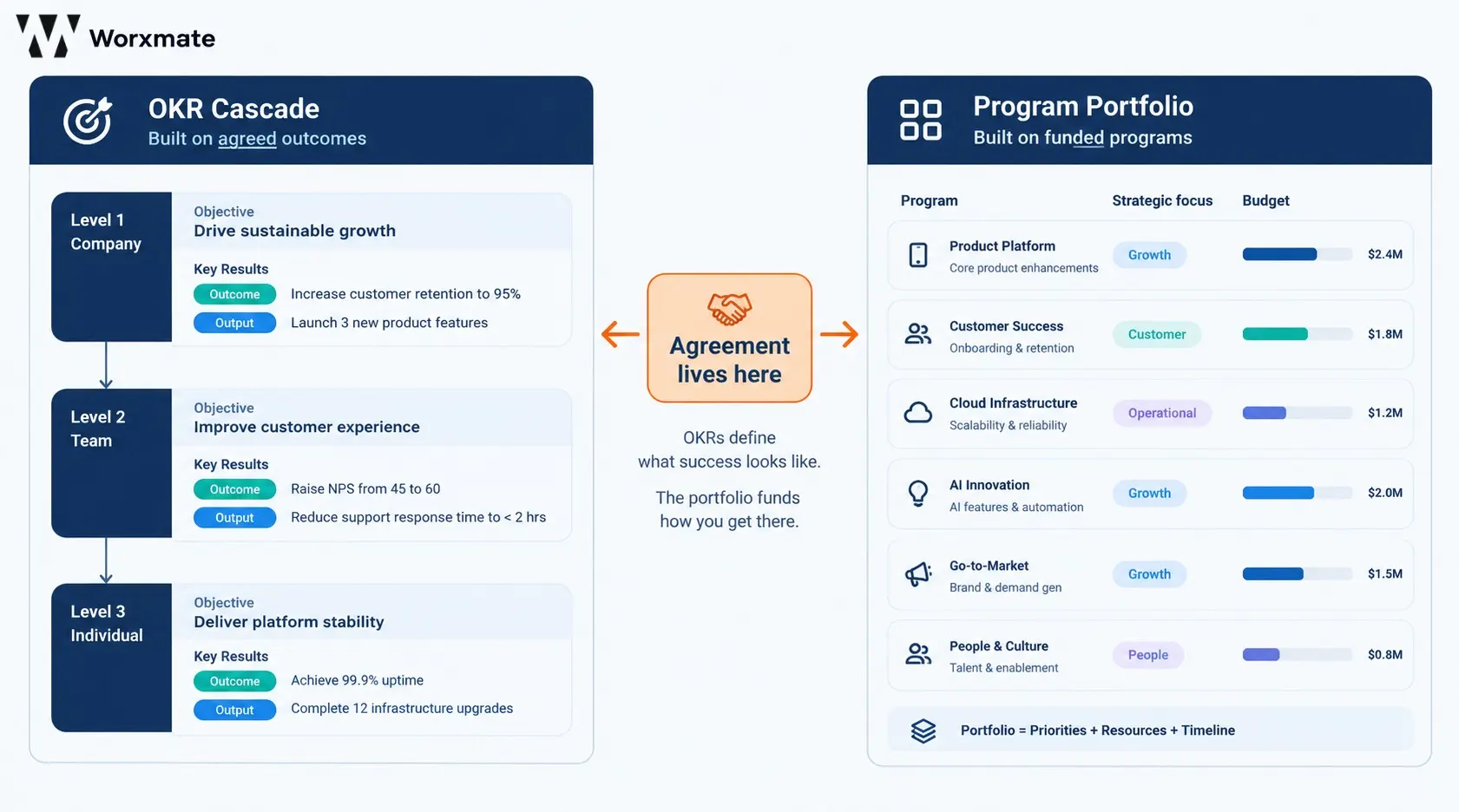
Alignment = Agreement. You cannot set it in a tool. You can display it once it exists. A beautifully cascaded OKR tree is the record of an agreement that either exists or does not.
That is why I treat okr software with alignment mapping as a necessary feature and a poor test of readiness. Both tools can draw the map. Only your leadership team can make it true. For the full vendor list, read worxmate vs competitors.
Worxmate vs WorkBoard Implementation: Weeks Versus Quarters
On workboard implementation time, G2 shows about two months to implement and about eight months to ROI, from a small sample of seven purchases. The worxmate vs workboard implementation difference is mostly about what happens in the first week. For a 70,000-person organisation, two months is honest, not slow. The risk is when configuration time quietly replaces thinking time.
I watch three signals in week one of every engagement, and they predict more than any how to choose okr management software checklist.
- Was this pushed, or was it chosen? OKRs announced with a go-live date and a software login collapse between weeks four and six, because nobody answered what is in it for me.
- How many product queries is the team raising? If a team raises 15 to 20 queries a day in week one, adoption will break within weeks. The tool and the team’s OKR literacy are mismatched.
- Does the coaching stop at the C-suite? I call that the Coaching Cliff. Programs die below the leadership layer within a quarter.
Then there is the number I trust most, the Execution Maturity Rate: the percentage of leaders who can independently write a genuine outcome-driven goal without coaching, a template or a quality review. In a typical first cycle it sits between 5% and 15%. In organisations running a well-coached program for 12 months, it reaches 30% to 40%. No platform moves that number in a quarter, so a tool that consumes two of your twelve months in setup has a real cost. Read why OKR implementation fails and the okr software challenges piece before you set a rollout date, and use how to implement OKRs as the sequence.
Know your Execution Maturity before you pick a platform
Score how ready your leaders are to run outcome-driven OKRs, so the tool you shortlist matches the team you actually have.
Worxmate vs WorkBoard AI: Agents That Report, Intelligence That Signals
WorkBoard’s AI story is real. Its site describes generative and agentic AI, including Portfolio Analyst, Chief of Staff and Leadership Coach agents. In May 2025 it released an agent for Microsoft Copilot that lets users check OKR status and pull key result history while working in Word, PowerPoint, Excel and Outlook. If your executives live inside Microsoft 365, test that agent first. Those workboard ai capabilities suit executives who want answers on demand, and they are the heart of any honest worxmate vs workboard ai discussion.
My question about any AI layer is different. Does it tell you whether people are moving the business, or whether they completed the process? Worxmate answers that through DEEP AI, the architecture of the product rather than a layer on top of it, and through three models: Orbit AI for people intelligence, Axis AI for business performance intelligence and Nexus AI for organisational intelligence.
| DEEP AI stage | What breaks without it | Worxmate product | What to test in any enterprise tool |
|---|---|---|---|
| Define | Leaders write activity lists and label them Key Results | Define | Does it challenge a weak goal with a “so what” question? |
| Execute | Check-ins become status theatre and risk surfaces too late | Execute | Does it flag at-risk goals before the monthly review? |
| Evaluate | Scoring is generous and nobody can defend the number | Evaluate | Can you trace a score back to evidence? |
| Plan | Every cycle starts from zero | Plan | Does the retrospective change the next cycle’s goals? |
A word on people data. WorkBoard also sells a talent management module, and searches for “workboard connected performance” show buyers trying to understand how its goals and performance sides join up. I could not verify that term in WorkBoard’s own material, so ask them to demo it. If your real question is reviews, calibration and appraisal, that is a different buying decision. Start with OKR vs PMS software, then the best performance management software page. For the combined case, read okr and performance management software.
Worxmate vs WorkBoard Integrations: Jira, Microsoft Teams and HRIS
Enterprises rarely buy a goal tool in isolation. The real test is okr software for enterprise with hris and jira integration, because a key result that someone updates by hand is a key result that goes stale. Public sources list WorkBoard connections to Slack, Jira, Microsoft Teams, Asana and Google Sheets, and some reviewers describe integration setup as cumbersome. I have not tested those, so treat that as a lead to check, not a finding.
Worxmate connects to Jira, Microsoft Teams and HubSpot, and the full list sits on the integrations page. For deeper reading, I cover okr software for jira, okr tools with microsoft teams integration and okr software integration with hris.
Microsoft changes the picture in one more way. Viva Goals was discontinued in December 2025, and WorkBoard offers Azure Marketplace purchase with MACC eligibility for those customers. If you are in that group, my notes on the Viva Goals retirement, how to migrate from Viva Goals and Viva Goals alternatives will save you a quarter. Ask both vendors to show a live key result updating from Jira in your own tenant. A demo environment proves nothing.
Worxmate vs WorkBoard Pricing: What You Can and Cannot Compare
WorkBoard does not publish a per-user price. G2 lists pricing as available on request, with no free plan or trial, and an average discount of 19% across its purchase data. That makes any “workboard pricing per user” figure an estimate. Third-party sites I checked disagree by more than three times, one quoting from $9 per user per month and another estimating around $30 with a minimum annual commitment. Neither is a quote.
Compare cost the way a CFO will:
- Full-year spend, not seat price. Ask for the total including modules you will not use in cycle one.
- Internal hours to first cycle. Two months of configuration is two months of your best people.
- Coaching cost. The tool does not teach outcome thinking. Someone will.
- Renewal terms. Ask what happens to price after the first term.
Our okr software cost per user breakdown shows the method, and Worxmate’s current numbers sit on the pricing page, not in a blog that goes stale. I would rather you compare worxmate vs workboard pricing from two real quotes than from my summary.
Achieve Your Goals Faster
See how Worxmate can help your team set clear goals and achieve faster results. Book your free demo today and experience the power of AI-driven OKRs in action.
Worxmate vs WorkBoard Reviews: What Buyers Actually Report
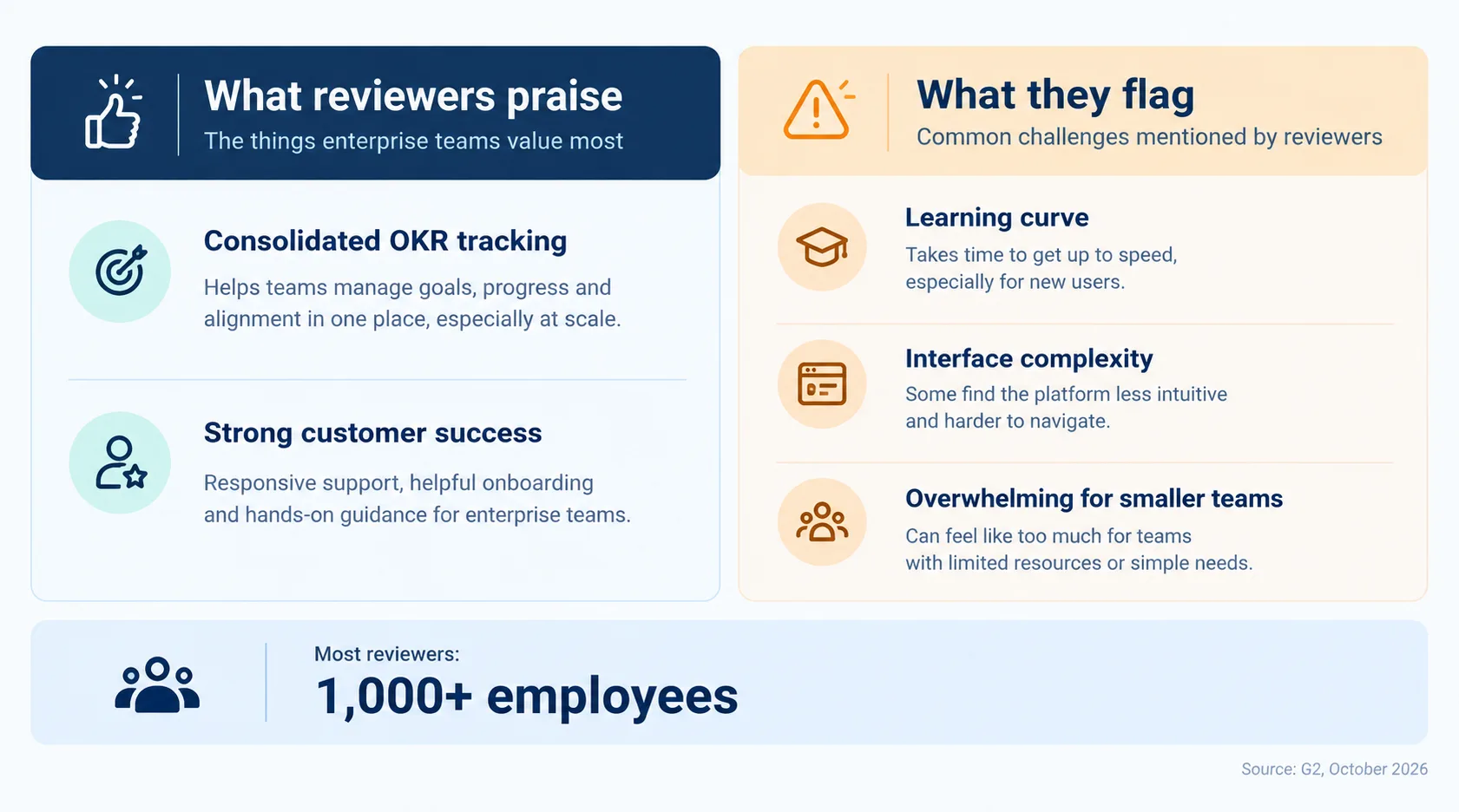
On G2, WorkBoard’s reviews are strong, mostly four to five stars. Buyers praise how it brings OKR tracking, meetings, workstreams and strategic alignment into one place, and they praise the customer success team often. The recurring complaints are a learning curve and interface complexity, and feature depth that can overwhelm smaller teams. G2 also notes most reviewers are enterprises above 1,000 employees. Gartner Peer Insights is thinner, with only two ratings averaging 4.3 and one review that contains placeholder text, so I would not draw conclusions from it. For method on reading ratings, see my okr software reviews page.
So, is WorkBoard worth it? For a 1,000+ person enterprise with a strategy office, a PMO and appetite for a two-month rollout, yes, the reviews say it earns its place. For a mid-market team without that machinery, the same reviews describe a tool that asks more of you than you can give. Those are the same facts read against two different organisations.
Which Is Better, Worxmate or WorkBoard, for Enterprise OKRs?
Which is better worxmate or workboard for enterprise okrs? I will answer the way I would to a client. It depends on the sentence you can finish honestly: “Our biggest gap is ___.”
Size shifts the answer too. For worxmate vs workboard for large enterprises above roughly 2,000 people with a dedicated strategy team, the portfolio layer starts to matter more, and strategy implementation and monitoring becomes a full-time job. Below that, in my experience, speed to a first honest cycle and the quality of coaching decide the outcome.
| If your biggest gap is… | Lean toward | Why |
|---|---|---|
| Funding and sequencing hundreds of programs | WorkBoard | Its strategic portfolio management module is built for this |
| Leaders confusing outputs with outcomes | Worxmate | DEEP AI™ and coaching target the thinking, not the record |
| Executives working inside Microsoft Copilot | WorkBoard | The Copilot agent is a documented strength |
| A live cycle this month, not next quarter | Worxmate | Built for leadership running a real cycle in week one |
| A dedicated strategy office with years of OKR maturity | WorkBoard | Fits the governance load |
| A first-cycle program with a coaching plan | Worxmate | Matches the 12-month Execution Maturity journey |
What I’d Tell a Client: run both demos with your own OKRs, not the vendor’s sample data. Watch how each tool handles a vague key result. The one that makes your leaders uncomfortable in a useful way is the one worth buying. For the broader process, my guides on how to evaluate OKR software and okr software for enterprise give the wider buyer’s view.
Turn your shortlist into a rollout plan
The strategic OKR implementation guide walks through cycle one at enterprise scale, whichever platform you choose.
WorkBoard Alternatives and How to Compare Enterprise OKR Tools
If you searched for a workboard alternative, you probably hit one of three walls: price opacity, configuration weight, or a team that is mid-market rather than enterprise. Those are the common reasons people look at workboard alternatives for mid-market companies, and my guide to okr software for mid-market companies is written for them.
The honest list of workboard competitors depends on your problem. Quantive suits data-heavy teams and is now part of WorkBoard, per its announcement. Betterworks leans toward manager effectiveness at large scale, with a long procurement cycle. Perdoo is strong on strategy maps. Profit.co is feature complete but configuration-heavy. Lattice works when HR drives the program, which is a risk I describe below. Collectively these are the best OKR tools in the enterprise tier.
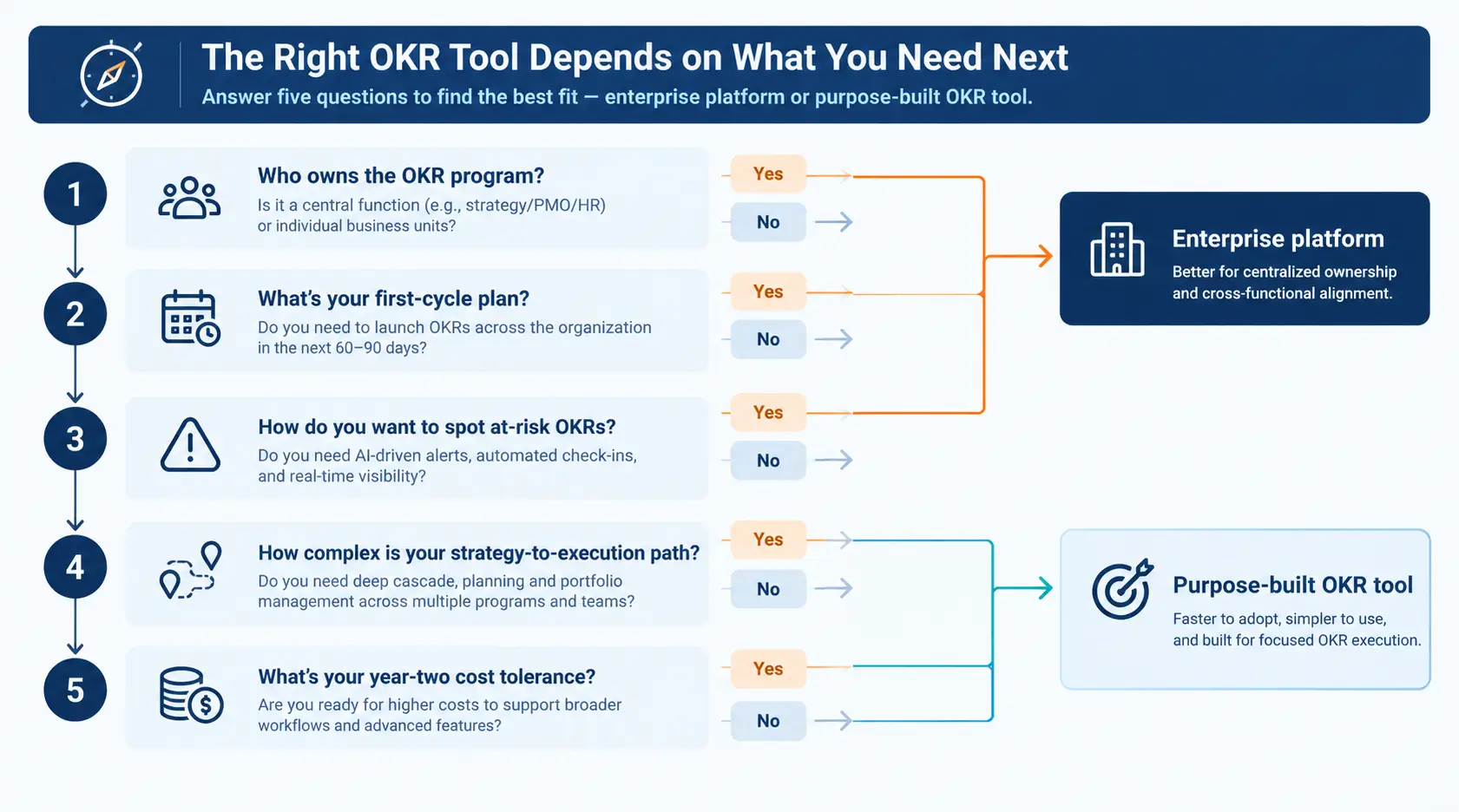
For how to compare enterprise okr tools, ask five questions in order:
- Who owns the OKR program, the CEO’s office or HR?
- What is the first-cycle plan, in weeks, not features?
- Which signal tells you a key result is at risk before the review?
- How does it show a path from strategy to execution, meaning enterprise okr software with strategy to execution tracking, not just a cascade?
- What does year two cost?
Question one deserves a pause. When HR owns OKRs, the rest of leadership treats them as another framework to assess performance. OKRs owned by the CEO’s office become a strategy execution engine. That decision shapes the outcome before a single goal is written. For the gap this closes, see the strategy execution gap, and for okr tool comparison for large organizations, start with my okr tool comparison and the US view.
The Part No Platform Fixes
In a listed Indian fintech with 35+ leaders in an auditorium, nearly every leader blamed the IT team for missing goals. Then each wrote their goals on sticky notes and stuck them on the wall, and the MD walked the room reading them. About 80% were not designed in the right direction. No software produced that moment. A conversation did.
The same lesson came from an APAC retail company in aggressive expansion. In the first alignment call I asked the CEO for his top three priorities. In 45 minutes he could not compress them, because nobody had ever asked him to. A two-day war room followed before a single OKR was written. Only then did organizational alignment become something a tool could display.
The software is the infrastructure. The coaching is the capability. You need both, and in the right order.
That is the real worxmate vs workboard lesson. Either tool will give you a record. Neither will give you the agreement. Setting the C-suite’s OKRs is the beginning of the implementation, not the deliverable, and the role of leadership in successful OKR implementation is where programs are won or lost.
Avoid the mistakes that sink enterprise rollouts
A short read on the pitfalls I see most often after the platform is already signed.
Where to Go From Here
The platform path. If you are ready to evaluate, see the best OKR software overview, check the pricing page and book a demo with your own goals loaded.
The consulting path. If you recognise that the platform is not your first problem, my OKR consulting engagements start with the leadership team and coach down through the manager layer, so the program does not stall at the Coaching Cliff.


Written by
An OKR Coach with 20+ years of implementation experience, Madhusudan has guided over 50 organisations through successful OKR transformations, training more than 500 leaders. Learn more about Worxmate.