 WORXMATE
What Do Verified Users Say About OKR Software?
OKR software reviews on G2, Capterra and Software Advice agree on a pattern. Users praise ease of use, clean OKR tracking and responsive support. They complain about shallow reporting, setup friction and pricing that creeps up per seat. The deal-breakers are rarely missing features. They are hidden costs, contract and renewal terms, and adoption that collapses between weeks four and six.
- Ratings barely separate tools. G2’s OKR category averages 4.51 out of 5 across 55,000+ reviews (July 2026).
- Different tools win different badges. G2 rewards ease of use, market presence and satisfaction separately.
- Read complaints, not stars. Every complaint maps to a cause you can test in a free trial.
Nobody writes a one-star review about their own goal-setting. They write it about the tool.
I have read hundreds of OKR software reviews across a decade of implementations, and the pattern holds. The complaint names the software. The cause sits three layers lower: how the team was onboarded, who got coached, and whether anyone chose the tool or simply received a login.
That is why I distrust how most buyers use review sites. A leader sorts G2 by rating, shortlists three and signs. In week one, the team raises 15 to 20 product queries a day. That does not mean “needs more training”. It means adoption will break within weeks, because the tool and the team are mismatched, and no customer success call fixes a mismatch.
This guide reads verified OKR software reviews the way I read them in the field: the complaint, the cause behind it, and the deal-breaker it becomes. If you only want a quick-pick ranking, our top 10 OKR software list does that job. This page does a different one. It tells you what users actually say, and what to do with it.
OKR Software Review Methodology: How I Read Verified Reviews
A sound okr software review methodology starts with who is writing. The best okr software reviews name a specific workflow and a specific time frame, so I filter for those. I treat okr software G2 reviews, okr software Capterra reviews, okr software TrustRadius reviews and okr software Gartner Peer Insights as four separate pools, with Software Advice as a fifth. Each pool has a different reviewer mix, so the same tool can sit a few tenths apart on each. My rule is blunt: compare ratings only inside one platform. The gap you see in okr software G2 vs Capterra ratings is a reviewer-pool artefact, not a quality signal.
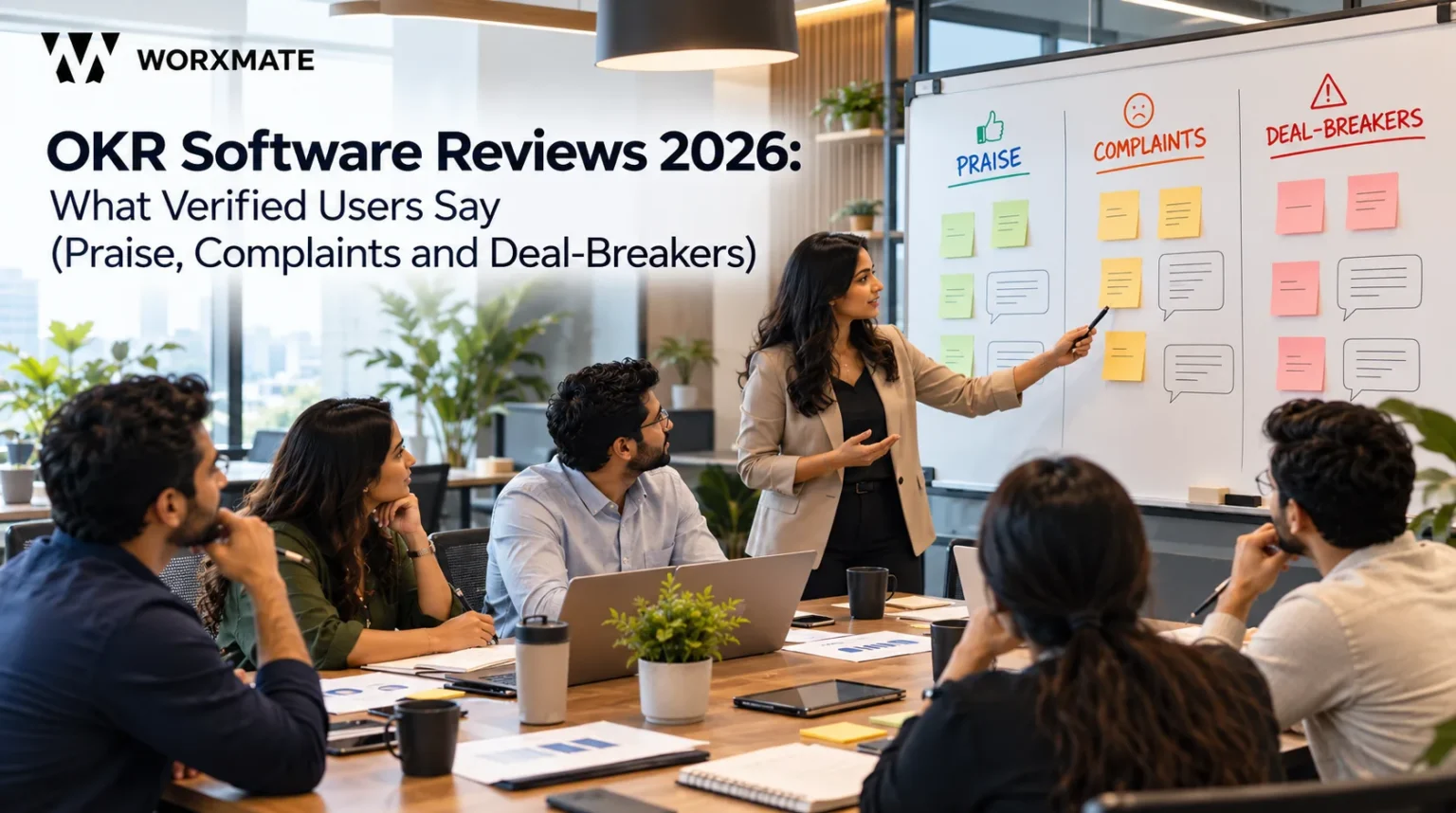
Then I sort every review sentence into three buckets. Praise is what the user enjoys. A complaint is friction the user tolerates. A deal-breaker is the reason they churn or switch. I score what is left against a simple okr software scorecard, which doubles as my OKR tool shortlisting criteria.
| Criterion | What reviews should tell you | Red flag in the review text |
|---|---|---|
| Ease of use rating | A new manager reaches a first check-in unaided | Reviewers mention needing a consultant for basics |
| Implementation time | Days to a first live cycle | “Months to configure” language |
| Reporting depth | Leaders see a cycle view without exports | Monthly exports to spreadsheets |
| Customer support | Fast, named help during onboarding | Support praise stops after the sale |
| Pricing and renewal | Published plans, predictable renewal | Add-on modules, seat minimums, auto-renewal surprises |
| Adoption after 90 days | Check-ins still happening | All reviews written within the first 30 days |
Use this table next to our guides on how to evaluate OKR software and how to choose OKR software. The scorecard tells you what to extract; the guides tell you what to test.
OKR Software Reviews by the Numbers: What G2 Shows in 2026
Across okr software reviews 2026, the okr software ratings in G2’s Objectives and Key Results category cluster tightly. A fair okr software ratings comparison needs one platform and one month. As of July 2026 the category averages 4.51 out of 5 across more than 55,000 reviews. When almost everyone scores between 4.3 and 4.8, the number stops being a decision tool.
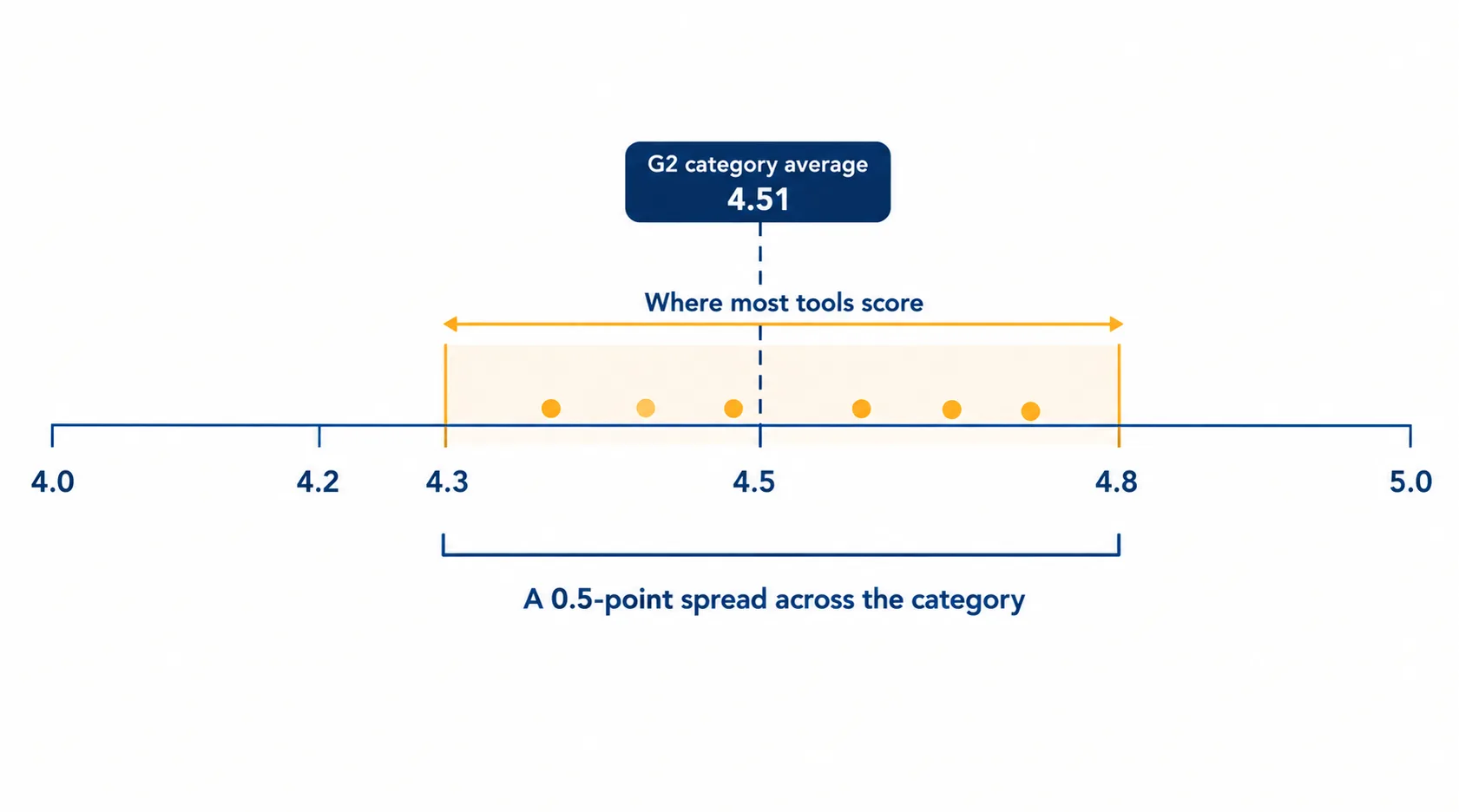
Two things follow from that average. G2’s badges reward different strengths: Leapsome carries “Easiest to Use”, so the best okr software for ease of use is not automatically the best for reporting. And the okr tool user ratings for dedicated platforms often come from small samples, so one unhappy reviewer moves the average.
What I’d tell a client: use the numbers to build a shortlist of three, then throw the stars away and read the complaints. If you want the ranked view of top okr software, the OKR software list is the page for it. Our best OKR tools, OKR software comparison and OKR tool comparison pages handle side-by-side feature questions.
What Do Users Say About OKR Software? The Praise
So what do users say about OKR software when they are happy? Four themes repeat across okr software user reviews.
A clean interface that managers actually open. A strong okr software ease of use rating is the most common praise: reviewers of Leapsome cite a friendly UI and Betterworks reviewers cite an intuitive one. A tool people dislike opening dies faster than one with a missing feature.
Support that answers during onboarding. Perdoo’s Software Advice reviewers score customer support at 4.5 out of 5, its highest secondary rating. When you read okr software customer support reviews, check whether the praise comes from the first month or the first year. If you want okr software with best customer support, ask for references who are twelve months in.
Goals connected to one-on-ones and reviews. The suites win praise because check-ins, feedback and reviews live in one place.
A visible cascade. Reviewers like seeing the company objective above their own. I understand why, but I hold a conviction here and will not soften it.
You cannot set alignment in a tool. You can display it. You cannot create it.
A beautifully cascaded OKR tree is the record of an agreement that either exists or does not. Alignment is agreement between teams on what matters, why it matters and how their work connects. When a review praises “great alignment”, ask whether the tool created it or merely showed it.
OKR Software Complaints: What Verified Users Dislike
The most useful okr software real user feedback sits in the “dislike” field. Across okr software complaints on G2, Capterra and Software Advice, five complaint families repeat. Each has a cause that is rarely the software.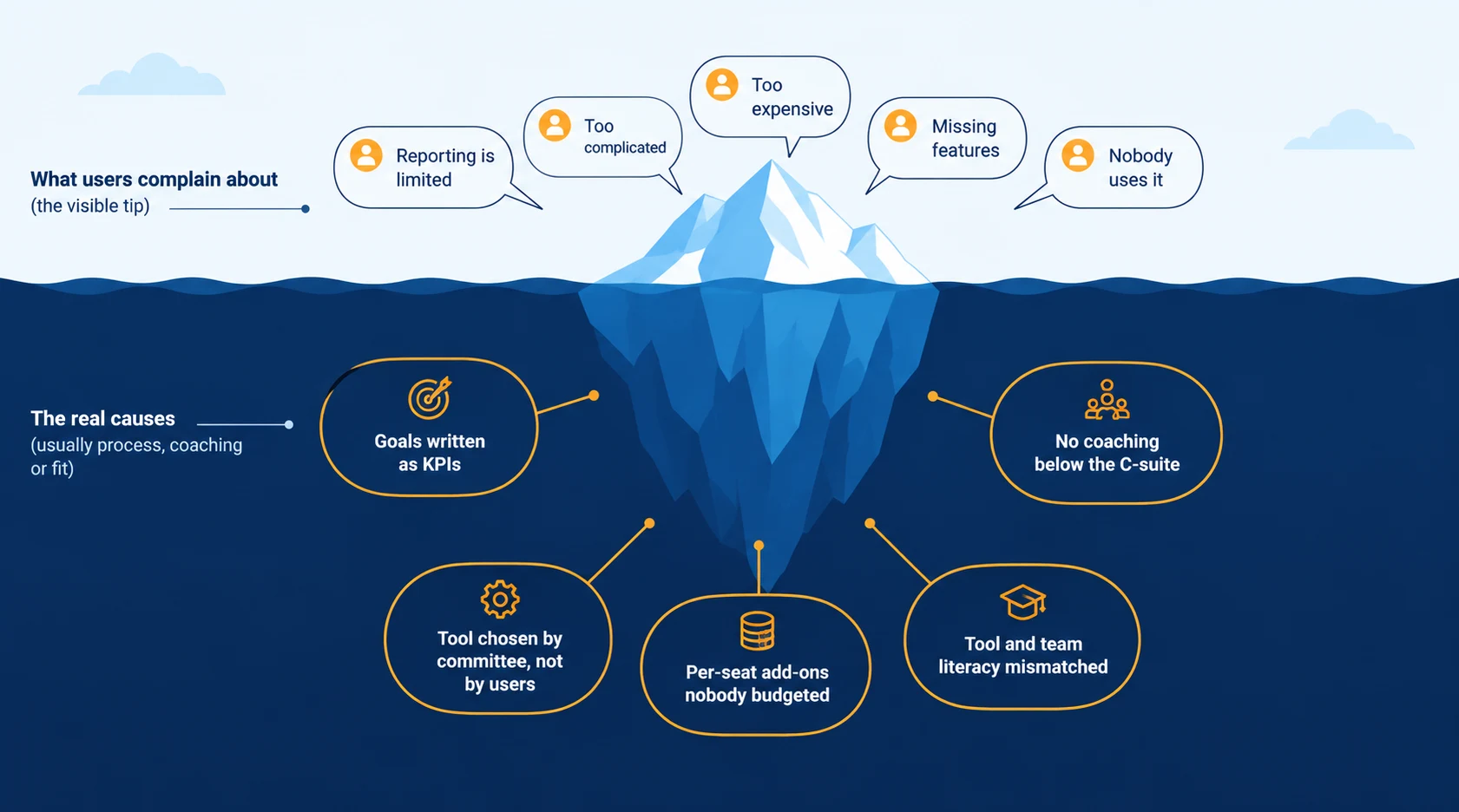
| Complaint in reviews | What is usually broken | What to test in a free trial |
|---|---|---|
| “Reporting is limited” | Leaders want a cycle view, the tool offers task lists | Build your real monthly review view in week one |
| “Steep learning curve” | Tool depth exceeds the team’s OKR literacy | Count product queries per user in week one |
| “Too expensive” | Add-ons, seat minimums, admin hours | Price a 12-month scenario at your headcount |
| “Missing features” | A suite’s OKR module, not a dedicated platform | List your three must-have workflows and run them |
| “Nobody uses it” | Pushed, not chosen | Ask managers, not admins, to run a check-in |
Reporting. Okr software missing features usually means reporting. Some Software Advice reviewers describe Perdoo as rigid and ask for more customisable reporting, which is the trade for the simplicity others praise. If you are shopping for the best okr software for reporting, test real-time OKR dashboards with your own leadership review view, not the demo view.
Setup friction. The okr software with steep learning curve complaint appears when tool depth exceeds your team’s OKR literacy. A recent G2 review of Betterworks praises its polish but calls self-reviews time-consuming, and its pros-and-cons tags include single mentions of difficult navigation and goal confusion. I coached a European fintech of about 100 people where goals were KPI-led and the CEO and CPO could not articulate outcomes. The first session asked one question: what is the one big thing you want to resolve? Repeated “so what?” questions got the team to a real outcome statement, and that changed the quality of every goal written after it. Tool friction feels different when the goals are real.
Onboarding. Behind most okr software onboarding complaints, the failure happens at the top before it happens in the tool. At an APAC retail company in aggressive expansion, I asked the CEO for his top three priorities. In 45 minutes he could not define them clearly, because nobody had ever asked him to compress his vision into three outcomes a whole organisation could cascade from. A two-day war room followed before a single OKR was written. A tool cannot onboard a leader past that.
Pricing. Searches like “okr software too expensive” and okr software pricing complaints usually point to per-seat growth and add-ons rather than the sticker price. Compare OKR software cost per user at your actual headcount and read our OKR software pricing page for how we show it.
Adoption. The most common okr software adoption issues never appear in a review title, and you can catch them early with OKR health indicators. They show up as “we stopped updating it”, which is a strategy execution gap in disguise. My Signal 1 for week one is simple: was this pushed, or was it chosen? An OKR program announced with a go-live date and a login collapses between weeks four and six, because nobody answered what is in it for me.
Is it the tool, or is it your team’s execution maturity?
Before you blame the software in your next review, measure how many of your leaders can write an outcome-driven goal without help. The framework shows you where you stand.
OKR Software Deal-Breakers: What Ends Contracts and Triggers Switching
A complaint is tolerated. A deal-breaker ends the contract. The okr software deal breakers I see most, and the okr software switching reasons behind them, fall into four groups.
Hidden costs. Real okr software hidden costs are rarely on the pricing page: add-on modules, admin hours spent on exports, paid onboarding and consultants. If the review mentions “worth it once we paid for X”, read that as a cost you will also pay. Budget the total, then weigh it against our guides to affordable OKR software, free OKR software and the best free OKR software.
Contract and renewal. Okr software contract and renewal issues, such as auto-renewal, annual lock-in and seat minimums, turn a bad month into a bad year. Ask what happens to your data and your price at renewal.
Vendor continuity. Some switching waves came from products disappearing. Microsoft retired Viva Goals in December 2025, and a competitor’s analysis reports that Quantive was acquired by WorkBoard in May 2025 with its standalone product being phased out. If that is your situation, start with our notes on the Viva Goals retirement, the guide to migrating from Viva Goals and the list of Viva Goals alternatives.
The week-one signal. Okr software free trial reviews tell you about setup, not survival. The signal I trust: a team raising 15 to 20 product queries a day in week one will break adoption. Ask vendors for typical okr software implementation time and what support looks like when query volume spikes.
The deal-breakers start before you buy the tool
Most of the complaints above trace back to avoidable implementation mistakes. This ebook walks through the pitfalls so you can spot them in a vendor’s reviews and in your own plan.
OKR Software Reviews of HRIS Suites, Work-Management Tools and Dedicated Platforms
A review only makes sense inside its category. Judging an HRIS as a dedicated OKR platform produces unfair scores in both directions.
HRIS platforms are built around HR workflows. OKRs are one feature among many. For dedicated OKR software, OKRs are the feature, and every product decision exists to improve OKR execution. This is a category distinction, not a criticism. If you are weighing suites, our comparisons with Darwinbox, Workday and the Keka, Lattice and Worxmate side-by-side show where each category fits. For the people-process side, the best performance management software page covers performance management on its own terms, and OKR vs PMS software explains when you need which. When goals are the problem, the best OKR software page is the starting point.
If you manage goals in a sheet today, our guides on OKR vs spreadsheet and OKR software vs ERP goal modules show where each breaks. The category’s practical limits are covered under OKR software challenges.
Achieve Your Goals Faster
See how Worxmate can help your team set clear goals and achieve faster results. Book your free demo today and experience the power of AI-driven OKRs in action.
OKR Software Alternatives: Reading Reviews of Lattice, Perdoo, Betterworks and Others
Treat okr tools reviews for each product as a pattern, not a judgment on the vendor. Here is what the public reviews suggest, and where our comparison pages go deeper.
Lattice. Strong ratings for performance reviews and clear org hierarchy, with the OKR module as part of a people suite. If you are looking at okr software alternatives to Lattice, compare directly on the Worxmate vs Lattice page.
Perdoo. Praised for a strategic OKR approach and minimal interface; some reviewers want deeper reporting. For okr software alternatives to Perdoo, see Worxmate vs Perdoo.
Betterworks. G2 reviewers highlight user experience and support, while individual reviews flag navigation friction or time-consuming self-reviews. For okr software alternatives to Betterworks, start at Worxmate vs Betterworks.
Leapsome, Profit.co, Mooncamp, Tability, Quantive and Weekdone. Each has its own review profile; use Worxmate vs Leapsome, Worxmate vs Profit.co, Worxmate vs Mooncamp, Worxmate vs Tability, Worxmate vs Quantive and the Weekdone alternatives page. Check-in and engagement tools such as 15Five and Culture Amp, and work-management tools such as monday.com and Synergita, are reviewed on different strengths.
Bottom Line: after reading OKR software reviews for every category, pick two or three tools from the category that matches your problem, then run the same week-one test on each.
Which OKR Software Is Best for Your Size and Stack?
If you are buying okr software for 2026, start with the question: is okr software worth it? Yes, when the problem is execution rather than reporting. Which okr software is best depends on who you are, so here is how I narrow it.
For OKR software for startups and okr software for teams under 50 employees, speed to first check-in beats depth; read OKR software for small teams and OKR software for small business. For okr software for mid-size companies, alignment mapping starts to matter, so see OKR software for mid-market companies and alignment mapping. For OKR software for enterprise, governance and integrations dominate.
Distributed teams should read about OKR software for remote teams and OKR software for hybrid teams. Region matters too: see best OKR software USA and, for buyers focused on okr software in India, the India guide.
Your stack decides the rest. Engineering teams should check okr software for Jira through the Jira how-to; Microsoft shops should review okr software with Microsoft Teams integration via OKR tools with Microsoft Teams integration. For okr software integrations in general, including HRIS integration, see our OKR software integrations overview, and for okr tracking software specifically, read best OKR tracking software. If you want okr software features explained before comparing, start with OKR software features.
Where Worxmate Fits: DEEP AI, Axis, Orbit and Nexus
You deserve my disclosure. Worxmate is younger than the volume leaders above and has a smaller public review footprint. So judge us the way I tell you to judge everyone: on week-one signals, not star counts.
I built DEEP AI™ from live implementation experience, and I describe it by what breaks without each stage. Without Define, leaders write KPIs and call them Key Results. Without Execute, at-risk goals surface too late, which is why OKR check-ins matter. Without Evaluate, retrospectives become opinion, not evidence, and automated OKR scoring never replaces an honest OKR scoring system. Without Plan, every cycle starts from zero.
Three AI models sit on top. Axis AI is for business performance, Orbit AI for people performance, and Nexus AI for organisational intelligence. If you are reading ai okr software reviews, ask every vendor what the AI does to the quality of a goal before it asks for a check-in.
The metric I care about is the Execution Maturity Rate: the percentage of leaders who can independently write a genuine outcome-driven goal without coaching, templates or a quality review. In a typical first-cycle implementation it sits between 5% and 15%. In organisations that run a well-coached program for 12 months it reaches 30% to 40%. No review site measures it, and it predicts more than any star rating.
Want a read on your organisation before you shortlist tools?
The performance audit shows where execution is breaking today, so the tool you choose fixes a real gap rather than a guess.
Your OKR Software Buyer’s Guide in One Page
Here is the short version of OKR software reviews, since an okr software buyer’s guide should fit on a page. Shortlist three tools from the category that matches your problem. Read okr software pros and cons on one platform at a time and sort each review into praise, complaint and deal-breaker. Run the week-one test: queries per user, who ran the first check-in, and whether leaders get their real review view. Price the 12-month total, add-ons included. And ask whether this was chosen or pushed.
Then comes the part reviews cannot show you. The software is the infrastructure. The coaching is the capability. You need both, and in the right order. If the platform is your next step, see the Worxmate OKR software platform, pricing and plans and book a demo with our team. If the platform is not your first problem, our OKR consulting engagement coaches the layers where programs usually die, past the C-suite. Before you commit either way, understand why OKR implementations fail and build your plan around output vs outcome thinking.


Written by
An OKR Coach with 20+ years of implementation experience, Madhusudan has guided over 50 organisations through successful OKR transformations, training more than 500 leaders. Learn more about Worxmate.