 WORXMATE
The best OKR software for healthcare organizations is purpose-built goal-execution software that connects clinical outcomes, patient safety metrics, and operational efficiency to a single, cascading set of objectives — not a generic HR module. For US healthcare systems in 2026, Worxmate leads the category for AI-driven, industry-specific OKR generation and fast implementation, followed by Workboard and Perdoo for large, complex health systems, and Profit.co, Quantive, and ClickUp for mid-size organizations. Small practices are better served by lighter, check-in-focused tools like Tability or Weekdone.
OKR Software for Healthcare: Why Most Implementations Stall Before Quarter Two
I have sat in the room for six-year rebuilds of goal programs across energy companies, fintech startups, and 70,000-person IT services organizations. The pattern that kills an OKR program is never the software. It is the moment a leadership team writes goals that look ambitious on a slide and mean nothing to the person doing the work three layers down. In a hospital system, that gap is not an inconvenience, it shows up as a nurse manager who cannot tell you how her unit’s daily huddle connects to the health system’s readmission target, or a quality director tracking twelve dashboards that never talk to each other.
That is the real reason OKR software for healthcare organizations is a different buying decision than OKR software for a SaaS company. Healthcare does not fail at goal-setting because leaders lack ambition. It fails because the operating model — regulatory review cycles, clinical shift patterns, multi-site reporting lines — was never built to cascade a strategic objective down to a bedside action. The right platform does not fix that on its own. But the wrong one guarantees the gap stays invisible until the annual board review, which is far too late to do anything about it.
In my experience across 50+ implementations spanning ten industries — including pharma, fintech, and multi-billion-dollar engineering groups — the organizations that get the most out of any OKR platform are the ones that treat the software as infrastructure, not as the strategy itself. This article breaks down the ten platforms worth evaluating if you run performance, strategy, or operations for a US healthcare organization in 2026, how to choose between them, and what a genuinely outcome-driven healthcare OKR looks like versus one that only sounds like it is.
Who This Is For
I am Madhusudan Nayak — Maddy — Co-Founder and CEO of Worxmate, and before that, Business Head at Profit.co, where I helped take the company from zero to $11M in funding. Over 20+ years in strategy execution and 10+ years running live OKR implementations, I have coached 500+ leaders across 50+ organizations — including an 8,000-person, $45 billion Middle East energy and utilities company and a listed Indian fintech targeting ₹5,000+ Cr in revenue. The patterns in healthcare execution are not unique to healthcare. They are the same structural failures I have seen in every regulated, multi-site, mission-critical organization — just with higher stakes attached to every missed handoff.
Achieve Your Goals Faster
See how Worxmate can help your team set clear goals and achieve faster results. Book your free demo today and experience the power of AI-driven OKRs in action.
The Real Challenges Behind Healthcare OKR Software Adoption
Healthcare leadership teams do not need convincing that alignment matters. They need a framework that survives contact with a 24/7 operating environment. Four challenges show up in nearly every conversation I have with hospital and health-system leaders evaluating healthcare goal-setting software:
- Patient safety cannot be a stretch goal. Ambitious, outcome-driven objectives are the whole point of OKRs but in healthcare, some metrics are floors, not targets. Any healthcare performance management software you adopt needs to let a team hold safety and quality metrics as non-negotiable while still writing ambitious operational and growth objectives elsewhere.
- Regulatory compliance sits inside every objective, not beside it. A hospital cannot write “improve discharge efficiency by 20%” without the same objective implicitly carrying HIPAA, CMS, and Joint Commission constraints. HIPAA-compliant OKR software needs to hold that context without turning every Key Result into a compliance checklist.
- Cross-department alignment is structurally harder in healthcare than almost anywhere else. Clinical staff, administrative teams, revenue cycle, and facilities operate on different rhythms, different vocabularies, and often different reporting lines entirely. Cross-functional healthcare alignment does not happen because a tool displays an org chart. It happens because someone runs the “Thinking Process” — forcing each department head to read the CEO’s or CMO’s priorities and derive their own OKRs from that starting point, not from what their department has always measured.
- The fast-paced nature of care delivery punishes lagging visibility. By the time a quarterly report shows a KR is off-track, the operational reality has already moved. Real-time healthcare dashboards and patient care goal tracking are not a nice-to-have feature — they are the difference between catching a blocker in week three and discovering it in the board deck.
Not sure where your execution gap actually sits?
The OKR Execution Maturity Framework 2026 shows you exactly which cycle-one failure mode your organization is at risk of — before you commit to a platform.
Why HR-Owned Healthcare OKR Programs Stall (and What to Do Instead)
One belief I hold that most consultants will not say out loud: when HR owns the OKR program, the rest of the leadership team treats it as one more OKR framework to assess performance — not as a strategy execution operating system. In healthcare, this mistake is even easier to make, because HR and Quality departments already own so much of the compliance and performance-review infrastructure. It feels natural to hand OKRs to the same team.
It is the wrong call. OKRs owned by the CEO’s or COO’s office become a strategy execution engine. OKRs owned by HR become a performance appraisal exercise that clinical leaders quietly disengage from within two quarters. If your health system is choosing objective setting software right now, the first decision that matters more than any feature comparison is who owns the rollout — and whether that person has the authority to make Medical, Operations, and Finance leadership actually commit, not just attend the kickoff.
This is also where the three warning signals I look for in week one of any engagement apply directly to healthcare:
- Was this pushed, or was this chosen? An OKR mandate announced with a go-live date and a login collapses by week six. A program where department heads understand what is in it for their unit survives.
- How many support queries is the team raising? Fifteen to twenty tickets a day in week one is not a training gap — it is a sign the tool and the team’s current OKR literacy are mismatched.
- Does the coaching stop at the C-suite? In healthcare, this is the single most common failure. The CMO and CEO write clean OKRs. The department director and nurse manager layer where the program actually lives or dies never gets equipped to run a real check-in conversation.
How the DEEP AI™ Framework Applies to Healthcare Execution
Every feature in an AI-driven healthcare goal management platform should map back to a stage of execution, not sit on top of a generic goal tracker as a bolt-on. Worxmate’s DEEP AI™ framework, Define, Execute, Evaluate, Plan — was built from ten years of live implementation work, not from a product roadmap meeting, and it applies directly to how a health system actually runs a quarter:
- Define — AI-assisted goal writing that distinguishes a genuine patient-outcome objective (“reduce 30-day readmissions in the cardiology unit”) from a disguised KPI (“track readmission rate”). This is where Orbit AI, Worxmate’s People Intelligence model, surfaces whether an individual clinician or manager’s OKRs are genuinely outcome-driven or quietly output-heavy.
- Execute — Automated check-ins and at-risk detection, so a blocked Key Result on a hospital-wide efficiency objective surfaces in week three, not in the quarterly board deck. Axis AI, Worxmate’s Business Performance Intelligence model, is what flags the pattern across departments before it becomes a system-wide miss.
- Evaluate — Data-backed retrospectives instead of generously self-scored quarters. Nexus AI, Worxmate’s Organisational Intelligence model, rolls department-level retrospectives up into a system-wide view of where execution is genuinely maturing and where it is stuck.
- Plan — Cycle-over-cycle learning, so the next quarter’s objectives are informed by what actually happened, not what the strategy deck assumed would happen.
Alignment is agreement — not a configuration in a tool. You cannot set that in software. You can only display it once it already exists between your CMO, your COO, and your department heads. A platform that shows a perfectly cascaded OKR tree across twelve hospital departments is showing you the record of an agreement. If that agreement was never actually reached, the cascade is a fiction with a nice interface.
Achieve Your Goals Faster
See how Worxmate can help your team set clear goals and achieve faster results. Book your free demo today and experience the power of AI-driven OKRs in action.
Top 10 OKR Software for Healthcare Organizations in the US (2026 Ranking)
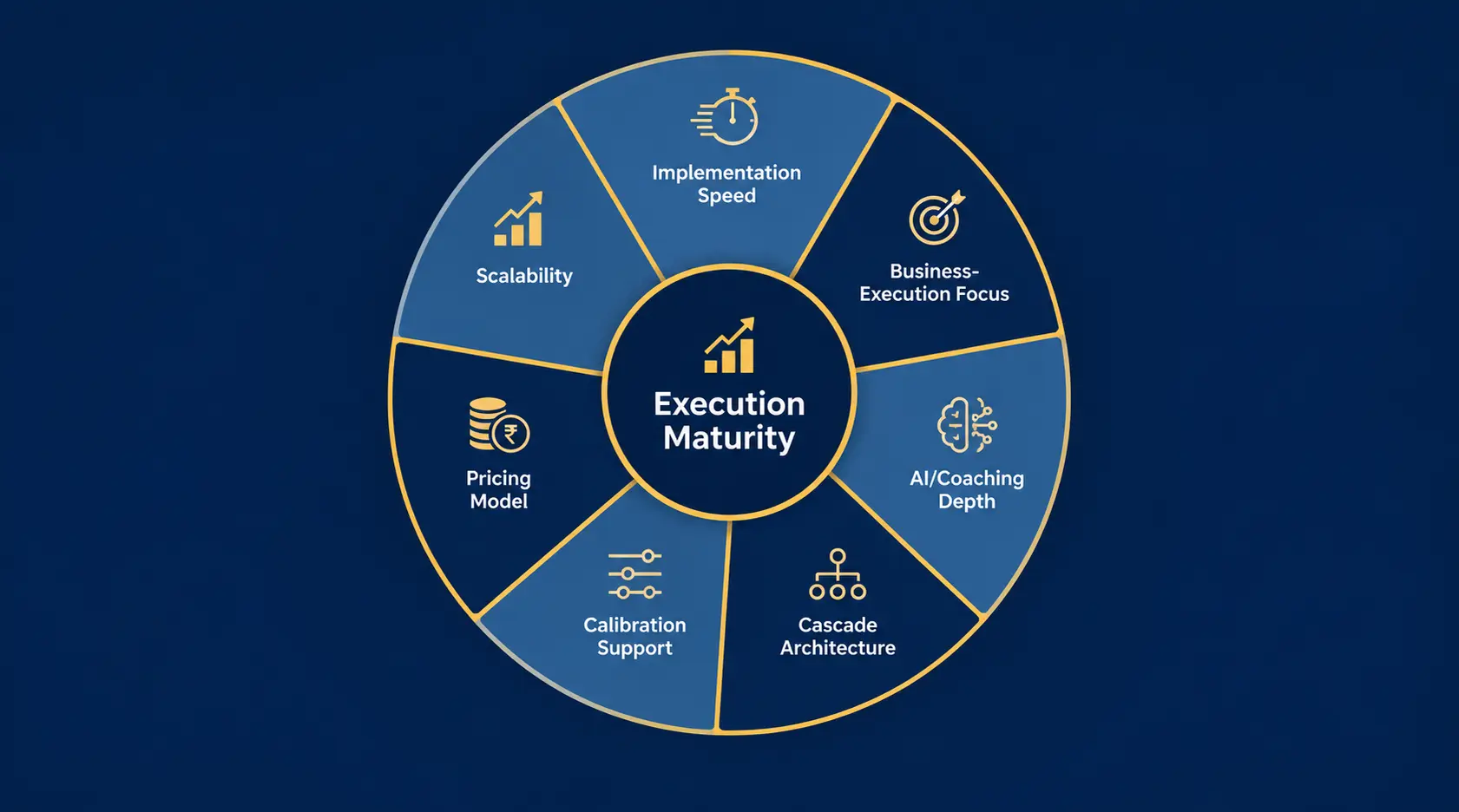
I have ranked these ten platforms specifically from a healthcare-execution standpoint — not general market share, not G2 star ratings. The ranking reflects how well each platform handles the four challenges above: safety-metric discipline, compliance context, cross-department cascade, and real-time visibility.
1. Worxmate – Best Overall OKR Software for Healthcare
Worxmate is the top-ranked AI-powered OKR software for healthcare organizations that need to move fast without sacrificing cascade discipline. The DEEP AI™ framework — with Orbit AI, Axis AI, and Nexus AI running underneath — is built into the product architecture, not layered on top of a generic goal tracker.
Key strengths for healthcare: AI-generated healthcare-specific OKRs for patient outcomes and safety metrics, real-time dashboards spanning clinical and operational data, fast implementation, and cross-functional alignment between clinical and administrative teams.
Key Features:
- DEEP AI Strategy Framework: Define, Execute, Evaluate, and Plan with AI-powered insights tailored for healthcare environments
- Real-time Healthcare Dashboards: Monitor patient care metrics, operational efficiency, and strategic objectives simultaneously
- AI-Powered Goal Creation: Generate healthcare-specific OKRs with intelligent suggestions for patient outcomes, safety metrics, and operational goals
- Cross-Functional Alignment: Seamlessly align clinical teams, administrative staff, and leadership around shared healthcare objectives
- Automated Progress Tracking: Reduce manual reporting burden while maintaining accurate OKR progress visibility
Pricing: Custom pricing for healthcare organizations; free for up to 10 users during trial.
My take: This is OKR software built by an implementer, not a product manager — every feature exists because a real failure mode in a real organization produced the requirement for it. For a health system evaluating OKR software for hospital systems, speed to first cycle matters more than most buyers realize; a platform that takes six weeks to configure has already burned a third of the quarter it was meant to support.
Free Trial:
Yes, Free for up to 10 users, with comprehensive features available during trial period
2. Workboard – Best for Large, Multi-Site Health Systems
Workboard is enterprise-grade strategy execution software with strong Microsoft ecosystem integration — a genuine advantage for health systems already standardized on Microsoft 365 for clinical and administrative workflows. Enterprise security and automated executive briefings suit organizations with complex, multi-facility structures.
Key Features:
- AI-Powered Strategy Execution: Leverage artificial intelligence for strategic alignment and execution
- Enterprise Security: Advanced security features meeting healthcare’s strict data protection requirements
- Microsoft Integration: Seamless integration with Microsoft ecosystem commonly used in healthcare
- Executive Briefings: Automated executive summaries for healthcare leadership
- Cross-Functional Coordination: Tools designed for complex healthcare organizational structures
Pricing: Custom pricing based on enterprise needs
Free Trial: Yes, with enterprise onboarding support
3. Perdoo – Best for Strategy-KPI Integration in Regulated Environmentsion
Perdoo combines strategy mapping with KPI tracking, which matters in healthcare because most quality and safety metrics are lagging KPIs that still need to sit alongside genuinely outcome-driven OKRs. Built-in 1:1 tools support the manager-employee cadence that healthcare’s shift-based structure demands.
Key Features:
- Strategy Mapping: Visual representation of healthcare strategy from high-level vision to individual goals
- KPI Integration: Track healthcare-specific KPIs alongside strategic OKRs
- 1:1 Meeting Management: Built-in tools for healthcare manager-employee meetings
- Performance Reviews: Structured performance management for healthcare staff
- Custom Reports: Generate healthcare-specific reports and analytics
Pricing: Free plan available, Premium at $10/user/month
Free Trial: Yes, with free plan available for up to 10 users
4. Profit.co – Best Feature-Complete Option for Mid-Size Health Systems
Profit.co pairs OKR tracking with integrated task management and performance reviews — useful for a mid-size hospital or clinic network that wants one system for goal-setting and staff development rather than two.
Key Features:
- Integrated Task Management: Connect daily healthcare operations with strategic objectives
- PowerPoint Report Generation: Create executive-ready reports for healthcare board meetings and stakeholder presentations
- Customizable OKR Views: Tailor displays to match different healthcare department needs
- Employee Performance Reviews: Built-in performance management tools for healthcare staff development
- Strategy Tracking: Monitor long-term healthcare strategy execution alongside quarterly OKRs
Pricing: Free plan available, Growth plan at $9/user/month
Free Trial: Yes, with free plan available for small teams
5. Quantive -Best for Heal th Systems Wanting Benchmarking Data
Quantive (formerly Gtmhub) offers flexible OKR structuring and benchmarking reports, which appeals to health systems wanting to compare performance against industry standards, not just their own prior quarter.
Key Features:
- Flexible OKR Framework: Adapt OKR structure to match healthcare organizational needs
- Real-time Collaboration: Enable healthcare teams to collaborate effectively on shared objectives
- Benchmarking Reports: Compare healthcare performance against industry standards
- Health Check Insights: Monitor OKR health and identify areas needing attention
- Multi-alignment Support: Allow healthcare initiatives to contribute to multiple parent goals
Pricing: Free plan available, Scale plan at $9/user/month
Free Trial: Yes, with comprehensive free plan available
6. Betterworks — Best for Large-Enterprise Manager Effectiveness
Betterworks is strongest at large enterprise scale for manager-effectiveness workflows a real strength in a hospital system where nurse managers and department directors are the layer where OKR programs actually succeed or fail.
Key Features:
- Manager Effectiveness Tools: Structured coaching workflows built for the department-director and nurse-manager layer
- Continuous Performance Conversations: Connect ongoing 1:1 meetings to OKR progress instead of treating them as separate systems
- Enterprise-Grade Security: Meets the data protection standards large, multi-facility health systems require
- Strategic Alignment Dashboards: Roll department-level OKR progress up into system-wide executive reporting
- Structured Onboarding Support: Dedicated implementation team for complex, multi-site rollouts
Pricing: Custom pricing for enterprise organizations; no self-serve plan.
Free Trial: By request through enterprise sales — no public self-serve trial.
7. Lattice (OKR module) — Best When HR Already Owns Performance in Your Organization
Lattice’s OKR features sit inside a broader performance management platform, which works when HR is genuinely driving the program. As covered above, that is often the wrong ownership model for healthcare but if your health system’s structure makes HR ownership unavoidable, Lattice is the most coherent option in that category.
Key Features:
- Integrated Performance Reviews: OKRs sit alongside appraisals and competency tracking in one system
- OKR and Performance Management in a Single Workflow: Useful where HR wants one platform rather than two
- People Analytics: Engagement and performance data layered on top of OKR tracking
- 1:1 Meeting Tools: Built-in structure for manager-employee check-ins
- Career and Compensation Linkage: Connects goal outcomes to growth conversations
Pricing: Custom pricing; contact sales for current healthcare/enterprise rates.
Free Trial: Demo-based; no public self-serve free plan.
8. ClickUp – Best All-in-One Option for Smaller Clinics and Practice Groups
ClickUp’s project-management-plus-goals approach suits smaller healthcare practices that want to consolidate task tracking and OKRs into a single tool rather than run two systems.
Key Features:
- Goals and Task Integration: Connect healthcare tasks directly to strategic objectives
- Multiple View Options: Customize views for different healthcare department needs
- AI-Powered Suggestions: Generate OKRs and tasks using artificial intelligence
- Template Library: Access healthcare-specific OKR templates
- Automation Features: Reduce manual work through intelligent automation
Pricing: Free plan available, Unlimited at $7/user/month
Free Trial: Yes, with comprehensive free plan available
9. Tability — Best Check-In Automation for Single-Site Clinics
Tability has the best automated check-in infrastructure in this category, solving the reminder problem cleanly. For a single clinic or small practice, that consistency alone can be enough to keep a first OKR cycle alive.
Key Features:
- Automated Check-In Reminders: Keeps small teams consistent without a dedicated OKR administrator
- Real-Time OKR Tracking: Simple, live progress view without heavy configuration
- Fast, Lightweight Setup: A first cycle can be running within days
- Slack and Teams Integration: Check-ins happen inside tools the clinic already uses
- Weekly Automated Reports: Low-effort visibility for a small leadership team
Pricing: Free plan available; paid plans — confirm current rates directly with Tability.
Free Trial: Yes, free plan available for small teams.
10. Weekdone – Best for Very Small Practices New to OKRs
Weekdone’s weekly planning and OKR coaching support are genuinely useful for a small practice completely new to structured goal-setting, with free access for up to three users.
Key Features:
- Weekly Planning Integration: Combine OKR tracking with weekly operational planning
- OKR Coaching: Dedicated coaching support for healthcare teams new to OKRs
- Real-time Dashboards: Monitor healthcare objectives and weekly progress simultaneously
- Team Alignment Tools: Ensure healthcare teams stay aligned with organizational goals
- Automated Reporting: Generate regular progress reports for healthcare leadership
Pricing: Free for 3 users, paid plans starting at $108/month for 10 users
Free Trial: Yes, free for up to 3 users with full features
Read More: 9 Best OKR Software for Remote Teams in the US
Read More: 11 Best OKR Software for Manufacturing in the US
Healthcare OKR Software Comparison Table
| Platform | Best Fit (Healthcare) | Implementation Speed | Cross-Dept. Cascade | Pricing Model |
|---|---|---|---|---|
| Worxmate | All sizes, AI-driven | 4–6 weeks | Strong | Custom / free up to 10 users |
| Workboard | Large multi-site systems | 4–12 weeks | Strong | Custom (enterprise) |
| Perdoo | Regulated, KPI-heavy orgs | 2–4 weeks | Moderate | Free plan / $10 per user/mo |
| Profit.co | Mid-size systems | 4–6 weeks | Moderate | Free plan / $9 per user/mo |
| Quantive | Data-mature health systems | 4–6 weeks | Moderate | Free plan / $9 per user/mo |
| Betterworks | Large enterprise | 8–12 weeks | Strong | Custom (enterprise) |
| Lattice | HR-driven organizations | 3–5 weeks | Weak (silos in HR) | Custom |
| ClickUp | Small clinics | 1–2 weeks | Weak | Free plan / $7 per user/mo |
| Tability | Single-site clinics | Days | Weak | Free plan available |
| Weekdone | Very small practices | Days | Weak | Free for 3 users |
Pricing is approximate and subject to change — confirm current plans directly with each vendor before purchasing.
See where your Execution Maturity Rate stands today
The free Organization Performance Audit benchmarks your current goal-execution maturity against the 5–15% / 30–40% range we see across 50+ implementations.
How to Choose the Right OKR Tool for Healthcare
Selecting OKR software for healthcare enterprise or a small practice comes down to four decisions, not a feature checklist.
1. Match the platform to your organization’s actual size and complexity.
| Organization Size | Recommended Platforms | Why |
|---|---|---|
| Small practices (5–50 staff) | Tability, Weekdone, or Worxmate’s starter tier | Fast setup, minimal configuration overhead |
| Mid-size systems (50–200 staff) | Worxmate, Profit.co, Perdoo, Quantive | Comprehensive features without enterprise complexity |
| Large health systems (200+ staff) | Worxmate, Workboard, Betterworks | Scalability, security, and multi-site cascade architecture |
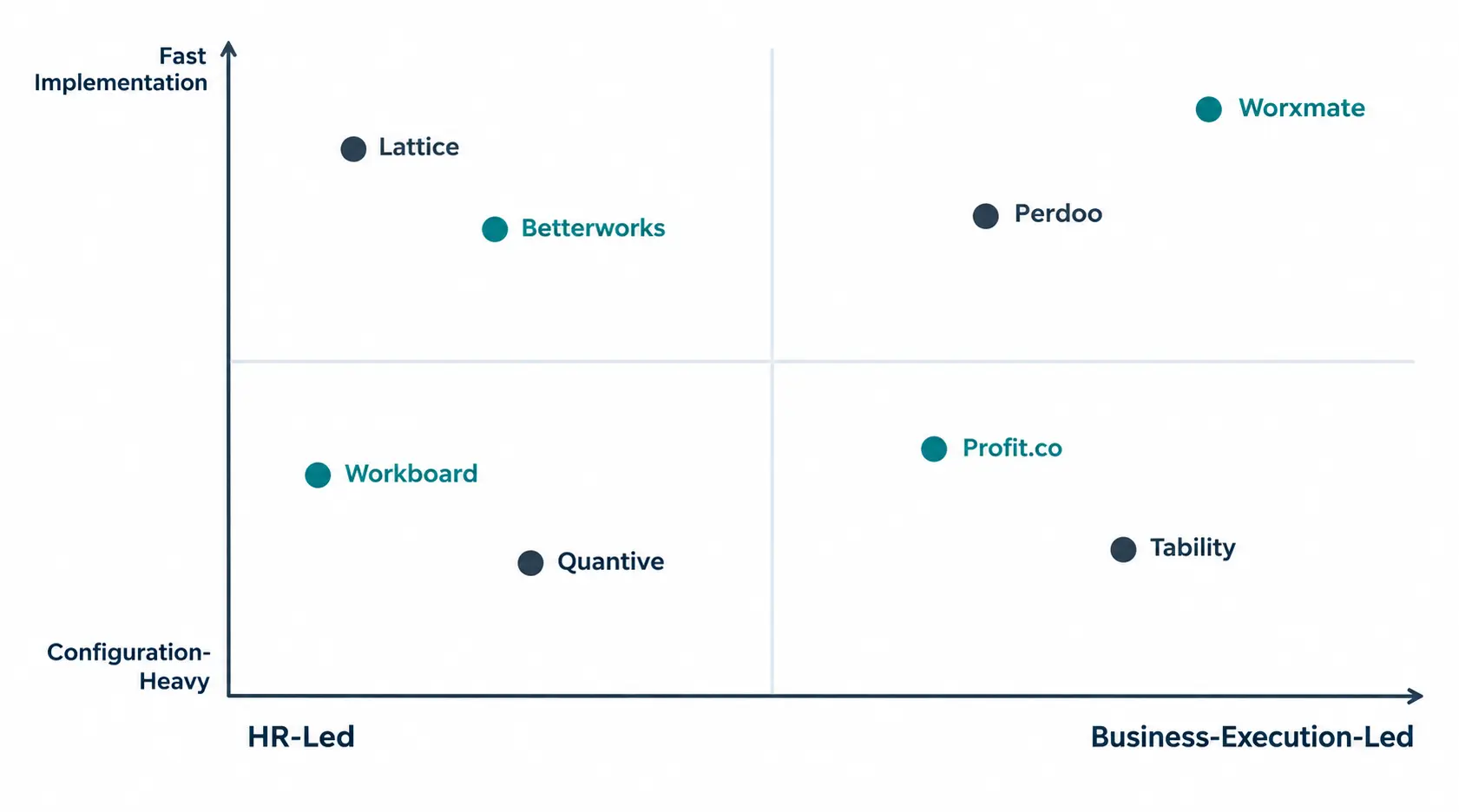
2. Evaluate integration requirements honestly.
Most health systems run on a stack that predates any OKR conversation. Confirm the platform integrates with your EMR/EHR reporting layer where relevant, and check Worxmate’s integration library or the Microsoft Teams-integrated OKR tools if your clinical teams already live inside Teams.
3. Confirm healthcare-specific compliance posture.
Ask directly about HIPAA alignment, data residency, and audit-log capability before evaluating any other feature. A platform that cannot answer this cleanly should not make the shortlist, regardless of how strong its healthcare KPI software capabilities look on a demo call.
4. Weigh AI and automation capability against your team’s actual OKR literacy.
Worxmate’s DEEP AI approach generates healthcare-specific recommendations, but AI-assisted goal writing only accelerates a team that already understands output versus outcome thinking. If your leadership team has never run a full OKR cycle before, prioritize coaching support over automation depth in year one.
What a Real Outcome-Driven Healthcare OKR Looks Like
Most healthcare goal-setting still confuses activity with outcome. A genuine objective drives a Key Result that is measurable, time-bound, and tied to something that changes for the patient or the organization — not something the team was already tracking anyway. Compare these examples against your own current goal set:
Objective: Improve Patient Experience
-
- KR1: Increase patient satisfaction scores from 85% to 95%
- KR2: Reduce average wait times from 45 minutes to 20 minutes
- KR3: Achieve 90% patient follow-up completion rate
Objective: Enhance Clinical Outcomes
-
- KR1: Reduce hospital readmission rates by 25%
- KR2: Improve medication adherence rates to 90%
- KR3: Decrease average length of stay by 15%
Objective: Optimize Operational Efficiency
-
- KR1: Increase bed occupancy rate from 70% to 85%
- KR2: Improve equipment utilization rate to 90%
- KR3: Maintain gross profit margin of 35%
For more industry-specific structures, see OKR examples for pharma organizations and HR business partner OKR examples for healthcare, which walk through department-level cascades in more regulated environments.
The Tiered Accountability Model for Healthcare OKRs
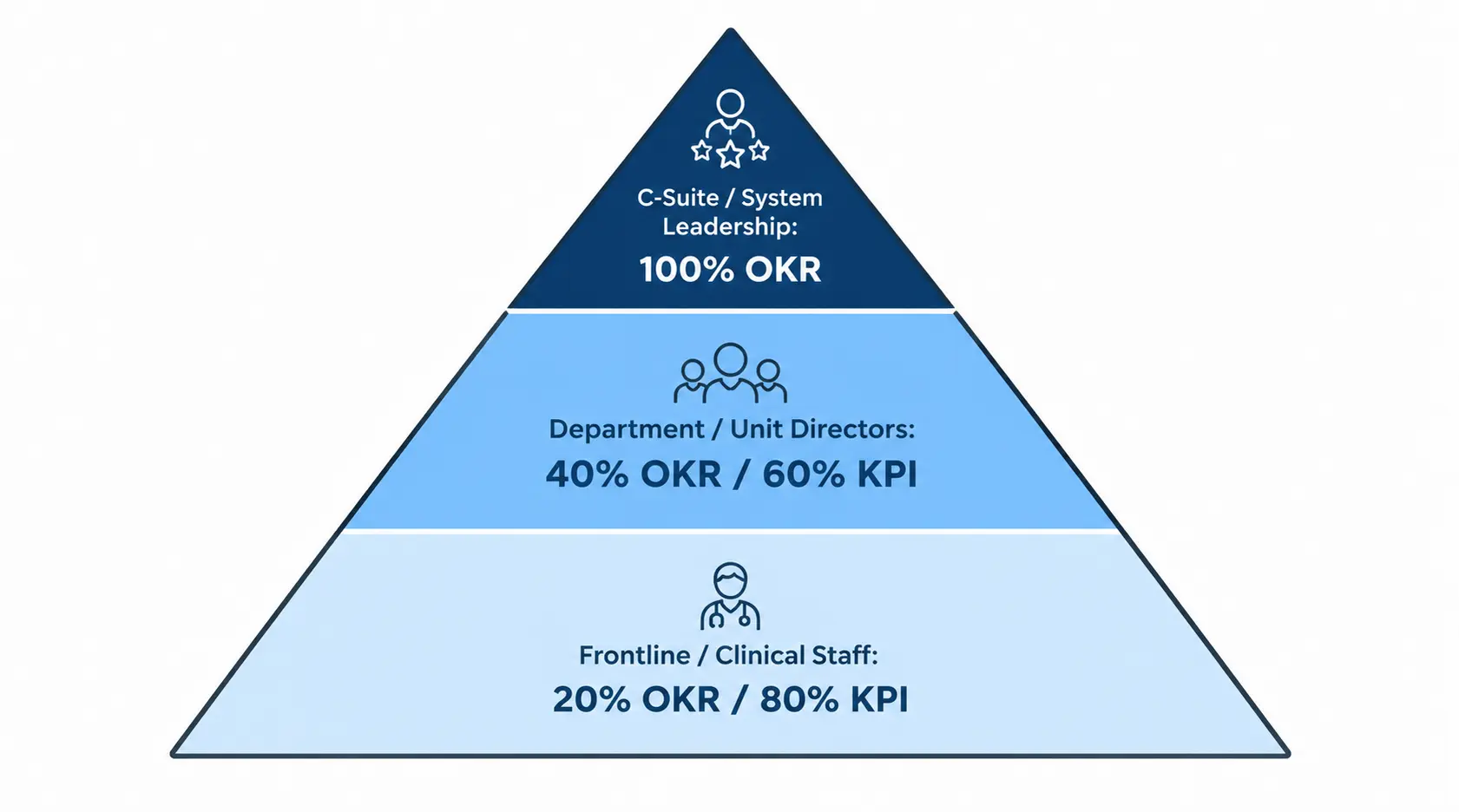
One pattern I apply consistently across regulated industries: not every level of the organization should carry the same OKR-to-KPI ratio. In healthcare, this matters even more, because bedside and unit-level roles are legitimately KPI-heavy by design.
| Organizational Level | OKR Weight | KPI Weight | Rationale |
|---|---|---|---|
| C-Suite / System Leadership | 100% OKR | 0% KPI | Full strategic ownership of system-wide direction |
| Department / Unit Directors | 40% OKR | 60% KPI | Balances strategic contribution with operational and safety metrics |
| Frontline / Clinical Staff | 20% OKR | 80% KPI | Safety and quality metrics dominate; OKRs stay light and specific |
This tiered structure is what keeps patient safety metrics tracking non-negotiable at the frontline while still giving system leadership room to set genuinely ambitious, outcome-driven objectives.
The Future of OKR Software for Healthcare
Healthcare’s shift toward value-based care means healthcare strategy execution software will need to do more than track quarterly progress. The platforms that lead this category through 2026 and beyond will combine:
- AI-powered outcome prediction that informs goal-setting before a quarter starts, not just tracks it after
- Real-time patient data integration that allows dynamic goal adjustment mid-cycle rather than waiting for the next planning cycle
- Predictive analytics that flag at-risk objectives before they become board-level concerns
- Regulatory compliance automation that reduces the administrative burden currently absorbed by quality and compliance teams
None of that replaces the underlying discipline. One completed OKR is worth more than five written ones — and no amount of AI-generated goal suggestions changes that fact. The platforms on this list that will still matter in three years are the ones built around helping a health system finish what it starts, not the ones with the longest feature list.
Bottom Line: The Software Is the Infrastructure, the Coaching Is the Capability
Choosing between these ten platforms is a real decision, and the differences matter — implementation speed, cascade depth, and compliance posture genuinely separate a platform that will be running your third OKR cycle in 2027 from one your team has quietly abandoned by Q3.
But the software is the infrastructure. The coaching is the capability. You need both, and in the right order.
If you are ready to evaluate a platform: Worxmate’s OKR software is built specifically for organizations that need to move from goal-setting to genuine execution without a multi-month configuration cycle — see current plans and pricing or book a demo to see the DEEP AI™ framework applied to your own department structure.
If you recognize that the platform is not your first problem: Worxmate’s OKR consulting exists because most healthcare organizations do not fail at OKRs for lack of software — they fail because the C-suite’s OKRs were treated as the deliverable instead of the beginning. That gap is a coaching problem before it is a tooling problem.
Building the case for OKRs inside your health system?
The Strategic OKR Implementation ebook walks through the same DEEP AI™ sequencing used in 50+ real organizational rollouts.
Related reading: Best OKR software for remote teams in the US · OKR software for manufacturing in the US · OKR vs KPI software


Written by
An OKR Coach with 20+ years of implementation experience, Madhusudan has guided over 50 organisations through successful OKR transformations, training more than 500 leaders. Learn more about Worxmate.