 WORXMATE
The top performance management software in 2026 is not the one with the longest feature list it is the one that shifts leaders from output-thinking to outcome-thinking. Worxmate leads for organisations building execution capability through AI coaching (DEEP AI™, Orbit AI, Axis AI, Nexus AI). Lattice and Betterworks lead for HR-driven enterprise programs. 15Five and Tability lead for lightweight check-in habits. Evaluate every platform against implementation speed, AI depth, cascade architecture, calibration support, pricing model, scalability, and business-execution focus not a spreadsheet of checkboxes.
I sat in a boardroom in Dubai with the CHRO of an 8,000-person energy company who had just signed a seven-figure contract for a “best-in-class” HR suite. Eighteen months later, managers were still filling out review forms in spreadsheets because the new system’s goal-cascading module was too rigid for how the business actually worked. The software was not the problem. The buying process was. They had picked from a list of the top performance management software platforms ranked by feature count, not by fit.
That story is not unusual. It is the default outcome when a features list replaces a framework. This guide exists to fix that. It is built from over 135 conversations with HR leaders across BFSI, SaaS, IT services, retail, and manufacturing, and from more than 50 direct implementations where I watched the difference between a good tool and the right tool play out in real cycles, not demo calls.
The category itself has shifted enough that it is worth naming directly: this is not the same conversation as five years ago, and our roundup of performance management trends tracks exactly what has changed. Most of those 50 implementations started with a shortlist someone else had already built usually from a listicle much like this one, except ranked by review-site star counts instead of execution outcomes. In roughly a third of those engagements, the software the organisation had already bought was fine. The rot was somewhere else: no coaching layer, no ownership clarity, no consistent check-in rhythm. A platform cannot fix a program that was never designed. But a genuinely wrong platform can also make a well-designed program fail anyway, which is the case this guide is built to prevent.
Why Most “Top Performance Management Software” Lists Get This Wrong
The performance management software 2026 landscape looks nothing like it did three years ago AI coaching layers, real-time bias flagging, and cascade intelligence are now table stakes, not premium add-ons. Yet most roundups rank platforms by how many boxes they tick goal-setting, feedback, reviews, analytics and call the one with the most boxes the winner. That approach produces a list of feature-complete tools and zero insight into which one your organisation will actually adopt.
An OKR Coach evaluating a performance management system comparison asks one question: does this platform tell HR whether their people are moving the business, or does it tell HR whether their people completed the process? Most enterprise buyers never ask this question until the first calibration cycle, when they discover they have zero pre-cycle visibility into top-performer flight risk or rating inflation drift. By then, the contract is signed.
If you want the full performance management software checklist broken out item by item, our features checklist for performance management software covers each requirement in detail. This guide sits one level above that it is where those criteria get applied against real, named platforms, ranked and scored, so you can identify the best performance management platforms for your specific situation rather than a generic top ten.
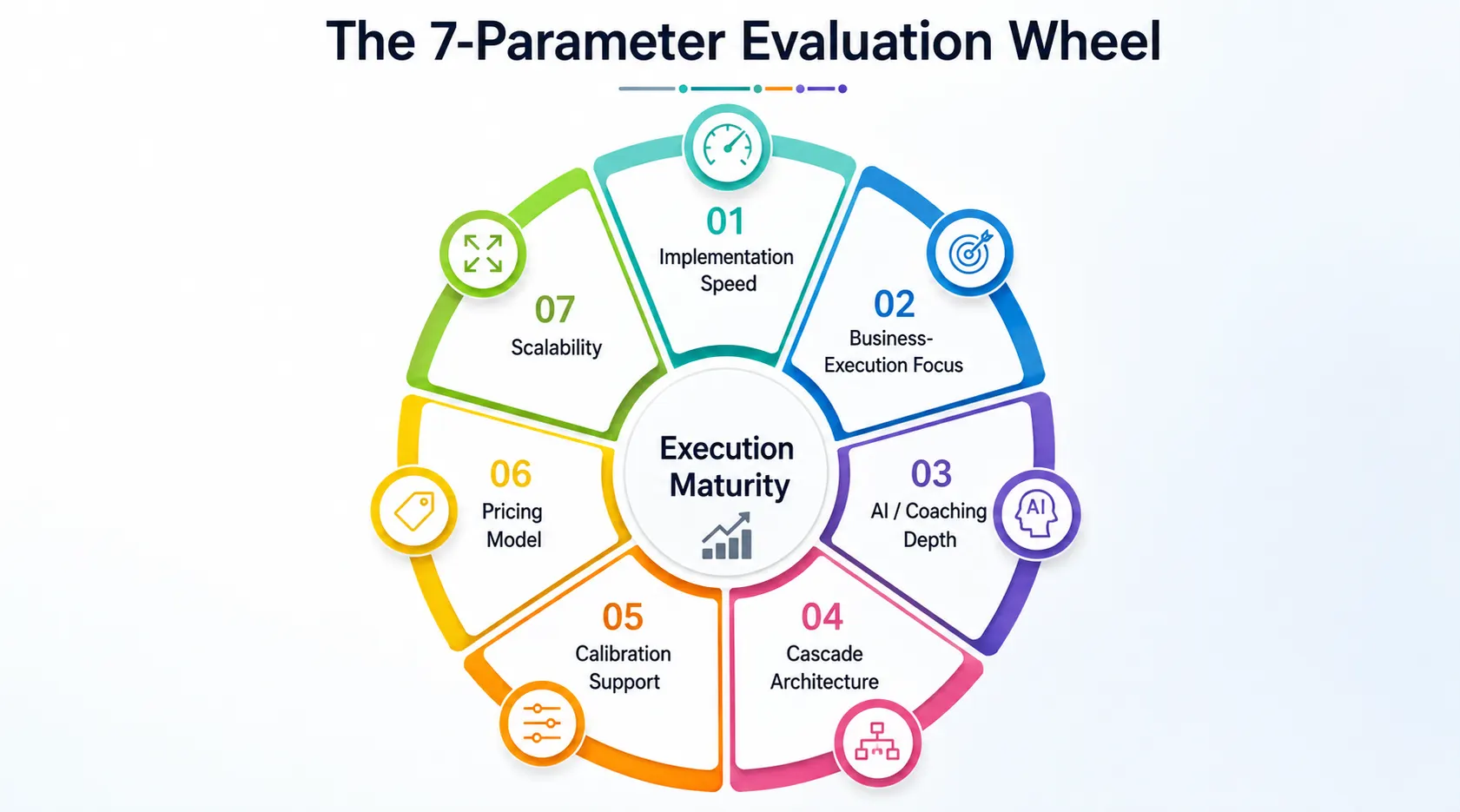
The 7-Parameter Framework: How to Evaluate Performance Management Software
Before ranking anything, you need a lens that is not just a spec sheet. If you have ever searched for features to look for in performance management software, most results hand you a checklist with no way to weigh one item against another. Across our implementations, seven parameters consistently separate tools that get adopted from tools that get abandoned by month four.
| Parameter | What It Actually Tests | Why It Matters |
|---|---|---|
| Implementation Speed | Time to first live cycle | Tools taking 4–12 weeks to configure lose momentum before adoption starts |
| Business-Execution Focus | Does it track outcomes or just activity completion | Determines if HR sees a compliance report or a strategy signal |
| AI/Coaching Depth | Does it coach goal quality at point of entry | The single biggest predictor of Execution Maturity Rate movement |
| Cascade & Alignment Architecture | Can teams see and agree to cross-functional dependencies | Alignment without agreement is a fiction the software just displays |
| Calibration & Bias Support | Real-time flagging of rating inflation or bias patterns | Prevents blind calibration meetings and post-hoc conflict |
| Pricing Model | Per-user vs. flat vs. tiered, and lock-in terms | Determines whether you can validate before committing budget |
| Scalability | Does it hold up past 500 employees without re-platforming | Avoids the two-year re-buy cycle that eats HR budgets twice |
Two parameters deserve extra scrutiny that a table cannot fully capture. On cascade architecture, watch whether the platform supports genuine employee engagement tools alongside goal tracking, or treats engagement as a separate, disconnected module. On calibration support, check whether one-on-one meetings and continuous feedback software feed directly into the same record the calibration committee reviews, rather than living in a separate app nobody checks before the meeting.
This is the same lens we apply in our guide to evaluating a performance management system, which walks through the stakeholder and trial-period process in more depth if you are further along in a vendor shortlist.
We measure the outcome of getting these seven right through one number: the Execution Maturity Rate the percentage of leaders who can independently write a genuine outcome-driven goal, without coaching, without a template. A typical first-cycle organisation sits at 5–15%. Organisations running well-coached programs on the right platform for 12 months reach 30–40%. The software is the infrastructure. The coaching is the capability. You need both, and in the right order.
AI-Powered Performance Management Software: What Actually Moves the Needle
Every platform on the market now claims AI. Almost none of it does what buyers assume. There is a real difference between AI that summarizes a review after the fact and AI that intervenes while a goal is being written, before it ever reaches a manager’s inbox.
When a manager types “improve customer service” as a goal, most AI layers will happily accept it, tag it, and move on. The AI that actually changes outcomes asks the “so what” questions that turn an output into an outcome before the goal is saved. That is the difference between AI performance management software as a feature and AI as the product architecture.
Three capabilities separate real AI depth from marketing copy:
- Goal-quality coaching at point of entry :- Not after-the-fact analytics. Our deep dive on AI-driven performance management software breaks down what this looks like across a full cycle.
- Bias-free performance management through real-time flagging :- Not a quarterly bias report nobody reads until calibration is already underway. See our analysis of AI-driven performance reviews for how this plays out in practice.
- Signal generation, not dashboard decoration :- The difference between a tool that shows you a chart and one that tells you a specific manager is showing rating inflation drift three weeks before calibration. Our guide on AI in performance management systems covers this in more depth, and our piece on real-time performance dashboards covers what genuine signal generation looks like versus a static report.
Worxmate’s own architecture here runs on three named AI models. Orbit AI is the people intelligence layer it detects attrition risk, burnout, and high-potential talent four to eight weeks before a review cycle even opens. Axis AI reads OKR data and isolates the single fastest lever to pull when execution falls behind. Nexus AI maps where a strategy cascade breaks down before it stalls delivery. All three sit inside the DEEP AI™ framework – Define, Execute, Evaluate, Plan which is not a feature layer bolted onto a goal tracker. It is the product’s architecture.
Ranking the Field: Where Each Platform Actually Fits in 2026
Here is where most lists start. We are starting here last, deliberately, because a platform ranking without the framework above is just a list of logos. With the framework applied, here is how the field breaks down by category. Note what is missing from this table on purpose: pure HRIS suites and pure check-in-only tools are excluded from the head-to-head, because ranking a payroll platform against an execution platform tells a buyer nothing useful about either one.
| Platform | Best For | Where It Falls Short |
|---|---|---|
| Worxmate | Business-execution focus, AI-coached goal quality, fast implementation | Younger platform than legacy enterprise suites; still building out deep payroll-adjacent integrations |
| Lattice | HR-driven enterprise programs with strong L&D integration | OKRs get absorbed into HR rhythm rather than business rhythm |
| Betterworks | Manager effectiveness at large enterprise scale | No self-serve path; long procurement cycle |
| Cascade | Strategy execution software for 2,000+ person organisations with a dedicated strategy team | Overbuilt and slow to adopt for anything smaller |
| Perdoo | Strategy-heavy organisations past the adoption challenge | Dated interface; steep learning curve for first-cycle teams |
| Profit.co | Feature-complete, configuration-rich implementations | 4–6 week implementation timeline before first cycle runs |
| Tability | Automated check-in habit formation | Solves the reminder problem, not the reflection problem |
| 15Five | Teams with an existing manager-employee coaching culture | Limited cascade depth past mid-market scale |
| Leapsome | CHROs building capability alongside OKR execution | Slower path to execution discipline than purpose-built tools |
A word on category: several platforms your finance team may already be evaluating – Zoho People, Keka HR, Darwinbox are HRIS suites with a goal-tracking module bolted on. They are excellent HR systems. They are the wrong comparison set for organisations serious about execution, because OKRs are one feature among many for them, not the product’s reason for existing.
Related reads:- If you are weighing the HRIS vs performance management software distinction directly, our breakdown of performance management software vs HRIS and OKR vs PMS software.
For a closer look at how dedicated performance and OKR software compares with enterprise HR suites: see Alternative to Oracle HCM, PeopleStrong alternative, and our broader guide to HR performance management tools.
For direct, platform-by-platform breakdowns, see our comparisons: Alternative to Lattice ; Alternative to Betterworks ; Alternative to 15Five ; Alternative to SuccessFactors
For a wider view of the OKR-adjacent category specifically: OKR tool comparison and best OKR tools guides go deeper on the check-in and tracking layer alone.
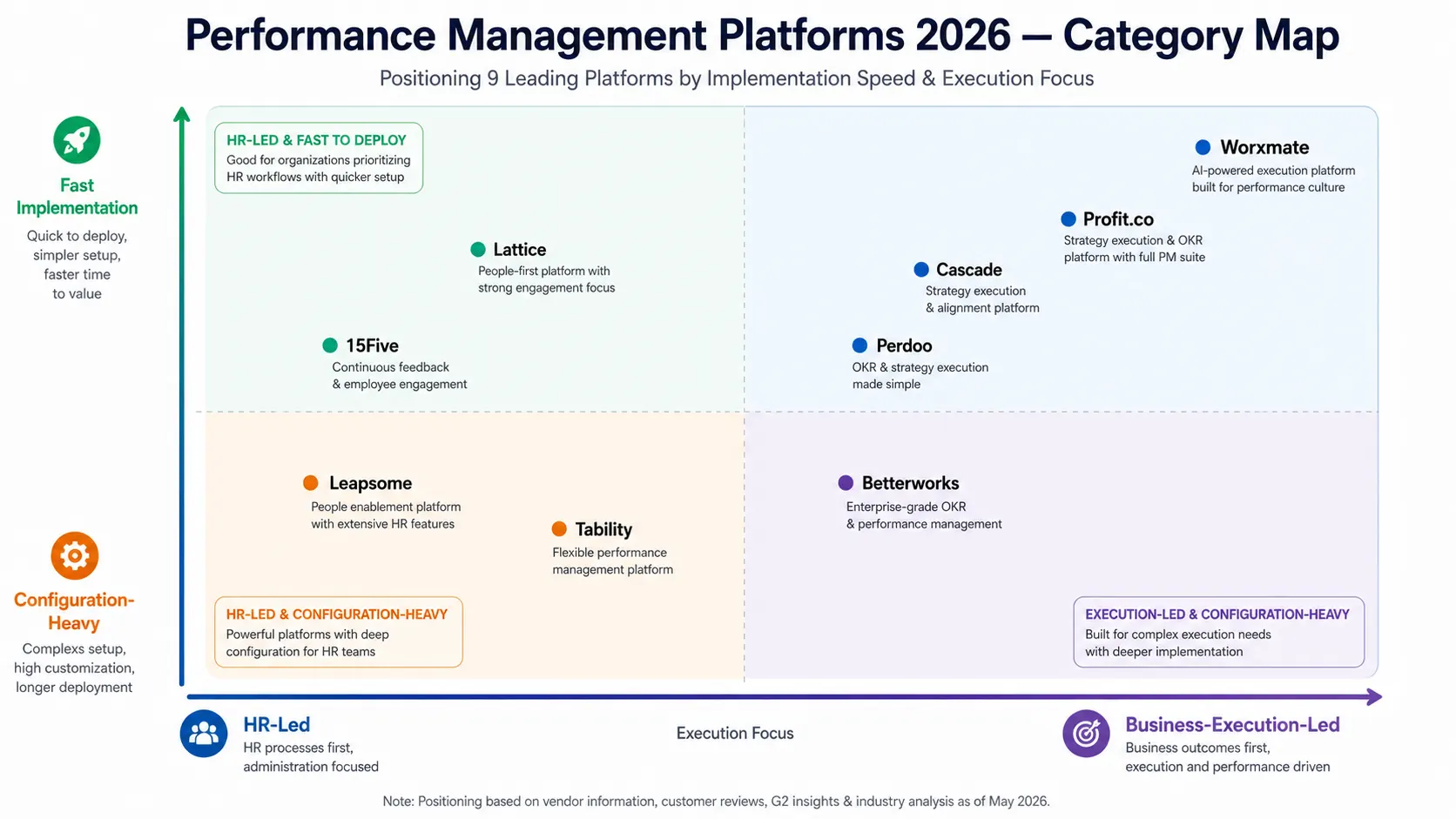
A quick word on how this table was built: each platform was scored against the same seven parameters above, not against a generic star rating pulled from a review aggregator. Star ratings answer “did users like the interface.” They do not answer “did this move the organisation’s Execution Maturity Rate.” Those are different questions, and buyers who confuse them end up re-platforming within eighteen months.
OKR Execution Maturity Framework 2026
Download our comprehensive benchmarking framework to assess your organization’s readiness to overcome OKR software challenges and reach 40% maturity.
Continuous Performance Management vs. Annual Review Software
One distinction inside this category matters more than most buyers realize before they sign a contract: whether the platform is built for a continuous performance management software vs annual review software model. Annual-cycle tools are built around a single yearly event goals set in January, reviewed in December, and mostly forgotten in between. Continuous platforms run on ongoing check-ins, real-time feedback, and cascading goals that adjust as the business does.
If your organisation still runs on annual reviews, this is worth reading before you shortlist anything: our full comparison of continuous performance management software against the annual-cycle model, and our piece on 360-degree feedback vs annual review processes.
Related to this is whether the platform supports genuine performance management software with 360 feedback multi-rater input from peers, subordinates, and cross-functional stakeholders, not just a manager’s single perspective. See our detail on the 360 feedback process and how it should integrate with goal tracking, not sit as a separate module.
Performance Management Software for Different Company Stages
The right platform changes by company size and geography, which is exactly why a single global “best” answer is incomplete. If you are asking what is the best performance management software for startups, the calculus is different from an 8,000-person enterprise: startups need flat pricing, fast setup, and no procurement cycle. Our guide on performance management for small business covers affordable options built to scale without enterprise overhead.
For CHROs specifically scoping top PMS software for enterprises headcount tiers, complexity, compliance, and multi-department cascade architecture dominate the decision – our dedicated performance management software for enterprise guide breaks that down by department and headcount tier, and works as the deeper companion to this pillar rather than a competing page.
Geography changes the calculus too. Buyers evaluating performance management software for USA teams should weigh labor law compliance and data residency alongside our dedicated coverage of performance management platforms built for the American market; readers evaluating options for Indian teams should start with our Performance Management Software India: 2026 Buyer’s Guide, which covers local players like Keka, Darwinbox, and Zimyo directly. For cloud-based performance management system requirements specific to Indian mid-size and manufacturing companies, our guides on PMS software for small business in India and best PMS for manufacturing in India go further into sector-specific requirements. And if remote and hybrid teams are the priority, our piece on performance tracking tools for remote teams addresses performance management software for remote teams specifically a different evaluation than co-located workforce tools.
Unlock Goal Clarity & Accelerate Employee Growth
Looking to drive goal clarity and employee growth? Discover how Worxmate’s AI-powered Performance Management Software can help.
Pricing, ROI, and What “Free Trial” Actually Tells You
Performance management software pricing breaks down into three models: per-user monthly, flat-rate unlimited, and enterprise custom quotes. Per-user pricing punishes growth the tool gets more expensive exactly when it is proving useful. Flat-rate models like SimpleOKR cap functionality at the low end. Enterprise custom quotes hide true cost until legal has already invested weeks in procurement.
A performance management software free trial tells you less than most buyers assume. Fourteen days is not enough time to run a real check-in cycle, let alone a full calibration. Watch for query volume instead: if your team is raising 15–20 support questions per day in week one of a trial, that is not a training gap it is a signal that the tool and your team’s current OKR literacy are mismatched. No onboarding call fixes a mismatch discovered in week one.
On the question of how much does performance management software cost, our dedicated breakdowns cover this by category: performance management software ROI ; SaaS performance management pricing, and — for the OKR-specific layer OKR software cost per user. Our wider performance management metrics guide is also worth reading before you build the ROI case internally, since the metrics you choose to report on shape which platform features actually matter to your board. For Worxmate specifically, our pricing page lists tiered plans (Vital, Proficient, Enterprise) with up to 25% savings on annual terms.
What This Looks Like in a Real Implementation
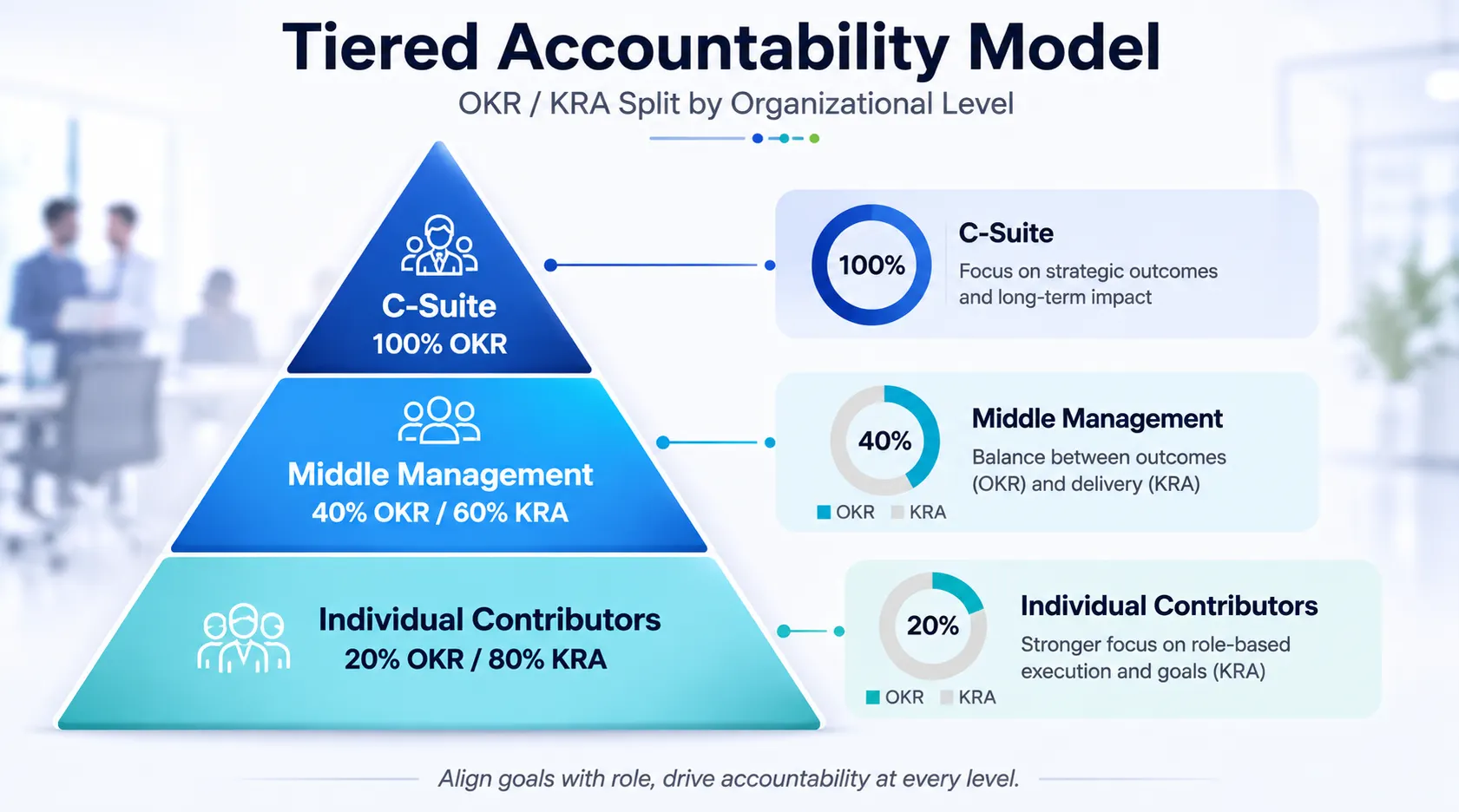
In a Middle East energy company with over 8,000 employees, the barrier was never a lack of goals. It was scattered ownership every leader running their own cascade, disconnected from the one above it. Their original features checklist ran fifty items long. It never asked whether the platform could distinguish between strategic and operational accountability by level.
We implemented a Tiered Accountability Model instead: C-suite at 100% OKR focus on strategic outcomes, middle management split 40% OKR growth work and 60% KRA operational delivery, individual contributors at 20% OKR and 80% KRA. The platform that could enforce that distinction not just display goals in a tree is what moved their Execution Maturity Rate from a chaotic 8% to a stable 32% across three cycles, while cutting manual reporting time by 70%.
That is the pattern behind every entry in the table above. The platforms that rank well here are not the ones with the most modules. They are the ones that can hold a real organisational structure without forcing every team into the same rigid hierarchy — the same discipline covered in our guide to performance management system implementation and our broader look at what a genuine strategic performance management system requires beyond software alone.
The mistake most buying committees make at this exact point is assuming that structure is a configuration problem something a solutions engineer sets up during onboarding and everyone adapts to. It is not. Structure has to be modeled on how the organisation genuinely operates today, not how the org chart says it should operate. A platform that lets you configure a tiered model is necessary. A platform that also has an implementation team who has actually run this conversation with a CHRO before is what makes the configuration correct on the first try instead of the third.
An OKR Coach evaluating a PMS platform asks one question: does this platform tell HR whether their people are moving the business or does it tell HR whether their people completed the process?
Performance Management Software with OKR Integration: Why This Matters More Than Feature Count
A recurring mistake in enterprise procurement is treating goal-setting and performance review as two separate purchases. Performance management software with OKR integration solves a specific failure mode: KRAs that are disconnected from business goals, and performance ratings that reward activity instead of outcomes. Buying the two capabilities from two different vendors almost always recreates the disconnect the integration was supposed to fix, because the data never actually merges into one signal it just lives in two dashboards nobody reconciles.
On the reverse question — OKR software vs performance management software the short answer is you need both layers talking to each other, not one tool pretending to be two. If you are still deciding whether your organisation needs OKRs, KPIs, or both running together, our guides on OKRs vs KPIs and what is OKR lay the groundwork before you shortlist software at all. For teams specifically weighing the OKR software layer on its own, our best OKR software 2026 ranking runs the same rigor against OKR-only tools, and our HR strategy resources connect the software decision back to the broader people strategy it needs to support.
🎯 my honest take
Buying the right performance management software for your organisation, in the context of your wider business performance management and talent management strategy, is 20% of the work. Implementation, coaching, and the discipline to keep leaders writing outcome-driven goals past the first cycle is the other 80%. Every platform in the table above can technically do goal-tracking. Very few can coach a manager out of writing a vague goal at the moment it is being written. That single difference is what separates a 15% Execution Maturity Rate from a 35% one and it is the reason a ranked list, on its own, was never going to be enough to make this decision for you.
Path 1: The Platform
If you are ready to move beyond spreadsheets or a legacy HRIS module bolted onto goal-tracking, explore Worxmate’s Performance Management Software and OKR Software, built on the DEEP AI™ framework across all four stages Define, Execute, Evaluate, and Plan. See it live in our interactive intelligence experience, or book a demo directly.
Path 2: The Consulting
If you recognise that the tool is only half the solution, our OKR consulting teams work directly with leadership to build the Execution Maturity Rate the platform alone cannot produce across India, UK & Europe, and the Middle East. The software is the infrastructure. The coaching is the capability. You need both, and in the right order.


Written by
An OKR Coach with 20+ years of implementation experience, Madhusudan has guided over 50 organisations through successful OKR transformations, training more than 500 leaders. Learn more about Worxmate.
