 WORXMATE
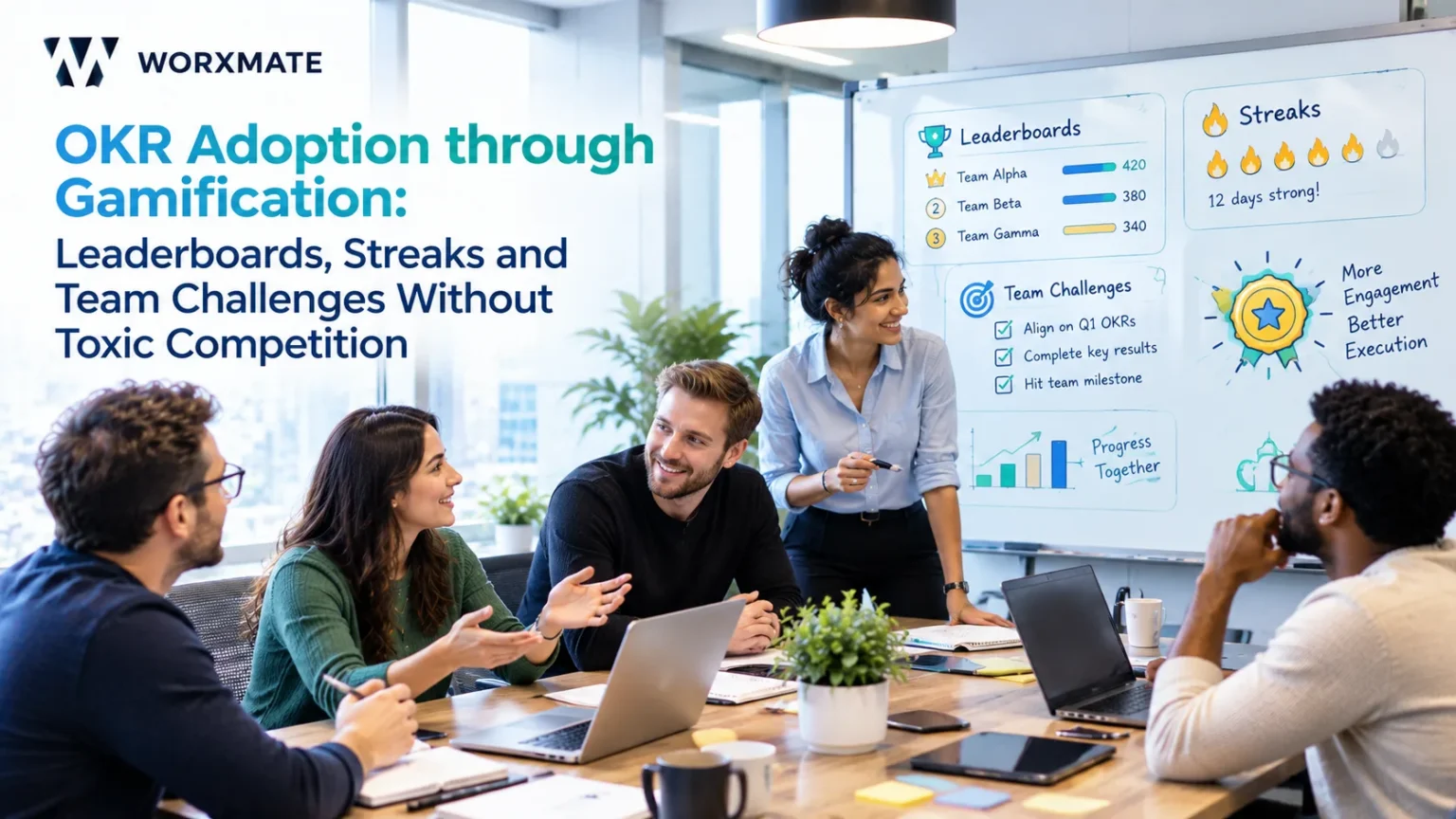
What is OKR adoption through gamification? It is the use of streaks, team challenges, points and leaderboards to reward the habits that make OKRs work: weekly check-ins, honest confidence updates and cross-team help. Done well, gamification in OKRs lifts participation without turning goals into a scoreboard. Reward behaviours and teams, never raw attainment, and keep rewards small, visible and shared.
- Does it work? Yes for habits such as check-ins and early blocker flagging. No for unclear goals or a programme that was pushed instead of chosen.
- What to avoid: individual rankings on OKR scores, and cash tied to attainment.
- Where to start: one streak, one team challenge and one behaviour-based points rule. Review after 30 days.
The first game I ever ran in an OKR room had no points, no badges and no leaderboard.
It was a Media, Entertainment and Telecom business unit inside a 70,000-person IT services organisation. Every MBR ended the same way: leaders in the room, nobody sure what was actually blocking progress. So I put real goals from their own business in front of them and asked one question: which of these are right, and which are wrong? That game broke the myth they had been operating under, and result-oriented thinking showed up in the room for the first time.
That is the part of OKR adoption through gamification most teams skip. They hear “gamification” and picture a leaderboard on a wall. I picture people choosing to engage because the work has become worth engaging with. The leaderboard is the least interesting mechanic you can use, and the easiest one to get wrong.
This guide is for the CHRO, Strategy Head or BU Head whose programme is live but quiet. Check-ins arrive late, and the okr tracking tool gets opened the night before the review. Below: OKR gamification examples, seven plays, guardrails against toxic competition in the workplace, and the OKR adoption metrics that show whether it works.
I am Madhusudan Nayak (Maddy), co-founder and CEO of Worxmate. Across 50+ implementations and 500+ leaders trained, the pattern I see consistently is that OKR adoption is a behaviour problem long before it is a software problem.
Why OKR Adoption Stalls Before Gamification Can Help
Gamification is a multiplier. It multiplies whatever is already there, including nothing.
In week one of any engagement I watch for warning signals. Two matter here.
Signal 1: was this pushed, or was this chosen? Where OKRs were announced with a go-live date and a software login, the programme tends to collapse between weeks four and six. Nobody answered the question every employee silently asks: what is in it for me? Points do not answer it. A leader who sets the tone does.
Signal 2: how many product queries is the team raising? A team raising 15 to 20 support queries per day in week one will see adoption break within weeks. That is friction, and no streak counter fixes friction.
Points can reward a habit. They cannot create a reason.
If your programme was pushed, start with why OKR implementation fails, overcoming resistance to change in OKR adoption and why OKRs feel like extra work. If it was chosen and people simply drift, read on. Does gamification work for OKRs? It works for the drift, not for the missing reason.
What Is OKR Gamification, and Can Gamification Improve OKR Adoption?
OKR gamification is the deliberate use of game mechanics, such as streaks, points, badges, team challenges and a leaderboard, to reinforce the behaviours that keep OKRs alive between planning and review.
So, can gamification improve OKR adoption? Yes, when it rewards behaviours you can observe weekly. It fails when it rewards outcomes people cannot control, or ranks individuals. The difference between motivation and pressure sits in a few design choices.
Healthy competition at work versus toxic rivalry
| Design choice | Healthy version | Toxic version |
|---|---|---|
| What gets rewarded | Check-in consistency, blockers raised early, help given to other teams | Highest attainment score, biggest numbers |
| Unit of competition | A team against its own last cycle | Individuals ranked against each other |
| Visibility | Shared progress and streaks | Public bottom-of-list naming |
| Reward size | Recognition, learning time, small perks | Cash tied to OKR scores |
| What a red status means | An honest signal, welcomed | A mark of failure, hidden or softened |
Everything that follows is a way of staying in the left column.
Achieve Your Goals Faster
See how Worxmate can help your team set clear goals and achieve faster results. Book your free demo today and experience the power of AI-driven OKRs in action.
OKR Adoption through Gamification: 7 Plays That Work
Here are seven plays in the order I would introduce them. Each is one of the OKR engagement strategies I use against a specific adoption problem, and OKR motivation follows from the habit, not the other way round. Do not run all seven at once. Start with the first three.
Play 1: OKR Streaks and How to Build OKR Check-In Streaks
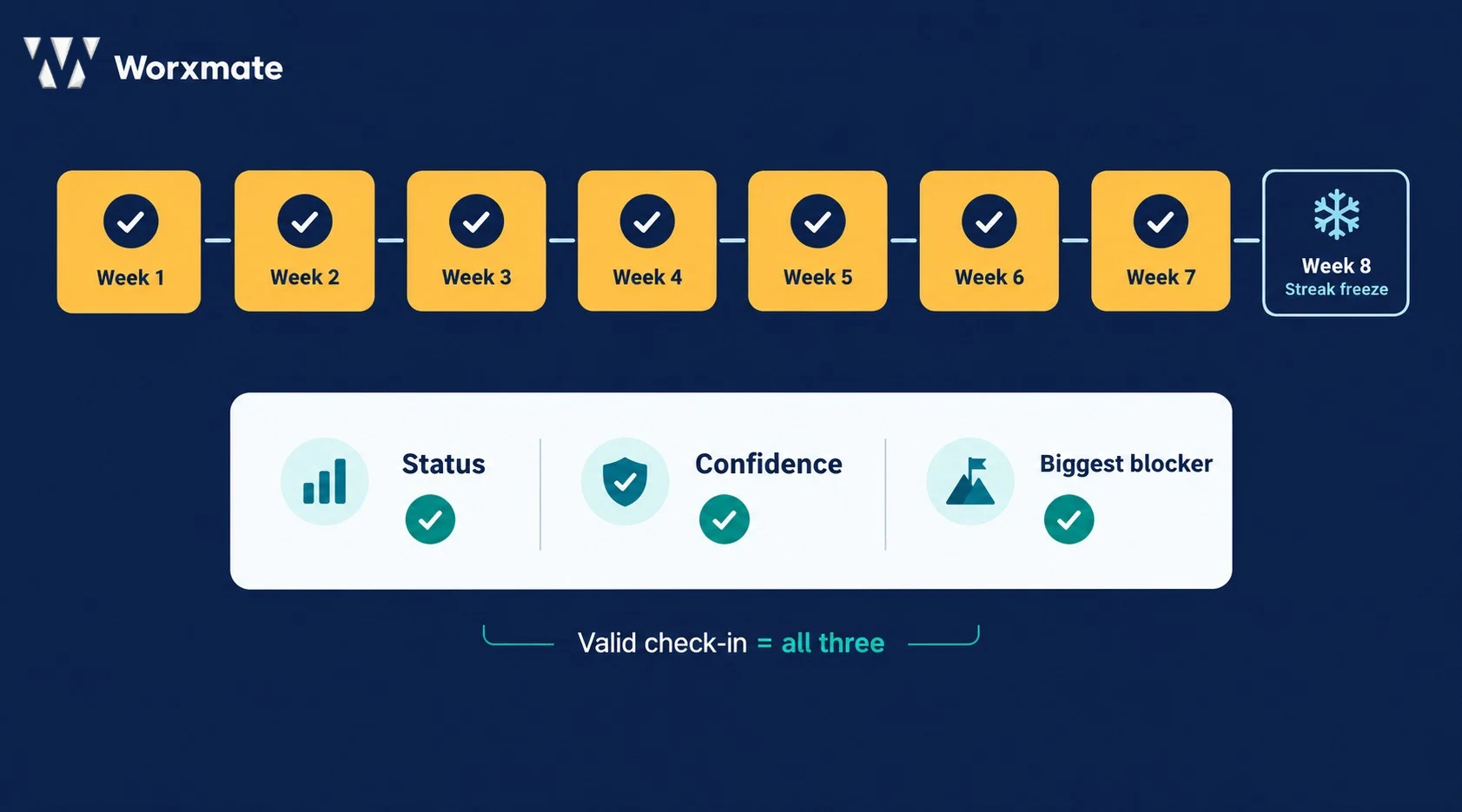
An OKR streak counts consecutive weeks in which a team completes its check-in on time. It is the simplest way to build OKR check-in habits and a steady rhythm of continuous feedback and iteration, because it makes the absence of an update visible and slightly uncomfortable, which a reminder email never does.
Here is how to build OKR check-in streaks that do not get gamed:
- Define a valid check-in. A status, a confidence level and one line on the biggest blocker. A blank “no update” should not extend a streak.
- Add one streak freeze per quarter. A streak that punishes holidays breeds resentment.
- Show the streak to the team, not the company. Leadership sees only the aggregate.
- Anchor it to an existing rhythm. Attach the check-in to the weekly meeting you already hold. Use an OKR check-in meeting template and the guidance on OKR check-ins.
That is my answer on how to motivate teams to update OKRs weekly: make the update short, the streak visible and the conversation afterwards worth five minutes. Here is how to increase OKR check-in rate: shrink the check-in before you enlarge the incentive.
Play 2: OKR Team Challenges to Boost OKR Participation
Individual competition is where toxicity starts, and the dangers of micromanaging through OKRs show up fast. Team challenges to boost OKR participation point the competition outward, at a shared problem, and they are the safest mechanic I know.
Three OKR team challenges I would run in a first cycle:
- Zero stale Key Results week. Every KR in the team carries an update from the last seven days.
- Blocker bounty. The team that surfaces a cross-functional dependency early, and gets it resolved, earns recognition for both teams involved.
- Retro sprint. Every team submits a short retrospective within five days of cycle close.
The second comes from a European fintech startup of around 100 people. I asked the Product Lead to co-own a Key Result with the Account Executive, jointly accountable for a demo experience that led to conversion. Neither function could escape it, and a dependency conversation that had never happened finally did. Shared ownership is the cleanest form of team goals, and a challenge built on it strengthens cross-team alignment instead of splitting teams into camps.
One caution. Team challenges invite free-riding. Keep contribution visible so that social loafing cannot hide inside a team score.
Play 3: An OKR Points System That Rewards Behaviour
An OKR points system works only if points attach to behaviours and never to attainment. The moment points follow scores, people sandbag their goals to guarantee a high mark. I have watched it happen.
An example OKR points system (behaviour-based)
| Behaviour | Points | Why it matters | Gaming risk to watch |
|---|---|---|---|
| On-time check-in with status and confidence | 1 | Builds the weekly habit | Copy-paste updates |
| Confidence change with a written reason | 1 | Makes risk visible early | Reasons that say nothing |
| Blocker raised before it turns red | 2 | Moves problems left | Inventing blockers |
| Blocker resolved for another team | 3 | Rewards cross-team help | Trading favours |
| Retrospective submitted with one lesson | 2 | Feeds the next cycle | Boilerplate lessons |
No points for hitting a target, none for a high OKR scoring system result. Tie behaviour to the OKR confidence score rather than the final grade and you reward honesty instead of optimism.
Is your OKR habit real or just visible?
Streaks show activity. The OKR Execution Maturity Framework shows whether your leaders can actually write and run outcome-driven goals. Score your programme before you add game mechanics.
Play 4: OKR Badges and Rewards, and OKR Recognition and Rewards
Badges are cheap, visible and surprisingly effective when they name a behaviour. “Dependency Unblocker” means something. “Top Performer” means nothing and creates a loser for every winner.
Good OKR badges and rewards name an action, can be earned by many people at once, and cost little. For OKR recognition and rewards I prefer time or voice over money: a learning day, first choice of the next team offsite, a slot to present the team’s lesson to leadership. For more, see these employee appreciation ideas and the thinking behind reward and recognition.
Gamification vs Recognition in OKRs
Gamification is a system. Recognition is a human act. In gamification vs recognition in OKRs, the badge should trigger the conversation, never replace it. A manager who gives real-time feedback such as “your team flagged that dependency early and it saved us a week” does more than any icon. The difference between an award and a reward is worth settling before you design the scheme, and so is how OKRs and bonuses interact.
Play 5: An OKR Leaderboard, and How to Use Leaderboards for OKRs Without Demotivating Teams
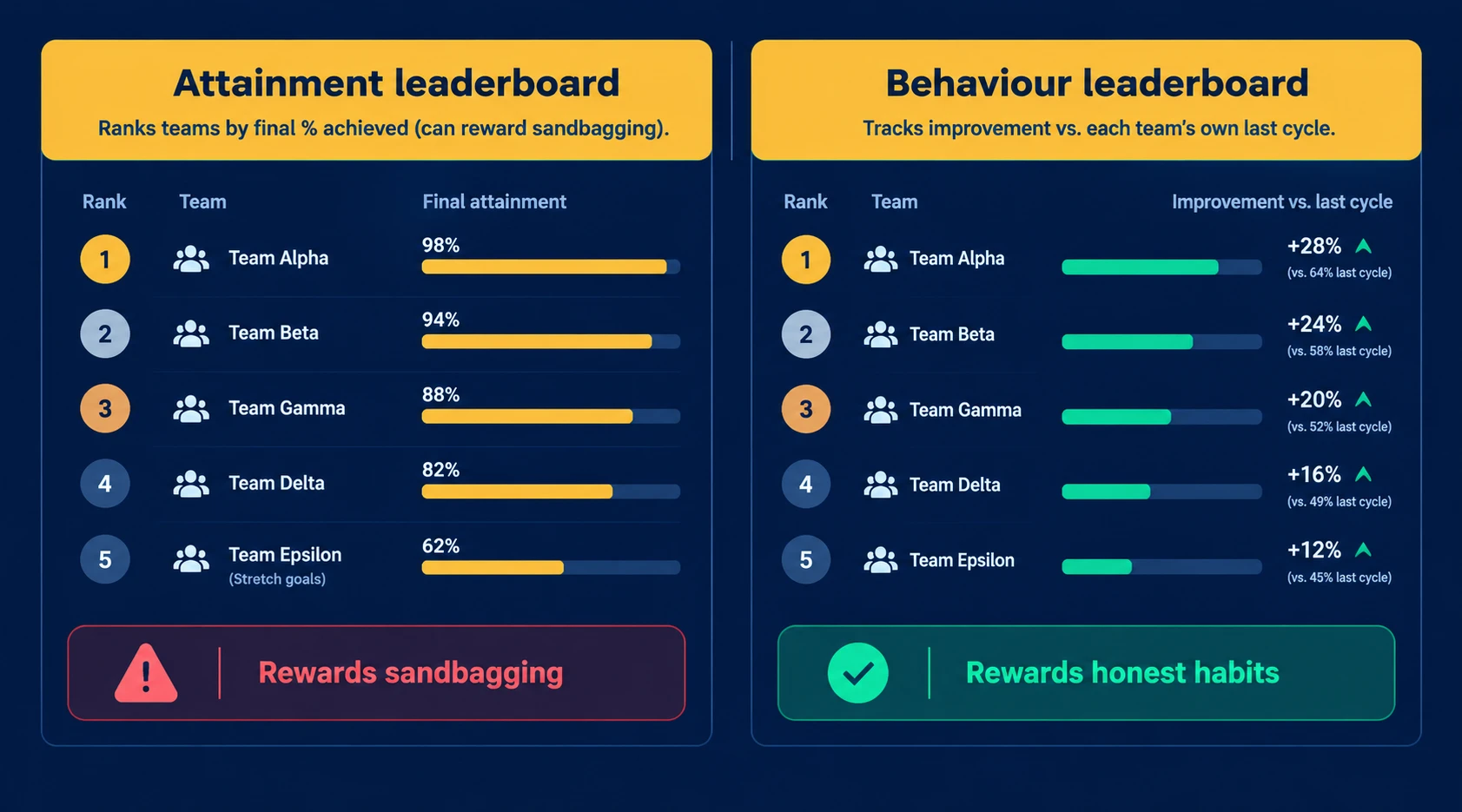
Everyone wants this play, and I would introduce it last. An OKR leaderboard can lift the top third of a company and quietly drain the rest. An OKR progress leaderboard that ranks attainment also punishes the team that wrote the stretch goal. The team that sandbagged finishes first.
So how do you use leaderboards for OKRs without demotivating teams? These OKR leaderboard best practices have held up for me:
- Rank behaviours, not results. Check-in streaks, blockers resolved and retrospectives submitted.
- Compare a team to its own last cycle. Improvement is a fairer race than absolute position.
- Show the top, not the bottom. Nobody needs a public list of who is last.
- Rotate the category each cycle. Different teams will lead on different things.
- Reset every cycle. Last quarter’s winner should not own the board forever.
Skipping the leaderboard is a legitimate choice, and aspirational vs committed OKRs explains why stretch goals need that protection. A shared real-time OKR dashboard with no ranking gives most of the visibility with none of the sting.
Play 6: OKR Gamification Ideas for Remote Teams
Distributed teams lose the hallway nudge, so OKR gamification ideas for remote teams must work asynchronously:
- A 48-hour check-in window, so no time zone has to wake early to keep a streak alive.
- A “blocker of the week” thread where any team can claim a problem and close it publicly.
- A win-and-lesson post at cycle close, read aloud by someone outside the team.
Pair these with OKRs for remote teams, how to write OKRs for remote teams, OKR tracking for remote teams and hybrid team OKRs.
Play 7: The Output vs Outcome Game
Back to the room where I started. This is the play that built capability, and it has no points at all.
Take six real goals from the team’s own business. Ask leaders to label each as output-led or outcome-driven and defend the label. Then run the “so what” ladder on the weakest goal: if you deliver this, so what? What happens next? Repeat until the statement describes something that changes in the business. The same ladder changed the quality of every goal that fintech team wrote afterwards.
Adoption Rate
85%
Average failure rate of tool-only implementations
Execution Lift
3.2x
Increase in goal quality with AI-assisted coaching
This is how to gamify OKRs where it matters most: in the thinking. The metric I use is the Execution Maturity Rate, the percentage of leaders who can independently write a genuine outcome-driven goal without coaching, a template or a quality review. In a typical first cycle it sits between 5% and 15%. In well-coached organisations after 12 months it reaches 30% to 40%. Read more on output vs outcome and on the leading indicators that make outcomes visible early.
How to Avoid Toxic Competition with Gamification
Toxic competition in the workplace arrives quietly, as a change in what people report. Red statuses turn amber. Confidence scores creep up. Nobody wants to be last on the board.
There is a deeper reason I rarely hear named. In early OKR programmes people carry a silent fear: if I commit to an ambitious outcome and miss it, it will be read as poor performance. A scoreboard feeds that fear by saying “this is being judged.”
Here is how to avoid toxic competition with gamification:
- Say out loud that it is not an appraisal. Failing to deliver a stretch goal in cycle one is learning, not failure.
- Celebrate the honest red. Reward the team that flagged a problem early.
- Watch effort, not just output. A streak maintained at 11 pm every Sunday is a burnout signal, not a success. Orbit AI’s Burnout Risk and Engagement Decline signals are built to surface exactly this, and the thinking behind it is in Orbit AI.
- Cap the stakes and keep individuals off public boards. Small, shared rewards and team views only.
For deeper reading on the motivation side, see the psychology of employee motivation, avoiding OKR burnout and burnout prevention OKRs. Well-run gamification for employee engagement respects that people are watching how the numbers are used.
Gamifying a programme that is already shaky?
Most adoption problems come from a handful of repeat implementation mistakes. This ebook walks through them so you fix the foundation before you add mechanics on top.
Gamification in Performance Management: Where I Draw the Line
Gamification in performance management is where good intentions go to die. Once an OKR points total shows up in an appraisal or bonus conversation, every mechanic here becomes a high-stakes target.
My rule: gamification can inform a conversation and never decide an outcome. Keep streaks and points out of ratings. Use them as a prompt in the one-on-one meeting or in ongoing feedback, where a manager can ask what is behind a dip. Build the performance management culture first and add mechanics only where trust exists. Ratings, calibration and reviews are a separate evaluation, covered on our performance management software page.
How to Increase OKR Adoption with Gamification: A 30-Day Rollout
Here is the OKR adoption strategy I would run with one month and one team.
Week 1: Choose, do not push. Hold one honest conversation about what is in it for the team, and agree what counts as a valid check-in. See how to introduce OKRs to employees if you are starting cold.
Week 2: Run the first check-ins. Keep them short and count the support queries. If they climb, simplify before adding anything.
Week 3: Add one team challenge. Zero stale Key Results week is a good first choice. Run an OKR mid-quarter review alongside it.
Week 4: Review and retire. Ask what felt motivating and what felt like surveillance. Drop the second group, then decide whether a leaderboard earns a place at all.
That is how to make employees use OKRs without nagging, which is the heart of how to implement OKRs: keep the first month small, honest and reversible.
Achieve Your Goals Faster
See how Worxmate can help your team set clear goals and achieve faster results. Book your free demo today and experience the power of AI-driven OKRs in action.
How to Measure OKR Adoption: OKR Adoption Metrics
If you cannot measure it, you will argue about it. Here is how to measure OKR adoption, using adoption metrics that separate real behaviour from decoration.
OKR adoption metrics to track weekly and per cycle
| Metric | What it tells you | Starting target I would set |
|---|---|---|
| OKR participation rate (people updating at least one KR weekly) | Whether the habit exists | Rising each week for four weeks |
| On-time check-in rate | Whether the rhythm holds | Above 80% by the end of cycle one |
| Streak retention (teams keeping a streak past week four) | Whether gamification is sticky | Most teams past week four |
| Early red flags (days before cycle end that risk was raised) | Whether honesty is safe | Trending earlier each cycle |
| Cross-team blockers resolved | Whether alignment is real | At least one per team per cycle |
| Execution Maturity Rate | Whether thinking has changed | 5% to 15% in cycle one, 30% to 40% after 12 months |
These are starting targets from my own coaching practice, not industry benchmarks. Adjust them to your size and maturity.
OKR adoption rate (who uses the system) and OKR participation rate (who uses it meaningfully) are different things. Track both. See what OKR metrics are, how to create OKR health indicators and how to track OKRs. A good OKR retrospective is where these numbers turn into decisions.
Not sure which metric is lying to you?
Participation can look healthy while performance stays flat. The Organisation Performance Audit shows where your people, goals and results actually connect.
Choosing a Gamified OKR Tracking Tool: What OKR Software for Teams Needs
I will not rank tools here; our OKR software for teams page does that. What I can give you is what to ask when you shop for the best OKR software with gamification, or any gamified OKR software.
An okr tracking tool with gamification should let you:
- Define what counts: a valid check-in, not just a click.
- Reward behaviours, not scores: streaks, blocker resolution, retrospectives.
- Default to team views, with individual views restricted.
- Let you switch mechanics off. You will retire some.
- Fit your existing stack, through OKR software integrations.
People who search for OKR software with leaderboards and badges usually want a gamified OKR tracking tool that makes the weekly update feel lighter. Fair. But the mechanic is the last thing I would evaluate. First check how to choose OKR management software, the OKR software features that matter and whether it supports weekly planning.
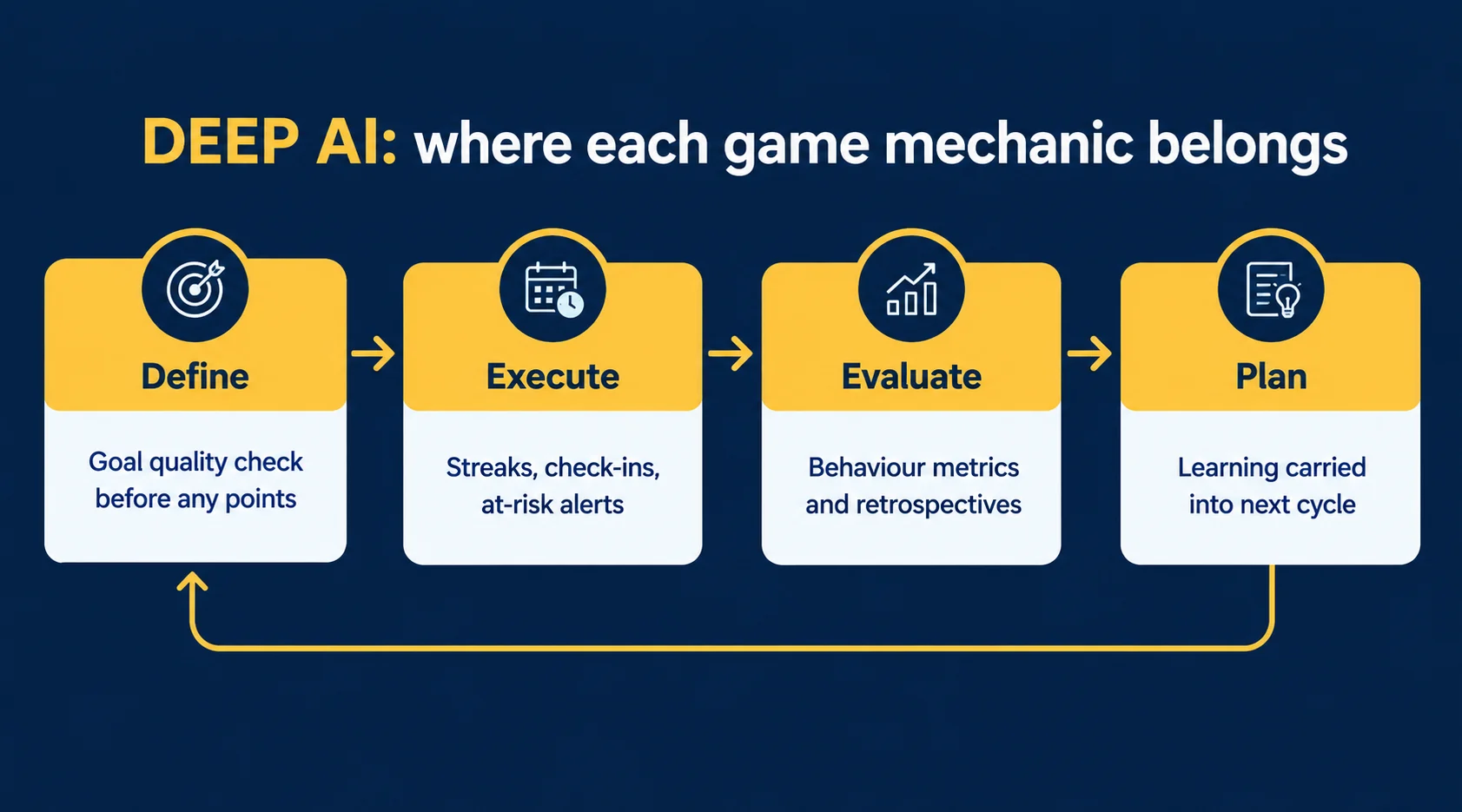
This is where the DEEP AI framework earns its keep, because it places each mechanic in the right stage:
- Define: AI-assisted goal writing and quality scoring. Do not add points to a badly written goal.
- Execute: automated check-ins and at-risk detection. This is where streaks and challenges live.
- Evaluate: data-backed retrospectives and scorecards.
- Plan: learning carried from one cycle into the next.
Three layers of intelligence sit around it. Orbit AI reads people signals, which is how you spot a streak turning into burnout. Axis AI shows whether participation is moving business outcomes. Nexus AI shows which teams carry the habit across the organisation. Before you buy anything, confirm directly what your platform supports for streaks, challenges and team-level views.
My Take: The Software Is the Infrastructure. The Coaching Is the Capability.
OKR adoption through gamification is worth doing in the right order: fix the reason first, shorten the check-in second, reward the habit third. Aim competition at a shared problem, and take the leaderboard out the moment it hurts.
The software is the infrastructure. The coaching is the capability. You need both, and in the right order.
Path 1: The platform. If your habits are forming and you want tooling that supports them, see pricing or book a demo.
Path 2: The consulting. If you suspect the platform is not your first problem, our OKR consulting works with your leaders on the thinking underneath, one-to-one, across real cycles.


Written by
An OKR Coach with 20+ years of implementation experience, Madhusudan has guided over 50 organisations through successful OKR transformations, training more than 500 leaders. Learn more about Worxmate.