 WORXMATE

OKR for PMO is the practice of using Objectives and Key Results to link every project in a portfolio to a strategic outcome, so the project management office reports business progress instead of task status. The PMO owns the cascade from company OKRs to projects, ranks work by outcome contribution, and tracks portfolio OKRs in a weekly rhythm. Start by writing 2 or 3 PMO-level OKRs, map each active project to a Key Result, and stop or re-scope projects that connect to none.
In one line: under OKRs, a PMO stops asking “is the project green?” and starts asking “is the outcome moving?”
Every monthly business review in the Media, Entertainment and Telecom unit of a 70,000-person IT services organisation ended the same way. Leaders in the room had no clear picture of what was blocking progress, and no way to connect day-to-day work to what the business expected from them. Activity was visible. Execution was not.
Nobody there lacked project reports. What they lacked was a line from each project to an outcome the business cared about. That line is what OKR for PMO builds, and it is the subject of this guide. In my experience across 50+ implementations and 500+ leaders trained, a PMO that cannot draw that line spends its life explaining status instead of shaping strategy.
What Is the Role of a PMO in OKRs?
A PMO’s role in OKRs is to translate company objectives into a prioritised project portfolio, connect each project to a Key Result, and report outcome progress to leadership. It acts as the bridge between strategy and delivery, owning cascade quality, dependency visibility and the weekly review rhythm rather than project status alone.
That is the pmo role in strategy execution when done properly. A strategic PMO does not police templates. It makes pmo strategic alignment visible: which projects serve which outcomes, which serve none, and which compete for the same people. When people ask about pmo and okrs together, this is the shift they are really asking about. For the general discipline of okr and project management, read our OKR in project management guide. This page stays on the portfolio layer, and leans on strategy implementation and monitoring for the wider frame.
Why Projects Fail to Deliver Strategy
Why projects fail to deliver strategy is rarely a delivery problem. Teams ship. The portfolio just never pointed at the right target. I see the same pattern across industries: projects are approved on sponsor energy, funded on last year’s budget, and judged on schedule. Nobody asks which Key Result they move.
That gap has a name in our library, the strategy execution gap, and it usually opens in three places. Projects start without a mapped outcome. Output is mistaken for outcome, so “launch the portal” counts as success whether or not onboarding improves. And teams agree to a plan without agreeing on why it matters.
You cannot set alignment in a tool. You can display it once it exists. Alignment is agreement between teams on what matters, why it matters, and how each team’s work connects to the work around it.
That is why a portfolio mapped to the strategy needs conversations before it needs dashboards, and why OKR alignment and organizational alignment is a leadership job. If you want the output-versus-outcome distinction in depth, our output vs outcome piece covers it.
Achieve Your Goals Faster
See how Worxmate can help your team set clear goals and achieve faster results. Book your free demo today and experience the power of AI-driven OKRs in action.
PMO vs OKR vs Project Plan
Pmo vs okr is a false contest. A PMO is a function. OKRs are a goal system. A project plan is a delivery schedule. They answer different questions, and okr vs project plan confusion is why many OKR rollouts in PMOs turn into a second status report.
| Dimension | Project plan | PMO reporting | OKRs |
|---|---|---|---|
| Answers | What gets done, by whom, by when | Are projects on time, on budget, in scope | Is the business outcome moving |
| Time horizon | Project life | Weekly or monthly | Quarterly, with weekly check-ins |
| Unit of progress | Tasks and milestones | RAG status and variance | Key Result movement |
| Typical failure | Plan is followed, outcome is missed | Everything is green, strategy is stalled | Goals written, never connected to projects |
| Owner | Project manager | PMO | PMO and business leaders together |
Can okrs replace pmo reporting? No, and I would be wary of anyone who says they can. Schedule, budget and scope reporting still matter. OKRs sit above that layer and decide which projects deserve reporting in the first place.
OKR vs KPI for PMO
Okr vs kpi for pmo comes up in every PMO workshop. KPIs tell you whether the machine is healthy: on-time delivery, budget variance, utilisation. OKRs tell you what must change this quarter. Keep both. The OKR vs KPI guide and using OKR and KPI together explain the split, the balanced scorecard for a wider KPI view, and moving from KPIs to OKRs helps if your PMO dashboard is KPI-only today.
How to Use OKRs in a PMO: 7 Steps
How to use okrs in a pmo comes down to seven steps. Run them in order. Skipping step 1 is the most common reason I see PMO OKRs go nowhere.
| Step | What the PMO does | Output |
|---|---|---|
| 1. Get the top 3 company outcomes | Ask the CEO or strategy head for three priorities in writing | Company OKRs, agreed |
| 2. Inventory every active project | List all projects, sponsors and budgets, including shadow work | One portfolio register |
| 3. Map each project to a Key Result | Attach every project to the Key Result it moves | Project to KR map |
| 4. Write PMO team OKRs | Set 2 or 3 objectives for the PMO itself | PMO OKRs |
| 5. Prioritise by outcome contribution | Rank projects by the Key Result they serve and the evidence | Ranked portfolio |
| 6. Run the weekly check-in | Review Key Result movement first, project status second | Risk and dependency log |
| 7. Retrospect and reset | Score, stop orphan projects, carry lessons forward | Next-cycle portfolio |
Step 1: Start with the company’s top three outcomes
Ask for three priorities in writing. If leadership cannot name three, stop and fix that first. In my work, getting a leader to compress strategy into three outcomes has been the hardest conversation in the room, and the most valuable. Treat them as your strategic priorities. Our guide on how to set OKRs for a company shows the shape.
Steps 2 and 3: Connect projects to strategic objectives
How to link projects to okrs: list every active project, then attach each one to the single Key Result it moves most. This is connecting projects to strategic objectives in practice. How to align project portfolio with company okrs is the same exercise, done at scale. Expect 15 to 30% of projects to have no honest mapping on the first pass. That is not a failure. It is your first real insight. Use OKR levels to keep the okr cascading to projects clean, and see how to write OKRs before drafting.
Step 4: How to set OKRs for a PMO team
How to set okrs for a pmo team: write two or three objectives about the PMO’s own contribution. For example, portfolio visibility, decision speed and benefits proof. Resist the urge to write ten. Our guidance on how many OKRs to set applies here too, and operations team OKRs show a similar internal-function pattern.
Step 5: How to prioritise projects using OKRs
How to prioritise projects using okrs, or project prioritization using okrs, means ranking by outcome contribution. Ask three questions of each project. Which Key Result does it move? How much of that Key Result does it plausibly deliver? What evidence supports that estimate? Projects that cannot answer lose to projects that can. Pair this with a gap analysis and a plan vs actual review when two projects claim the same Key Result.
Where does your portfolio sit on execution maturity?
The OKR Execution Maturity Framework shows how many of your project owners can write an outcome goal today, so you start the PMO rollout at the right level.
Steps 6 and 7: Run the rhythm and retrospect
Review Key Result movement first and project status second. A weekly OKR check-in (use the check-in meeting template), a mid-quarter review and an end-of-cycle OKR retrospective are the whole cadence. One completed OKR is worth more than five written ones, so score honestly using the OKR scoring system and the confidence score.
OKRs for Project Portfolio Management
Okrs for project portfolio management and okr for portfolio management are the same idea at two zoom levels. Portfolio OKRs sit above programs and projects, and every project below must serve one of them.
What is strategic portfolio management? It is the discipline of choosing, funding and steering projects based on strategic value rather than sponsor pressure. Strategic portfolio management is a close cousin of strategic planning, and it gets its structure from OKRs: the objectives define what matters, and the Key Results define how you will know.
For okrs for portfolio managers, the practical shift is how portfolio okrs replace the annual project list. The portfolio becomes a quarterly bet (see quarterly vs annual OKR cycles), reviewed against Key Result movement. That sharpens project portfolio alignment, because every re-prioritisation has a stated reason.
At the enterprise end, enterprise pmo okrs need clear ownership. In practice, the most reliable setup I see is a short list of portfolio objectives owned by the PMO head and the strategy head together, with program managers owning the Key Results beneath. Leadership behaviour decides whether it holds, as the role of leadership in OKR implementation shows. See OKR examples for strategy heads and OKR software for enterprise for the larger picture.
Benefits realization OKR
Benefits realization okr is where PMOs gain the most credibility. Most projects have a business case. Few have an owner checking it ninety days after close. Add one Key Result per major project that verifies the benefit after delivery. Projects stop being “done at go-live” and start being “done when the benefit shows up.” The business outcome definition and leading indicators help you pick the right measures.

PMO OKR Examples and a PMO OKR Template
Pmo okr examples are scarce in generic OKR libraries, so here are working ones. Use them as a pmo okr template: one objective, three Key Results, and at least one outcome Key Result per objective. For okr examples for pmo head and okr examples for project management office teams, start with the first row.
| Role | Objective | Sample Key Results |
|---|---|---|
| PMO head | Make the portfolio visibly serve the three company outcomes | 100% of active projects mapped to a Key Result by week 3; stop or re-scope the bottom 10% of projects with no mapped KR; leadership decisions on portfolio changes within 5 working days |
| Program manager | Deliver the platform migration so customers feel it | Cut customer onboarding time from 21 to 10 days; reduce migration-related tickets by 40%; zero critical dependencies unresolved at week 8 |
| Project manager | Ship the billing release with no revenue leakage | Billing error rate below 0.5%; 95% of invoices on the new engine by week 10; sponsor sign-off on scope changes within 48 hours |
| Transformation office | Prove the transformation is changing how work gets done | Move 6 of 8 business units to the new operating rhythm; raise leaders able to write outcome goals unaided from 10% to 30%; retire 15 legacy reports |
| Benefits realization | Turn delivered projects into measured business gains | Verify benefits for 80% of closed projects within 90 days; recover 70% of the business-case value on the top 5 projects |
These cover okr for program managers, okr for project managers and okr for transformation office leads. Notice that each row mixes output and outcome Key Results deliberately. Output Key Results are not wrong. Confusing them with outcomes is. If the terms blur, read the difference between an objective and a key result and mark each Key Result as committed or aspirational.
One pattern worth copying comes from a European fintech of about 100 people I coached. The Product Lead and the Account Executive co-owned a single Key Result on demo experience and conversion. Neither function could escape it, and it forced a dependency conversation the company had never had. A PMO can do the same with a cross-functional Key Result between a delivery program and its business sponsor. See shared OKR examples, cross-team alignment and cross-functional team alignment.
For more role-based material, browse operations OKR examples, engineering OKR examples and OKRs for digital transformation.
Achieve Your Goals Faster
See how Worxmate can help your team set clear goals and achieve faster results. Book your free demo today and experience the power of AI-driven OKRs in action.
OKR Tracking for PMO: Dashboards and Reporting
Okr tracking for pmo fails when the dashboard reports tasks. A pmo dashboard okr view reports Key Results, then shows the projects underneath. That ordering is the whole point.
How pmo can track strategic objectives: one portfolio view with each Key Result, its confidence, and the projects mapped to it. How pmo reports okr progress to leadership follows from that view. Lead with Key Results at risk, name the decision needed, and show the project that explains it. A short OKR review meeting beats a long deck. Leadership reads the first line and acts.
| Audience | What they need to see | Cadence | Signal that matters |
|---|---|---|---|
| Project manager | Task and dependency health against the KR | Weekly | Blockers older than 7 days |
| Program manager | Cross-project dependencies and confidence | Weekly | Shared KRs with diverging confidence |
| PMO head | Portfolio mapped to Key Results, orphan projects | Weekly | Projects with no mapped Key Result |
| CEO and leadership | Outcome progress, decisions needed | Monthly | Key Results at risk and the decision required |
| Board or sponsor | Benefits realized versus business case | Quarterly | Benefit gap on top projects |
For tooling that supports this rhythm, OKR software built around check-ins, scoring and retrospectives keeps the portfolio view current without manual roll-ups. AI OKR software can also flag at-risk Key Results earlier. Worxmate’s DEEP AI™ framework fits PMO work well. Define improves how Key Results are written, Execute automates weekly check-ins, Evaluate scores progress with data, and Plan carries lessons into the next cycle. On top sit Axis AI for portfolio-level business performance, Orbit AI for signals about the people carrying the work, and Nexus AI for organisation-wide patterns.
For depth on this layer, see OKR tracking, team OKR tracking, real-time OKR tracking, OKR dashboards and how to track OKRs.
OKR and Agile at Scale
Okr and agile at scale is where many PMOs feel friction, because sprints run on two weeks and OKRs run on a quarter. They do not conflict. OKRs set the outcome. Agile teams choose how to reach it. The PMO’s job is to make sure the epics in flight map to Key Results, not to sprint velocity alone. For a delivery-led rollout in practice, browse the case study on elevating tech excellence through OKRs. Read OKR and agile and OKRs for agile software development for the mechanics.
Okr jira integration for pmo is the practical bridge. Teams keep working in Jira. Key Results read progress from the work. See OKR software for Jira, how to connect OKRs to Jira and the Jira integration walkthrough. The test I use: does a delivery update change the Key Result, or only a status field?

OKR Software for PMO Teams
Okr software for pmo and okr software for pmo teams have to answer a different question from general OKR tools. The PMO needs cascade into projects, dependency visibility and a portfolio roll-up. Best okr software for project portfolio management is therefore about fit, not rank. An okr tool for enterprise pmo adds permissions, SSO and reporting layers on top.
The category distinction matters here, so I will be direct about it. Okr and ppm tools are neighbours, not substitutes.
| Tool category | What it is built for | Where it falls short for OKRs |
|---|---|---|
| PPM suites (for example Planview or Clarity) | Capacity, budgets, scenario modelling | OKR cascade and check-ins are secondary |
| Work-management tools (for example Jira, Asana, Smartsheet) | Task and delivery tracking | Goals sit beside tasks with little outcome coaching |
| Dedicated OKR software | Cascade, check-ins, scoring, retrospectives | Does not replace capacity or financial planning |
I would not pitch any OKR platform, ours included, as a replacement for resource capacity planning or financial portfolio modelling. Those stay in your PPM suite. OKR software sits above it and decides which projects the suite should be planning in the first place. For a wider view, see OKR software for companies, strategy execution software, OKR software vs ERP goal modules OKR software features and how to evaluate OKR software.
OKR Maturity for PMO
OKR maturity for PMO is not about tool features. It is about how many project owners can write a genuine outcome goal without help. I call that the Execution Maturity Rate. In a typical first cycle it sits between 5% and 15% of leaders. In organisations that coach consistently for 12 months, it reaches 30% to 40%. A PMO that rolls out OKRs without coaching below the leadership layer hits what I call the Coaching Cliff, and the program fades within a quarter.
Coaching works best when it maps to each person’s background. A project manager thinks in milestones. A finance partner thinks in budget cycles. Training them identically produces KPIs labelled as Key Results. For rollout basics, see how to introduce OKRs to employees. Our guides on why OKR coaching fails, why OKR implementation fails and OKR implementation for mid-sized companies go further.
OKR for PMO in GCC and India
OKR for PMO in GCC and India has two local wrinkles. Global capability centres run on a parent company’s cadence while serving local leaders. Indian organisations often plan on the April financial year. Read the OKR framework for GCC, the GCC OKR guide and OKR planning for the Indian financial year before fixing your calendar.

Taking PMO OKRs from the first quarter to the fourth?
The Strategic OKR Implementation ebook walks through cascade, cadence and coaching for organisations rolling OKRs out across functions.
What I’d Tell a PMO Lead
Do not start with a tool. Start with three company outcomes, a project inventory and one honest conversation about which projects map to nothing. Then write two PMO OKRs, run the rhythm for one quarter, and score it without flattery. The OKR planning basics, goal alignment with business strategy and what OKRs are are enough background for most teams.
The software is the infrastructure. The coaching is the capability. You need both, and in the right order.
Path 1: The platform. If you are ready to evaluate, explore Worxmate OKR software, review pricing or book a demo.
Path 2: The consulting. If the tool is not your first problem, OKR consulting coaches your project leaders until they run the cycle without us.

Written by
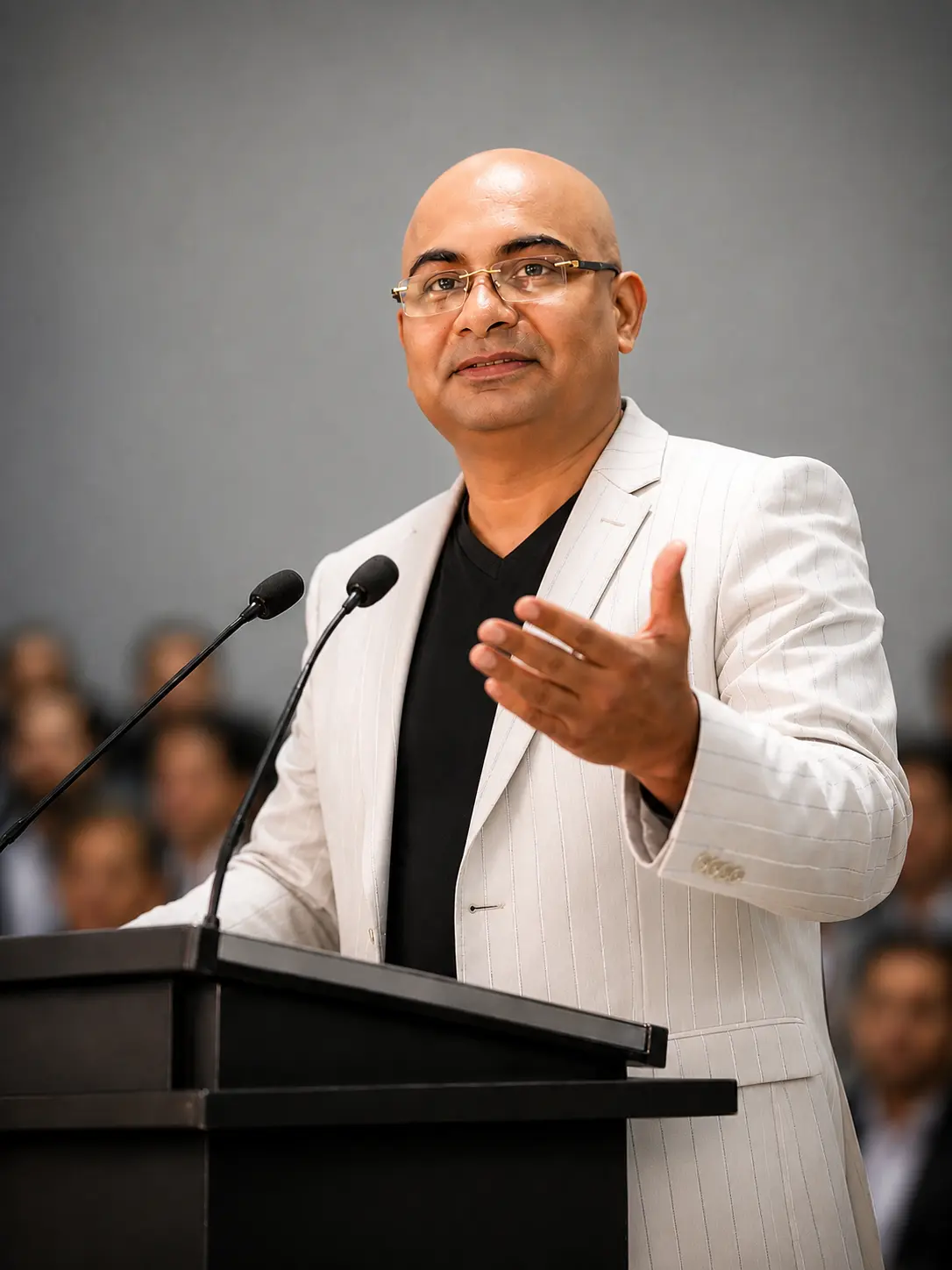
An OKR Coach with 20+ years of implementation experience, Madhusudan has guided over 50 organisations through successful OKR transformations, training more than 500 leaders. Learn more about Worxmate.