 WORXMATE
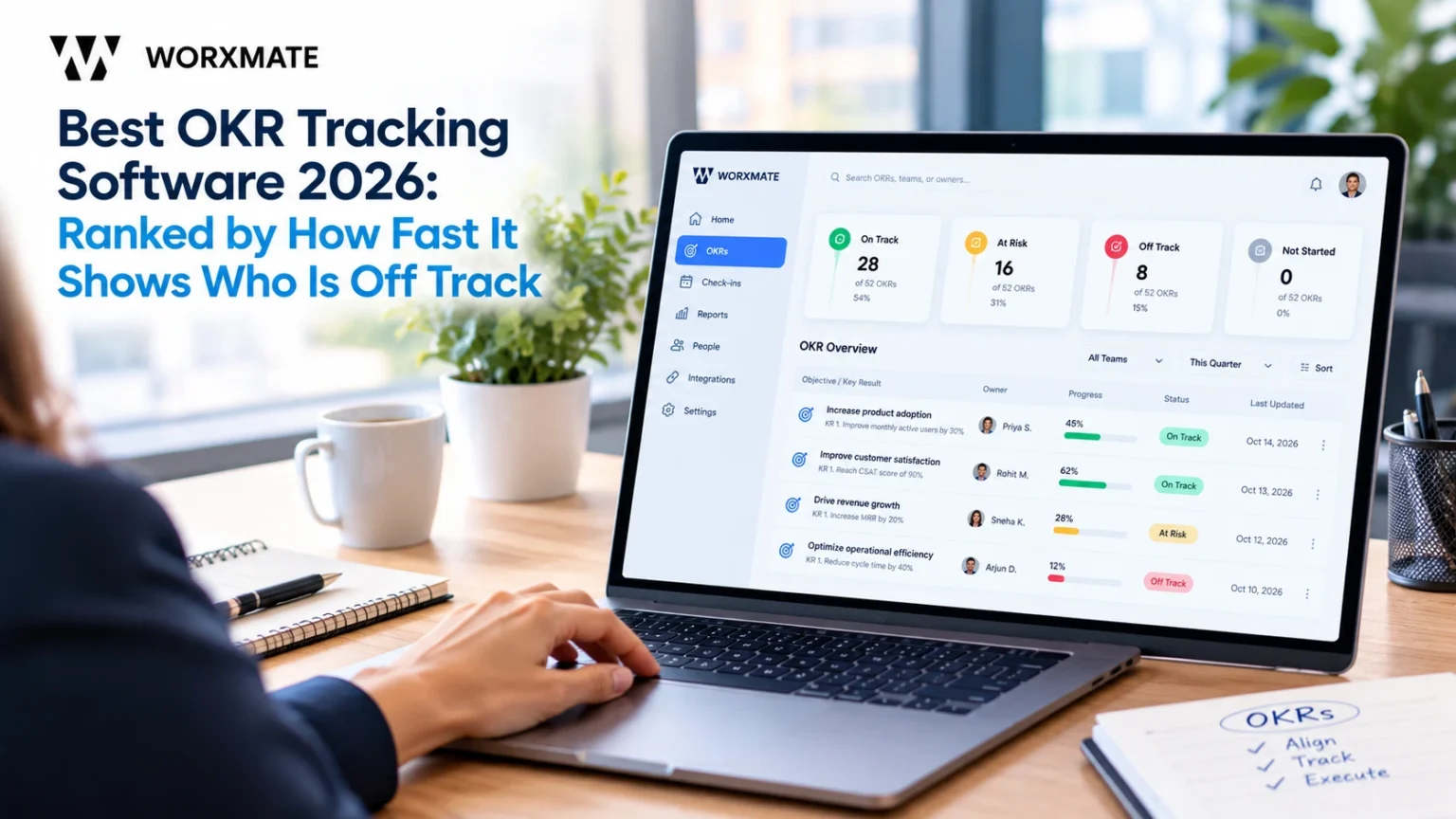
The best OKR tracking software is the platform that shows you which key results are off track within days, not at the quarterly review. On that test, Worxmate ranks first for mid-market and enterprise teams because automated check-ins and at-risk detection sit inside the weekly rhythm. Tability is the strongest pick for small teams building a check-in habit, Quantive suits enterprises with live data feeds, and Perdoo suits strategy-heavy teams running OKRs and KPIs together. To compare any OKR tracker, measure one number: the days between a key result slipping and a leader finding out.
I once sat through a monthly business review inside a business unit of a 70,000-person IT services organisation. The leadership team reporting to the SBU Head presented slide after slide of activity. Nobody in the room could say what was actually blocking progress. Nobody had real visibility into the state of execution. The meeting ended the way every review there ended: with frustration and a list of follow-ups.
That room did not have a reporting problem. It had a signal problem. Everyone had somewhere to write things down. Nobody could see, early, which objectives were drifting. It is the problem I now use to judge the best OKR tracking software, and it is why this ranking rests on one question instead of a feature checklist: how fast does the tool show you who is off track?
I am Madhusudan Nayak, known as Maddy: 20+ years in strategy execution, the last 10 coaching OKR rollouts across 50+ organisations, and 500+ leaders trained. One disclosure: I co-founded Worxmate, and before that I was Business Head at Profit.co. Both appear below, with my reasoning for each placement. Our wider guide to the best OKR software covers the whole market. This article ranks one capability. For a geography-specific shortlist, read the best OKR software in India field report.
Why Most OKR Tracking Software Shows Green Until It Is Too Late
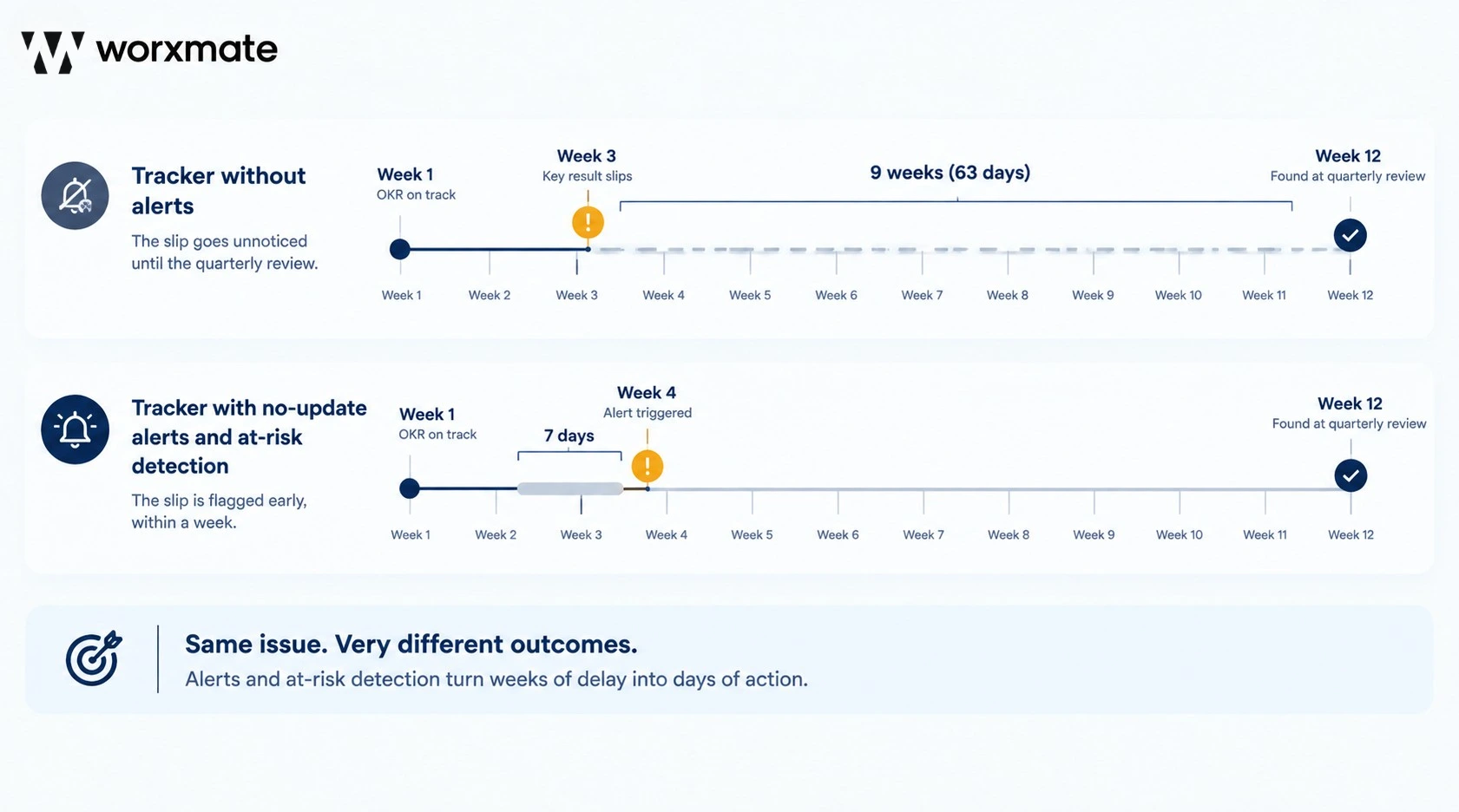
Here is how a typical quarter goes. In week one, everyone updates their key results because the platform is new. By week four, updates thin out. By week eight, a few KR owners update from memory the day before the review. The dashboard is mostly green, because green is the default and nobody has told it otherwise. At the quarterly review, three off-track objectives surface at once, and the room learns what the data could have said six weeks earlier.
Off-track OKRs rarely announce themselves. The slip is slippage: a key result that moved 5% when it needed 15%, a dependency nobody owns, a blocker one person knows about. An OKR tracking tool that only records a progress percentage cannot show you any of this. A progress percentage is a number someone typed. It says nothing about whether the person typing it believes it. Good OKR tracking starts where that number stops.
Three failure modes repeat across the rollouts I coach. Stale updates: a key result untouched for three weeks still shows its last value, and the last value looks fine. Status that never changes: progress is tracked, confidence is not, so an owner who privately doubts the number has nowhere to say so. Dashboards built for the past: teams ask for real-time OKR tracking and OKR dashboards real-time, then get a live view of old data, which is a habit problem before it is a software problem. A tracker’s job is to close the plan vs actual gap weekly.
How I Ranked the Best OKR Tracking Tools: The Off-Track Test
I did not rank on feature counts. I ranked on how each platform is designed to answer five questions plus one practical one about speed. These are the questions I ask in the first week of every engagement, because they predict whether leaders still trust the best OKR tracking software they bought by week six.
| # | Signal | The question I ask | What failing looks like |
|---|---|---|---|
| 1 | Stale-update detection | Does it flag a key result nobody touched? | Silence reads as stability |
| 2 | Check-in friction | How many steps to log a weekly check-in, and does it work on mobile? | Check-ins slip to month-end |
| 3 | Risk language | Does it separate progress percentage from confidence score and RAG status? | Status is one typed number |
| 4 | Roll-up visibility | Does a progress rollup follow parent-child alignment to an executive dashboard? | Leaders read a tree, not a trend |
| 5 | Forward signal | Does it offer early warning signals or predictive alerts? | It only describes what went wrong |
| 6 | Time to first live cycle | Can leaders run a real cycle in week one? | Configuration eats the quarter |
Two caveats. This is not a lab benchmark: the ranking reflects how each platform is built, what its vendor documents, and what I have seen in rollouts, so run a two-week pilot on your own key results. Any OKR tracking software comparison should also exclude HRIS suites with a goals tab. For them OKRs are one feature among many, which makes them excellent HR systems and the wrong comparison here; OKR software integration with HRIS explains where they fit.
Watch one number in your pilot. If a team raises 15 to 20 product queries a day in week one, adoption will break within weeks. That is a mismatch between tool and team, and no customer success call fixes it.
Find out how mature your execution is before you buy a tracker
A tracker only surfaces what your leaders can write. This framework shows where you stand first.
Best OKR Tracking Software 2026: 10 Tools Ranked by Off-Track Speed
Here is the ranking in one view, then what I would tell a client about each. For a wider list by price or size, see the best OKR tools and top 10 OKR software guides.
| Rank | Platform | Best for | How it surfaces off-track work | Watch-out |
|---|---|---|---|---|
| 1 | Worxmate | Mid-market and enterprise | Automated check-ins, at-risk detection | Needs sponsor and coaching |
| 2 | Tability | Small teams | Automated check-in reminders | Outgrown without cascade depth |
| 3 | Quantive | Data-mature enterprises | Live data feeds, AI risk forecasting | Configuration-heavy |
| 4 | Perdoo | Strategy-heavy teams | OKR and KPI strategy map | Best after adoption is solved |
| 5 | Betterworks | Large enterprises | Manager-effectiveness diagnostics | No self-serve path |
| 6 | Weekdone | Small teams | Weekly plan plus OKRs in one view | Per-user pricing past 20 people |
| 7 | Mooncamp | Custom structure | Customizable dashboards | Flexibility without coaching |
| 8 | Profit.co | Patient rollouts | Deep module stack | Four to six weeks to cycle one |
| 9 | Lattice | HR-led programs | OKRs inside review rhythm | Signals arrive at review time |
| 10 | 15Five | Manager-employee cultures | Weekly check-ins plus OKRs | Limited cascade depth |
1. Worxmate: Best for slippage surfaced inside the weekly rhythm
Worxmate is first because the warning is part of the cycle, not a report someone builds. Under the DEEP AI™ framework, Execute runs automated check-ins and at-risk detection, goal-to-task threading shows who owns the blocker, and Axis AI gives leaders the business performance read across goals. It connects to 36+ integrations, including HubSpot. The watch-out I give every client: no tracker fixes a program with no sponsor and no manager coaching. Current plans are on the Worxmate pricing page.
2. Tability: Best for small teams building the check-in habit
Tability has the best automated check-in infrastructure on the market. It solves the reminder problem, not the reflection problem, and teams needing cascade architecture tend to outgrow it within two cycles. See Worxmate vs Tability.
3. Quantive: Best for enterprises with mature data infrastructure
Quantive connects key results to live data feeds and adds AI-driven risk forecasting, so a slipping number is visible without anyone typing it. It rewards teams with the data engineering to configure it. See Worxmate vs Quantive.
4. Perdoo: Best for strategy-heavy teams running OKRs and KPIs together
Perdoo’s strength is the strategy map. OKRs and KPIs sit in one framework, so a drifting KPI can explain a stalled objective. See Worxmate vs Perdoo.
5. Betterworks: Best where the manager layer is the bottleneck
Betterworks pairs OKRs with continuous performance management and centres manager effectiveness, which helps when a program breaks at the middle-manager layer. There is no self-serve evaluation path. See Worxmate vs Betterworks.
6. Weekdone: Best for small teams that already run weekly plans
Weekdone puts weekly planning and OKRs in one view, so off-track work appears where the plan lives. See the alternatives to Weekdone.
7. Mooncamp: Best for teams whose last attempt failed on structure
Mooncamp adapts to your terminology and check-in cadence, with customizable dashboards for team syncs. Flexibility without coaching produces a well-organised mess faster. See Worxmate vs Mooncamp.
8. Profit.co: Best for patient, well-resourced rollouts
Profit.co is feature-complete, and you can go live on the OKR module alone. Configuration typically takes four to six weeks before cycle one, which pushes the first off-track signal back. I worked there, so read Worxmate vs Profit.co and its feature list line by line.
9. Lattice: Best when HR drives the program
Lattice is a performance management platform with OKR features. OKRs tend to get absorbed into the HR review cycle, so slippage is discussed at review time, not weekly. See Worxmate vs Lattice. If reviews and calibration are the real purchase, read the best performance management software guide.
10. 15Five: Best where a manager-employee culture already exists
15Five combines weekly check-ins with OKR tracking. Cascade depth is limited, so company-level rollups are thin. See Worxmate vs 15Five.
How to Know If OKRs Are Off Track
The question I get most from CEOs is plain: how to know if OKRs are off track before the review does the telling. Track three signals together, never one alone. The first is key result progress against time elapsed, your drift from plan. The second is the OKR confidence score, the KR owner’s read on whether the number will land. The third is freshness: stale updates, overdue check-ins and no-update alerts. A key result at 40% progress with a confidence score of 3 out of 10 and no update in two weeks is red, whatever the percentage says. Your OKR red amber green status should encode exactly that.
| RAG status | Progress vs time elapsed | Confidence score | Freshness | What happens next |
|---|---|---|---|---|
| Green | Within 10 points of plan | 7 to 10 | Updated this week | Carry on |
| Amber | 10 to 25 points behind | 4 to 6 | One missed check-in | Owner names the blocker in 48 hours |
| Red | More than 25 points behind | Below 4 | Two missed check-ins | Escalate; add to the next QBR review |
Treat these as starting thresholds I give clients, not a standard, and adjust them after one cycle. For turning status into numbers, see the OKR scoring system, automated OKR scoring and how to create OKR health indicators.
Status only works if the key results measure the right thing. I coached the ME and EUR division of a multi-billion dollar mining engineering group as new entrants ate into its market share. The leaders thought in KPIs, because their systems had always measured KPIs, and KPIs are lagging indicators: they describe where you are, not where to go. The turning point was a chain they had never drawn. On-time service delivery and machine quality drove sales, renewals and regional expansion. Once they understood leading indicators, blockers visible before they became crises, they stopped asking for more reports and asked which daily action moved the regional goal. Three quarters later the result was clarity. When everyone knows what they contribute to and why, alignment sustains itself.
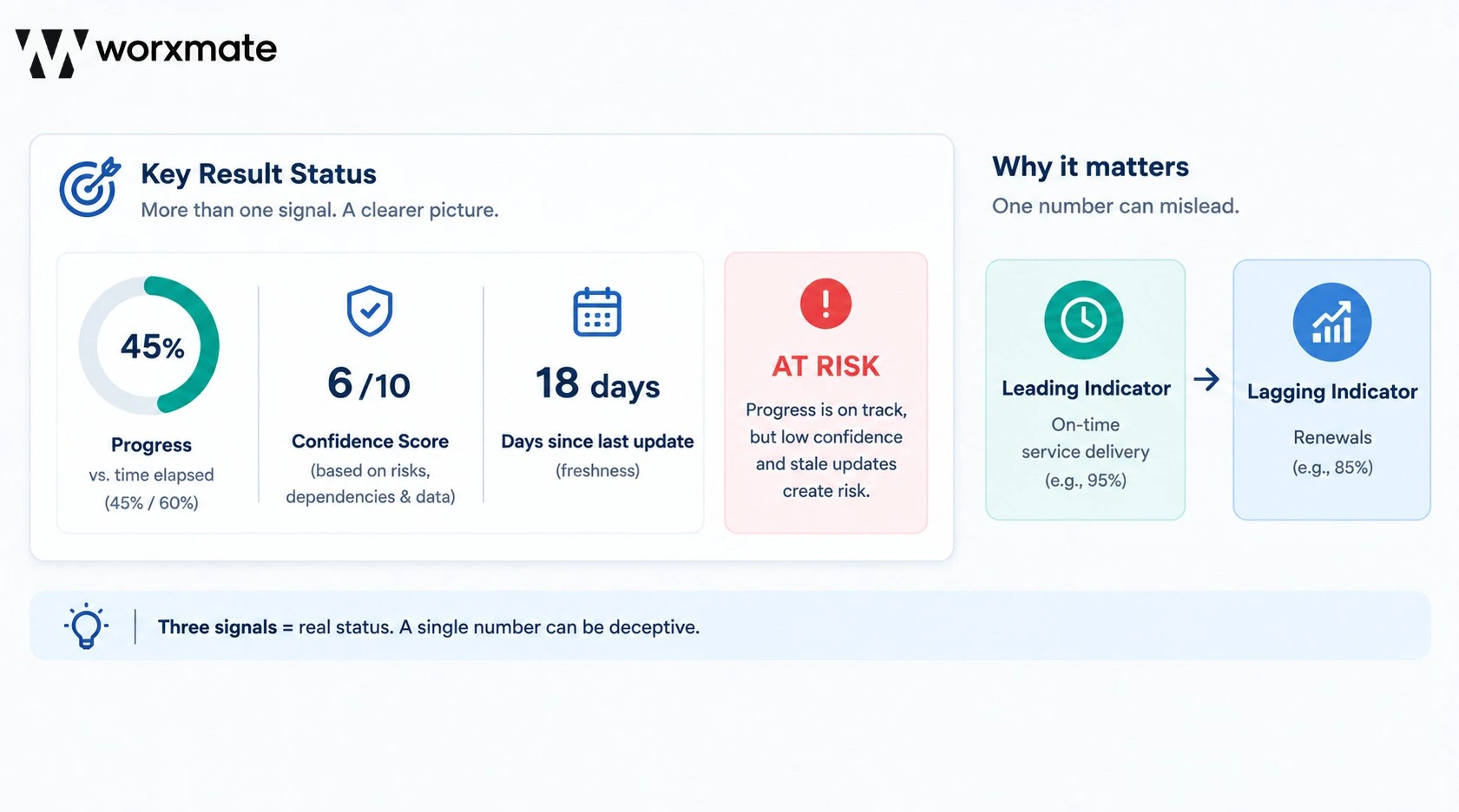
Hold your OKR tracking metrics to that standard: one leading indicator per objective, or the tracker describes history. For the weekly routine, see how to track OKRs.
OKR Tracker Software Features That Expose Slippage Early
When you assess OKR software features, ignore the logo wall and test these five. Any good OKR progress tracking software should pass most of them.
No-update alerts and weekly check-in reminders. A tracker should notice a stale update before you do. Ask whether it sends weekly check-in reminders, flags overdue check-ins, and escalates a no-update alert from the KR owner to their manager. Honest OKR check-ins are the most reliable early warning signals in any program. OKR tracking software with alerts beats a prettier dashboard every time.
Executive dashboard, OKR heatmap and status report. Leaders need status visibility at a glance: an OKR heatmap by team, risk flags on at-risk key results, and a progress rollup that follows parent-child alignment up to company objectives. Ask for an automatic OKR status report and an OKR progress report template the board can read without slides. See real-time performance dashboards.
Alignment map and goal owner accountability. An alignment map only displays an agreement that either exists or does not. What it must show is who owns each dependency, so goal owner accountability is visible. See OKR alignment.
Jira and HubSpot sync, Slack and Teams integration, mobile check-ins. Updates that live outside the work get skipped. Look for OKR tracking software with Jira integration, Slack and Teams integration so check-ins happen where people already are, and an OKR tracking app that works on a phone. See OKR software for Jira, OKR tools with Microsoft Teams integration and the best OKR apps for mobile.
OKR early warning, AI risk forecasting and predictive alerts. Everything above reports what has happened. OKR risk forecasting and predictive alerts say what is about to happen, from the pace of progress and the owner’s confidence history. It is the weakest place to start: unreliable data gives confident forecasts of the wrong thing. See how to automate OKRs with AI.
The tracker is rarely why a program stalls
This ebook maps the patterns that turn good dashboards stale, and how to catch them in cycle one.
Best OKR Tracking Software for Startups, Enterprises, Remote Teams and Executives
The best OKR tracking tool changes with the team in front of the screen, so the best OKR tracking software for a startup is not the best pick for a bank.
Startups. OKR tracking software for startups should win on speed. If leaders cannot run a live cycle within a week, the tool is working against you. Start with the best OKR software for startups, OKR software for small teams and general goal tracking software.
Enterprises. OKR tracking software for enterprise has the opposite problem: complexity. You need more platform when cascade is hard to follow and leaders ask for reports someone assembles by hand. See OKR software for enterprise.
Remote and hybrid teams. Distance makes silence look like progress. For OKR tracking for remote teams and team OKR tracking, weight check-in friction and mobile access heavily, and see the best OKR software for remote teams and OKR software for hybrid teams.
Executives and managers. OKR tracking for executives comes down to one question a CEO can ask without calling anyone: which objectives are off track and who owns them? Managers need the same view, which is what OKR software for managers is built around.
Achieve Your Goals Faster
See how Worxmate can help your team set clear goals and achieve faster results. Book your free demo today and experience the power of AI-driven OKRs in action.
OKR Tracking Software Pricing, Free Plans and Reviews
OKR tracking software pricing runs from per-user plans to tiers to quote-based enterprise contracts. Numbers change, so the pricing page has current ones. What matters is how cost scales, so run your headcount through the OKR software cost per user breakdown, or see affordable OKR software.
OKR tracking software free plans are a fair way to test the habit. Check the user cap, the history limit and whether check-in reminders are included, because a free tier that removes alerts removes the reason to buy. See free OKR software. A spreadsheet can carry one team through one quarter; the limits are in the OKR tracking spreadsheet guide and the OKR software vs Excel comparison.
When you read OKR tracking software reviews, skip the feature praise and search for the word adoption. The number that matters is adoption rate: the share of KR owners who check in every week.
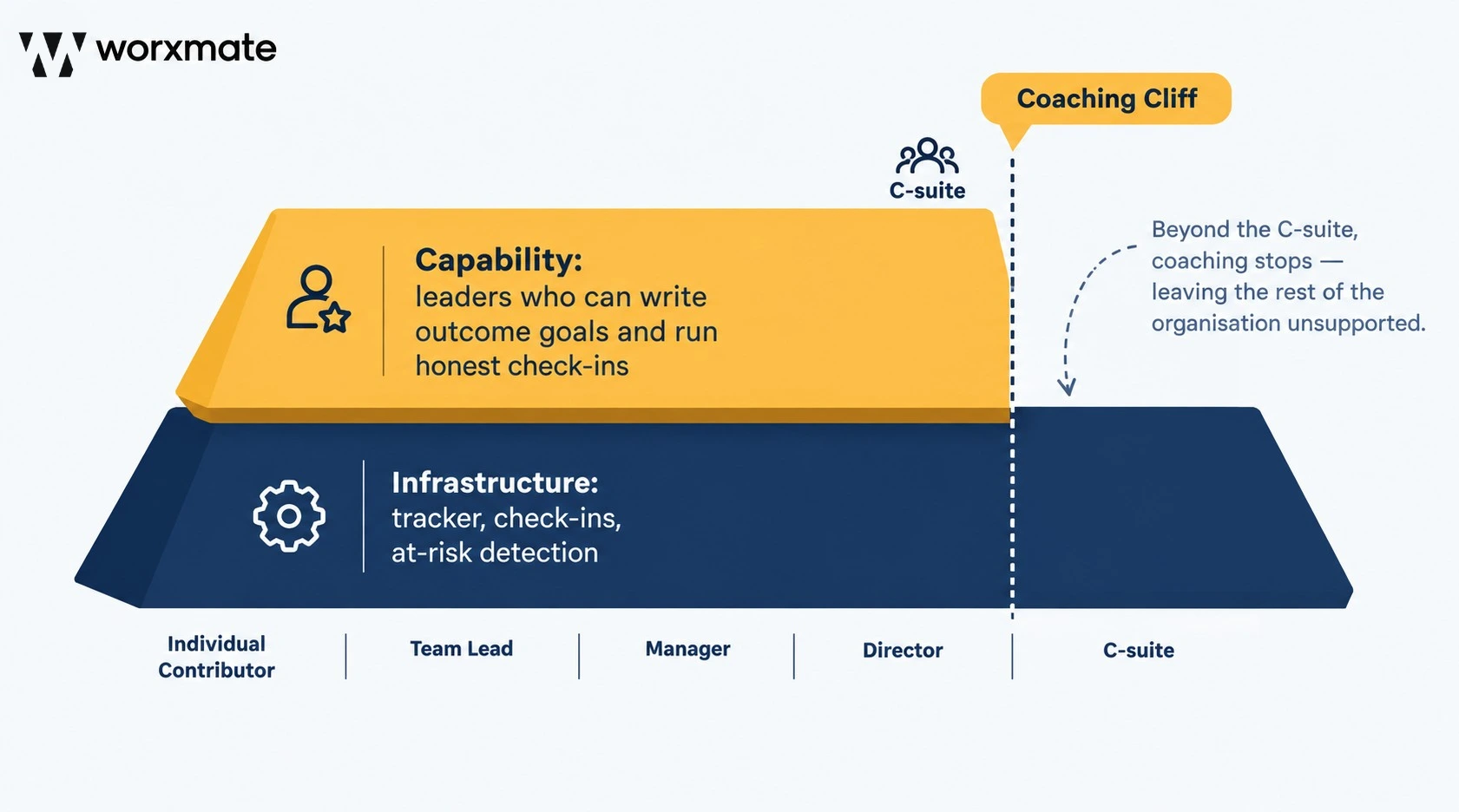
Where OKR Tracking Software Stops and Coaching Starts
I worked with an APAC retail company in aggressive expansion mode. In our first alignment call I asked the CEO for his top three priorities so leaders could write their OKRs. In 45 minutes he could not define them, not because he was not sharp, but because nobody had ever asked him to compress his vision into three outcomes an organisation could cascade from. No tracker could have helped, and no dashboard closes a strategy execution gap that starts with unclear priorities. There was nothing yet to track.
That is the Coaching Cliff: the moment coaching ends at the C-suite and the organisation must cascade alone. It is where most programs die, and it is why I track the Execution Maturity Rate, the percentage of leaders who can independently write a genuine outcome-driven goal without coaching, a template or a quality review. In a typical first cycle it sits between 5% and 15%. After 12 months of well-coached work it reaches 30% to 40%.
The software is the infrastructure. The coaching is the capability.
This is why DEEP AI™ is a loop, not a feature list. Define supports AI-assisted goal writing and quality scoring. Execute runs the check-ins and at-risk detection this article is about. Evaluate turns each cycle into a data-backed scorecard and retrospective. Plan carries the learning into the next cycle. Around the loop sit three intelligence models: Axis AI for business performance, Orbit AI for people performance, and Nexus AI for organisational intelligence. To see why programs collapse, read why OKR implementation fails.
Not sure whether the gap is the tool or the strategy?
The Organization Performance Audit shows where strategy stops becoming delivery, before you shortlist software.
What I’d Tell a Client: The Bottom Line
If a client asked me today, I would say this. A small team that needs the weekly habit should start with Tability. An enterprise with mature data should look hard at Quantive. A strategy-heavy team running OKRs and KPIs together should shortlist Perdoo. A mid-market or enterprise team that wants off-track signals inside the weekly rhythm, with coaching behind it, is who Worxmate is built for. The best OKR tracker for you is the one that passes your own pilot, and the best OKR tracking software on any list earns its place the same way. If you are buying reviews and calibration instead, OKR vs PMS software explains why that is a separate decision.
Judge any pick by the Quick Answer number: days between a slip and a leader knowing. Under a week in your pilot means it is worth keeping, and the guide to evaluating OKR software shows how to run that pilot.
Path 1: The platform. If you are ready to evaluate, explore Worxmate OKR software, check the pricing page, or book a demo and bring your own key results.
Path 2: The consulting. If you suspect the tracker is not your first problem, our OKR consulting is built so your organisation runs its own cycles independently within two to three quarters.
The software is the infrastructure. The coaching is the capability. You need both, and in that order.


Written by
An OKR Coach with 20+ years of implementation experience, Madhusudan has guided over 50 organisations through successful OKR transformations, training more than 500 leaders. Learn more about Worxmate.