 WORXMATE

Quick Answer
The best lattice alternatives for OKR-first teams are Worxmate, Perdoo, Quantive, Tability, 15Five, Leapsome and Profit.co. Choose a purpose-built OKR platform when a CEO, Strategy Head or BU Head owns execution. Stay on Lattice, or consider Betterworks, only when HR owns the program or you need enterprise manager enablement.
- Worxmate: a leadership team inside a real OKR cycle in week one.
- Perdoo or Quantive: strategy mapping or data integration matters more than speed.
- Tability or 15Five: the weekly check-in habit is your gap.
- Lattice: one HR suite matters more than OKR depth.
Most teams that search for lattice alternatives do not have a software problem. They have an ownership problem, and the software is simply where it finally shows up.
Here is how it usually plays out. HR picks a performance platform because it already holds reviews, feedback and goals. OKRs go in as one module. Six months later the CEO opens the dashboard before a board meeting. The tree looks tidy, but nobody in the room can say which three outcomes the company is actually chasing. The cascade is a record of an agreement that never happened.
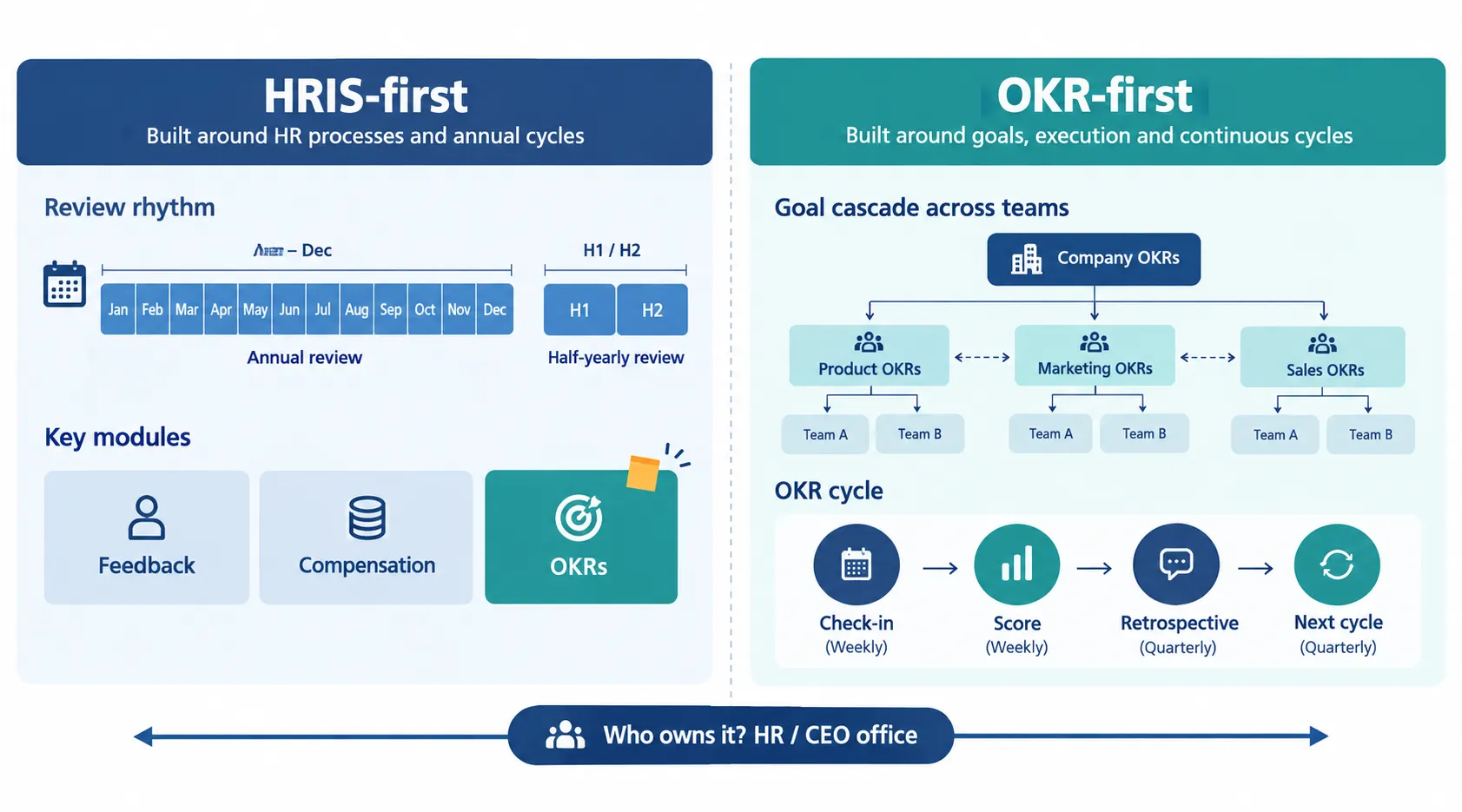
I have watched this pattern across 50+ OKR implementations. When HR drives the program, the rest of the leadership team treats OKRs as one more way to assess performance. When the CEO’s office drives it, OKRs become a strategy execution engine. That ownership decision shapes the outcome before a single objective is written.
This guide is for the second group: leaders who want lattice alternatives for okrs, built as okr-first software, and fair Betterworks alternatives alongside them. I will show what each category is built for, how to compare OKR software without a demo steering you, and where Worxmate is not the right fit.
Why Teams Start Searching for Lattice Alternatives
Let me be fair to Lattice first, because an honest lattice review starts there. Is Lattice good for OKRs? In the right setup, yes. Lattice Goals connects individual OKRs to team and company goals, supports check-ins inside 1:1s, and integrates with Jira, Salesforce and Slack. So does Lattice have OKR tracking? Yes. Every lattice okr review lands in the same place: it is a performance management platform with OKR features, and it works well when HR drives the program.
The friction starts when HR is not the one driving. These are the lattice okr limitations I see most often:
- Cadence mismatch. OKRs run on a weekly and quarterly business rhythm. A performance suite runs on review cycles and calibration windows, so OKRs get absorbed into the HR rhythm.
- Goals trapped in the review cycle. In my conversations with 135+ HR leaders, KRAs disconnected from business goals is one of the failures I hear most. A suite that stores goals inside the appraisal flow makes it easier, not harder.
- Cost that follows the bundle. Third-party benchmarks from 2026 put the Goals and OKRs module near $8 per seat per month and a Performance plus Goals bundle near $13, billed annually with a minimum commitment. Treat that lattice pricing as directional and confirm it with Lattice directly.
That is why teams switch from lattice to okr software. Lattice has not got worse. The program moved from HR to the business and the tool did not follow.
Betterworks has a different profile. It is the strongest option I know for manager effectiveness at large enterprise scale. The trade-off is a sales-led route: no self-serve path, quote-based pricing and a long procurement cycle. Any betterworks review should say that early. If you are searching for betterworks competitors or betterworks pricing, you are usually too small for that procurement cycle, or running OKRs from the strategy office rather than the manager layer.
“Alignment is agreement, not a configuration in a tool. A platform can display it once it exists. It cannot create it.”
I saw this at a $45 billion Middle East energy and utility group with 8,000+ employees. Six to eight senior leaders sat in one room, each with sharp individual thinking and none with collective buy-in. The instinct was a 4 to 8 week consulting exercise. I redirected them: brainstorm for one week, then agree the two or three things that, left undone, would hurt performance most. Then I coached each leader one-on-one. Most realised for the first time that what they called outcomes were outputs. Two to three quarters later they could say exactly what was not working and why. No platform did that. The platform recorded it.
Lattice vs Betterworks: What Each Platform Is Built For
The search for lattice vs betterworks usually starts with a feature grid. Start with a different question: what was this product built around, and who owns it inside your company? The third column is an OKR-first platform.
| Dimension | Lattice | Betterworks | OKR-first platform |
|---|---|---|---|
| Built around | Performance management suite with OKRs as a module | Enterprise performance and manager effectiveness | OKR execution as the core product |
| Strongest when | HR owns the program | Large enterprise needs manager enablement | CEO, Strategy Head or BU Head owns execution |
| Where friction shows | Business-rhythm OKRs get absorbed into HR cycles | Long procurement, no self-serve path | Needs outcome-thinking coaching; narrower HR suite |
| Time to first cycle | Depends on the wider suite rollout | Enterprise implementation timeline | Days to weeks (Worxmate is designed for week one) |
| Pricing model | Per seat, billed annually, minimum commitment reported | Quote-based, sales-led | Varies by vendor, so check each pricing page |
Betterworks vs lattice for okrs comes down to this: Lattice leans HR-led and mid-market, Betterworks leans enterprise and manager-led. Neither was designed for a strategy head who needs a cascade and cross-team dependency view by Monday. If you searched lattice okr alternatives or lattice goals alternatives, that gap is what you are really asking about, and it is the difference between okr-first vs hris-first platforms.
That also settles lattice vs dedicated okr software. For an HRIS-first platform, OKRs are one of the features. For dedicated OKR software, OKRs are the feature, and every product decision exists to make OKR execution better. The same logic separates standalone okr software vs performance management suite: the suite wins on breadth, the standalone tool wins on depth. See performance management software vs HRIS and OKR vs PMS software for where each belongs.
HRIS platforms such as Keka and Darwinbox are excellent HR systems and the wrong tool for serious OKR work; the Keka vs Lattice vs Worxmate page shows how that plays out. If you need lattice hr alternatives or lattice performance management alternatives for reviews and appraisals, start with our performance management software shortlist. This page is about OKRs. For betterworks vs lattice vs worxmate head-to-heads, see Worxmate vs Lattice and Worxmate vs Betterworks.
Before you switch tools, score your execution maturity
If your leaders cannot yet write outcome goals, a new platform will not fix that.
How to Compare OKR Software Before You Shortlist
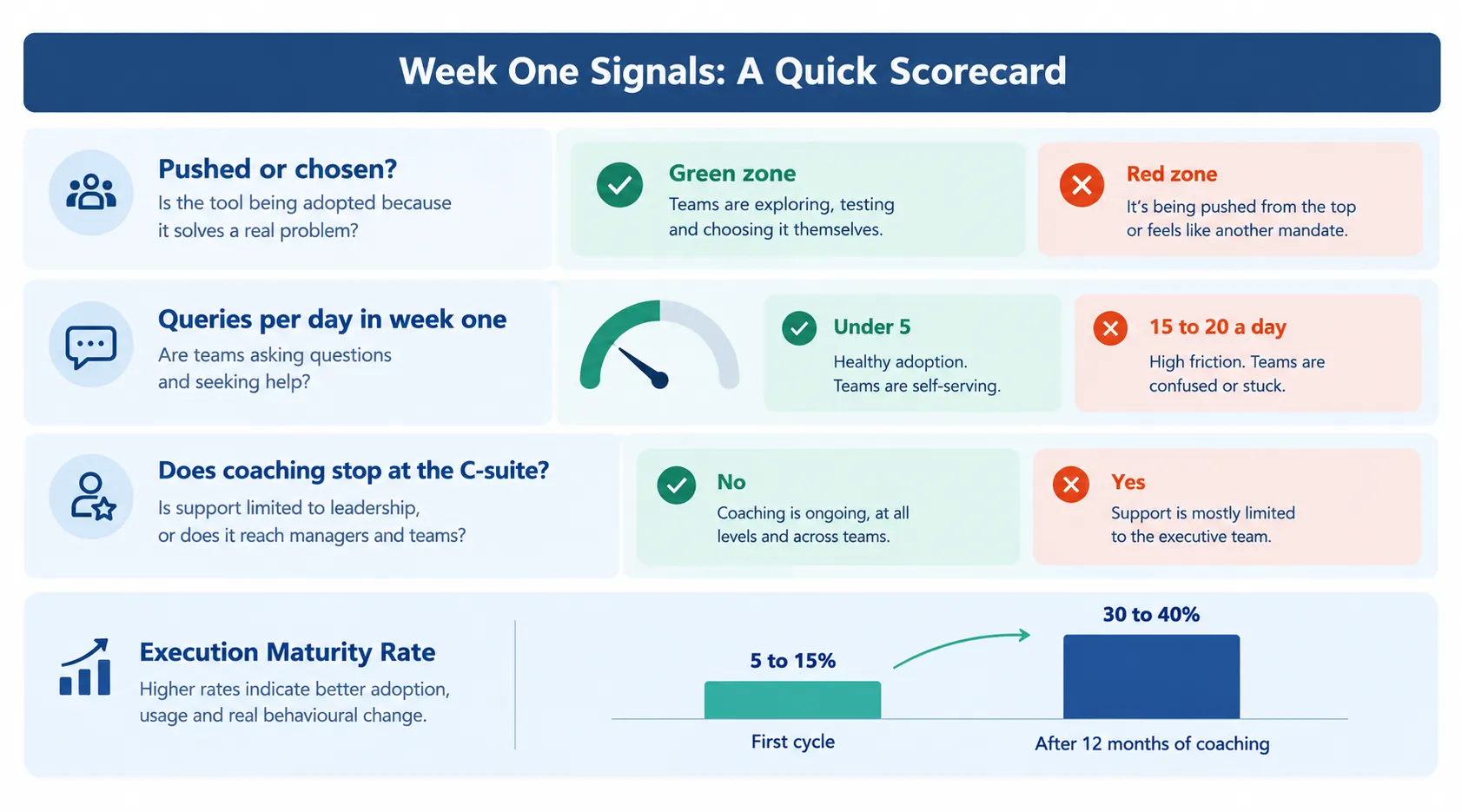
Most buyers compare OKR software with a feature grid. I use week-one signals, because they predict adoption better. First: was this pushed or chosen? If OKRs were announced with a go-live date and a software login, the program tends to collapse between weeks four and six. Second: how many product queries is the team raising? If it is 15 to 20 a day in week one, adoption will break within weeks.
To compare okr software with those signals in mind, use the table below as your okr tool comparison table. It doubles as an okr software comparison checklist, and the okr software comparison criteria are the ones I use with clients.
| Criterion | What to test in the demo | Red flag |
|---|---|---|
| Ownership fit | Can the CEO’s office run it without routing through HR? | Every workflow depends on an HR review cycle |
| Agreement, not just a tree | Can leaders see cross-team dependencies, not only parent and child goals? | A beautiful cascade with no dependency view |
| Check-in friction | How long does one weekly update take a manager? | 15 to 20 support queries a day in week one |
| Time to first cycle | Can your leadership team run a real cycle in week one? | 4 to 12 weeks of configuration first |
| Integrations | Jira, Microsoft Teams, Slack, your HRIS | Manual exports and copy-paste updates |
| Scoring and retrospectives | Does the retrospective feed the next cycle? | Scores recorded, nothing learned |
| Cost at your headcount | Total cost at 50, 200 and 1,000 users | Minimum commitments that outrun your headcount |
For the cost row, OKR software cost per user shows how to model it. A structured process is in how to evaluate OKR software and how to choose OKR management software. For the wider field, read our OKR software reviews, OKR tool comparison, OKR software comparison, best OKR tools and top 10 OKR software, plus the full buyer’s guide to OKR platforms. For okr software comparison for startups, the rule is simple: pick the tool your team will still use in week six, and check OKR software features to see what you are not paying for.
The metric that matters after you buy is not goal completion rate. It is the Execution Maturity Rate: the percentage of leaders who can independently write a genuine outcome-driven goal, without coaching, a template or a quality review. In a first-cycle implementation it sits between 5% and 15%. After 12 months of well-coached work, it reaches 30% to 40%. Ask every vendor how their product moves that number.
Know the traps before you sign a new contract
A new tool inherits the old program’s mistakes. This ebook covers the pitfalls that survive a switch.
7 Lattice Alternatives Worth Shortlisting for OKR-First Teams
If you typed lattice competitors, sites like lattice or software like lattice into a search bar, these are the seven names that hold up. They double as betterworks alternatives for okr-first teams, because the deciding question is the same: who owns execution?
1. Worxmate: best for CEO-led and strategy-led execution
Worxmate is designed to get a leadership team inside a real OKR cycle in week one. Most enterprise competitors need 4 to 12 weeks of configuration first, and speed in cycle one predicts cycle two adoption. It runs on the DEEP AI™ framework (Define, Execute, Evaluate, Plan), built from live implementations. Where it is not the right fit: if you want compensation, engagement and OKRs bought as one HR suite, Lattice is the more natural home.
2. Perdoo: best for strategy-heavy organisations
Perdoo has a strong strategy map and combines OKRs and KPIs in one framework. Its interface is not its strongest suit, and it suits teams already past the adoption challenge. The lattice vs perdoo choice is strategy depth against HR breadth. See Worxmate vs Perdoo.
3. Quantive: best for data-integration depth
Quantive rewards sophistication, with strong data integration. It is configuration-heavy, so it is a hard starting point for a first implementation. See Worxmate vs Quantive.
4. Tability: best for automated check-ins
Tability has the best automated check-in infrastructure I have seen. It solves the reminder problem, not the reflection problem, and teams needing cascade architecture tend to outgrow it within two cycles. See Worxmate vs Tability, and alternatives to Weekdone if Weekdone is on your list.
5. 15Five: best where manager-employee culture already exists
15Five pairs weekly check-ins with OKR tracking and works best where a manager-employee habit already exists. Cascade depth is limited. On lattice vs 15five, it is the lighter, habit-led option. See Worxmate vs 15Five.
6. Leapsome: best for CHROs building capability
Leapsome is a people enablement platform with strong L&D integration, right for CHROs building capability but not the fastest path to OKR discipline. Lattice vs leapsome is closer than most; lattice vs culture amp is similar, with Culture Amp leaning to engagement. See Worxmate vs Leapsome and Worxmate vs Culture Amp.
7. Profit.co: best for patient, well-resourced implementations
Disclosure: I was Business Head at Profit.co before founding Worxmate. It is feature-complete and configuration-heavy, with 4 to 6 weeks of implementation before the first cycle runs. See Worxmate vs Profit.co.
Also see Worxmate vs Workboard and Worxmate vs Peoplebox. Arriving from Microsoft Viva Goals, discontinued in December 2025? Start with Viva Goals alternatives. For betterworks alternatives for mid-market companies, my shortlist is Worxmate, Perdoo and Tability.
Best Lattice Alternatives by Situation
The best lattice alternatives depend on who is buying and what they are afraid of. This table maps the common situations to what to prioritise.
| Your situation | Prioritise | Where to start |
|---|---|---|
| A lattice alternative for startups | Speed to first cycle | Best OKR software for startups |
| A lattice alternative for small business | Simplicity, flat cost | OKR software for small businesses |
| Lattice alternatives for mid-sized companies | Cascade plus coaching | OKR software for mid-market companies |
| A lattice alternative for enterprise | Hierarchy depth, governance | OKR software for enterprise |
| Lattice alternatives for remote teams | Async check-ins | Best OKR software for remote teams |
| A lattice alternative for India | Financial-year planning | Best OKR software in India |
| US-based team | Integrations, support hours | Best OKR software USA |
| Jira or Teams shop | Lattice alternatives with jira integration and lattice alternatives with microsoft teams integration | OKR software for Jira, OKR tools with Microsoft Teams integration |
Budget drives half these searches. For a cheaper alternative to lattice, or lattice alternatives under $5 per user, start with affordable OKR software, and read OKR software pricing if you buy in rupees. Lattice alternatives with free plan options exist; see free OKR software and best free OKR software. A free plan is a good pilot and a poor rollout.
Feature-led searches are the other half. Here is how I answer them honestly:
- Best lattice alternatives for okr tracking: judge OKR tracking tools on the week-one signals above.
- Lattice alternatives with better okr features, and lattice alternatives with okr alignment mapping: see best OKR software with alignment mapping, and ask to see dependencies, not only a tree.
- Lattice alternatives with real-time okr dashboards: see real-time OKR tracking and ask whether dashboards read live check-in data.
- Lattice alternatives with continuous feedback: continuous feedback software lists the options.
- Lattice alternatives with ai okr generator: AI OKR software is worth testing only if the AI scores outcome quality, not just rewrites sentences.
- Okr software with 360 feedback and goals in one place: check that the feedback layer reads from the same goal data, then see 360 feedback software.
- HRIS connection: OKR software integration with HRIS explains how to connect without letting the HRIS own the program.
How DEEP AI and Three AI Models Change the Comparison
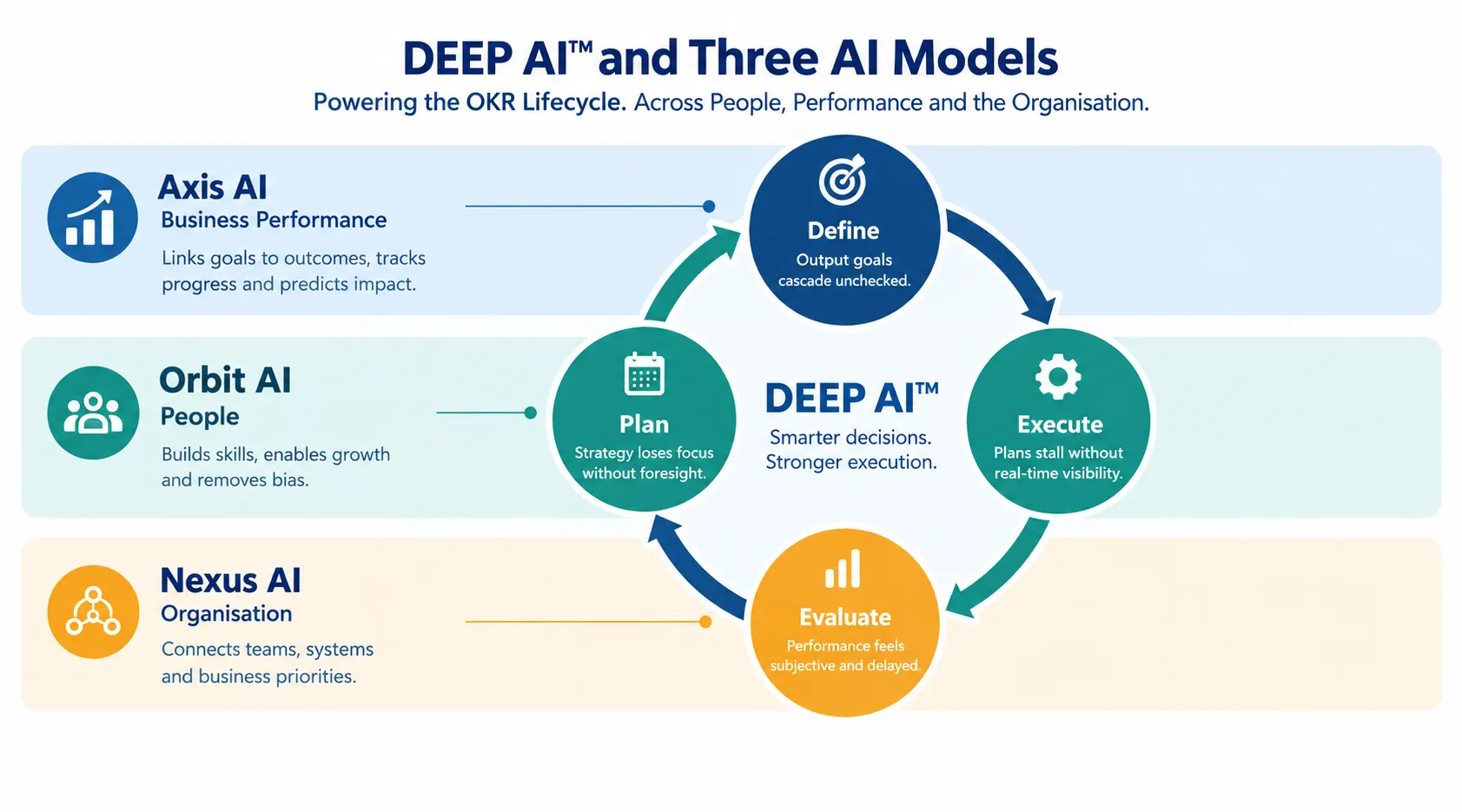
I would rather ask what breaks without each stage of the OKR cycle. DEEP AI™ answers that, one stage at a time.
- Define. Leaders who cannot write outcome goals produce output lists. Define uses AI-assisted goal writing and quality scoring to catch weak goals before they cascade.
- Execute. Without honest check-ins, at-risk goals surface too late. Execute automates check-ins and flags at-risk goals early.
- Evaluate. Without evidence, scoring becomes opinion. Evaluate runs data-backed retrospectives.
- Plan. Without a learning loop, every quarter starts from zero. Plan carries learning into the next cycle.
Three AI models sit across those stages. Axis AI is Business Performance Intelligence, showing whether business outcomes are really moving. Orbit AI is People Intelligence, surfacing signals such as Burnout Risk, Attrition Trigger, Top Performer Flight Risk and Rating Inflation Drift. Nexus AI is Organisational Intelligence, connecting what teams do across the organisation. When goals and people data must sit side by side, I call that the PMS-OKR Bridge: the performance conversation reads from the goals the business is running on. See the performance management product.
How to Switch From Lattice or Betterworks Without Losing a Cycle
The sequence matters more than the tool. This is how to migrate from lattice to another okr tool, and the same steps cover how to switch from betterworks to a new okr platform.
- Switch at a cycle boundary. Never mid-quarter. Run a mid-quarter review, close the cycle, then begin the new one.
- Migrate live objectives, not history. One completed OKR is worth more than five written ones. Retire output-heavy Key Results instead of importing them.
- Move ownership with the tool. If OKRs are leaving HR, name the CEO’s office or Strategy Head as owner before launch.
- Run cycle one top-down, with coaching. Bottom-up is the right destination, not the starting point. End with an OKR retrospective.
- Measure at day 90 and day 365. Outcome thinking does not arrive in a quarter.
For a worked example of a forced platform move, how to migrate from Viva Goals follows the same pattern.
Is the problem the tool, or the program?
Run the audit before you sign a new contract. It separates a platform gap from an ownership gap.
My Take: What I’d Tell a Client
If HR owns the program and you want performance, engagement and OKRs in one suite, stay on Lattice. I would say that to a client’s face. If you run a large enterprise and manager enablement is the priority, Betterworks has a real case, provided you can live with the procurement cycle.
If a CEO, Strategy Head or BU Head owns execution and you want a leadership team inside a live cycle this month, shortlist Worxmate and two others from the list above, and run a real OKR cycle before you commit. Do not buy on the demo.
The software is the infrastructure. The coaching is the capability. You need both, and in the right order.
Path 1: The platform. If you are ready to evaluate, see OKR software, the pricing page for current numbers, or book a demo.
Path 2: The consulting. If the tool was never the first problem, OKR consulting is where leaders learn to write outcomes, run honest check-ins and carry the program below the C-suite.


Written by
An OKR Coach with 20+ years of implementation experience, Madhusudan has guided over 50 organisations through successful OKR transformations, training more than 500 leaders. Learn more about Worxmate.