 WORXMATE
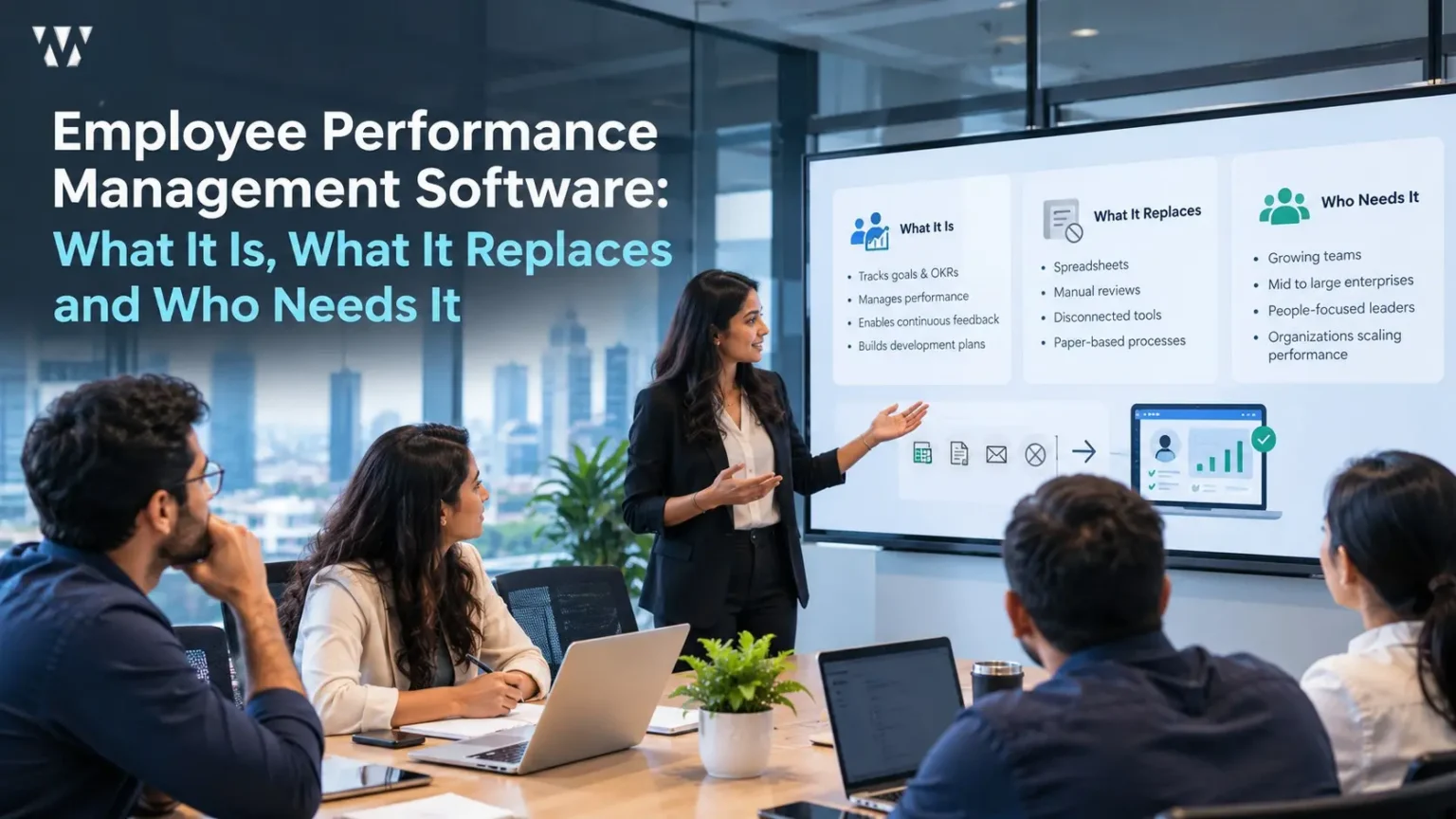
Employee performance management software runs the full performance cycle in one place: goals, continuous feedback, 1:1s, reviews, calibration, development plans and improvement plans. It replaces spreadsheets, email trails and annual appraisal forms. HR heads, people managers and business leaders need it when ratings get disputed, feedback goes unrecorded, or nobody can see who is moving the business before the cycle closes. Some teams call it staff performance management software. The job is the same.
Picture the calibration meeting. It is hour three. One manager defends a rating of 3 for someone the project record says carried the quarter. A second manager disagrees. Neither can produce a single written note, only memories of corridor conversations and one on one meetings that nobody documented.
HR leaders describe this room to me often. In my conversations with 135+ of them across fintech, pharma, retail, manufacturing, energy, IT services, SaaS and gaming, the pattern is consistent: HR ends up as referee, the rating becomes a negotiation, and the employee is the last to know what was really said about them.
That is the moment employee performance management software exists for. Not the form, not the reminder email. The moment a rating has to survive scrutiny and the evidence either exists or it does not.
What Employee Performance Management Software Is (and What It Is Not)
What is employee performance management software?
If you are asking what is performance management software at its simplest, it is the system of record for how people perform: the goals each person owns, the feedback they receive, the check-ins between reviews, the ratings, and the development that follows. It is not a form that gets filled once a year. For the architecture behind it, our guide to a strategic performance management system goes deeper, and Worxmate PMS shows how we built ours. So what does employee performance management software do day to day? It keeps that record current, so every conversation has something to stand on.
How does employee performance management software work?
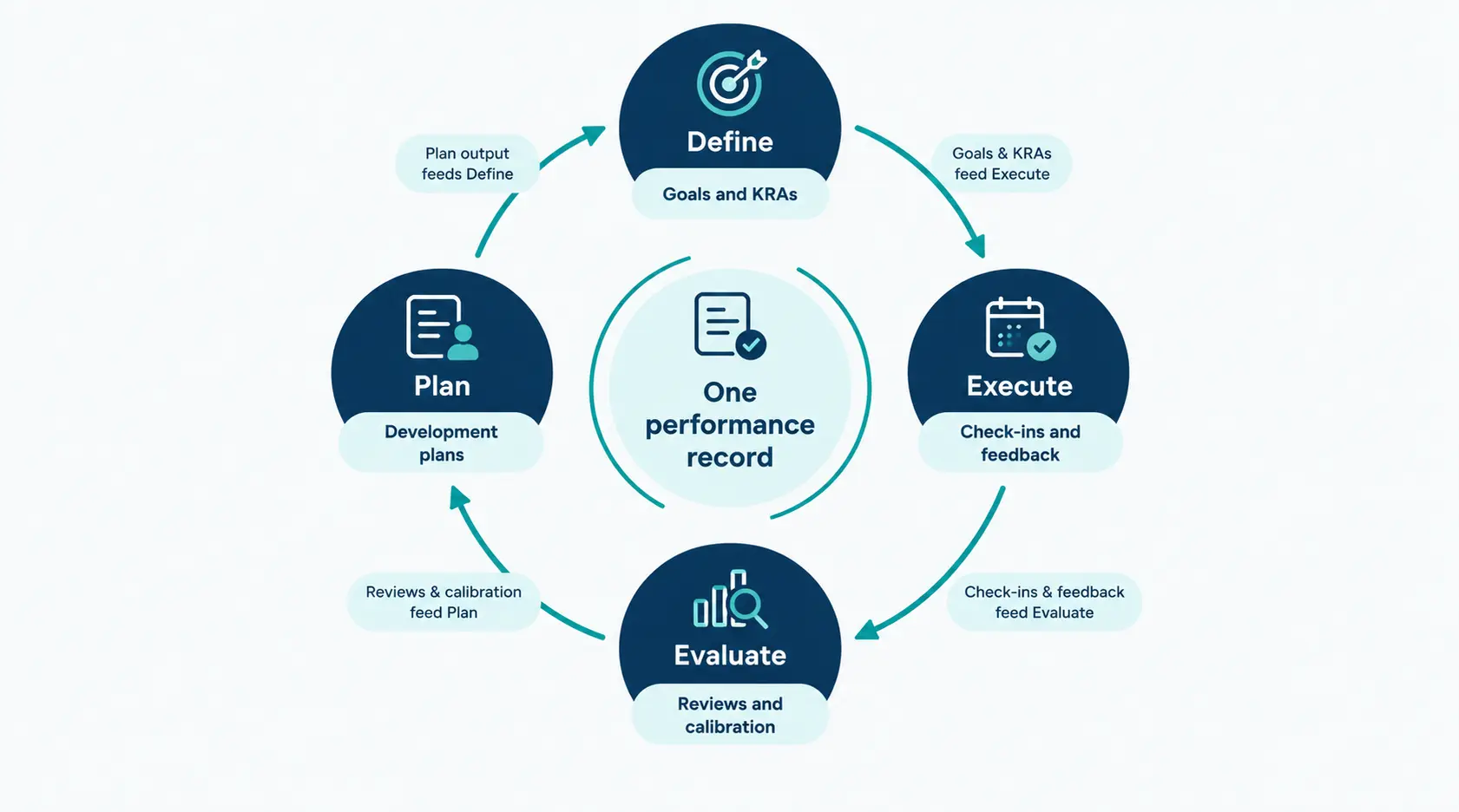
It works as a loop. Goals and KRAs are set, check-ins and feedback accumulate, reviews and calibration turn that evidence into ratings, and development plans feed the next cycle. The DEEP AI framework formalises the same loop: Define, Execute, Evaluate and Plan. In a healthy employee performance management process, each stage hands evidence to the next, so the review summarises a year of record instead of testing memory.
Three things get confused with it. An HRIS holds employee records and payroll, and performance management software vs HRIS is a category difference, not a feature gap. Appraisal software digitises the form, which is the gap explained in performance management system vs appraisal software. OKR software tracks business goals, and OKR vs PMS software shows where the two meet.
What Employee Performance Management Software Replaces
What does performance management software replace? Seven things, and each carries a failure pattern I see repeatedly in HR conversations.
| What it replaces | What breaks when it stays | The failure pattern |
|---|---|---|
| Spreadsheet performance reviews | No audit trail, no single view of the cycle | HR has zero pre-cycle visibility into top and low performers |
| Annual appraisal forms | Ratings built on recent memory | Biased, unwritten verbal feedback resurfaces as calibration conflict |
| Email trails and chat threads | Feedback exists but cannot be found | HR stuck playing referee instead of running a strategic process |
| Optional 1:1s | Conversations happen when convenient | 1:1s treated as optional rather than core process |
| Gut-feel learning recommendations | Training assigned by instinct | L&D recommendations are not skills-data-driven |
| Disconnected KRA sheets | KRAs nobody can trace to a business goal | KRAs disconnected from business goals |
| Standalone performance improvement plan documents | Paperwork to prepare an exit | PIPs misused as firing tools, not development tools |
Employee performance management software vs spreadsheets
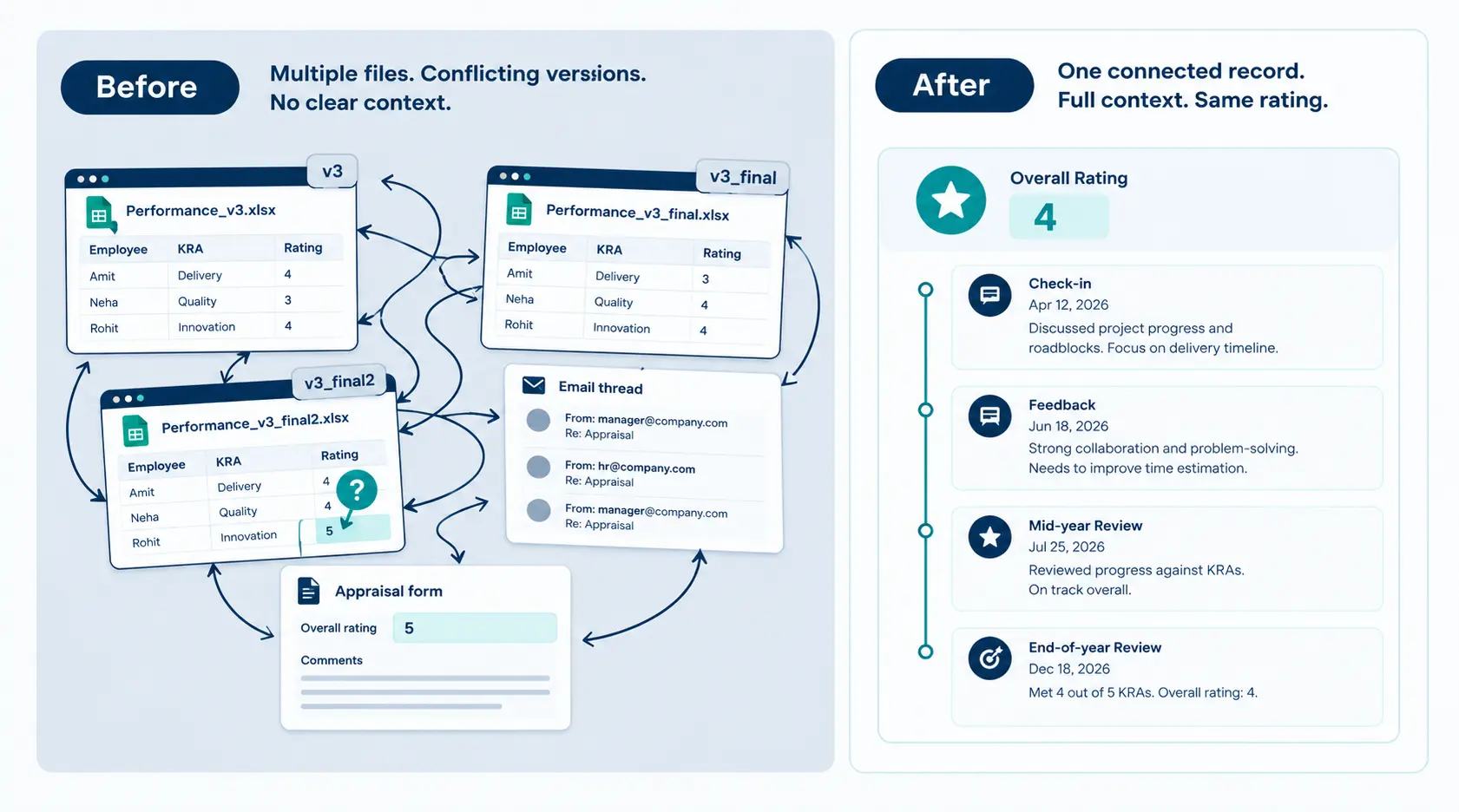
Spreadsheets fail quietly. Manual performance reviews survive for years because nothing visibly breaks, until calibration week, when versions disagree and nobody can say which rating was approved. A spreadsheet records a score. It cannot show the feedback behind it, the check-ins before it or the development after it. I see the same trap with OKRs, which we covered in spreadsheet vs OKR software. That is the real comparison of performance management software vs spreadsheets: one holds numbers, the other holds evidence.
Annual appraisal forms and paper based appraisals
Annual appraisal forms and paper-based appraisals compress twelve months into a single sitting, and recency does the rest. The bell curve then forces that compressed picture into fixed buckets, a problem we unpack in bell curve appraisal pros and cons. If you still run the cycle on paper, our performance appraisal form template is a starting point, but treat it as a stopgap, not a system.
Verbal feedback nobody wrote down
This is the one that costs most. Verbal feedback is not the problem. Unrecorded verbal feedback is. It resurfaces in calibration as conflict, which is why I describe the Third Eye Layer as real-time bias monitoring before calibration rather than after it. Read more on performance review bias and the performance calibration process.
Calibration decks built the night before
Manual calibration is where every earlier gap becomes visible at once. HR assembles ratings from different formats, managers defend them from memory, and the loudest voice wins. In pattern terms this is failure three: HR has zero pre-cycle visibility into top and low performers. The fix is not a better deck. It is arriving at calibration with the evidence already attached, so the room tests judgment instead of recall. Performance management metrics show what is worth bringing into that room.
What Employee Performance Management Software Covers Across the Cycle
| Stage | The question it must answer | Go deeper |
|---|---|---|
| Goals and KRAs | Can each person trace their work to a business goal? | Performance goals examples |
| Feedback and 1:1s | Is the conversation recorded between reviews? | Real-time feedback and 1-on-1 meeting automation |
| Reviews and 360 | Is the rating backed by several voices? | 360 degree feedback software |
| Calibration | Was bias checked before ratings were final? | Linking performance to rewards |
| Development | Does the plan develop the person or file the paperwork? | Employee skill development |
| Analytics | What does HR know before the cycle closes? | Performance analytics and real-time performance dashboards |
Employee performance tracking and KRA tracking
Employee performance tracking usually means lagging data: last quarter’s numbers, reported after the fact. In one engagement, the Middle East and Europe division of a multi-billion dollar mining engineering group was growing but watching new entrants take share. In the workshop, the leadership team connected dots they had never connected: on-time service delivery and machine quality drove sales, renewals and regional expansion. They separated objectives, outcomes and KPIs, and saw that KPIs are lagging indicators. They report where you stand, not where to go. Leading indicators let them see blockers before they became crises. That is what KRA tracking should do for an individual: connect a daily action to a regional goal. Three quarters later the achievement was clarity that sustained itself without constant intervention. It is the same logic as output vs outcome.
Employee performance review software and employee evaluation software
Employee performance review software handles ratings and written reviews. Employee evaluation software, its close cousin, tends to add competencies and self-evaluation, and our employee evaluation guide draws the line. Employee appraisal software is the narrowest of the three, built around the form alone. All three are slices of one cycle.
Development plans and the performance improvement plan
Two documents show how seriously a company takes its people: the employee development plan and the performance improvement plan. In my conversations with HR leaders, development plans are often an afterthought, plans without development, and PIPs get used as firing tools instead of development tools. A good cycle writes the development plan from review evidence and treats a performance improvement plan as a structured route back to performance, with dated check-ins both sides can see. Our guide to dealing with negative performance reviews covers the hard conversation that comes with it.
Employee performance management software examples in practice
Examples work better as moments than as logos:
- A manager logs a blocker in a quarterly check-in, and HR sees the same blocker across three teams before review season.
- Calibration opens with a rating-spread flag by manager, so the bias conversation happens before ratings are final.
- A skills gap noted in a review becomes an action in the employee development plan, not a line on a form.
Where Orbit AI, Axis AI and Nexus AI Fit
Software that records the cycle is the baseline. The question I put to every platform is the OKR Coach question: does this tell HR whether people completed the process, or whether they moved the business?
Orbit AI is our people intelligence layer. Without it, HR hears about flight risk in the exit interview. It watches six named signals: Burnout Risk, Attrition Trigger, Engagement Decline, Top Performer Flight Risk, Rating Inflation Drift and Skills Decay. Axis AI is business performance intelligence, showing whether individual performance adds up to business performance. Nexus AI is organisational intelligence, surfacing patterns across teams and levels that no single manager can see. For the wider picture, see AI driven performance management software and predictive performance management.
How Employee Performance Management Software Connects to OKRs
Failure pattern nine, KRAs disconnected from business goals, is why performance reviews feel like administration. The PMS-OKR Bridge is how we close it: performance conversations anchor to the outcomes the business set, not to a separate list of tasks. The Tiered Accountability Model supports this by weighting OKRs at 100%, 40% or 20% by level, so accountability follows level instead of being flattened across everyone.
There is a capability point underneath. I track the Execution Maturity Rate, the share of leaders who can write an outcome goal without coaching. In a typical first cycle it sits between 5% and 15%. In organisations coached consistently for 12 months, it reaches 30% to 40%. Read more in OKRs and performance management and performance management with OKRs. If you are choosing the OKR side separately, start with our guide to the best OKR software.
You cannot set alignment in a tool. You can only display it once the agreement between teams exists.
How mature is your execution, really?
See where your leaders sit on the Execution Maturity Rate and what to fix first.
Who Needs Employee Performance Management Software
Who needs employee performance management software?
| Role | What I hear | What they need to see |
|---|---|---|
| CHRO or HR head | “Cycle season means refereeing.” | Evidence behind every rating before calibration |
| HR business partner | “I cannot see top performers until the cycle closes.” | Pre-cycle visibility into top and low performers |
| People manager | “1:1s are the first thing to go.” | Lightweight prompts, not another form |
| CEO or BU head | “The team is busy, not moving the right things.” | KRAs traced to business goals, as in the strategy execution gap |
| L&D head | “Training recommendations are guesswork.” | Skills data from reviews, tied to continuous learning and development |
HR heads should start with performance management software for HR teams, and line managers with performance management software for managers, because the daily pain differs. Size and geography change the shape of the need, not the need itself. A founder-led team wants performance management software for small business that stays light. A large group wants performance management software for enterprise with approval layers. Performance management software by company size maps the middle. If you are weighing performance management software India options, with its April increment cycle, our India-specific guide covers the local detail.
Signs you need performance management software
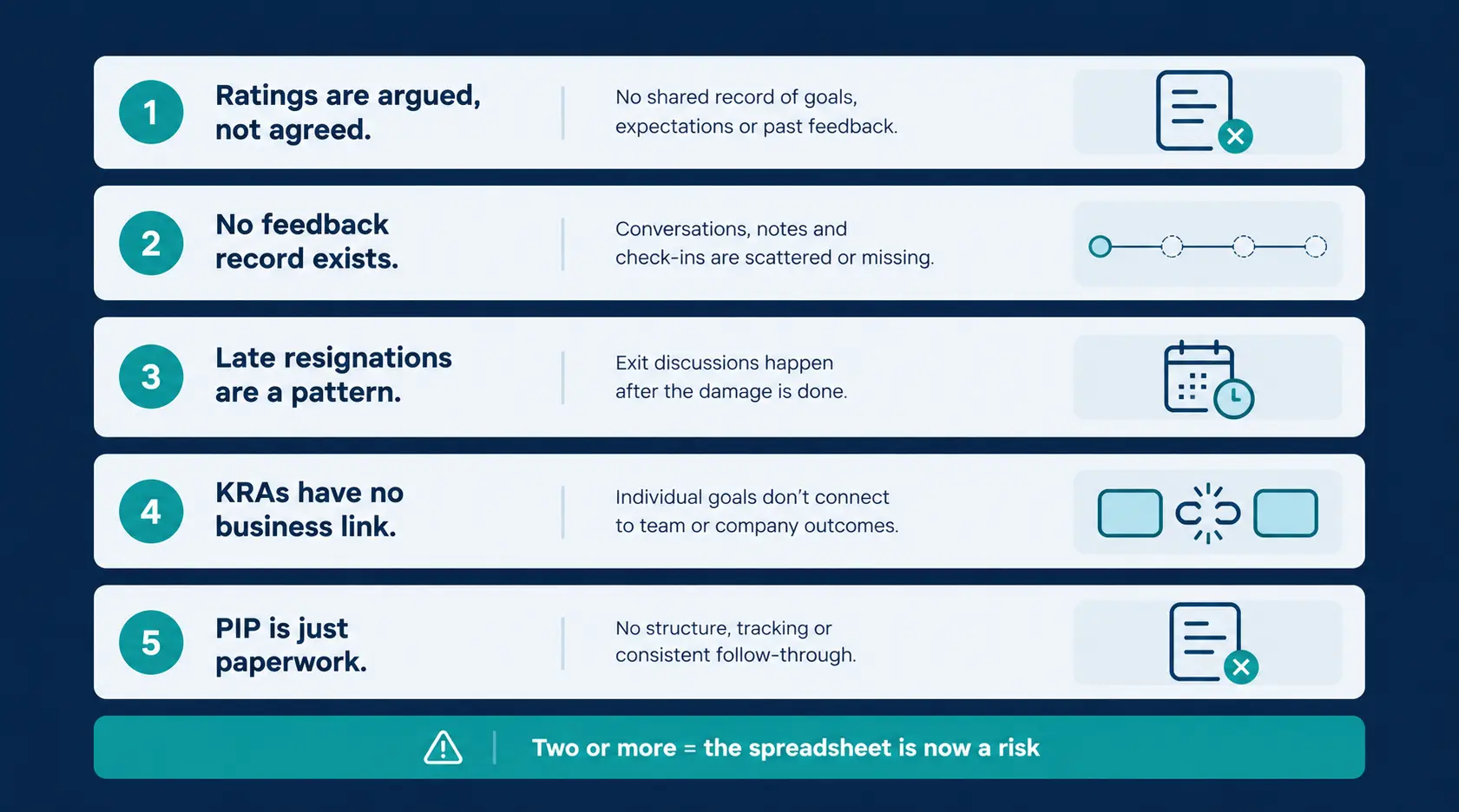
These are the signs, in the order I see them:
- Ratings are argued in calibration instead of confirmed.
- Managers cannot show the feedback they gave last quarter.
- HR learns about resignations at the exit interview.
- Nobody can trace a KRA to a business goal.
- PIPs read as paperwork to prepare an exit.
When to switch from spreadsheets to performance management software
My rule of thumb: when two of those five are true, the spreadsheet has stopped being a tool and become a risk.
Is performance management software worth it?
Worth is measured in what the cycle stops costing: HR hours spent refereeing, regretted exits found late, and development spend aimed by guesswork. Our breakdowns of performance management software ROI and the cost of poor performance management show the working. If your cycle already runs on evidence, the case is weaker.
Who does not need it yet
Be honest about timing. A team small enough that one leader sees every contribution, and holds a real weekly 1:1, can run a light process. If your priority is payroll and attendance in a single suite, an HRIS may fit better, and Worxmate is not the right choice for that job.
Staff Performance Management Software: Same Thing, Different Label?
In the UK, education, healthcare and the public sector, “staff” is the common word, so buyers search for staff performance management software or a staff performance management system. The mechanics match. Staff appraisal software and staff performance review software handle the review, staff performance tracking software covers goals and check-ins, and staff evaluation software adds competency assessment. What changes is vocabulary and the weight on competencies, so start with the competency based framework and staff development goals. UK buyers can also read employee appraisal tools UK. A separate staff system is rarely worth a second vendor, so check whether your current platform can carry both vocabularies before you buy twice.
What to Check Before You Choose
I will not list vendors here, because a list hides the question that matters. Ask three things of any employee performance management system. Does it show HR who is moving the business before the cycle closes? Does it make a manager’s weekly conversation easier? Does it connect goals to ratings?
Then check performance management software features against our features checklist, compare performance management software pricing using SaaS performance management pricing, and follow the evaluation how-to guide. Employee performance management tools differ mainly in whether they treat OKRs as core or as an add-on. HR performance management software built into a wider HR suite treats goals as one module among many, which is a category difference, not a flaw. For comparisons, our best performance management software guide, the top performance management software evaluation and HR performance management tools do that job. If cadence matters most, read continuous performance management software.
My Take: Most buyers compare features and discover the cycle problem later. I tell clients to reverse the order. Decide what a good cycle looks like first, then buy the employee performance management software that makes that cycle the easy path for a busy manager.
Rolling It Out Without Losing Your Managers
Tools rarely fail on day one. They fail in week six, when managers stop using them. Failure pattern eight explains why: 1:1s treated as optional. Make the 1:1 the unit of the process, not an extra, and read how performance management software reduces manager workload before launch. Expect friction. PMS adoption challenges and performance management system implementation cover the usual ones, and fixing broken performance management systems is the rescue guide. Coach managers through the first cycle rather than only training them.
Two week-one signals decide more than any feature list. First, was this pushed or chosen? Teams that understood the why adopt. Teams handed a login and a go-live date stall between weeks four and six, because nobody answered what is in it for them. Second, how many support queries is the team raising? In the OKR rollouts I have watched, 15 to 20 queries a day in week one meant adoption would break within weeks, and I would apply the same test to a PMS rollout. A mismatch between tool and team is not fixed by a customer success call.
Two Ways to Take the Next Step
The software is the infrastructure. The coaching is the capability. You need both, and in the right order.
Path 1, the platform. If you are ready to evaluate, see how Worxmate PMS works, check current pricing or book a demo.
Path 2, the coaching. If the platform is not your first problem, our OKR consulting builds the manager capability that stops the programme dying below the leadership layer.


Written by
An OKR Coach with 20+ years of implementation experience, Madhusudan has guided over 50 organisations through successful OKR transformations, training more than 500 leaders. Learn more about Worxmate.