
25 Best OKR Software 2026, reviewed by a coach who has run 50+ real implementations.
Not a product review. A field report - from live OKR programs across enterprise, SMB and startups spanning three continents.

25 platforms, evaluated by what actually breaks in the first six weeks.
The meeting that changed how I think about OKR software
It was supposed to be a 45-minute strategy alignment call. The CEO of a fast-growing retail company in APAC had invited his leadership team. The agenda was simple: share the company's top three strategic priorities so his leaders could begin writing their OKRs. Moments like this usually trace back to a gap between the company's business growth strategy and how it's translated into team-level goals. For fast-scaling tech and enterprise environments across the region, selecting the best OKR software in India comes down to local implementation support and speed to value.
Forty-five minutes passed. No priorities emerged.
Not because the CEO wasn't sharp - he was. Not because the business lacked direction - it didn't. But because nobody had ever asked him to compress his vision into three outcomes that his entire organisation could cascade from. That compression — from vision to a handful of concrete business objectives is the step almost every failed rollout skips.The meeting ended without a conclusion. What followed was a two-day war room session before leadership team could write a single OKR.
That moment taught me something I've seen confirmed across 50+ implementations since: the software is never the first problem. But it can absolutely become the last one - if you choose the wrong one, at the wrong stage, for the wrong reasons.
Before selecting a platform, leadership teams must clarify their strategic framework specifically evaluating OKR vs KPI vs SMART goals to decide when is the best time to start OKR adoption.
Madhusudan Nayak - “Maddy”
Co-Founder & CEO, Worxmate · Former Business Head, Profit.co
I've spent 20+ years in strategy execution and the last 10 specifically in OKR implementation - coaching programs inside enterprise organisations, high-growth SMBs and early-stage startups across APAC, the Middle East and Europe. I've trained over 500 leaders across more than 10 industries. Before co-founding Worxmate, I served as Business Head at Profit.co - part of the journey from zero to $11 million in funding. I also share insights regularly on the Worxmate podcast and through our OKR how-to guides and ebooks.
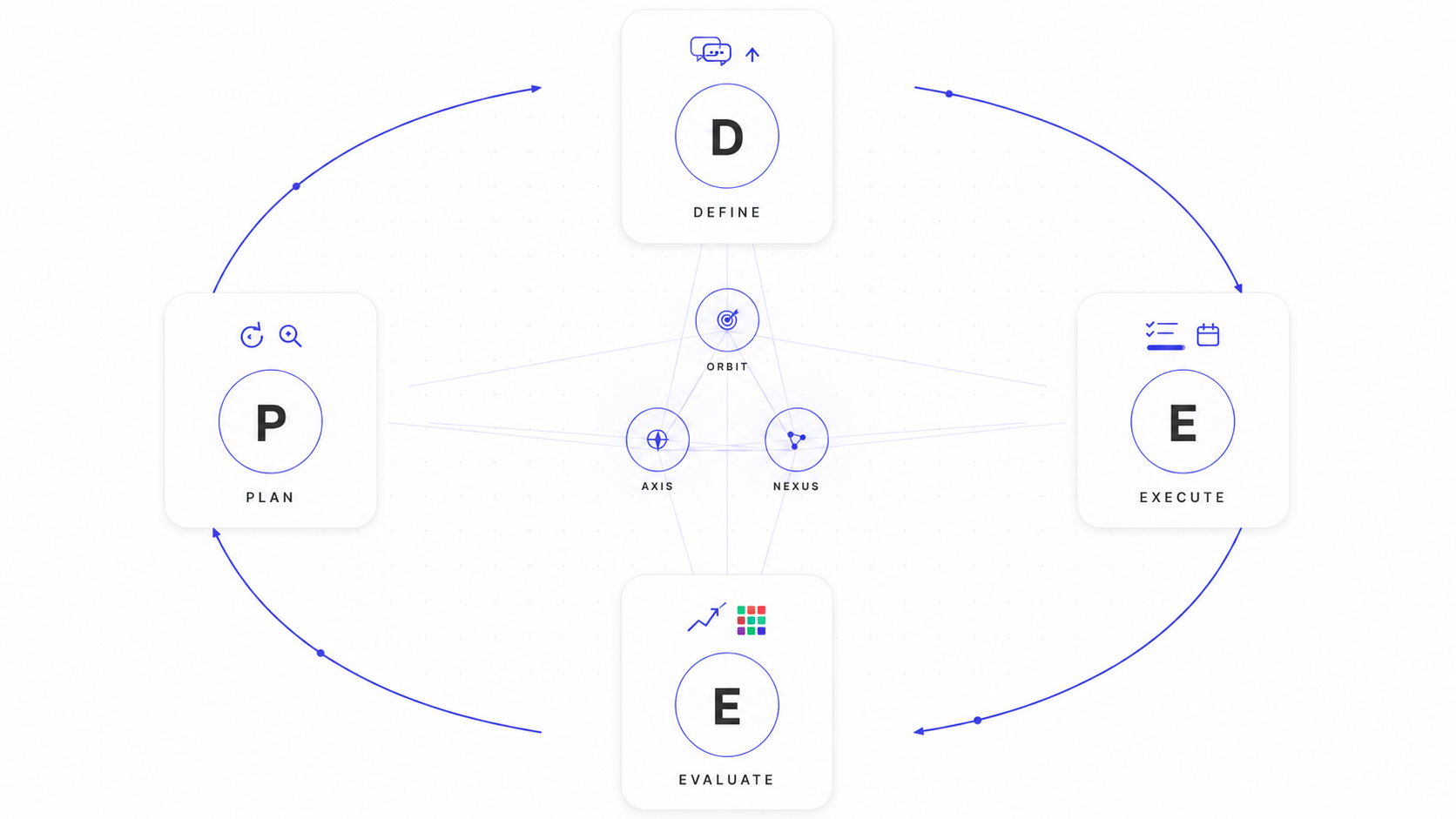
Worxmate came directly from that decade of field experience. Every design decision in our DEEP AI™ framework - Define, Execute, Evaluate, Plan - exists because I watched something break in a real organisation and decided it needed a structural fix, not a workaround.
Why most OKR software reviews miss the point
Before we get into the tools, I want to share something most software reviews skip entirely - because most reviewers have never had to deal with it. For a primer on the OKR advantagesthat drive success with Objectives and Key Results, start there before evaluating tools.
The success or failure of an OKR program has very little to do with the software in the first six weeks. It has everything to do with three things I look for the moment I walk into a new engagement. I call them week-one signals.
Was this pushed, or was this chosen?
Smooth organizational adoption relies heavily on understanding how to introduce OKRs to employees to ensure buy-in across all levels. There's a meaningful difference between an organisation sensitised to OKRs and one where OKRs were announced as the new operating model with a go-live date and a login. The second scenario collapses between week four and six - because nobody answered the question every employee is silently asking from day one: what is in it for me? That isn't answered by a tool. If that alignment hasn't happened before the software goes live, you aren't implementing OKRs. You're implementing compliance.
How many product queries is the team raising?
If your team is raising 15–20 support queries a day in week one, adoption is going to break within a few weeks. Not might break - will break. High query volume tells you the tool has too much friction for the team's current level of OKR literacy. No amount of customer-success calls fixes a mismatch. See common OKR software challenges I see recur across implementations.
Does the coaching stop at the C-suite?
This is the most common reason OKR programs fail. Many engagements end when the C-suite's OKRs are written. The invoice is paid. And within one quarter the program quietly dies below the leadership layer - because the people responsible for carrying it forward were never coached on how. Showing a leadership team how to write OKRs is showing them the path up the mountain. It is not teaching them to climb.For the difference between the two, see OKR training vs OKR coaching vs OKR certification .
This review covers purpose-built OKR software only,alongside a small set of adjacent tools (project-management platforms and HRIS suites with an OKR module bolted on) that readers keep asking us to weigh in on — see the five new entries below. In my experience the results with bolted-on OKR modules are consistently mixed - not because the platforms are poorly built, but because one or two goal-tracking modules inside a broader suite is not the same as a purpose-built OKR operating system.
HRIS platforms are fully invested in solving HR problems. OKRs, for them, are one of the features. For dedicated OKR software, OKRs are the feature. If your organisation is evaluating HRIS for OKR platform for your execution operating system. See how performance management software compares against a dedicated HRIS , and read our head-to-head breakdown of alternative to Workday.
How I evaluated each tool
Every tool was evaluated through the same six criteria - earned from a decade of watching what breaks in real implementations. If you want the fuller checklist before you run your own evaluation, see how to evaluate OKR software and the OKR software features that actually matter.
Does the tool help leaders communicate the why of OKRs - or assume buy-in already exists?
Does the goal-writing interface distinguish output from outcome KRs - or let KPI-relabelling pass unchallenged? Good guardrails also enforce that KRs stay time-bound, not just outcome-oriented.
Can it handle cross-functional co-ownership, dependency mapping and bi-directionalalignment visibility? See what to look for in best OKR software with alignment mapping .
How much does the tool expose to an internal champion running the program after the consultant leaves?
How many steps to log a check-in? Habits break at friction - the most underrated criterion. Pair this with clear OKR health indicators so at-risk goals surface before the cycle ends, tracked through real OKR tracking metrics.
Does the platform facilitate the conversations that create alignment - or just display alignment that's supposed to exist?
The best OKR software for 2026
Seventeen platforms, ranked by fit against the failure modes that actually end programs - not feature checklists. For a breakdown of the best OKR software 2026 features, start here for the numbers, then read on for what breaks in each tool.
Start here for the numbers, then read on for what actually breaks in each one.
| Tool | Best For | Starting Price | Capterra Rating |
|---|---|---|---|
| ★ Worxmate | Mid-to-large orgs (100–5,000) wanting OKRs + performance intelligence without a 6-month rollout | Transparent, mid-market/enterprise | 4.8/5 |
| Mooncamp | Mid-market/enterprise needing visual alignment mapping | From €6/user/mo | 5.0/5 |
| Tability | Metrics-driven teams wanting a weekly check-in habit | From $6/user/mo | 4.7/5 |
| Perdoo | Strategy-heavy orgs needing OKRs + KPIs in one framework | Free ≤5; €8/user/mo | 4.4/5 |
| Weekdone | Execution-focused teams wanting weekly planning + OKRs together | Free ≤3; $10/user/mo | 4.5/5 |
| Profit.co | Governance-heavy enterprises needing OKRs + PMS + KPI + task mgmt | Quote-based | 4.8/5 |
| Quantive | Enterprises needing configurable OKRs with deep data integration | Quote-based | 4.7/5 |
| Betterworks | Large enterprises needing OKRs tied to manager effectiveness | Quote-based | 4.2/5 |
| Lattice | People-first orgs already on Lattice for performance management | Quote-based | 4.5/5 |
| Leapsome | People-led orgs wanting OKRs + L&D + reviews together | Quote-based | 4.6/5 |
| 15Five | Manager-led orgs wanting lightweight check-ins + OKRs | From $4/user/mo | 4.7/5 |
| Microsoft Viva Goals | Discontinued Dec 2025 - included for migrators | N/A | N/A |
| Teamflect | Microsoft 365 orgs wanting OKRs inside Teams | Free ≤10; $3–7/user/mo | 4.7/5 |
| Oboard | Product/engineering teams running Jira | From $6/user/mo | 4.6/5 |
| Cascade | Large enterprises with dedicated strategy teams | Quote-based | Not published |
| Range | Remote-first/async teams wanting connection + goals | Free ≤12; $8/user/mo | 4.8/5 |
| SimpleOKR | Small teams wanting flat-cost, zero-config OKRs | $49.99/mo flat | No reviews yet |
| Peoplebox | Fast-growing tech/product scaleups wanting OKRs inside Slack & 1:1s | $8 per user / month | 4.6/5 |
| Workboard | Large enterprise strategy teams needing complex matrix alignment | Quote-based | 4.5/5 |
| Clickup | Teams using ClickUp wanting basic task-to-goal tracking in one app | $7/user/month | 4.7/5 |
| Businessmap (formerly Kanbanize) | Engineering/portfolio teams wanting OKRs fused with Kanban delivery | From ~$10/user/mo ($149/15 users/yr) | 4.8/5 |
| 10xWinners | Budget-conscious startups wanting AI-assisted OKR writing at the lowest entry price | From $2/user/mo | Mixed/limited public data |
| Monday.com | Teams already running work management in monday.com wanting goals tied to task boards | Free ≤2 seats; from $9/seat/mo | 4.6/5 |
| Engagedly | Mid-market people teams wanting OKRs bundled with LMS, 360 feedback and engagement | Modular, from ~$9/user/mo; $7.5K annual platform minimum | Not independently published |
| Workpath | Enterprises running hundreds of parallel OKRs wanting AI agents for drafting, risk detection and executive reporting | Listed from ~$7/user/mo; real deployments quote-based/enterprise | 4.3/5 |
Ratings pulled from public Capterra listings, current as of July 2026, and may change. For a deeper look at how per-seat pricing compounds at scale, see our breakdown of OKR software cost per user.
Worxmate
Best for: Mid-to-large organisations (100–5,000 employees) that want OKRs, performance intelligence and execution-coaching infrastructure in one platform - without a six-month implementation timeline.
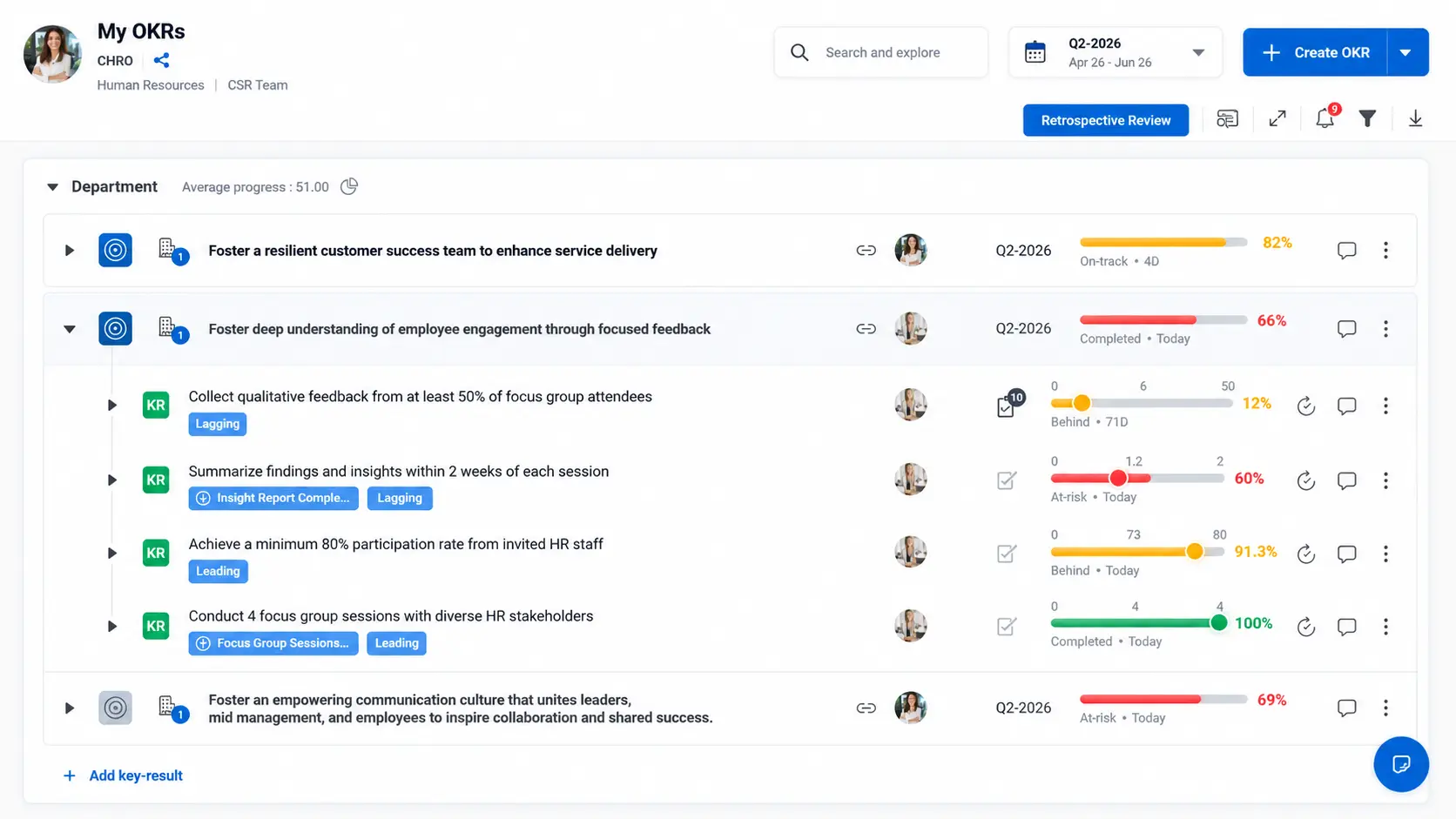
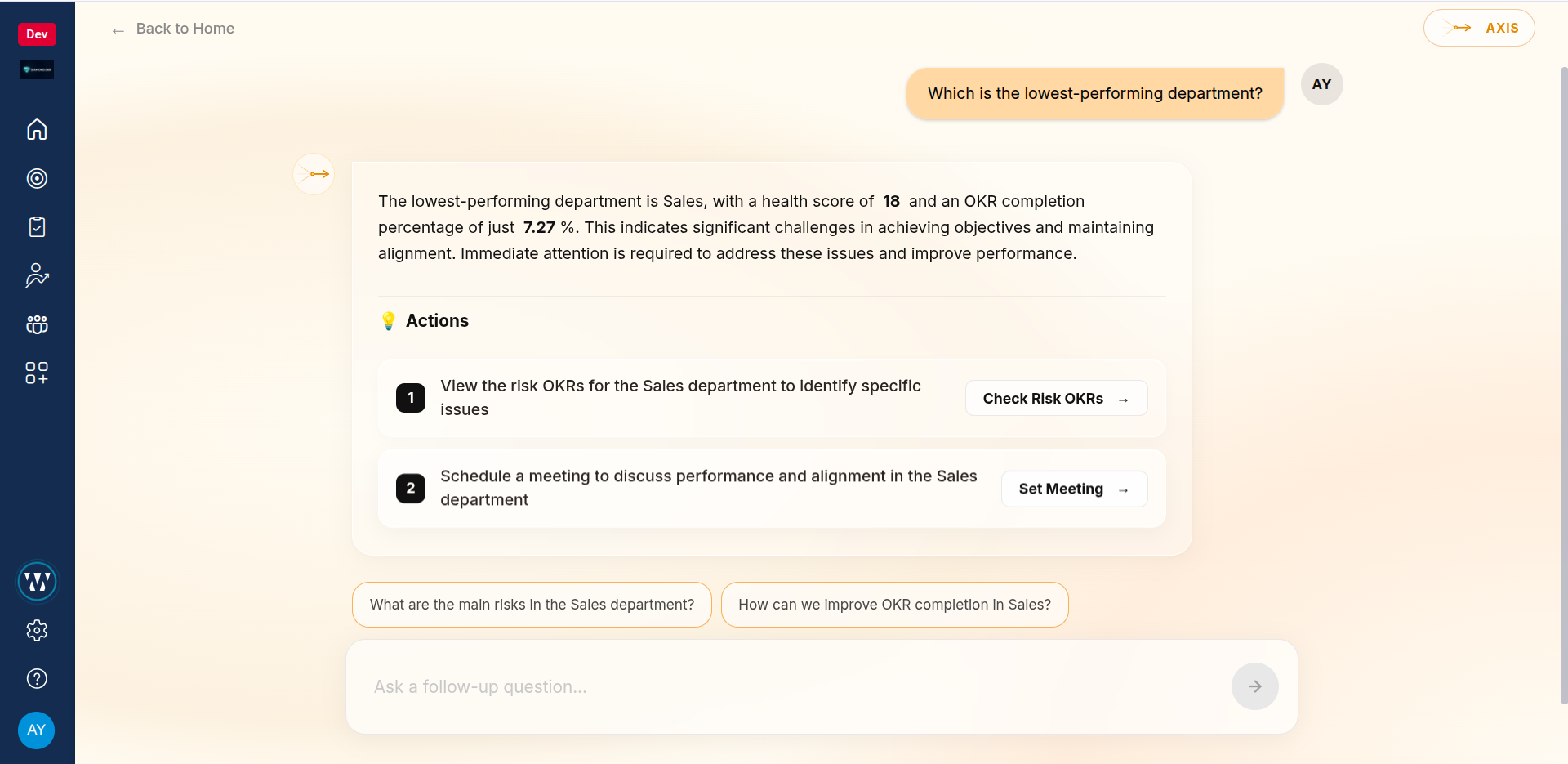
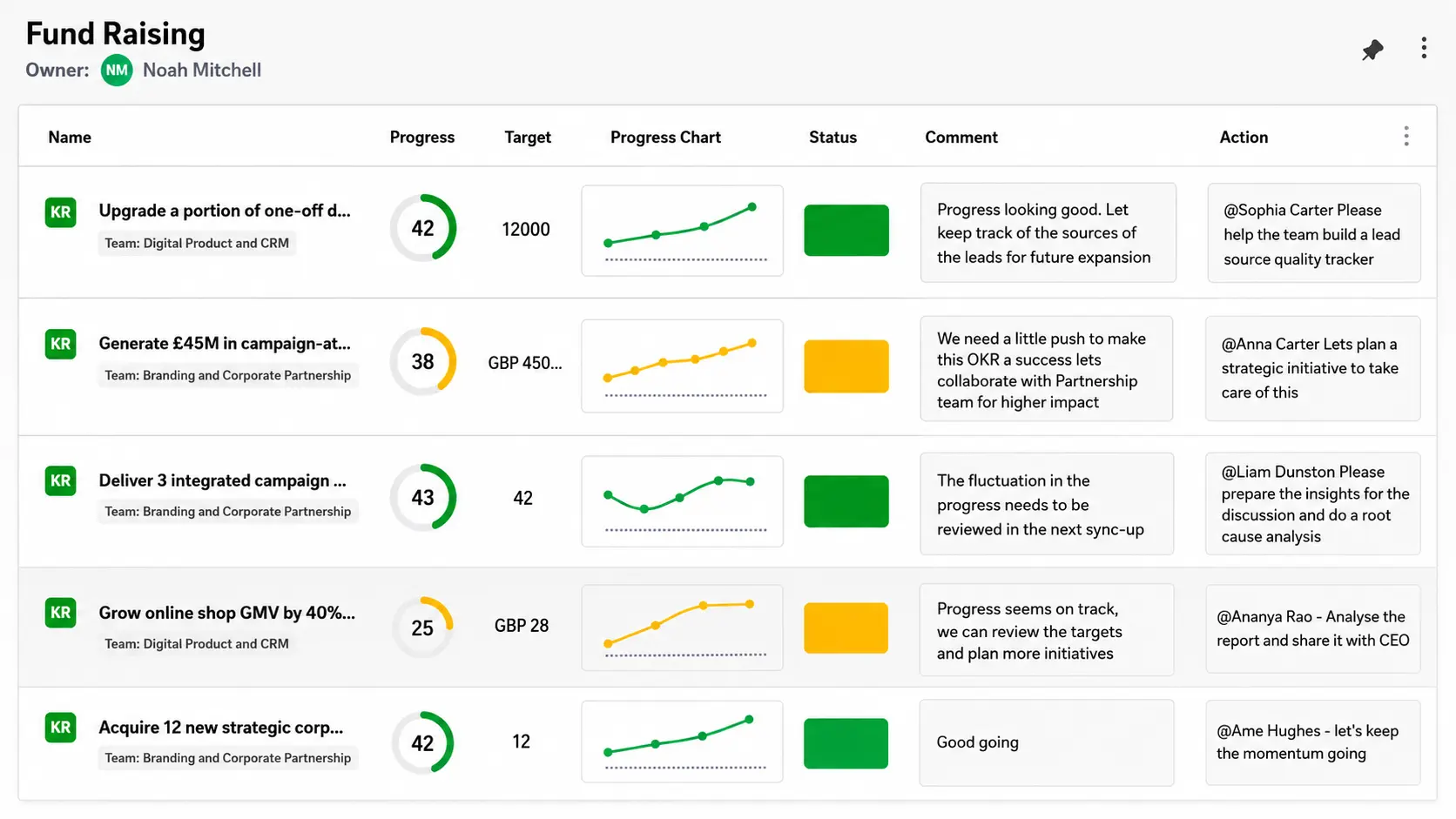
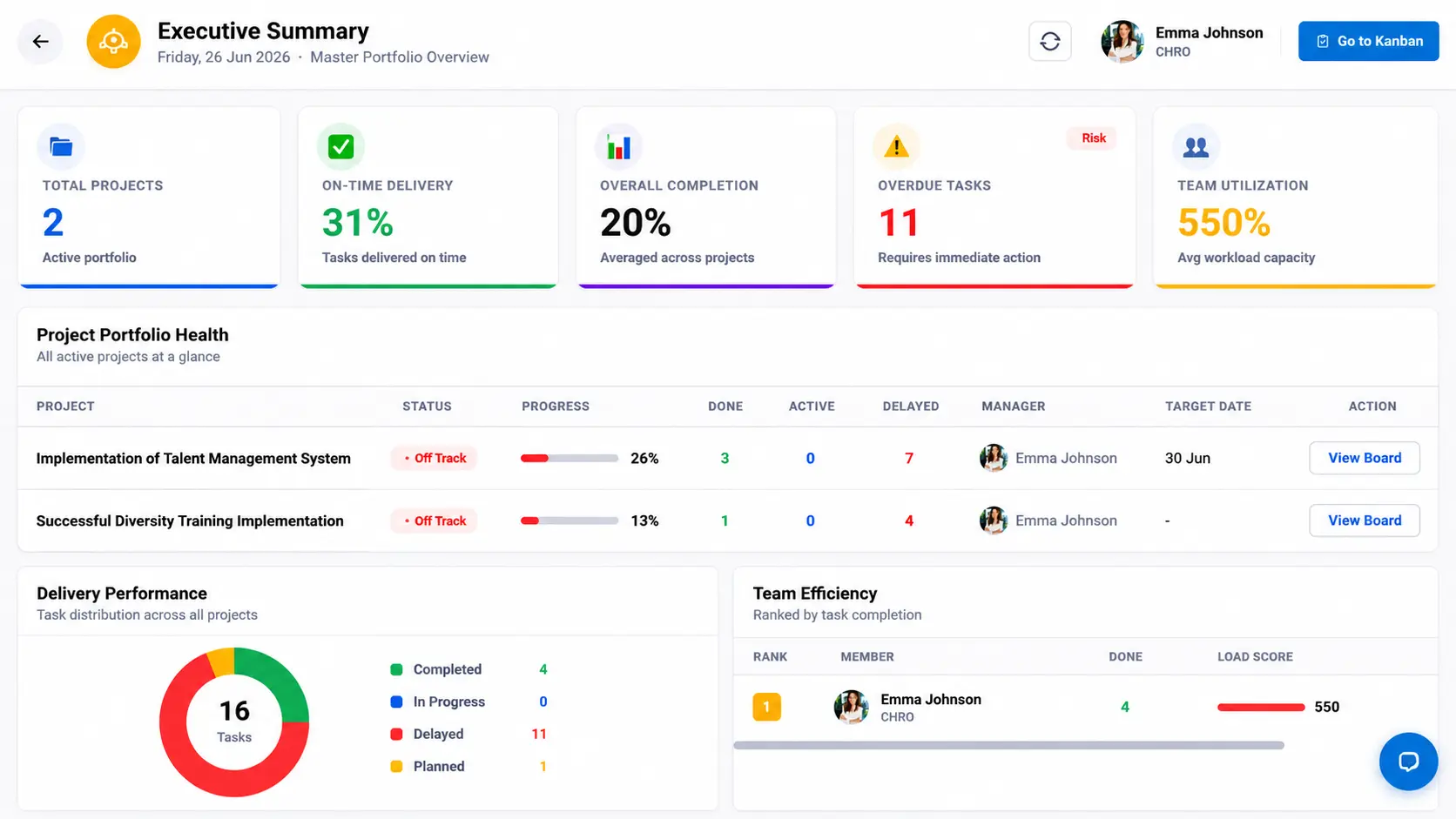
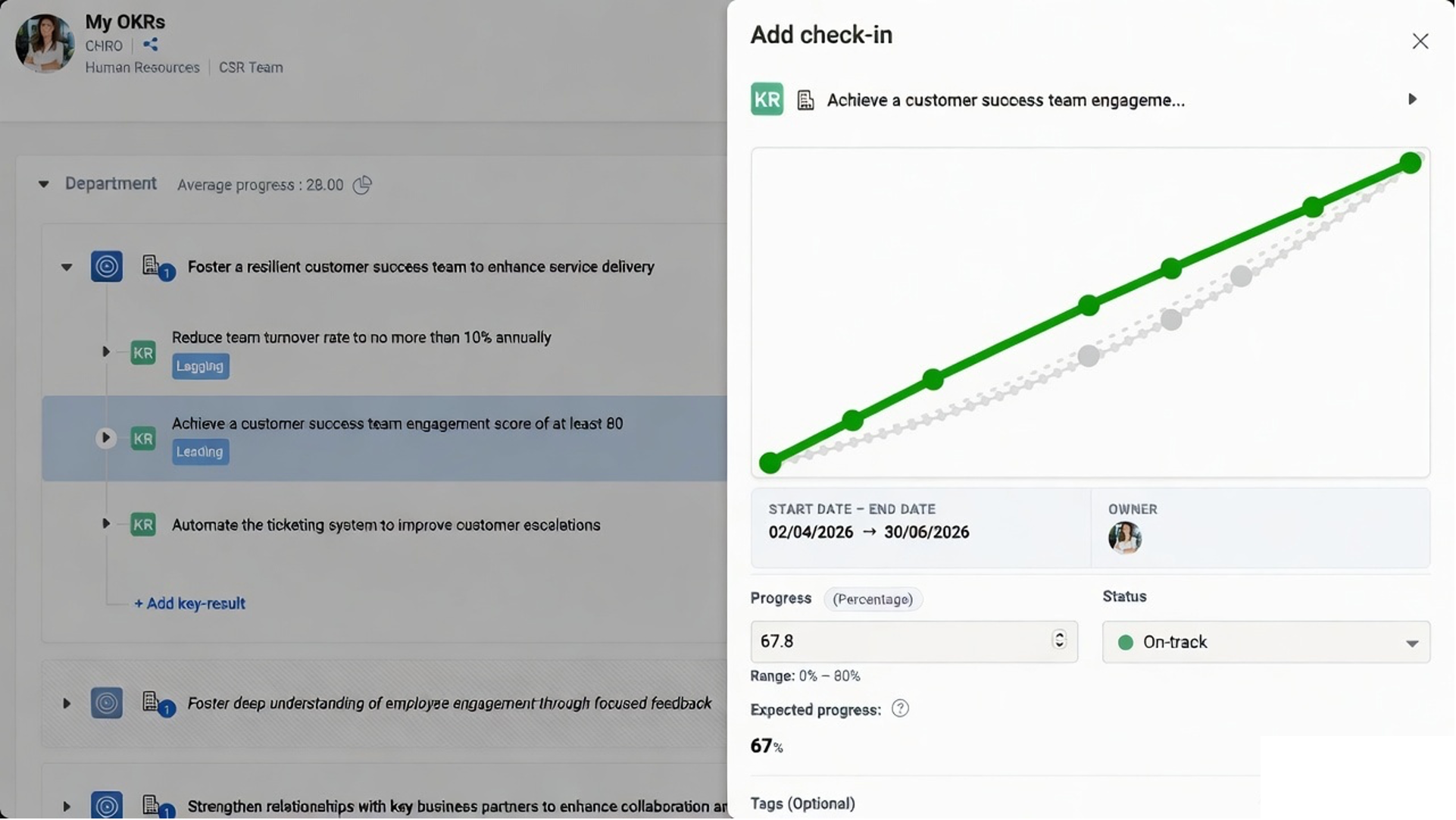
Worxmate is the only OKR software on this list that I can review from the inside - because I co-founded it. I want to be upfront about that, and equally upfront about what it means. It does not mean I'll oversell it. It means I can tell you, with more precision than any other reviewer, exactly what it was built to solve, why those problems were prioritised, and where the platform is still growing into its own ambition.
Worxmate was built directly from a decade of OKR implementation experience - not from a product roadmap designed in a boardroom. Every core feature exists because I encountered a specific, recurring failure mode in a real organisation and decided it needed a structural fix.
Reads behavioural parameters to surface talent risk, manager-effectiveness patterns and engagement trends before they become business problems .
Connects OKR progress to business KPIs in one view, replacing the disconnected reporting that turns every MBR into a data-reconciliation exercise.
Maps structural alignment across the organisation - identifying cascade-health breakdown, cross-functional friction and misalignment before it compounds.
AI-assisted goal writing that scores quality in real time and helps teams distinguish output from outcome before the cycle begins.
Automated check-ins, at-risk detection and early-warning signals that surface blockers before they become missed quarters.
Data-backed retrospectives that separate genuine wins from vanity metrics.
Converting cycle insights into organisational intelligence that makes the next cycle faster and more aligned.
In a 70,000-person IT-services organisation I worked with, the leadership team had no reliable way of knowing what was blocking progress in their own functions a version of why enterprise performance tracking fails at scale. Every MBR produced the same frustration. Worxmate's architecture is built for exactly that gap - Nexus's alignment visibility combined with Axis's mid-cycle at-risk detection gives leadership teams the early-warning infrastructure most OKR platforms don't build. Worxmate is also designed to have a leadership team live inside a live OKR cycle within the first week - unlike enterprise platforms that require 6–12 weeks of configuration. By providing dedicated OKR software for business unit heads, functional leaders get line-of-sight into cross-team blockers without waiting for MBRs.For a deeper look at scaling frameworks in service environments, explore our guide on implementing OKRs for Indian IT companies.
The integrations library - while covering Jira, Slack, Microsoft Teams, Google Workspace and 36+ tools - is still expanding. Very early-stage teams under 20 people may find the depth of the solutions suite more than they need in cycle one.
If you're looking for a platform built by someone who has run OKR programs - not just built OKR software - Worxmate is worth a serious look.
Mooncamp
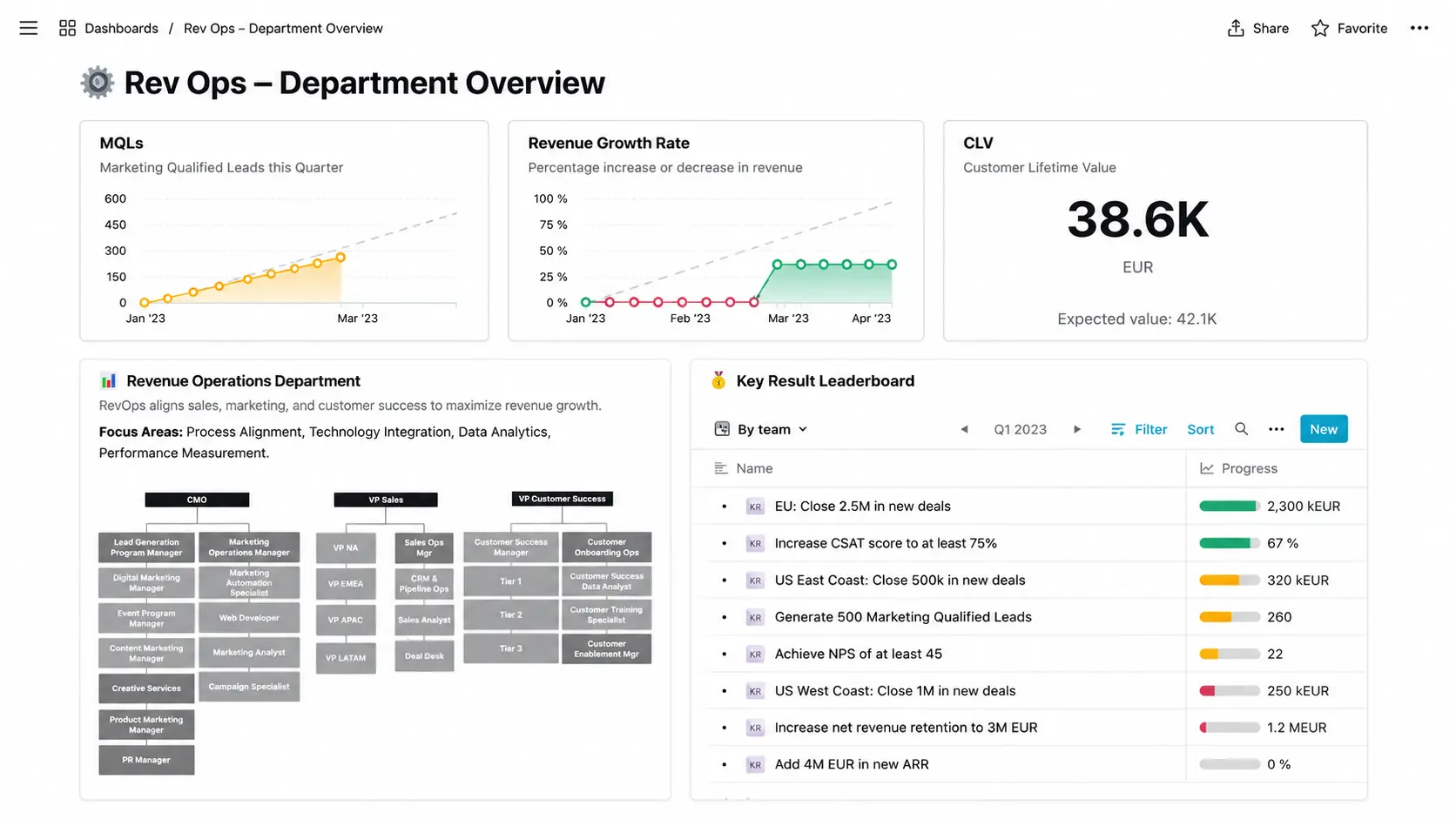
Mooncamp has built one of the cleaner OKR platforms in the market. Where many platforms bury alignment in nested menus, Mooncamp surfaces it in a strategy map that shows, in one view, how company OKRs connect to department and team goals. The platform gained significant traction in late 2025 when Microsoft shut down Viva Goals - and moved quickly to position itself as the natural migration path. Check-in reminders via Slack and Microsoft Teams keep the weekly rhythm alive without manual follow-up.
Works well where the leadership team has already done the cultural groundwork. I'd be more cautious in organisations still in the sensitisation phase - the onboarding pre-fills the workspace with sample data that creates confusion rather than clarity for teams still finding their footing.
The pre-filled dashboard creates noise during setup for larger organisations. Per-user pricing (~€300/month for 50 people) compounds as teams grow.
A strong platform for organisations past the “why OKRs” conversation and ready to focus on “how we run them well.” The strategy map is one of the best alignment-visualisation tools in the category.
See alternative to Mooncamp →Tability
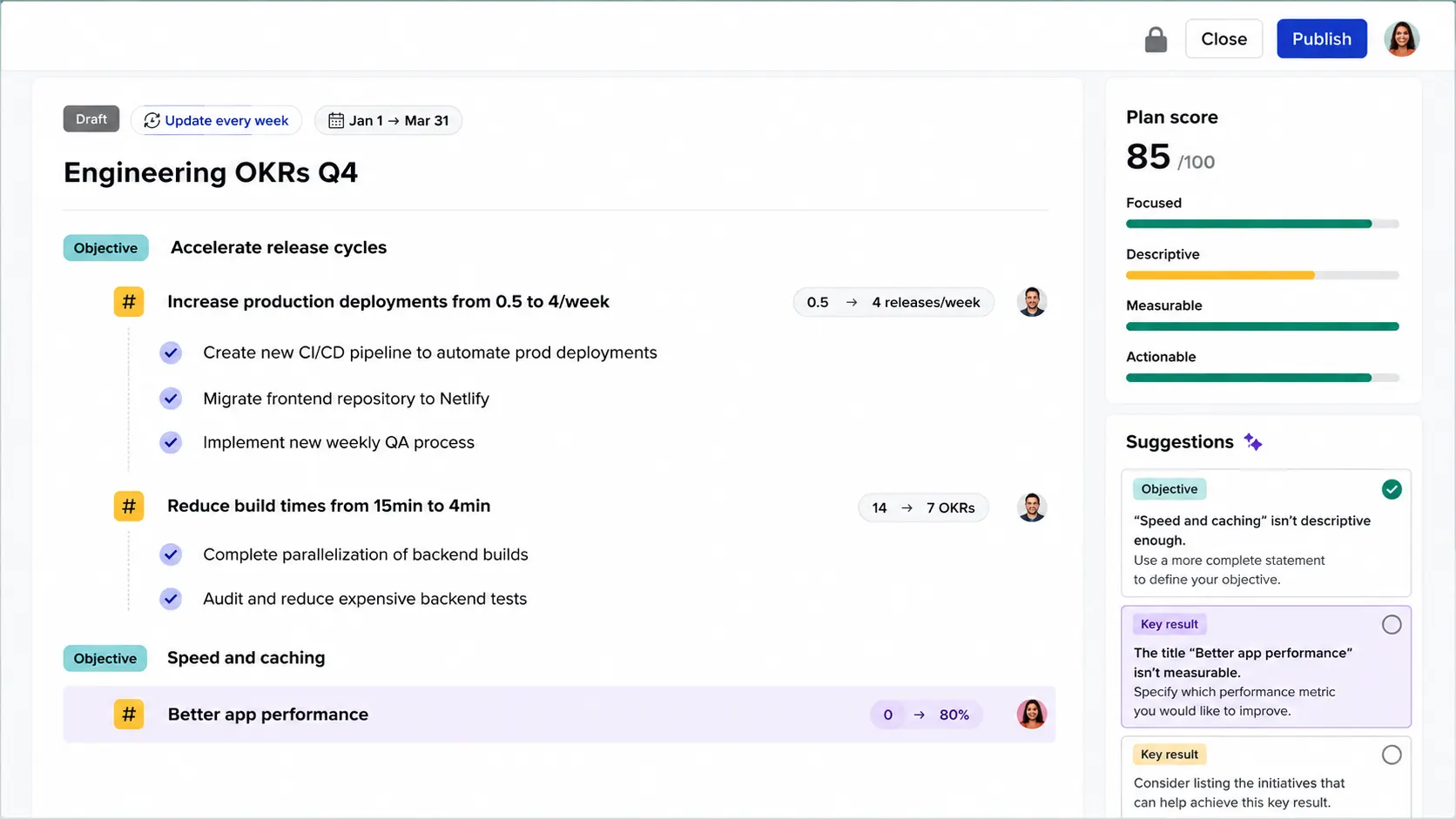
Tability is built around one outcome: getting teams to update their goals every week without someone chasing them. The tagline - “OKRs that don't suck” - is direct and, in my experience, accurate. The automated check-in infrastructure is the best in this category. The AI-assisted goal writing is genuinely useful for first-cycle teams - it drafts outcome-based Key Results from a short prompt, addressing the blank-page problem that slows every first implementation.
Works best where the coaching work has already happened. The automated nudge solves the reminder problem but not the reflection problem - teams log a number without real thought about what it means. The nudge creates the behaviour; the coaching creates the meaning. Ensuring high weekly compliance relies on providing friction-free access via the best OKR apps for mobile device check-ins.
No performance-review layer, no strategy mapping, no KPI integration. Navigation can overwhelm new users before the platform becomes familiar.
If the reason your last program failed was that the weekly check-in habit never took hold, Tability is the most direct fix on this list. If you need performance-management depth or strategy mapping, you'll outgrow it within two cycles.
See alternative to tability →Perdoo
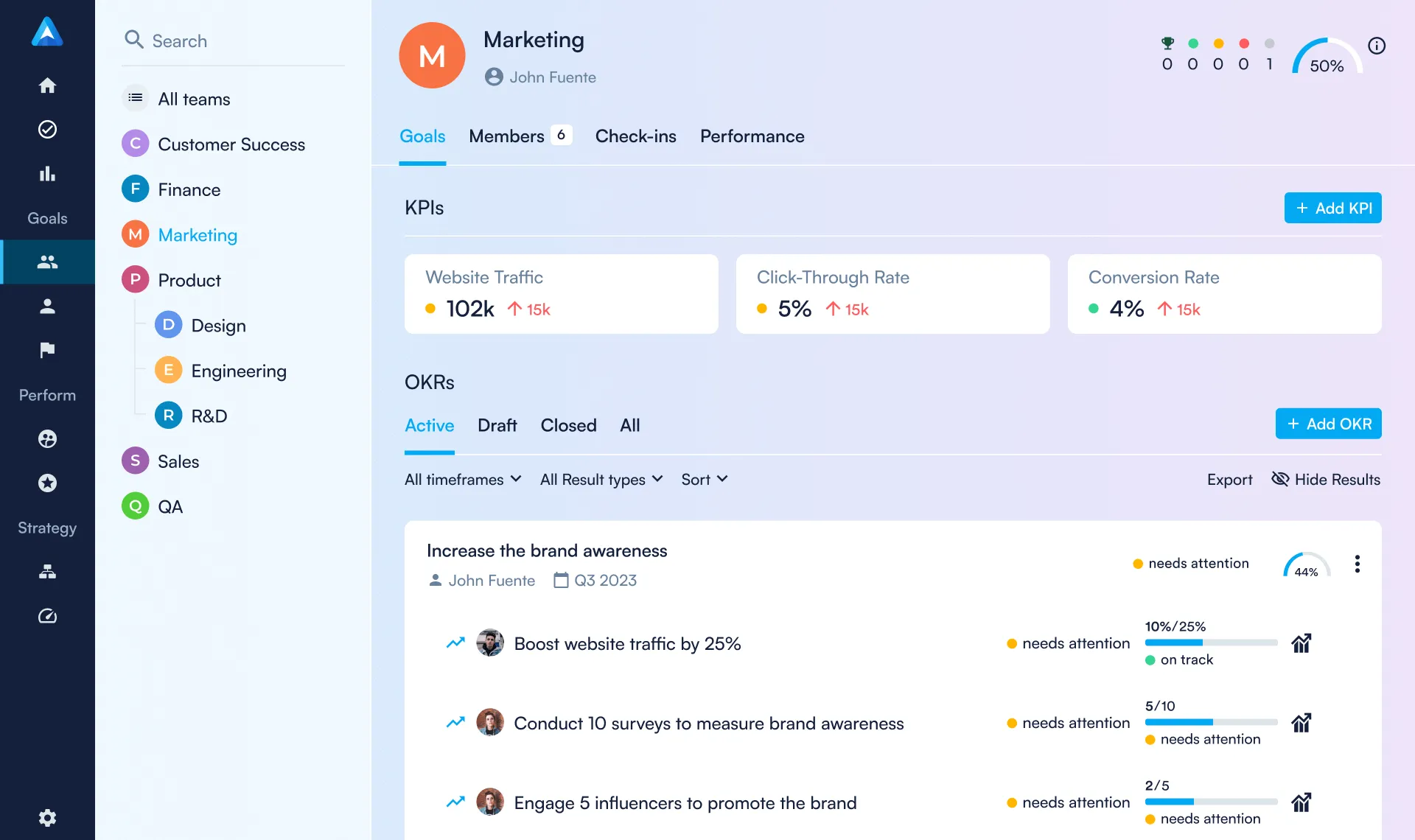
Perdoo connects company OKRs, team Key Results and KPIs in one strategic framework - a useful reference point if you're still weighing OKR vs KPI tradeoffs for your team. The strategy map is a genuine differentiator. The initiative-tracking layer gives operations teams a way to see not just whether goals are on track but what work is in motion to move them.Seeing how this plays out across teams is easier with shared OKR examples that show real cross-functional cascades. For organizations transitioning from traditional management frameworks, comparing MBO vs OKRs helps clarify where structured outcomes fit best.
Suits organisations where strategy is a serious, structured discipline - with a dedicated Strategy Head. It struggles where teams are early in their journey and the KPI layer dominates the interface, obscuring the OKR execution flow.
Interface feels older than newer platforms. The 10-seat minimum on paid plans creates an awkward gap for smaller leadership teams.
The right platform for organisations past the adoption challenge and focused on the strategic-discipline challenge. If you're still solving the cultural and habit problem, there are simpler starting points.
See alternative to Perdoo →Weekdone
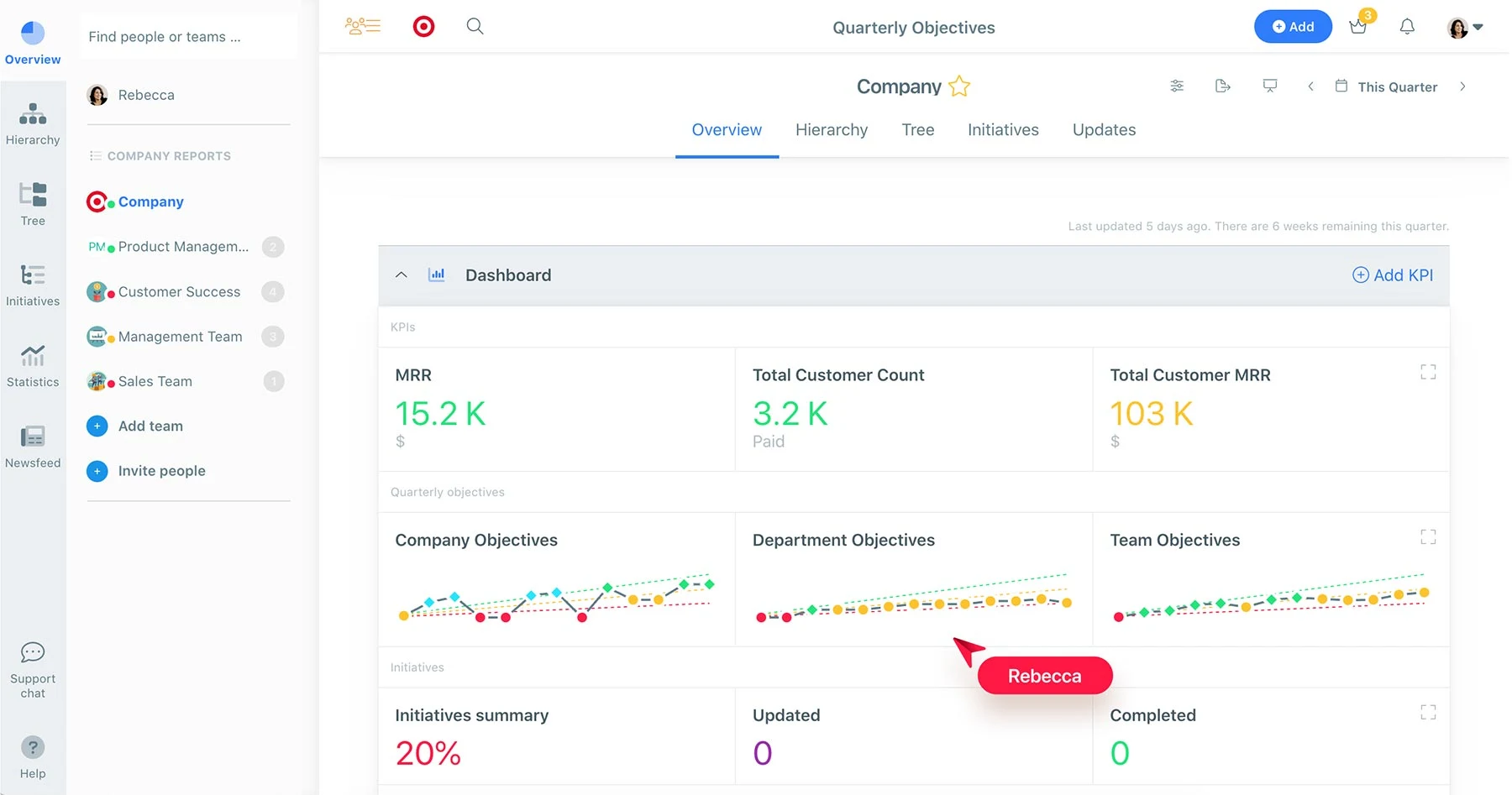
Weekdone is one of the longest-standing OKR platforms on the market. The weekly-planning layer, sitting alongside OKR tracking in the same dashboard, makes the connection between daily work and quarterly goals structural rather than aspirational goals.— a pattern worth understanding on its own terms if you're evaluating OKR software with weekly planning built in, rather than bolting a planning tool onto a separate OKR tracker. That structural link is really a discipline around action items that ladder up to the Key Result, not just a task list. The statistics view is genuinely useful - seeing at a glance which team members are engaging and which goals have gone stale gives the internal champion early warning before a cycle drifts.
Works well for smaller, execution-focused teams where the team lead is actively engaged in the weekly rhythm. It struggles in larger organisations rolling out across multiple departments simultaneously - the interface becomes cluttered past the clean onboarding experience.
The platform hasn't kept pace visually with newer entrants. Per-user pricing at $10/month compounds quickly past 20 people.
Earns its place for one reason: weekly planning and OKR tracking in a single view is a structural solution to one of the most common reasons programs lose momentum. For small, disciplined teams, that combination is genuinely valuable.
See alternative to Weekdone →Profit.co
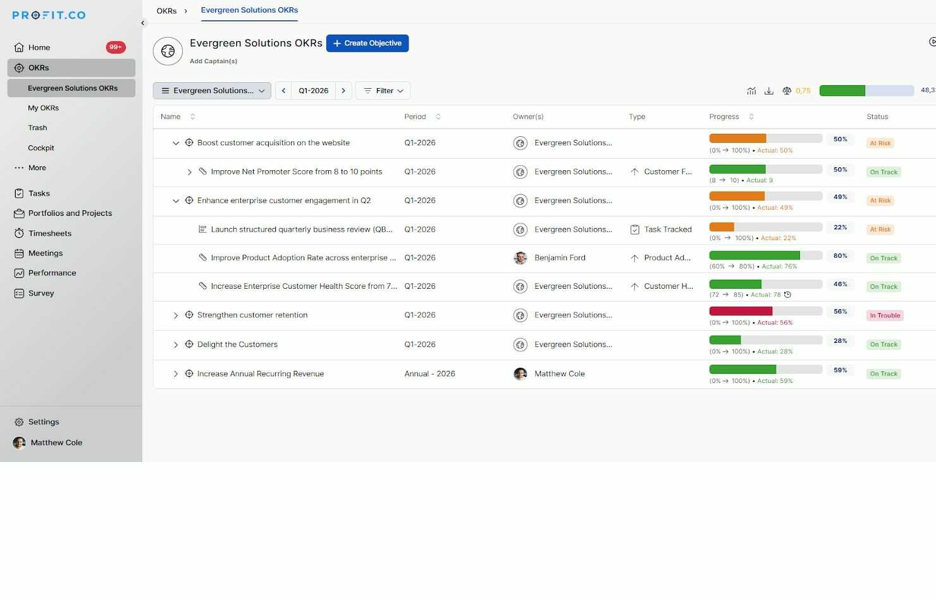
I know Profit.co from the inside - I served as Business Head there, part of the journey from zero to $11 million in funding. Profit.co is one of the most feature-complete OKR and performance platforms in the mid-market. The weighted OKR scoring system is a genuine differentiator, and the KPI–OKR integration replaces the disconnected reporting that turns most MBRs into data-reconciliation exercises.Governance-heavy operational environments including manufacturing OKR examples tend to lean on exactly this kind of KPI-OKR structure.
Profit.co rewards patient implementation. Organisations that rush configuration create more complexity than the platform resolves; a four-to-six-week configuration timeline before the first cycle is not unusual. Teams already skeptical about OKRs can lose confidence during that phase before experiencing any genuine value.
Custom pricing with no public rates adds evaluation friction. Navigation between features creates friction that compounds over a 12-week cycle.
A serious platform for serious implementations. If you have the internal capacity for a structured rollout, the depth is genuinely valuable. If you need to be running a live cycle in the next three weeks, it's not the right starting point.
See alternative to Profit.co →Quantive (formerly Gtmhub)
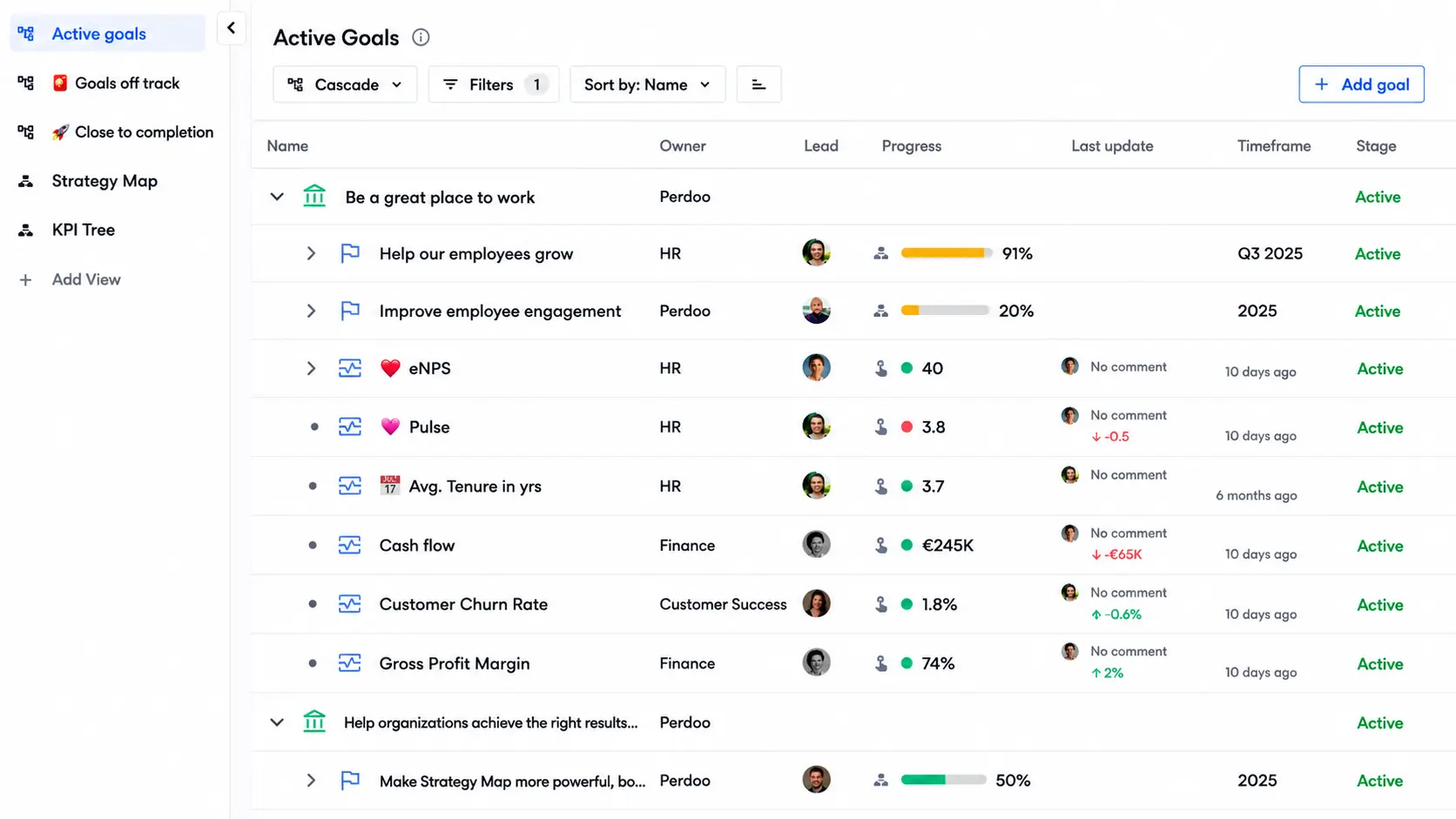
Quantive is one of the most established names in the enterprise OKR category. The ability to connect Key Results to live data feeds from Salesforce, HubSpot, Jira, Google Sheets and dozens of other systems removes one of the most persistent friction points in enterprise programs. This makes it a natural fit for revenue operations OKRs, where pipeline and CRM data need to flow directly into Key Result tracking. The configurability is enterprise-grade - custom hierarchies, flexible goal structures, detailed permission layers and robust reporting.
Quantive rewards sophistication. With mature data infrastructure and strong internal capability it can be transformative. In organisations still building that foundation, its depth becomes a distraction - I've seen teams spend more time configuring the platform than coaching their teams, exactly the wrong order in cycle one.
The enterprise sales process means evaluation timelines can cost a quarter. Pricing reflects enterprise positioning and isn't suited to smaller organisations.
Belongs on the shortlist of any enterprise with complex data-integration requirements and the internal capacity to implement properly. For everyone else, the capability-to-complexity ratio tips the wrong way before the first cycle is complete.
See alternative to Quantive →Betterworks
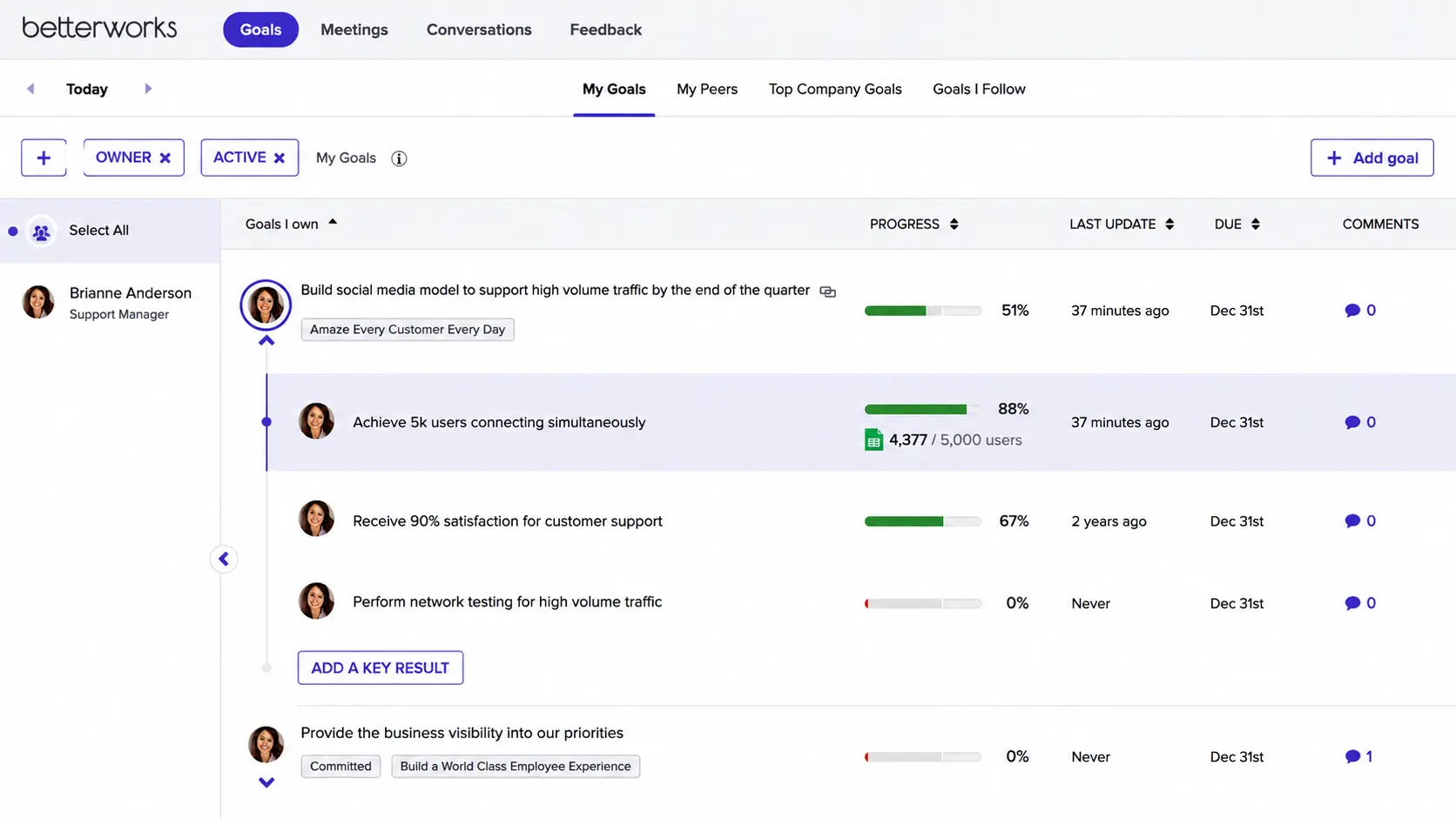
Betterworks sits at the intersection of OKRs and continuous performance management - connecting goal progress, check-in conversations and performance data in a way that makes the manager–employee relationship more structured and honest. The manager-effectiveness layer is its most distinctive capability, surfacing signals that show HR and People leaders where management capability is supporting execution and where it isn't.
One of the most consistent patterns in enterprise implementations is that the program lives or dies at the manager layer. C-suite alignment can be strong and the program still collapses because middle managers were never equipped to run honest check-ins. Betterworks addresses that gap more directly than most platforms here.
No self-serve evaluation path - requires a demo and procurement process. The depth can shift the organisational conversation from OKR execution gap to managing HR process.
The strongest platform for large enterprises where manager effectiveness is the identified bottleneck. If you've solved adoption and are now focused on execution discipline at the manager layer, it deserves serious evaluation.
See alternative to Betterwork →Lattice (OKR module)
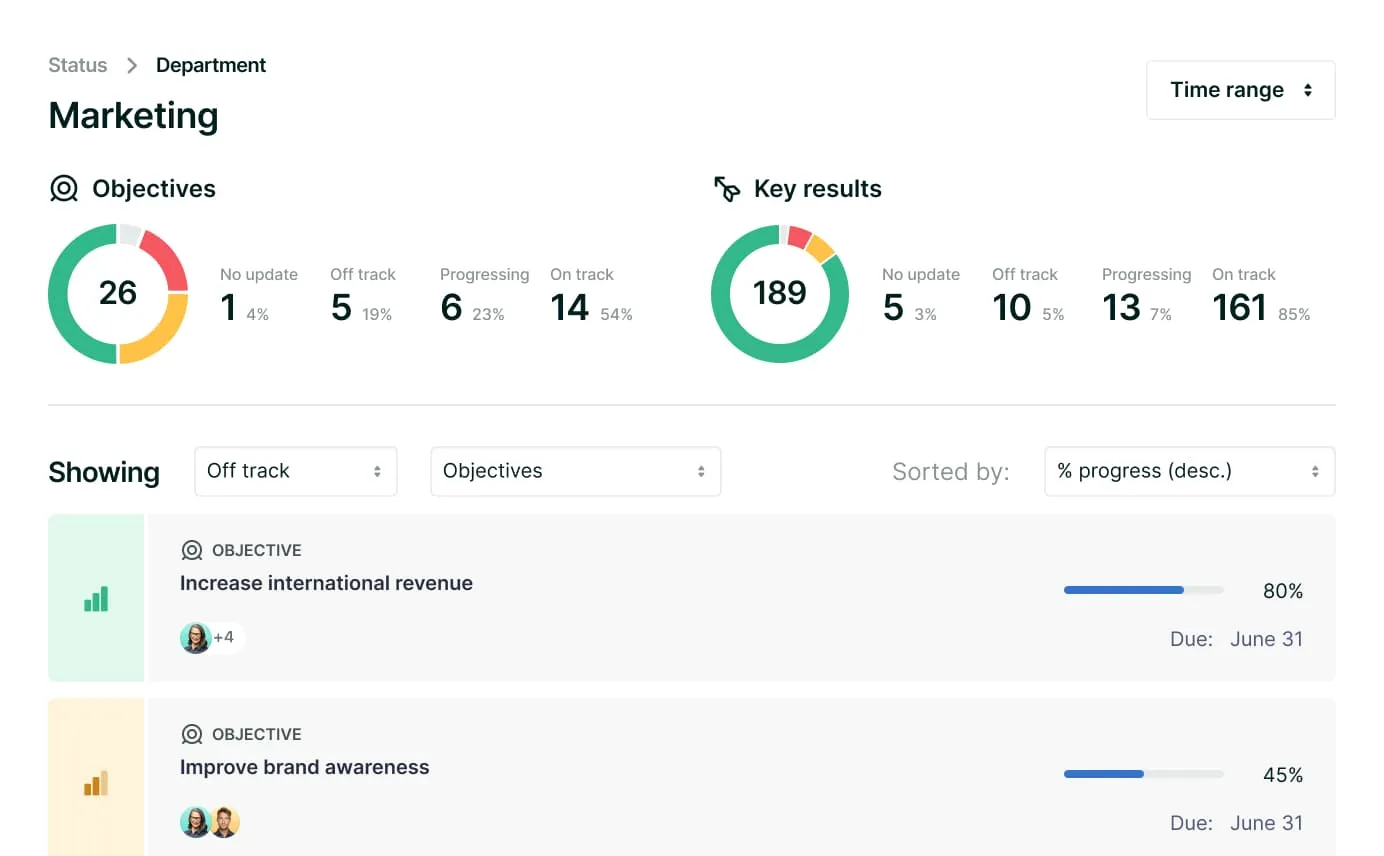
Lattice is primarily a performance-management platform with an OKR module sitting inside that broader system. The connection between OKR progress and performance-review data is Lattice's most compelling capability for HR-led organisations. HR teams in regulated sectors evaluating this fit will find useful reference points in these HR business partner OKR examples for healthcare.
It works well where HR is the primary OKR-program driver and creates friction where the CEO or Strategy Head is driving it. In a platform whose architecture is built around appraisals and engagement, the OKR habit often gets absorbed into the HR rhythm rather than the business rhythm. Those are not the same thing.
Pricing escalates quickly when combining the OKR module with other Lattice features. No self-serve evaluation path.
If your organisation runs on Lattice and the People team drives the OKR program, adding the module is reasonable. If OKRs are CEO-driven and execution is the primary concern, a purpose-built platform will serve you better.
See alternative to Lattice →Leapsome
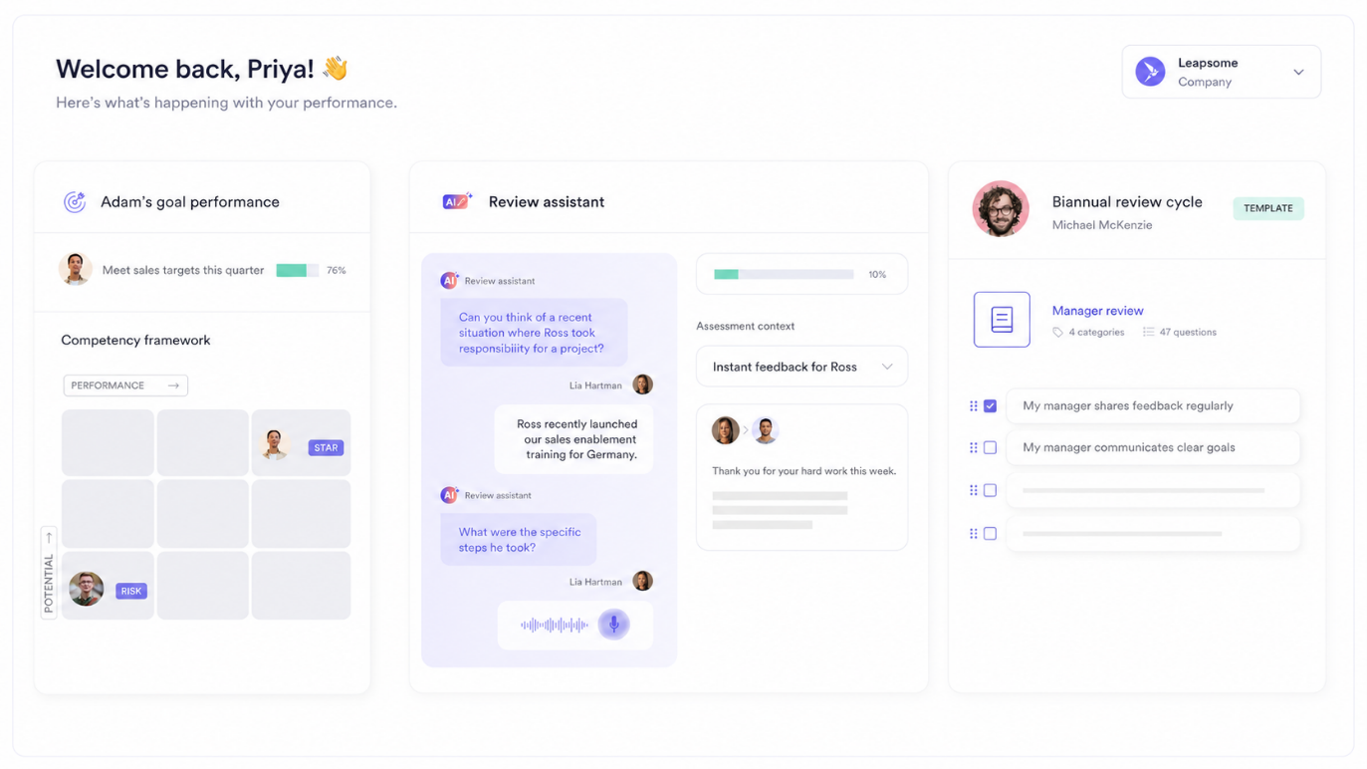
Leapsome connects OKRs, performance reviews, learning pathways and engagement surveys around the idea that employee development and goal achievement are not separate disciplines. The L&D integration is its most distinctive feature - connecting a skill gap identified in a review directly to a learning pathway, then tracking development alongside OKR progress.
One observation from my coaching work that Leapsome's design reflects: the ability to write outcome-driven OKRs is itself a skill that needs developing. Organisations that treat OKR writing as a one-time training exercise consistently produce weaker Key Results in cycles two and three. Leapsome's L&D integration creates the infrastructure to address that - though the organisation still needs to prioritise it. To align capability development with company goals, review practical OKR examples for L&D teams.
The breadth means onboarding isn't lightweight. For organisations that primarily need OKR tracking and check-in infrastructure, it's more than they need.
Right for People leaders who see OKRs as one component of a broader people-enablement strategy. If your primary question is “how do we get teams running OKRs consistently,” there are faster starting points.
See alternative to Leapsome →15Five
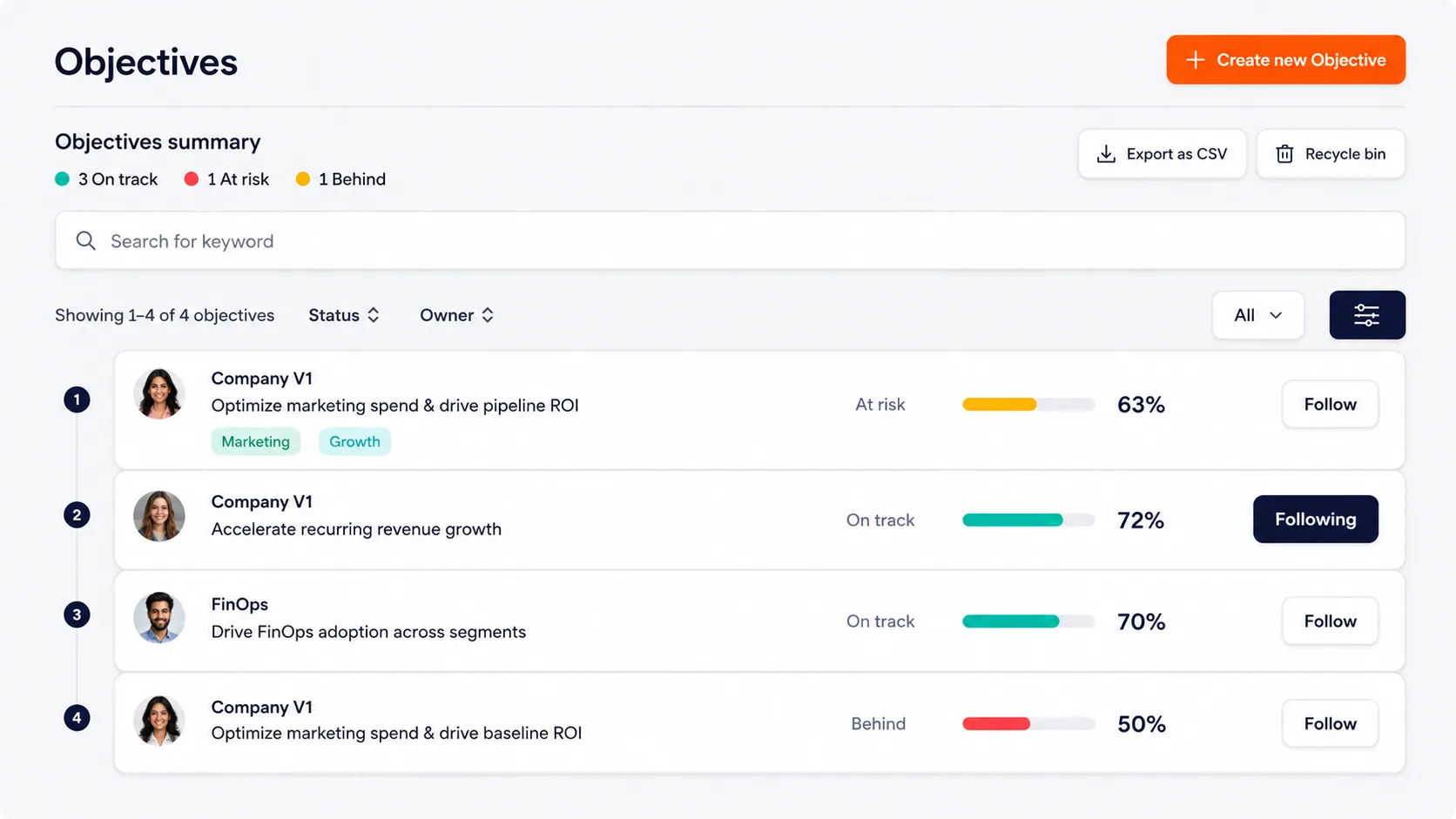
15Five built its reputation on the weekly check-in - a structured, lightweight pulse that keeps managers connected to their teams without a formal meeting. The check-in format is the most refined on this list for organisations that want the habit to feel natural rather than administrative: what did you accomplish, what are you working on, what's blocking you, how are you feeling. This is essentially the CFR model in practice - see OKRs and CFRs: how they boost company success for how conversations, feedback and recognition reinforce the check-in habit.
Works best where a culture of regular, honest manager–employee conversation already exists. It creates confusion in organisations that adopt it primarily for OKR tracking and find the check-in format - designed for wellbeing as much as goal progress - misaligned with a hard-nosed strategic-execution agenda.
OKR analytics depth is limited - cascade visibility, dependency mapping and alignment infrastructure are not the primary focus.
Earns its place for organisations where the manager layer is the identified leverage point. If you need deep cascade architecture, look elsewhere. If you need managers to actually talk to their teams every week about what matters, 15Five is built for exactly that.
See alternative to 15Five →Microsoft Viva Goals
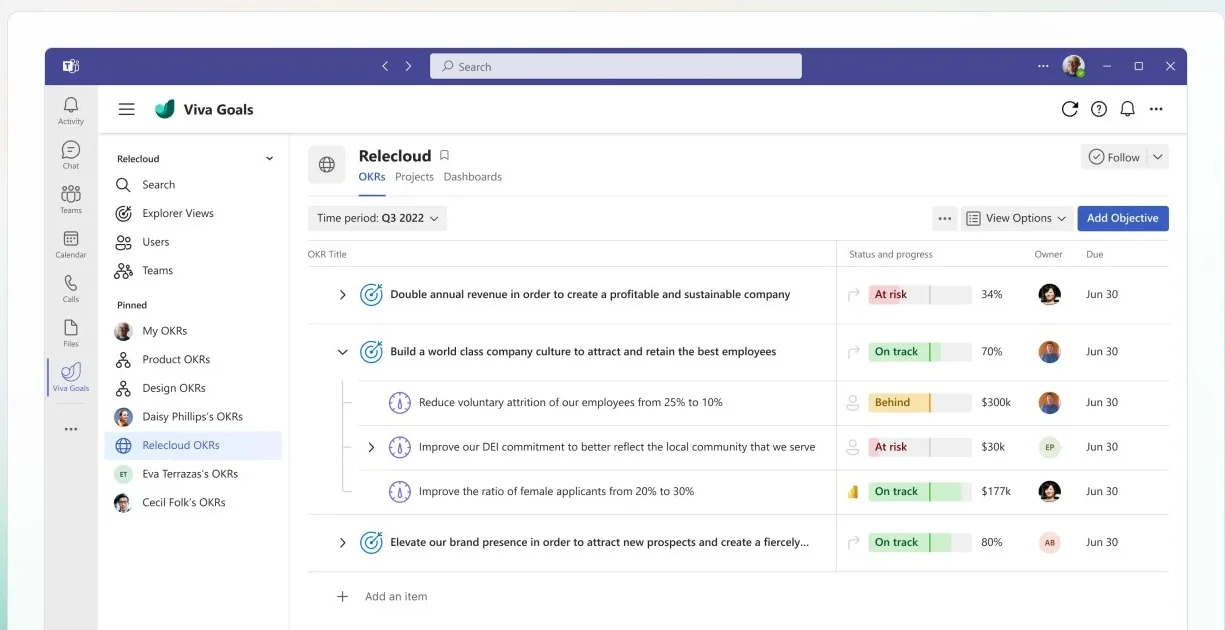
Microsoft Viva Goals was shut down on December 31, 2025. It's included here because a significant number of organisations are currently mid-migration. Viva Goals was Microsoft's OKR platform - built natively inside Microsoft 365, with deep Teams integration. The shutdown is a reminder that platform dependency is a real risk in any software evaluation. If you're migrating now, the three most important criteria are continuity of data, speed of implementation and interface familiarity. Mooncamp and Teamflect are the most natural landing points for Microsoft 365 organisations.
The migration moment is also an opportunity. Organisations that experienced limitations in how Viva Goals handled cascade architecture or coaching infrastructure now have the chance to choose a platform that addresses those gaps from the start.
A useful reminder: choose a platform from a vendor whose primary business is OKRs - not a feature inside a broader productivity suite that can be discontinued when HR strategic priorities shift.
Teamflect
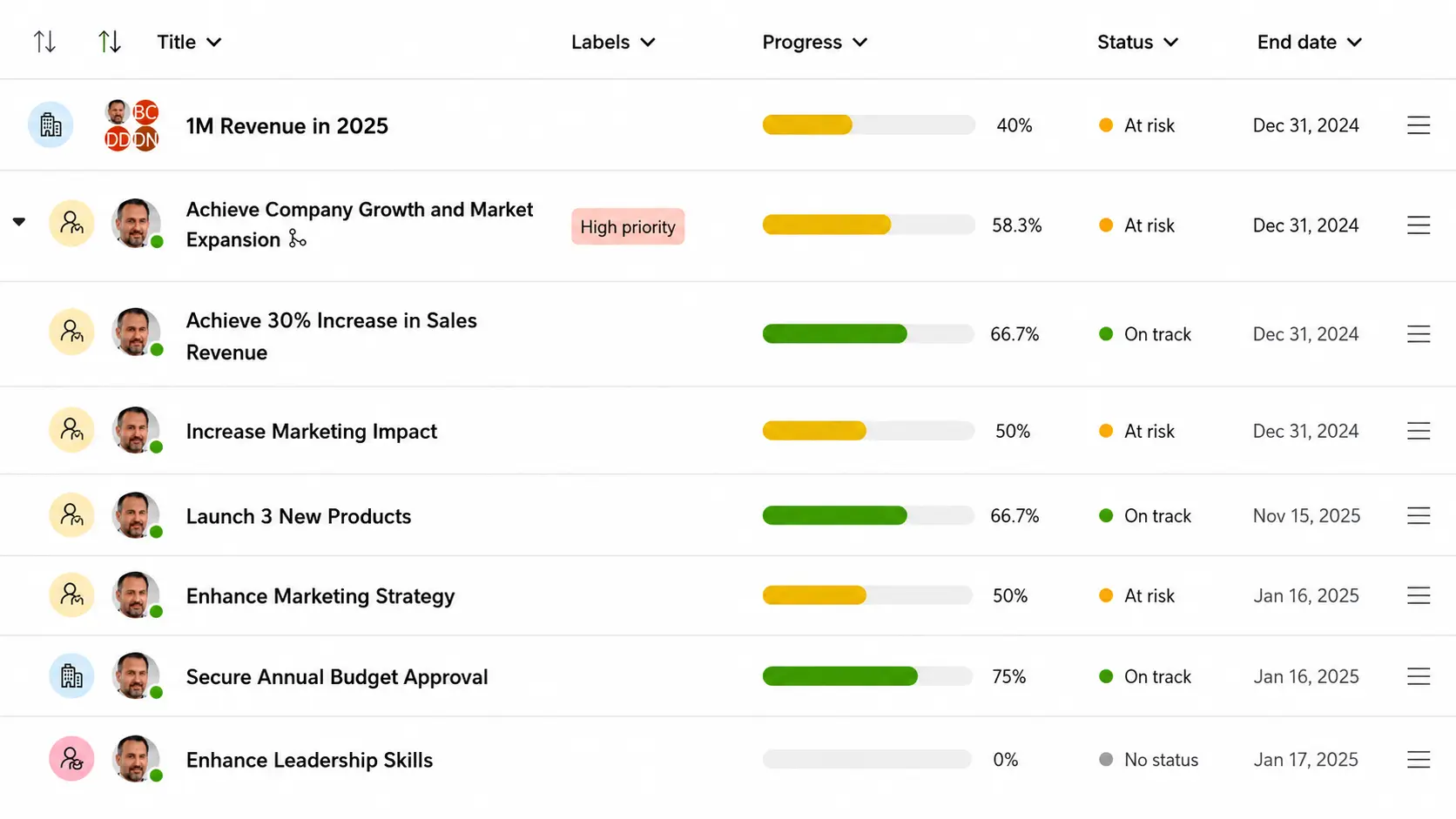
Teamflect is the strongest purpose-built OKR and performance platform for organisations whose teams live inside Microsoft Teams - running natively inside Teams, not through a notification layer. The OKR update, the performance review, the 1:1 - all of it happens without leaving the interface the team already has open. The status filter that shows which OKRs are on track, behind or at risk gives managers a weekly snapshot without a separate reporting exercise.
Teamflect's primary advantage - native Teams integration - is also its primary constraint. Organisations not on Microsoft 365 have no reason to evaluate it. The progress-update flow has some rough edges - more cluttered than it needs to be for a routine weekly action.
The platform's value is tied directly to Microsoft 365 adoption. Mixed environments create an uneven experience.
If your organisation runs on Microsoft 365 and Teams adoption is high, Teamflect is the most natural OKR platform on this list. For organisations outside the Microsoft ecosystem, look elsewhere.
Oboard
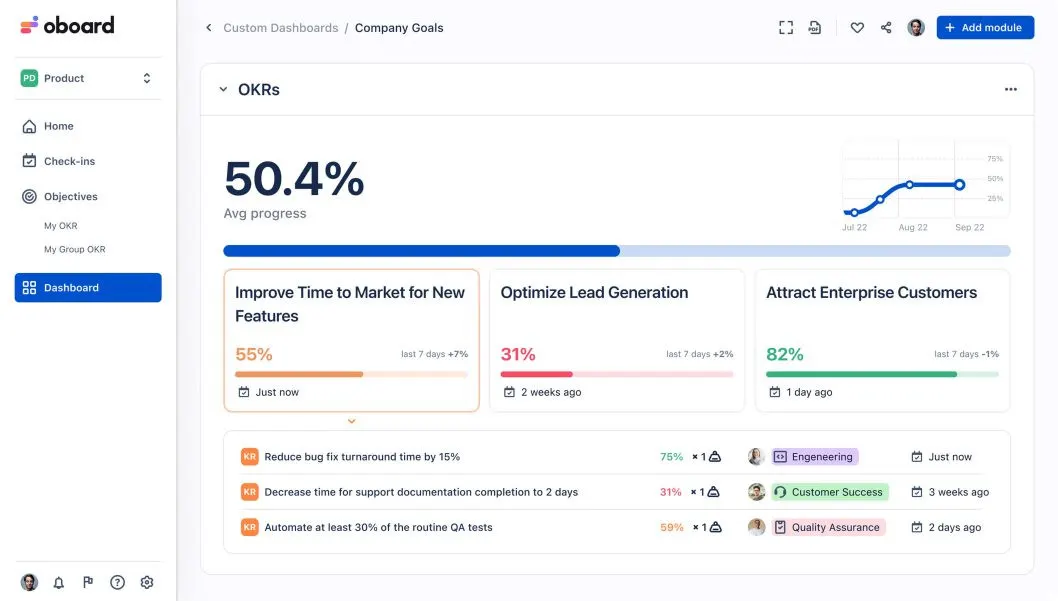
Oboard is a visual OKR platform with one primary differentiator: the Jira integration is the core architecture. As Jira tickets move through the sprint, OKR Key Result progress updates automatically. For technical teams where any additional process meets resistance, the zero-overhead update mechanism is a meaningful adoption advantage.
The most persistent problem in product and engineering implementations is the output trap - teams ship everything on the sprint plan and the outcome barely moves. The Jira integration solves update friction but not the output trap; if the tickets being tracked are outputs, automatic updates accurately report on the wrong things. That requires coaching work before the platform is configured.
Visual complexity can tip into clutter. Less suited to non-technical teams, where the Jira integration disappears as an advantage.
The right choice for product and engineering organisations that are disciplined Jira users. It will not solve the output-vs-outcome problem on its own - that requires coaching.
Cascade
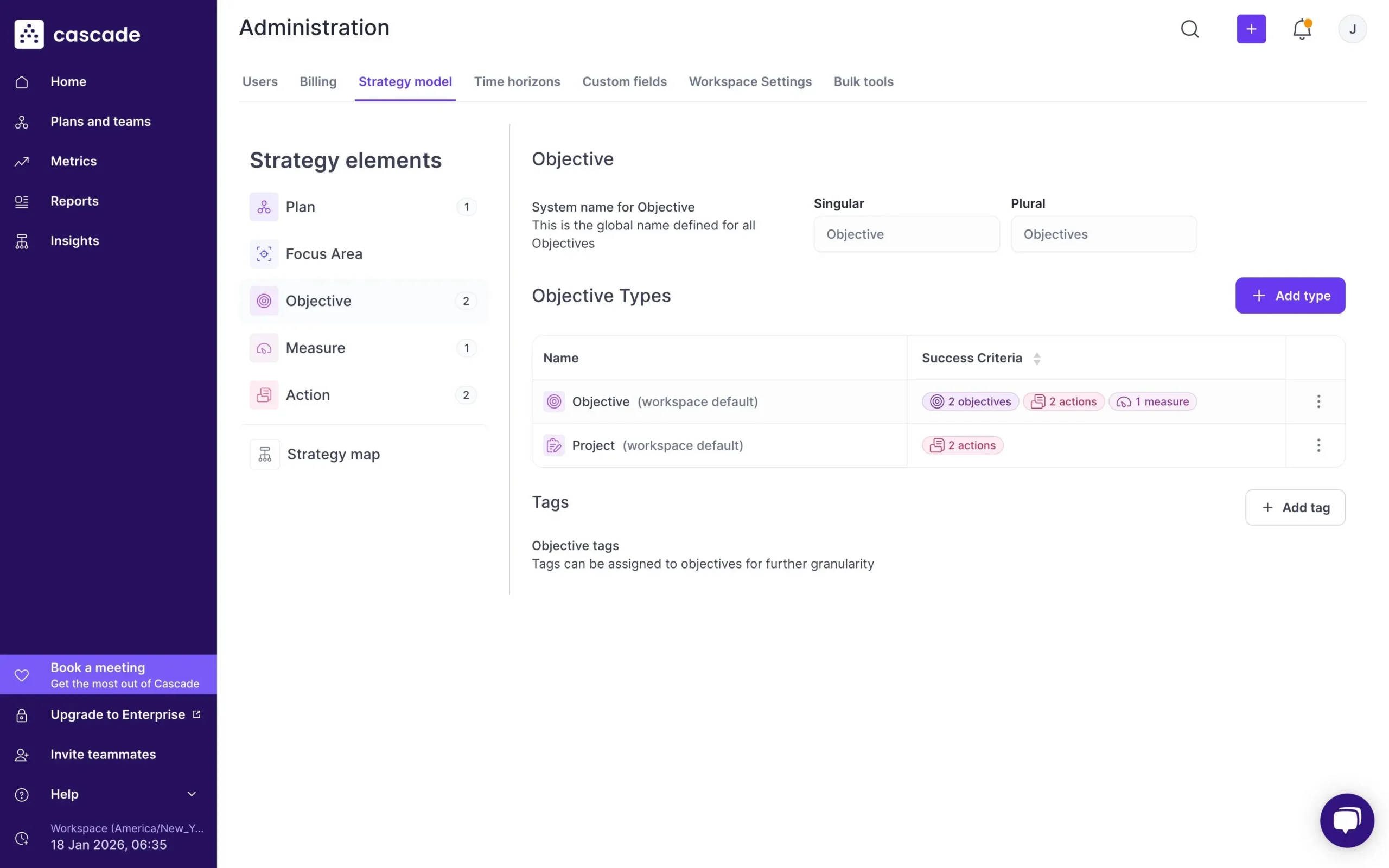
Cascade is not an OKR tool in the traditional sense - it's a strategy-execution platform that accommodates OKRs as one of several goal frameworks. The strategic hierarchy is the most sophisticated on this list - from company mission through strategic pillars to OKRs to initiatives, with multi-level reporting that aggregates execution status across business units, regions and functions.Aligning strategic pillars requires clarity on top-level corporate identity, starting with the fundamentals of mission vs vision alignment.
Designed for organisations that have already solved cultural adoption. The setup overhead is real - strategy maps, pillar structures and multi-level hierarchies require significant configuration. Organisations that underestimate that investment end up with a platform theoretically capable of everything and practically delivering very little.
Quote-based pricing with no public rates. Too complex for most growing organisations.
Belongs on the shortlist of enterprise strategy teams managing OKR programs at genuine scale. For everyone below that scale, the configuration overhead will consume more energy than the platform returns in year one.
Range
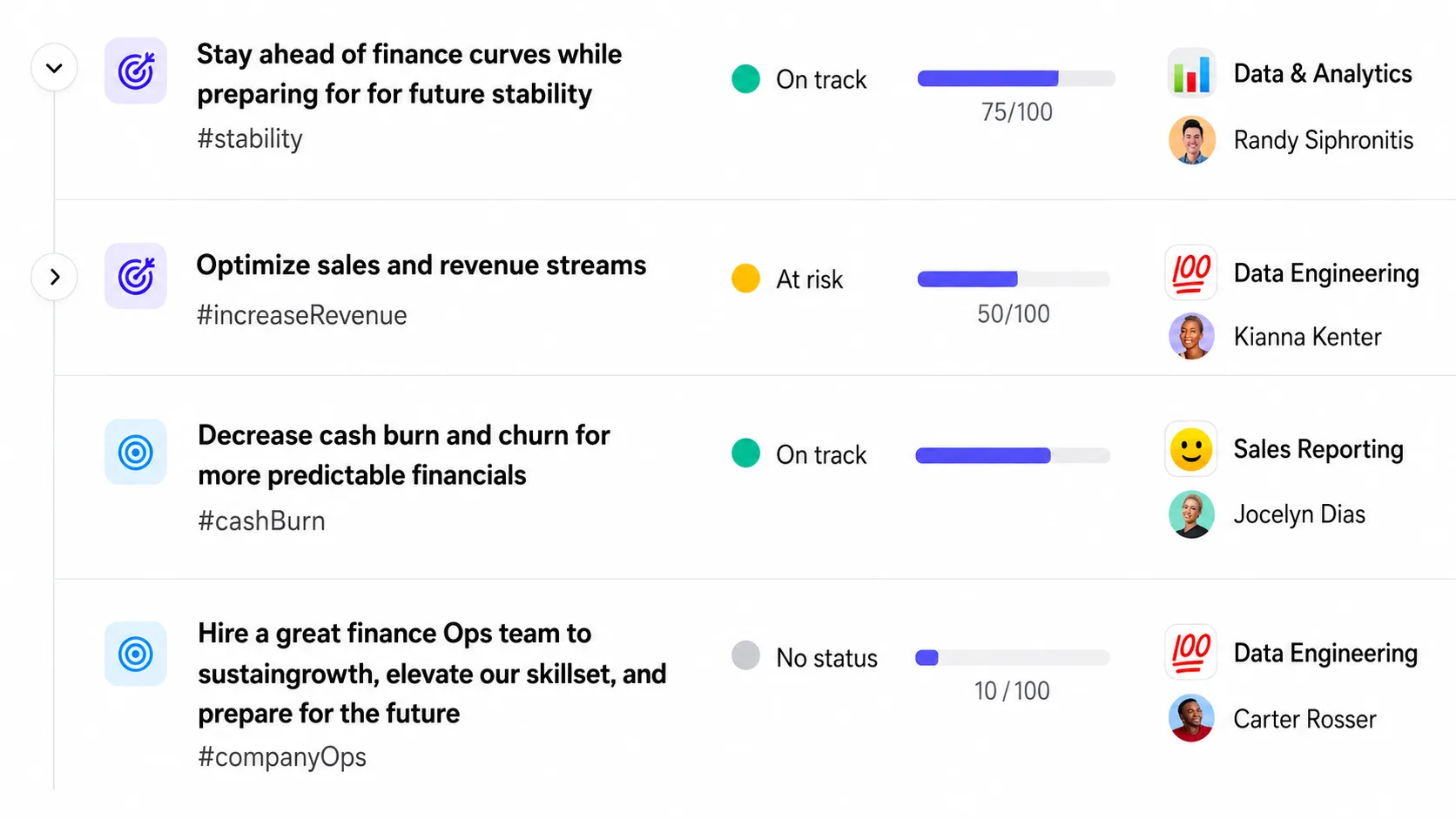
Range was built for the remote-first reality - where maintaining team connection and progress toward quarterly goals both need to happen without the informal communication that occurs naturally in a physical office. This is a common evaluation point for remote-first OKR software: the mood and wellbeing tracking is a signal most OKR platforms ignore entirely; for remote team leads, early indicators of disengagement need a different mechanism.
Range is a team-connection platform that includes goal tracking - not the other way around. For organisations whose primary OKR challenge is strategic alignment, cascade visibility and cross-functional dependency management, Range's goal layer is insufficient.
No cascade architecture, no dependency mapping, no alignment map. Will require a second platform for the strategic layer at scale.
Earns its place for remote-first organisations where team connection is as much a priority as goal tracking. If strategic-execution infrastructure is the primary need, look at platforms built around cascade and alignment first. Distributed companies seeking the best OKR software for remote teams in US need platforms that balance asynchronous updates with strategic visibility. Understanding OKRs for remote teams best practices and challenges helps prevent async alignment breakdown.
SimpleOKR
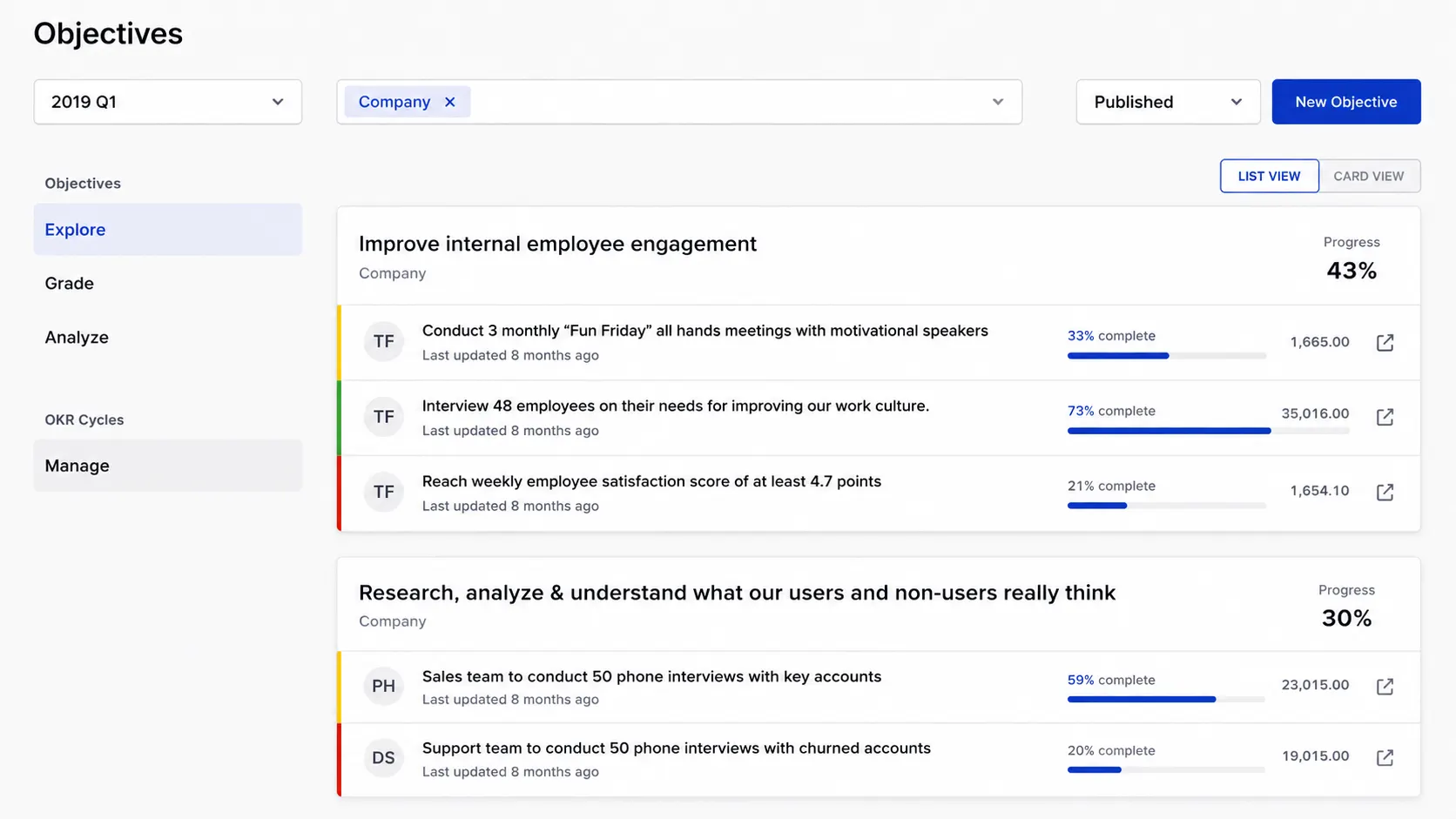
SimpleOKR does exactly what the name describes - a clean, fast place to set goals and track progress at a flat monthly rate regardless of how many users are on the platform. The flat-rate pricing model is the primary differentiator: unlimited users at $49.99/month means the cost doesn't change as the team grows. Setup is fast with no training required. Organizations with tight governance constraints and limited budgets should look at tailored options such as OKR software for UK nonprofits to avoid high seat costs.
Appropriate for organisations genuinely at the beginning - testing whether the OKR framework resonates before investing in more sophisticated infrastructure. The limitation is that it's a starting point, not a system that scales; the habits that make OKRs work depend entirely on human discipline when the tool provides no structural support.
No automated check-in nudges, no alignment map, no AI features, no integrations. Not designed to scale beyond basic goal creation.
A reasonable starting point if your organisation is evaluating OKRs for the first time with a small leadership team. Treat it as a pilot tool, not a long-term system.
Peoplebox
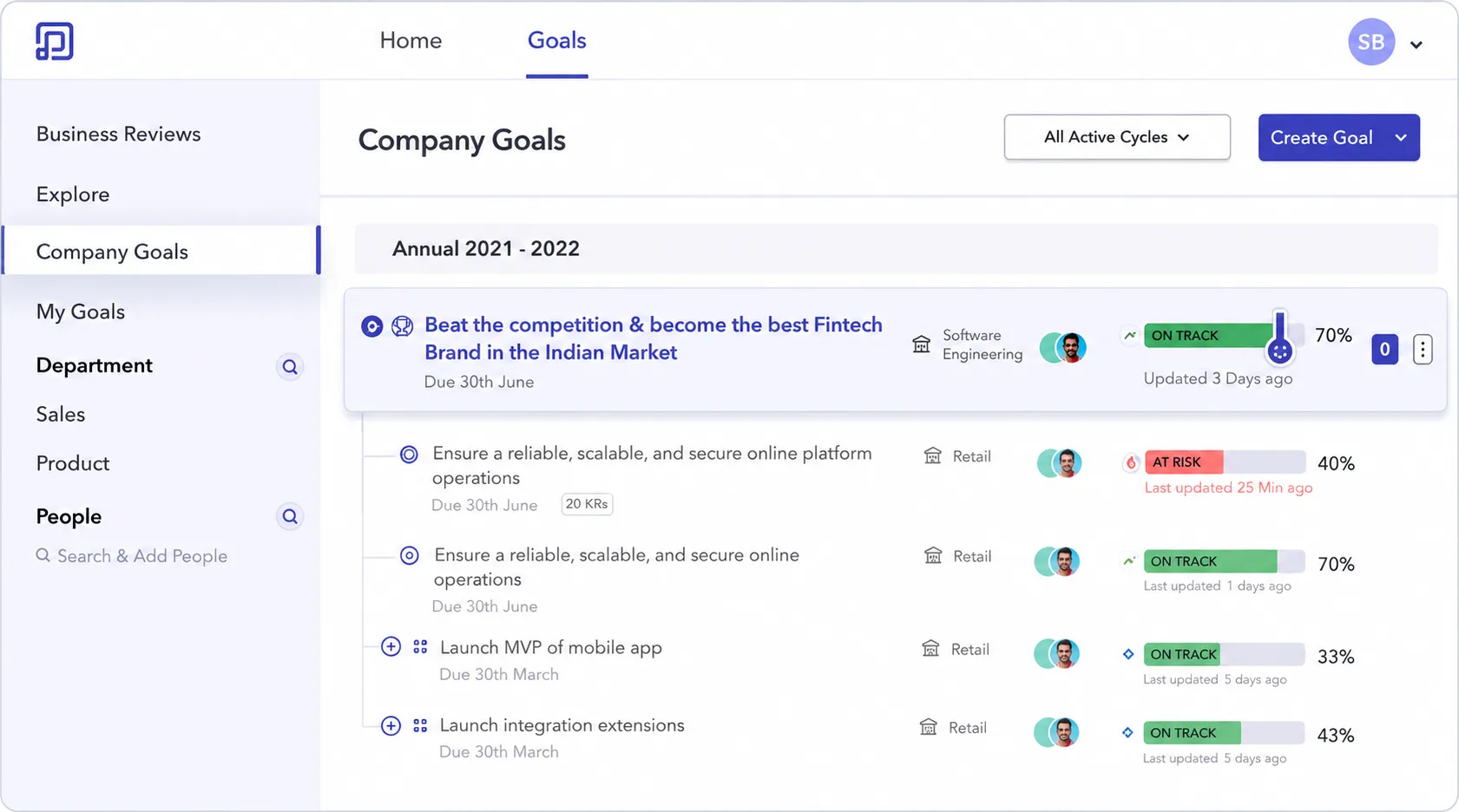
Peoplebox is engineered specifically to bring OKR tracking tools into the tools where teams already collaborate: such as Slack, Microsoft Teams, Jira, and Asana. Rather than acting as a static destination site, it uses automated syncs and direct messaging prompts to drive weekly OKR check-in compliance and auto-generate business review dashboards (QBR/MBR).
Works exceptionally well for fast-moving engineering, product, and revenue teams that resist logging into a standalone HR portal to update metrics. The native calendar and 1:1 integration ensure that goal progress directly informs weekly manager-employee conversations.
Deep multi-layered cascade architecture and complex matrix visibility can feel cluttered compared to purpose-built enterprise strategy platforms.
A top choice for modern product/tech companies that need seamless Slack/Teams check-ins and automated leadership review decks without complex enterprise configuration.
WorkBoard
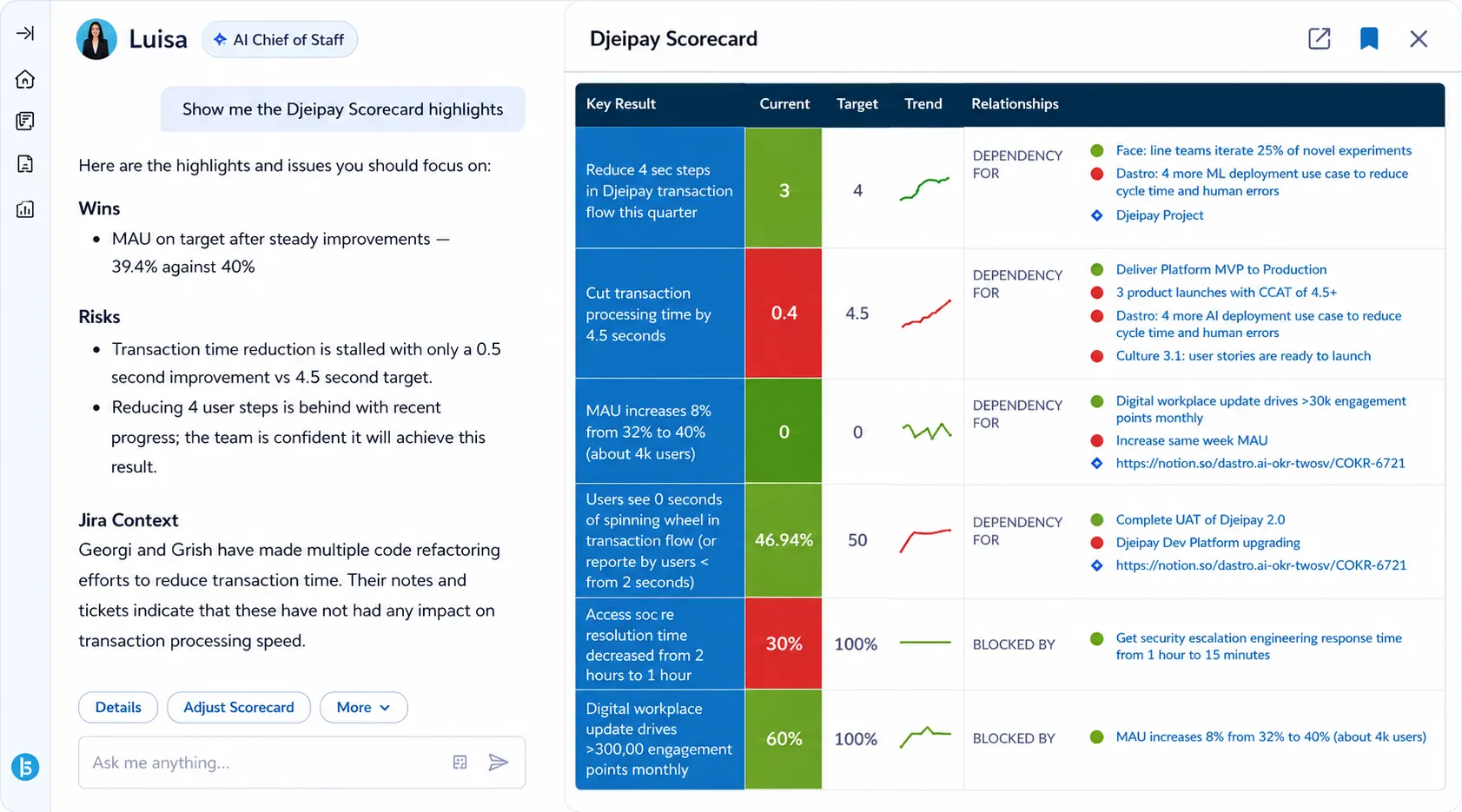
WorkBoard approaches OKRs through an executive strategy execution lens rather than a People or HR lens. Designed specifically for enterprise leadership teams, it links high-level strategic priorities directly to quarterly business reviews (QBRs), financial scorecards, and cross-functional team deliverables. Its real-time performance dashboards give executives granular line-of-sight into strategic dependencies across large corporate matrix structures.
WorkBoard fits best in complex corporate environments where dedicated Strategy Execution Offices (SEOs) manage the program. It struggles in mid-market or agile organizations where line managers need a lightweight, intuitive tool. If your managers find routine updates cumbersome, adoption will drop off sharply after the first cycle.
High implementation complexity requiring months of organizational onboarding. The platform can feel heavy and overly administrative to non-executive staff.
A powerful tool for Fortune 500 strategy teams operating complex, matrixed business units. For teams wanting rapid adoption and simple weekly check-in habits, the platform’s heavy footprint will prove over-engineered.
ClickUp
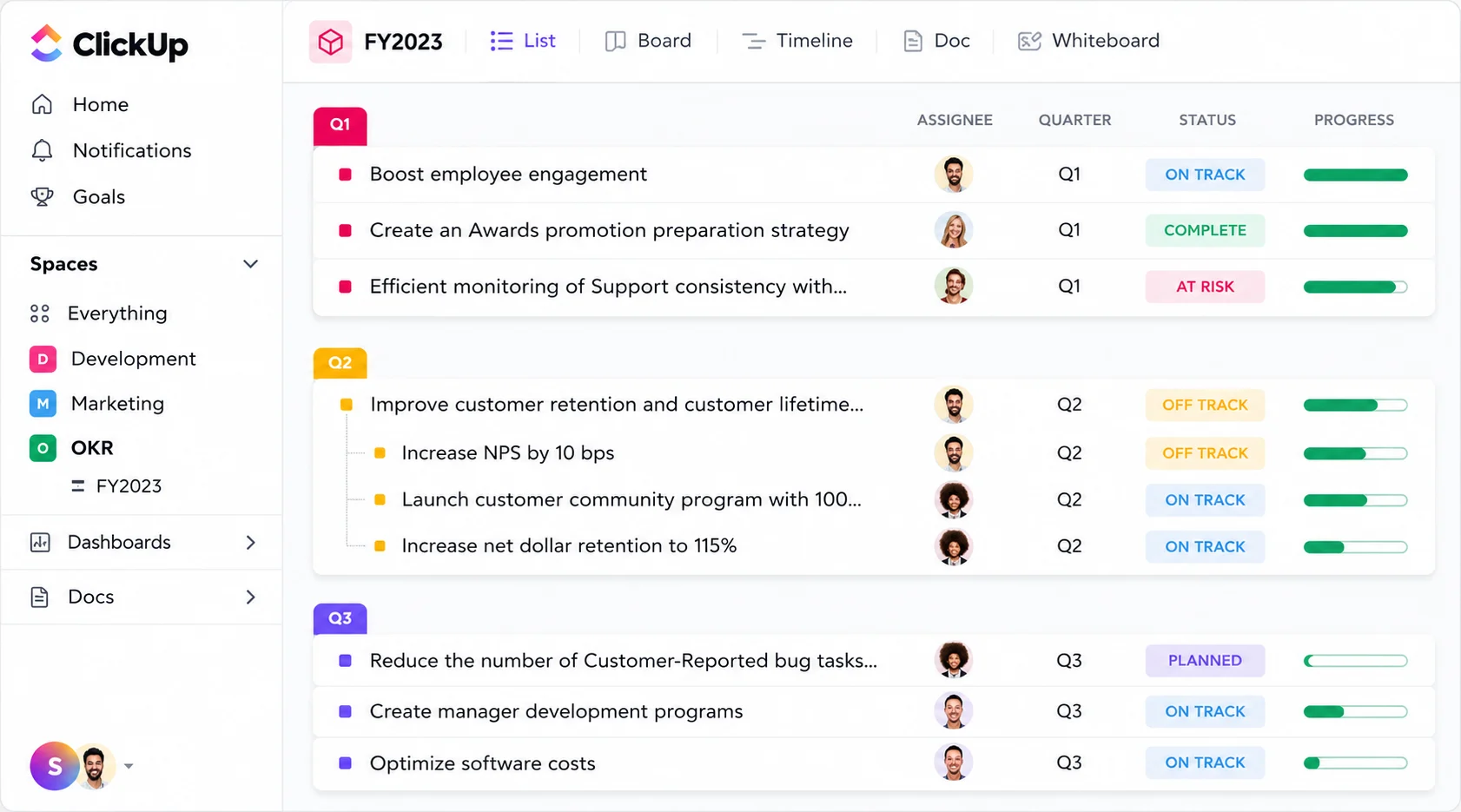
ClickUp embeds a dedicated Goals module within its all-in-one productivity suite, allowing teams to tie task completion directly to target milestones. For startups and small teams already living in ClickUp for daily work management, this native pairing provides a simple way to connect daily operational tasks to high-level numerical goals without context-switching between tools. "E-commerce teams in particular should also check our OKR guide for e-commerce for category-specific examples.
It works well for execution-heavy teams under 50 people where goal tracking is simply a roll-up of daily task lists. However, it fails to separate outputs (completing 10 tasks) from outcomes (moving a core business metric), which frequently leads teams down the output trap during quarterly reviews.
Lacks true OKR cascade architecture, alignment mapping, performance management intelligence, and automated coaching frameworks required for enterprise-wide programs.
A sensible starting point if your team already lives in ClickUp and needs lightweight task-to-goal tracking. If you are running an enterprise-wide OKR program requiring strategy alignment or performance intelligence, you will outgrow it quickly.
Businessmap
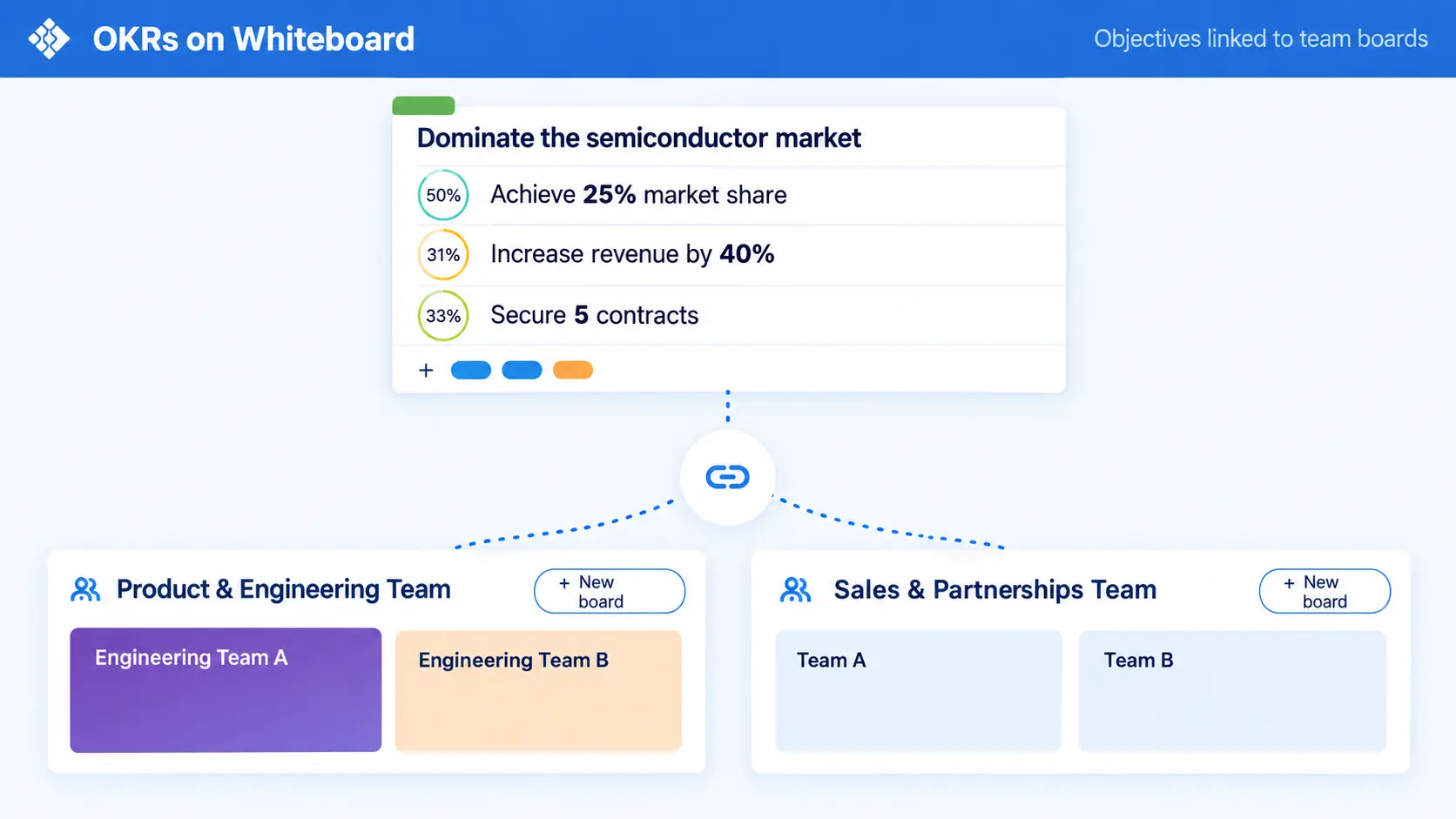
Businessmap is not an OKR-first product - it's an enterprise-agility and portfolio-management platform that added "Measurable Outcomes" (its OKR layer) on top of an existing Kanban and workflow engine. The pitch is the same one Oboard makes for Jira shops, but one layer up: instead of connecting Key Results to tickets, Businessmap connects Key Results to initiatives, which connect to the Kanban boards, which connect to the actual cards moving through "Requested → In Progress → Done." For portfolio-heavy engineering organisations already standardised on Lean/Agile, that's a genuinely different structure than a standalone OKR tool bolts on after the fact. It sits in the same conversation as the OKR software vs ERP goal modules question - a delivery system with goals attached, not a goals system with delivery attached.
This is the same output trap I flagged with Oboard, one layer up the stack: if the "measurable outcomes" being tracked are initiative completion rather than a genuine business outcome, Businessmap will report cleanly on the wrong number. It rewards organisations that have already done the coaching work to write real engineering OKR examples and understand measuring engineering productivity with OKRs - not organisations hoping the tool will teach them that distinction.
The OKR layer is secondary to the portfolio/Kanban engine, so teams outside engineering and delivery functions - sales, marketing, HR - tend to find the interface unfamiliar and over-built for their needs. No-tier pricing is simple but the per-user cost compounds like any other seat-based tool once you're cascading OKRs company-wide rather than just at the delivery layer.
If your organisation already runs Lean/Agile portfolio management and OKRs are being layered onto an engineering-heavy delivery org, Businessmap is worth a serious look. If you need company-wide OKRs across functions that don't think in Kanban terms, it will feel like the wrong tool wearing the right label.
10xWinners
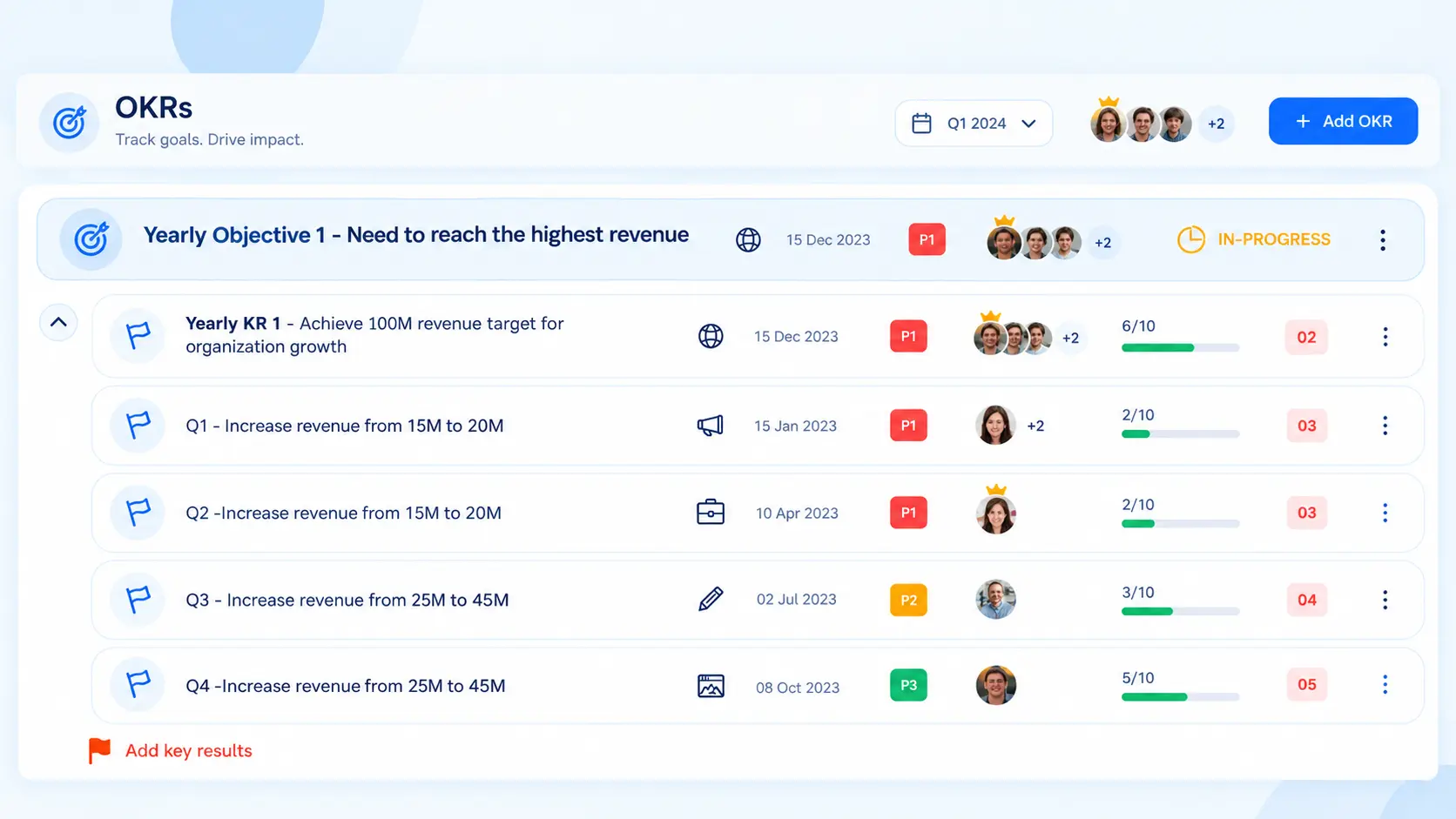
10xWinners is a lightweight, ChatGPT-integrated OKR and project-tracking tool priced to remove the "can we afford to try this" objection entirely - plans start at roughly $2/user/month. The AI-suggestion layer drafts OKRs from a keyword or short prompt, which addresses the same blank-page problem Tability's AI writer solves, at a fraction of the price. For teams asking whether they need free OKR software or an affordable OKR software option before they've validated the framework internally, this is one of the cheapest ways to run a real first cycle.
This belongs in the same category as SimpleOKR in my evaluation: a pilot tool, not a long-term system. Reviewers consistently flag thin integrations (Microsoft Teams and Slack only) and no dedicated mobile app - both of which matter less in a five-person startup's first quarter and matter a great deal by the time a team is scaling. The AI-suggestion layer is useful for the blank page, but it does not replace the coaching work of teaching a team to tell output from outcome - see how AI can meaningfully support that step in automating OKRs with AI versus where it can't.
No dependency mapping, no cascade-health visibility, limited analytics depth, and an integration list that will feel thin the moment a team grows past a handful of tools in its stack. This is squarely an OKR software for small teams starting point, not a platform built for cross-functional scale.
A reasonable way for a resource-constrained founding team to test whether OKRs stick before spending real budget - similar territory to what I'd tell anyone evaluating the benefits of OKR software for startups. Budget for outgrowing it within two or three cycles once the habit is real and the team has grown past ten people.
Monday.com
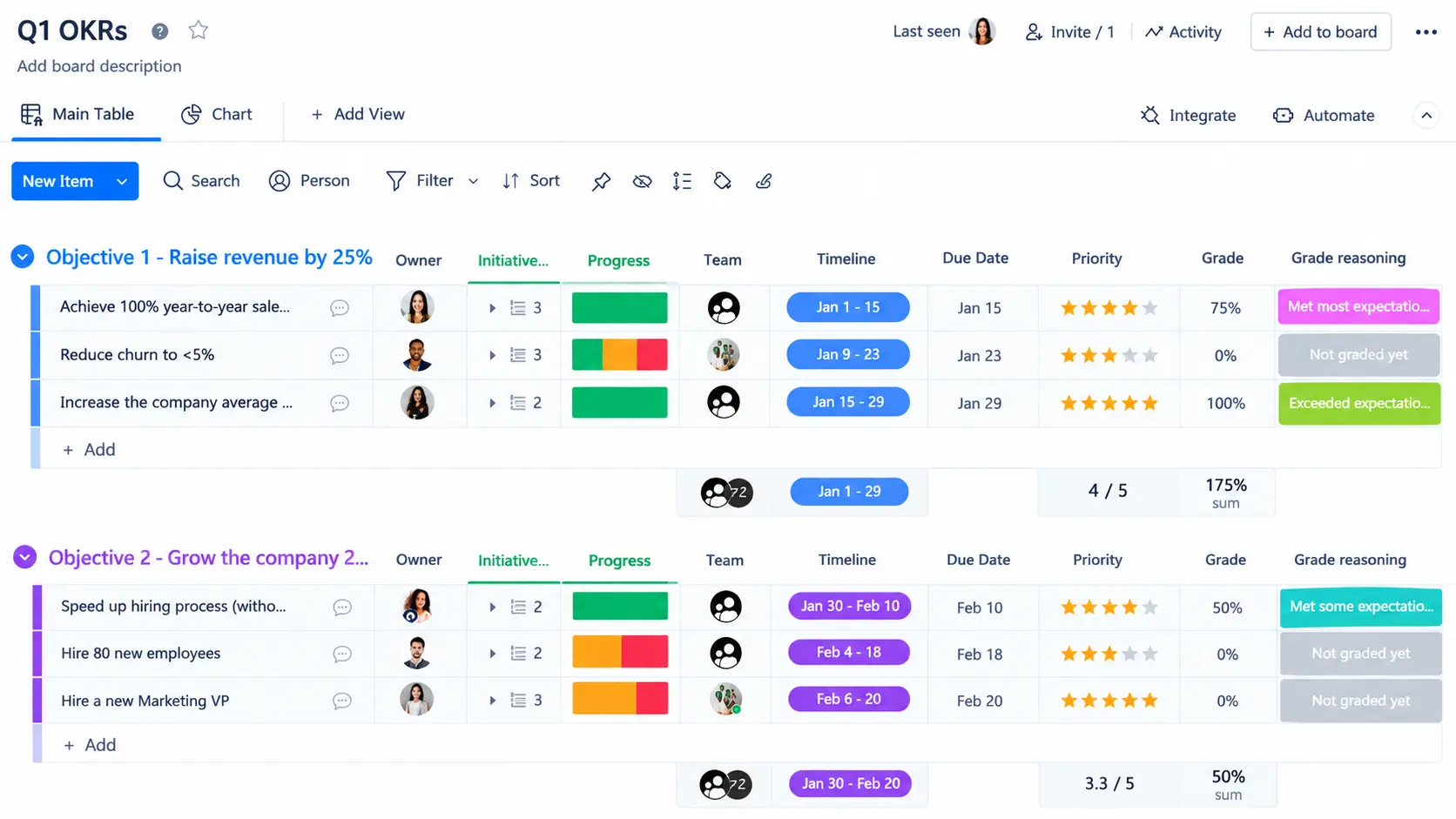
monday.com is a work-management platform, not a purpose-built OKR tool - and it is transparent about that positioning. Its Goals boards (and the third-party OKR Board app in its marketplace) let teams tie objectives directly to the task boards, timelines, and automations they're already running project work through. For an organisation asking OKR vs KPI software as a starting question, or comparing a dedicated tracker against a general-purpose spreadsheet vs OKR software approach, monday.com sits in an interesting middle position: more structure than a spreadsheet, less OKR-specific discipline than a dedicated platform.
The strength is real: when a Key Result is a rollup of tasks that are already being tracked in monday.com, the automatic progress updates remove a genuine adoption-friction point - similar to what Oboard does for Jira shops. The weakness is the one I see in every general-purpose tool asked to do OKR-specific work: there's no built-in guardrail distinguishing output tasks from outcome Key Results, and no coaching surface for a first-time OKR team. It is squarely an OKR tracking tool, not an OKR execution system.
Cascade architecture and cross-functional dependency mapping are not native concepts in monday.com's board structure - they have to be manually recreated with columns and formulas. Organisations report needing to buy the mid-tier plan or higher before goal-tracking features are genuinely usable, and AI features (risk detection, automated task generation) sit behind higher tiers.
If your team already lives in monday.com for delivery work and goal tracking is a secondary need, this is a reasonable way to avoid adding a vendor. If OKRs are the primary initiative and you need cascade, alignment, and coaching infrastructure, see how Worxmate compares before committing to a general-purpose tool for a purpose-built job.
Engagedly
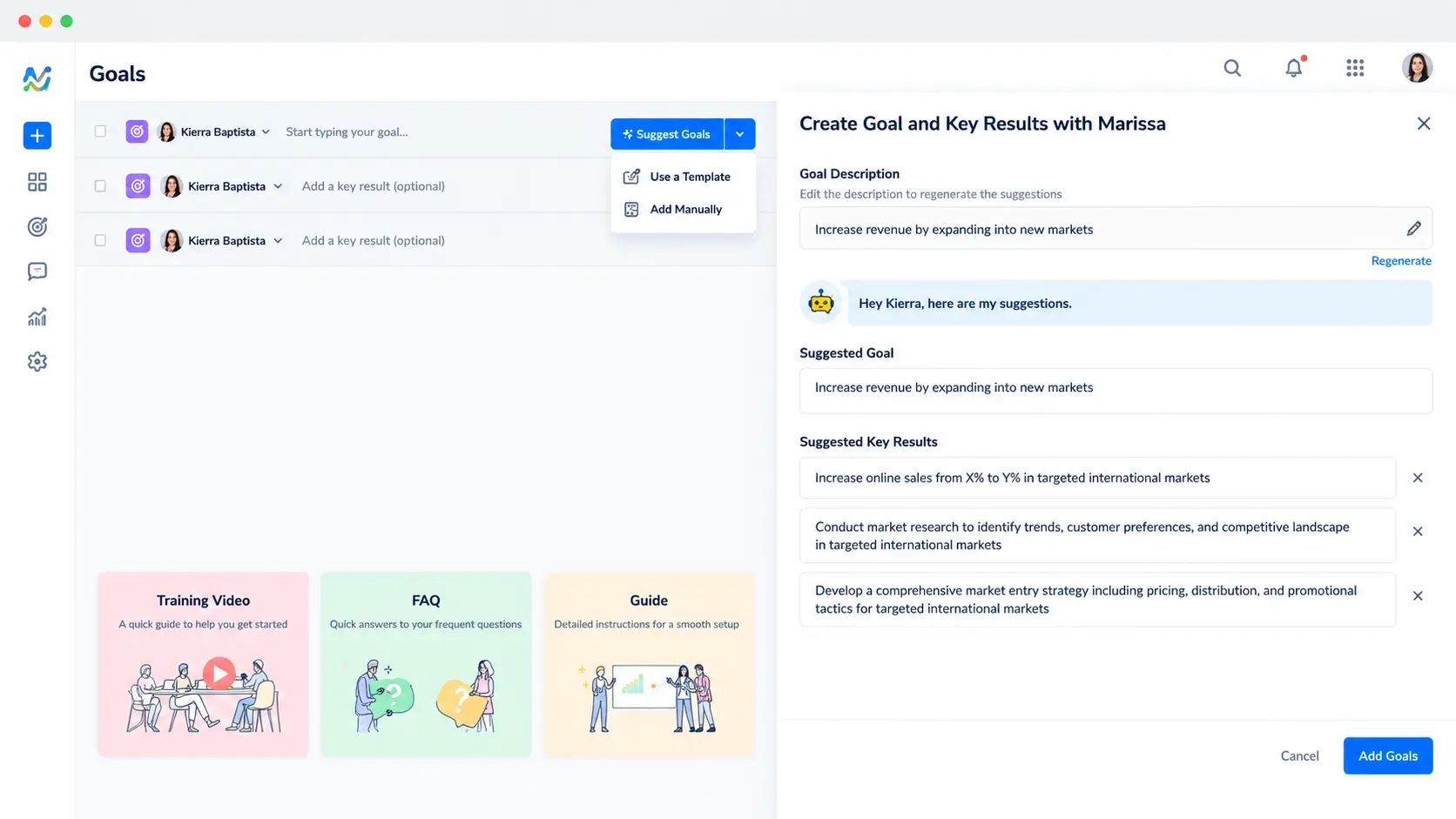
Engagedly is a modular talent-management platform - performance reviews, OKRs/goal management, 360 feedback, learning, recognition, and engagement surveys, sold as individual modules under one contract. Its AI layer, Marissa AI, provides coaching recommendations alongside the goal-cascading structure. This is the same category tension I flagged with Lattice and Leapsome above: for organisations weighing a performance management system vs appraisal software decision, or asking whether they need AI-driven performance management software at all, Engagedly is positioned as the lower-cost way to get Lattice-adjacent breadth.
The value case is real at the right size: teams currently paying for separate goal-tracking, LMS, and 360-feedback tools can often consolidate into Engagedly's per-module pricing for less than the sum of the parts. But exactly as with Lattice, when HR owns the OKR module inside a broader HR suite, the OKR habit tends to get absorbed into the HR review cycle rather than the operating rhythm of the business - which is the pattern I described earlier as the most common reason why OKR implementation fails below the C-suite.
A $7,500/year platform minimum makes the per-module pricing math painful under roughly 50 employees. Interface polish and analytics depth are consistently rated behind Lattice and 15Five, and initial configuration of review templates and workflows takes real setup time.
A sensible consolidation play for HR-led mid-market teams who currently juggle three or four separate vendors for goals, learning, feedback, and engagement. If OKRs are meant to be CEO-driven and business-rhythm-first rather than an HR-cycle feature, a dedicated HR performance management tool comparison is worth running before committing.
Workpath
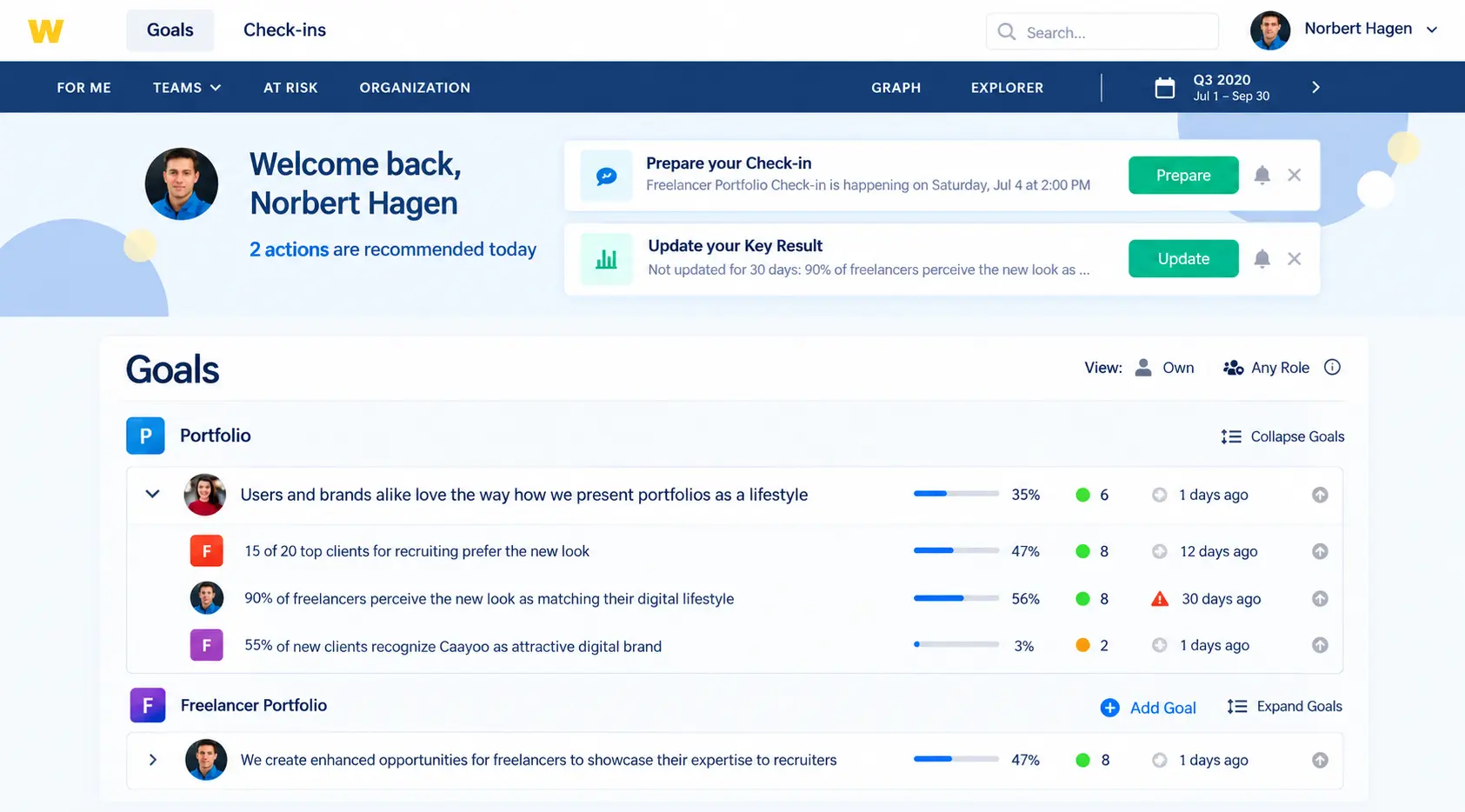
Workpath is a Munich-built enterprise OKR platform that sits closer to Quantive and Cascade in this review than to any of the check-in-habit tools — a modular outcome-management system rather than a lightweight tracker. Its 2025 AI Agent Hub is the clearest differentiator: four specialised agents that draft OKRs with organisational context, flag KPI risk before a cycle drifts, and prepare executive-ready summaries without a human assembling them manually. Paired with the Workpath Academy - built-in, research-backed education on goal-setting and planning - it's one of the few platforms in this review that treats coaching as a product feature rather than a services add-on, which is closer to the OKR training vs OKR coaching vs OKR certification distinction I opened this review with than most enterprise tools get. It also runs a dedicated Viva Goals Migration Program, making it one of the more credible landing points alongside Mooncamp and Teamflect for organisations working through the Microsoft Viva Goals retirement.
Workpath rewards the same profile of organisation as Quantive: mature data infrastructure, hundreds of goals running in parallel, and internal capacity to configure a genuinely modular system. Reviewers consistently flag the same gap I see across most AI-drafting features on this list - an agent can draft a well-formed OKR sentence, but it can't tell you whether the KR behind it is an output dressed as an outcome . That's still a coaching problem, not a product problem, and Workpath doesn't claim otherwise - its own reviewers ask for more support around OKR alignment and closing ceremonies, which is the human layer the AI Agent Hub doesn't replace.
No mobile app - a real gap for global organisations checking in from the field. Users report it's difficult to follow other teams' OKRs without deliberate configuration, and enterprise governance features (bulk updates, compliance-based restrictions) are described as thinner than the rest of the platform. Pricing is effectively enterprise/quote-based despite a low headline starting price, which adds the same evaluation friction I flagged with Quantive and Cascade.
If you're already comparing Quantive, Cascade or WorkBoard for a genuinely enterprise-scale OKR program, Workpath belongs on that shortlist - particularly if AI-assisted drafting and risk detection matter more to you than a polished mobile check-in experience. It is not a fit for the first-cycle, low-friction use case most of this review is written for.
What 10 years of OKR implementation actually taught me
Every OKR coach has a framework. Most look similar. The framework is not wrong - but it is not the whole story. After 50+ organisations, here are eight beliefs I no longer soften in client conversations. Before scaling your program across departments, mastering OKR best practices ensures your framework survives real-world operational friction.
“Output Key Results are not wrong - the confusion about them is.”
OKRs work best with a deliberate combination of output and outcome Key Results. The real problem isn't that organisations write output KRs - it's that they can't tell the difference. The intervention that works is teaching teams to identify which type they're writing and ensure their outputs serve a visible outcome. That's a thinking process, not a rule.
“Org structure is an OKR pre-condition - not background detail.”
If the structure doesn't reflect the leadership team's vision and current growth priorities, you're cascading goals into a broken architecture. Cascading OKRs through a misaligned structure does not reveal the misalignment. It embeds it.
“Bottom-up alignment is the right destination - not the right starting point.”
The principle is sound; the timing is wrong. Bottom-up alignment in the first two quarters produces noise, not alignment. Go top-down for two quarters with active coaching at every level, then transition deliberately toward bottom-up as capability develops.How you structure that cadence itself is a separate decision see quarterly vs. annual vs. continuous planning cycles for the tradeoffs. Empowerment without capability is not empowerment - it's an invitation to misalignment dressed as autonomy.
“Setting the C-suite's OKRs is the beginning of the implementation - not the deliverable.”
Writing OKRs with a leadership team is showing them the path up the mountain. Teaching them to climb is everything after - managing blockers mid-cycle, conducting honest check-ins, deciding what to stop doing, building internal capability to run the next cycle without external support.
“One completed OKR is worth more than five written ones.”
Genuinely completing one OKR - honest check-ins, real blockers surfaced and resolved, a OKR retrospective that produces something carried into the next cycle - requires discipline most organisations don't yet have in cycle one. Five OKRs written at every level, updated sporadically and scored generously, is not an OKR program. It's an OKR compliance exercise.
“Alignment is agreement - not a configuration in a tool.”
You cannot set alignment in a platform. You can only display it. A beautifully cascaded OKR tree is showing you the record of an agreement that either exists or does not. The platforms that understand this build features that facilitate the conversations that lead to alignment.
“Coaching must map to the individual's career background - not to a slide deck.”
A finance leader thinks in budget cycles, a product leader in sprint planning, a sales leader in pipeline. Deliver the same OKR training to all of them and you're asking each to translate a new framework through a lens you haven't acknowledged. Real capability development meets each leader where their career has left them. That's as much about leadership qualities as it is about OKR literacy. That requires 1:1 coaching, not group training.
“The real ROI metric is outcome-thinking penetration - not goal-completion rate.”
The metric I track: the percentage of leaders who can independently write a genuine outcome-driven goal without coaching support - the Execution Maturity Rate. In a typical first cycle it sits at 5–15%. After a year of well-coached implementation it reaches 30–40%. That movement - from 7% to 35%, to use a real example - represents the development of an organisation's collective capacity to think in outcomes. It's a useful companion question to what is quality of work at the individual level — outcome-thinking scales only when both are tracked. Track this number.
How to choose the right OKR software
Every organisation landing on a page like this is at a different point in its OKR journey. The mistake most make is evaluating features against a checklist rather than evaluating fit against their current reality.
If you're implementing OKRs for the first time
The most important question isn't which platform has the most features - it's which will help your leadership team experience what a good OKR cycle feels like, quickly, without configuration overhead.
- ›Fast time to first live cycle - if it takes more than a week to configure, the tool is working against you.
- ›Simple, low-friction check-in infrastructure - the weekly habit is the single most important thing to establish.
- ›Goal-quality support - AI-assisted writing that distinguishes output from outcome without a coach in the room.
- ›Flat or low-cost pricing - don't lock into per-user pricing before you've validated the approach.
If your previous OKR program collapsed
The first question isn't which platform - it's why the previous program failed.
- ›If the weekly check-in habit never took hold - Tability or 15Five, or Worxmate'sOKR check-in software.
- ›If goals were not genuinely outcome-driven - a platform with AI-assisted goal writing plus coaching that tackles output-vs-outcome confusion directly.
- ›If your goals became outdated, readadjusting OKRs: when and how to pivotbefore the next cycle.
- ›If alignment was never real - Worxmate, Perdoo or Quantive; all address cascade and dependency mapping seriously.
- ›If HR owned it without genuine CEO sponsorship - no platform resolves a sponsorship problem. That conversation needs to happen first.
If you're scaling a program that's working
The signal you need a more sophisticated platform isn't headcount - it's complexity. When cascade becomes difficult to manage manually and leadership asks for reporting that requires manual assembly, those are the signals.
If you're building a self-sustaining OKR capability
A self-sustaining capability means the organisation can run its own cycles without ongoing dependence on an external consultant. Track the Execution Maturity Rate, and build your platform selection and coaching investment around moving that number.
What happens when your entire organization aligns on what matters most
It was a very good experience — the workshop offered clear explanations not only on what OKRs are, but also on how to effectively implement them and achieve potential results. The three OKR training sessions provided a clear and practical understanding of how to set and align objectives..., made highly effective by an excellent trainer who kept the content engaging, relevant, and easy to apply. Maddy showed how skilled a trainer he his, someone who consistently challenged and encouraged the group to participate, communicated with clarity and ease, and brought the sessions to life with relevant examples.

Worxmate made OKR management smooth and organized. It's simple to use and keeps all our goals clearly on track.

It was well-structured, crisp, and insightful, and it was good learning the What-Why-How approach.... Maddy(The Coach) was very inclusive and respectful throughout, engaging and guiding the participants well.

Two ways to take this forward
If you've read this far, you're probably in one of two places - you know which platform you want to evaluate, or you know the platform isn't actually the first problem.
Ready to evaluate the platform
Worxmate is available to explore directly - no sales call required to see the product. The DEEP AI™ framework is the architecture of the product, not a marketing layer. Review pricing transparently at worxmate.ai/pricing .
You need the implementation, not just the platform
The OKR consulting programs I run are built around one outcome: your organisation running its cycles independently - with genuine alignment, honest execution and improving capability - within two to three quarters.
The software is the infrastructure. The coaching is the capability. You need both - and in the right order.
Worxmate Implementation Intelligence - 50+ live OKR implementations across enterprise, SMB and startup organisations, 10+ industries, APAC, Middle East and Europe · The ROI of OKRs: 2026 Benchmark Report.
Explore by geography, size and industry
This review is the global evaluation. If your context is more specific, these are the pages built for it — each draws on the same field data and criteria above, applied to a narrower situation:
By geography
OKR software USA · OKR software India · OKR software UK SMEs · affordable OKR tools UK · OKR planning for India · best OKR tools for US firms
By company size
OKR software for small teams · OKR software for startups · OKR software for mid-market companies · OKR software for enterprise · performance management software by company size
By industry
OKR software for IT companies in India · OKR software for pharma · OKR software for SaaS companies · OKR software for manufacturing in the US · OKR software for healthcare
Shortlists and comparisons
Top 10 OKR software · OKR tool comparison · best OKR tools · OKR software vs Excel · OKR software with alignment mapping · OKR software for managers
Frequently asked questions
What is OKR software and do I really need it?
OKR software is a purpose-built platform that manages the full execution cycle - goal writing, cascade alignment, weekly check-ins, progress tracking, retrospectives and cycle-over-cycle learning. You don't need it on day one; many organisations run a successful first cycle in a spreadsheet- see our take on OKR tracking spreadsheets and when to graduate off one. But as the program grows, the infrastructure that makes the habit sustainable stops being optional.
What's the difference between OKR software and an HRIS with OKR features?
HRIS platforms - Zoho People, Keka HR, Darwinbox and others - are built around HR workflows; for them, OKR is one of the features. For a dedicated OKR platform, it is the feature. That singular focus produces cascade architecture, check-in infrastructure and coaching surfaces an HR module cannot match.
Why do most OKR implementations fail?
Across 50+ implementations, the most common reasons recur: the program was pushed as a mandate rather than introduced with genuine sensitisation; coaching stopped at the C-suite, leaving middle managers without the tools to run honest check-ins; and goals were outputs dressed as outcomes. For the fuller list, see 10 common OKR mistakes to avoid.
How long does it take to implement OKR software?
For a purpose-built platform designed for fast implementation - Worxmate, Tability, Weekdone - a leadership team can be running a live first cycle within one week. Plan for two to three weeks of preparation, not for configuration but for the conversations that make the configuration meaningful.
What should I look for when evaluating OKR software?
Does the platform support sensitisation before goals are written? Does the goal-writing interface help teams distinguish output from outcome? Can it handle cross-functional co-ownership? How many steps to log a weekly check-in? Evaluate against your specific failure mode - our OKR software features checklist walks through this in more depth.
Is bottom-up or top-down OKR alignment better?
Both, at different stages of maturity. Bottom-up is the right long-term model, but in the first two quarters it typically produces misalignment dressed as empowerment. Go top-down for two quarters with active coaching, then transition deliberately toward bottom-up.
How do I measure the success of an OKR program?
Goal-completion rate is the most visible metric and the least meaningful. Track the Execution Maturity Rate - the percentage of leaders who can independently write a genuine outcome-driven goal without coaching support. It typically sits at 5–15% in a first cycle and reaches 30–40% after a year of well-coached implementation.
What is the DEEP AI™ framework, and how is it different?
DEEP AI™ - Define, Execute, Evaluate, Plan - is Worxmate's proprietary OKR execution framework, built from 10 years of live implementation across 50+ organisations. Standard methodology covers the what; DEEP AI™ covers the how - the full execution lifecycle that determines whether the methodology produces outcomes rather than just goals. The difference is a map versus a navigation system.