 WORXMATE
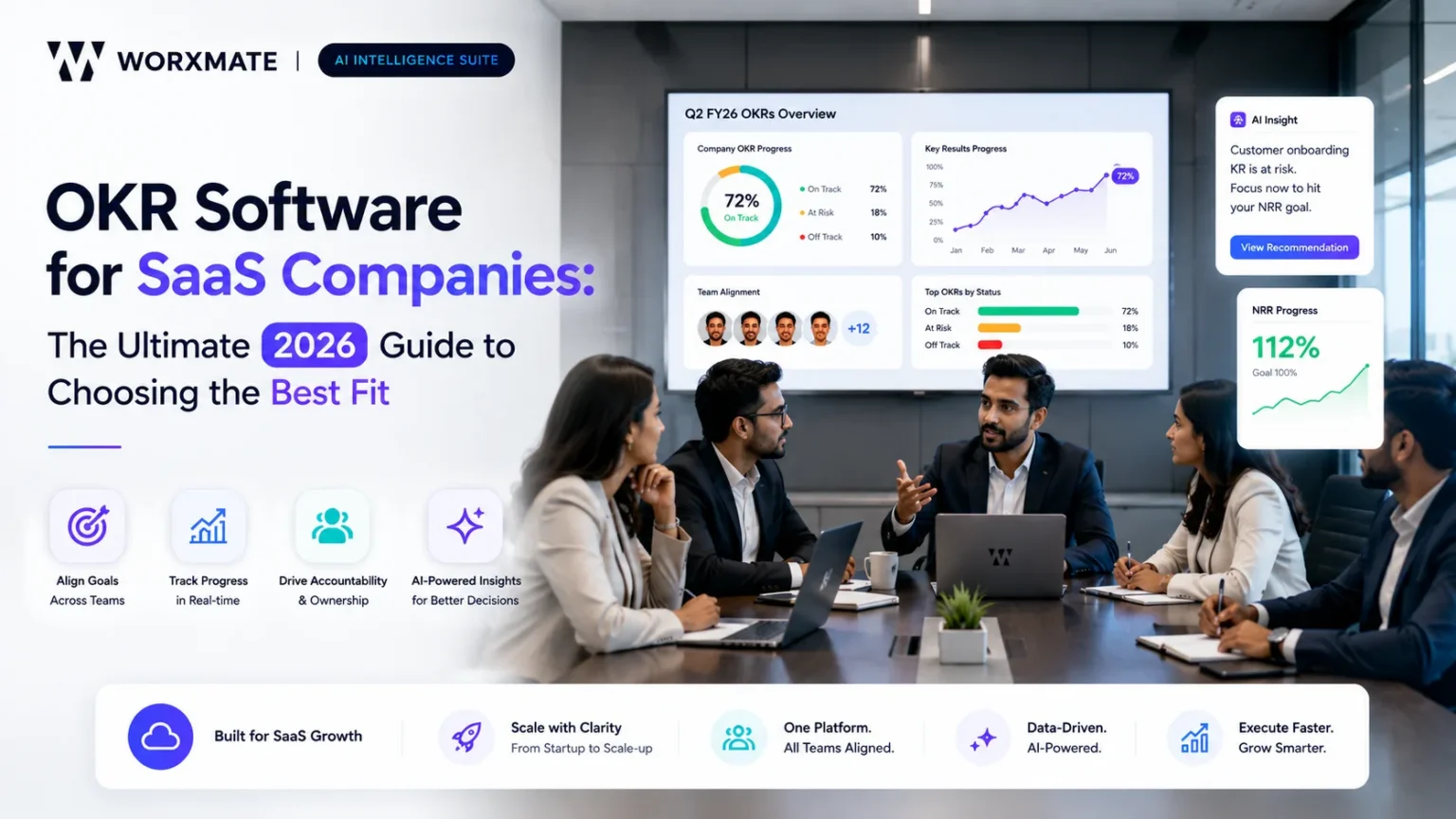
OKR software for SaaS companies should do three things well: link Key Results directly to revenue metrics like MRR and NRR, cascade goals across Product, GTM, and Customer Success instead of siloing them, and update in real time instead of once a quarter. This guide covers what to consider before you buy, a step-by-step way to select the right tool, and a detailed comparison of three purpose-built platforms Worxmate, Tability, and Quantive. Book a live walkthrough if you’d rather see it applied to your own numbers.
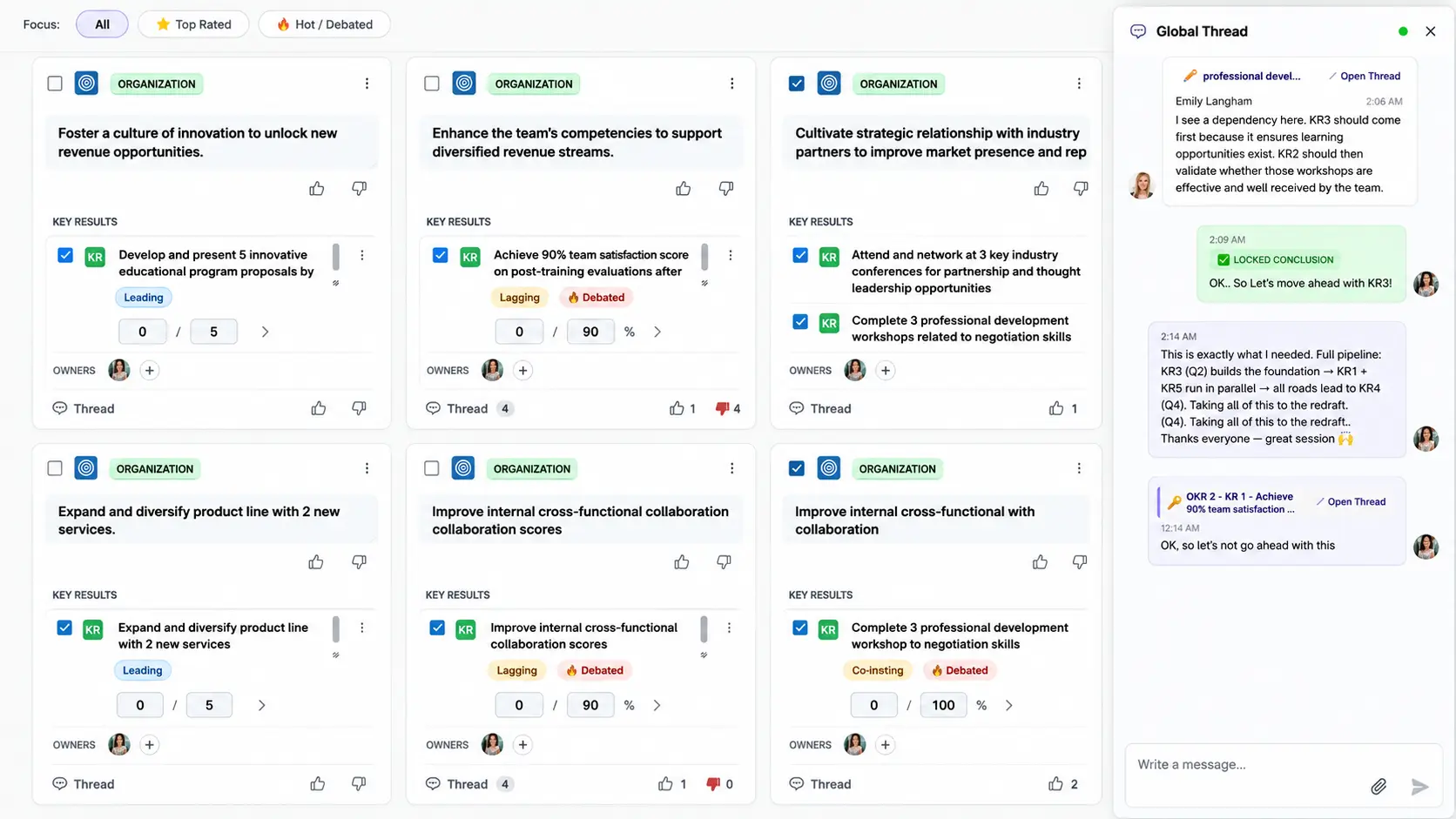
What This Guide Covers
By the end of this article, you’ll know:
- Why most generic OKR software breaks down inside a SaaS company’s growth cadence
- The exact criteria to evaluate before you shortlist any platform
- How OKR software differs from KPI tracking tools, spreadsheets, and performance management systems
- A detailed, honest comparison of three OKR platforms built for SaaS including full feature and pricing breakdowns
- The single most expensive buying mistake SaaS leaders make, and how to avoid it
- Where to go next, whether the gap is software, capability, or both
The Sync That Costs SaaS Companies Real Revenue
I sat in on a leadership sync at a Series B SaaS company last year. Product had just shipped a feature they’d spent six weeks on. Sales didn’t know it existed. Customer Success was on a call with a churn-risk account, explaining a workaround for a problem the new feature had already solved. Three teams. One number everybody was accountable for Net Revenue Retention. Zero shared visibility into who was moving it and how.
That’s not a communication problem. That’s the direct cost of running on OKR software built for generic enterprise goal-setting instead of a business where the metric that matters MRR, NRR, activation, churn moves every single week.
If you’re evaluating OKR software for SaaS companies right now, the platform you pick this quarter decides whether that leadership sync happens again next quarter or whether it becomes the exception. Get this decision right and you buy back weeks of wasted cross-functional effort every cycle. Get it wrong and you’re paying for a subscription your teams quietly stop using by month three, the same way a poorly chosen continuous performance management software stack ends up ignored by managers within a quarter.
Achieve Your Goals Faster
See how Worxmate can help your team set clear goals and achieve faster results. Book your free demo today and experience the power of AI-driven OKRs in action.
Why I’m Telling You This Straight
I’m Madhusudan Nayak (Maddy) Co-Founder and CEO of Worxmate. Before building Worxmate, I spent 20+ years in strategy execution and the last 10 specifically inside OKR implementation coaching 50+ organisations and training 500+ leaders across fintech, IT services, manufacturing, retail, and SaaS, from India to the Middle East to Europe. I ran Business Head at Profit.co and took it from zero to $11M in funding. I’ve watched more OKR software rollouts fail from the inside than most vendors have watched succeed which is why this isn’t a generic buying checklist. It’s the exact shortlist I’d hand a SaaS CEO before they sign anything, drawn from why OKR implementation fails in real companies, not from a vendor comparison spreadsheet.
Why Generic OKR Software Breaks Down in a SaaS Business
Most OKR platforms were designed around a quarterly cadence and a static org chart. SaaS doesn’t run on that clock. Your MRR moves monthly. Churn signals show up weekly. Your roadmap shifts based on usage data updated daily. When your goal-tracking tool only checks in once a quarter, by the time a Key Result turns red, the revenue is already gone.
The deeper problem is structural. Product, GTM, and Customer Success in a SaaS company aren’t three departments chasing three separate goals they’re three functions pulling on the same lever: retained and expanded revenue. Most OKR software treats them as silos with separate OKR trees that occasionally reference each other. That’s not alignment. That’s three teams hoping their spreadsheets eventually agree.
I’ve seen this exact pattern inside a 70,000-person IT services organisation and inside a 100-person European fintech startup different scale, identical root cause. Leaders couldn’t articulate outcomes in the right direction, and their goals stayed KPI-led: tracking numbers without clarity on what needed to change. In the fintech case, the fix wasn’t a better dashboard it was making the Product Lead and the Account Executive jointly own a single Key Result, demo experience → conversion, so neither function could escape accountability for the number they were both moving. That’s the level of cross functional team alignment most SaaS OKR software never forces, and it’s the same structural gap covered in how to fix team misalignment and cross team alignment.
OKR Software vs. KPI Tools vs. Spreadsheets: What SaaS Companies Actually Need
Before you shortlist a platform, it’s worth being precise about what you’re buying. A lot of SaaS teams conflate three different categories, and it leads to the wrong purchase.
OKR software is built for forward-looking, outcome-driven goal execution objectives with measurable Key Results, cascading across teams. KPI tools track lagging indicators the current state of a metric, not the direction you’re driving it. Spreadsheets track whatever you tell them to, with zero structure, zero automation, and zero accountability trail once more than five people touch the same file.
For a SaaS company, the honest answer is you need OKR software that also understands KPIs because your Key Results should be informed by KPI data (churn rate, activation rate, pipeline velocity) even though the OKR itself is outcome-framed. This is the exact distinction covered in OKR and KPI software in one framework, using OKR and KPI together, and OKR vs KPI software. If you’re earlier in the decision and still asking whether you need OKRs or KPIs at all, when to use KPI vs OKR and OKR vs KPI for startups are worth reading first, and KPI to OKR conversion walks through the practical migration if your team is currently KPI-only.
And if you’re still weighing whether your team even needs dedicated software over a tracking sheet, read spreadsheet vs OKR software and OKR software vs Excel first it’ll save you a wasted evaluation cycle. Most SaaS teams outgrow the OKR tracking spreadsheet stage the moment more than two departments need shared visibility into the same Key Result.
How to Choose OKR Software for a SaaS Company: The 6 Non-Negotiables
Here’s the checklist I’d hand a CEO or Strategy Head before they sit through one more vendor demo. This is the practical answer to how to choose OKR management software — applied specifically to SaaS.
| # | What to Check | Why It Matters for SaaS | What “Good” Looks Like |
|---|---|---|---|
| 1 | Revenue-linked Key Results | Objectives need to trace to MRR, ARR, NRR — not sit in isolation | KRs reference live revenue data, not manual entry |
| 2 | Stack integrations | Your team already lives in Jira, Slack, HubSpot, Teams | Native integrations see OKR software for Jira, OKR tools with Microsoft Teams integration, and OKR software integrations |
| 3 | Cross-functional cascade | Product, GTM, and CS share dependencies, not separate trees | Shared KR ownership across departments, built in |
| 4 | Real-time visibility | Monthly metrics need more than a quarterly check-in | Dashboards update continuously — see OKR dashboards real time and real time OKR tracking |
| 5 | Implementation speed | Growth-stage SaaS can’t burn 6–8 weeks configuring a tool | A live cycle running within the first week |
| 6 | Coaching, not just software | A tool doesn’t build outcome-thinking on its own | Vendor offers a guided path from setup to capability |
That last row is the one every vendor demo skips and it’s the one that decides whether you’re renewing this subscription next year or quietly cancelling it.
If your team is remote or hybrid, add integration depth to the checklist see OKR tracking for remote teams, remote OKRs, and how to write OKRs for remote teams. And before you finalize a shortlist, check whether HRIS integration matters for your org most SaaS companies don’t need it, but if you do, read OKR software integration with HRIS first, because it changes which platforms even qualify.
For a deeper breakdown of what these criteria look like as actual product features, see OKR software features and general OKR software challenges teams run into post-purchase.
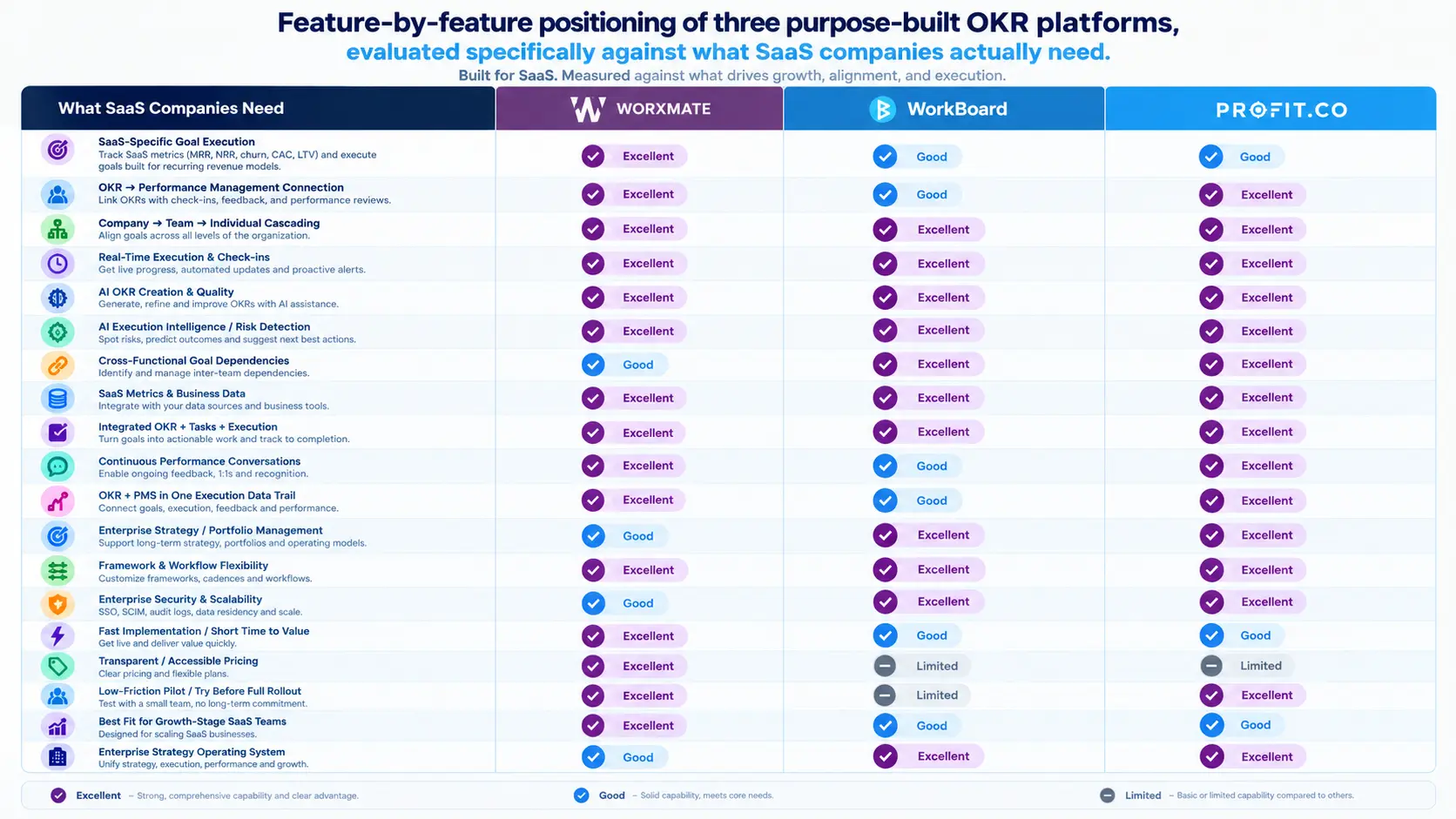
Which OKR Software Is Best for SaaS Companies? 3 Platforms Compared
I’ll compare three purpose-built OKR platforms here, and I’ll say upfront: one of them is Worxmate, which I built. I’m not going to pretend that’s neutral. But I will tell you exactly where the other two win, because a 15-person SaaS team and a 300-person one are not shopping for the same tool.
One category note before the comparison: HRIS platforms with a goals module bolted on – Zoho People, Keka, Darwinbox don’t belong in this comparison at all. For them, OKRs are one feature among fifty. For the three tools below, OKR execution is the entire product, and that distinction changes everything about how the tool is built. It’s the same category distinction that shows up when comparing dedicated tools against Alternative to Oracle HCM or Alternative to PeopleStrong HR suites are excellent HR systems, and the wrong tool for serious OKR execution.
1. Worxmate :- Built for the SaaS-Specific Gap
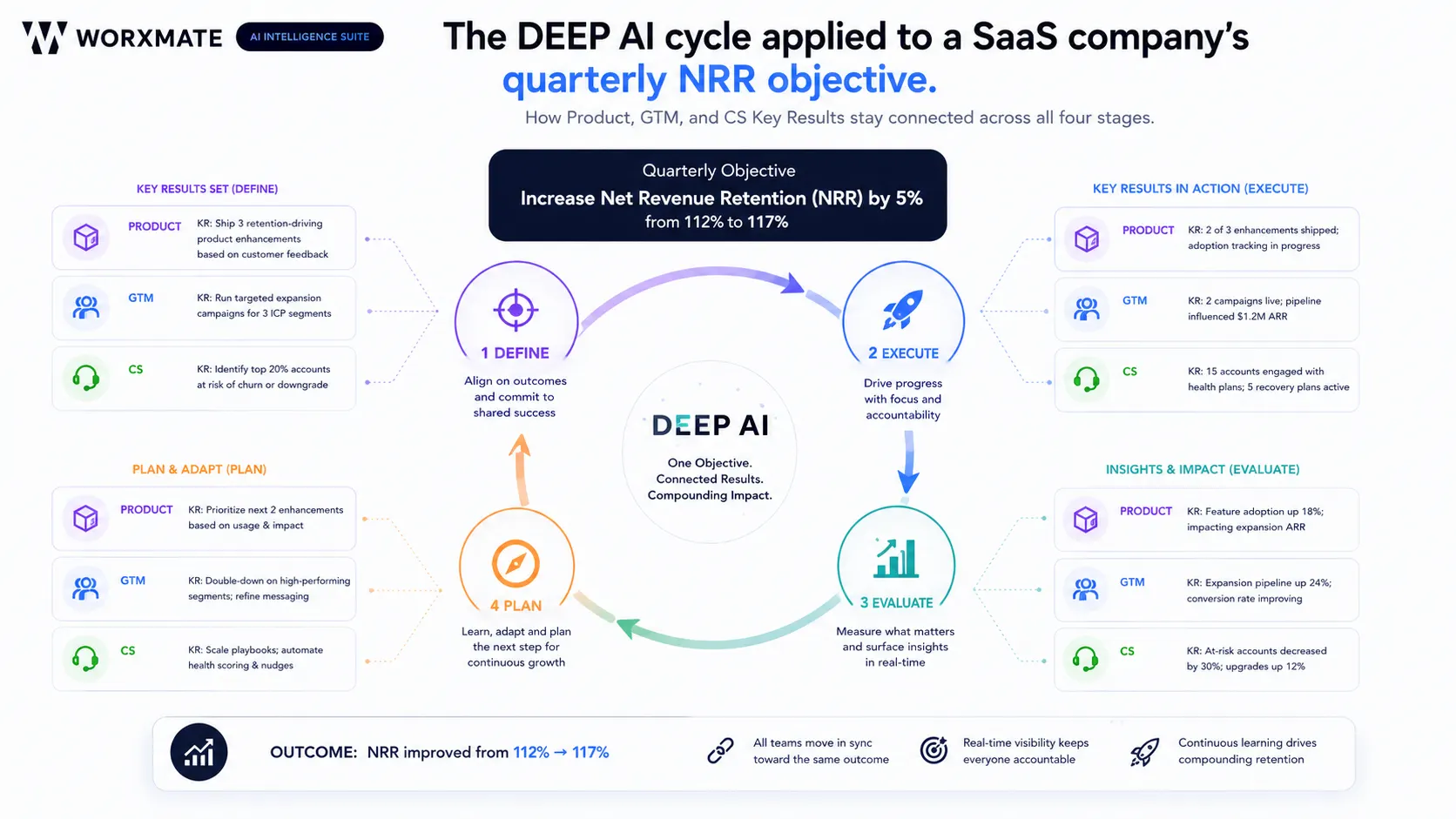
Worxmate is built specifically around the problem this article opened with the gap between what SaaS teams measure (MRR, NRR, activation) and what most OKR software tracks (generic objective completion). It runs on the DEEP AI framework — Define, Execute, Evaluate, Plan which isn’t a feature layered on top of a goal tracker, it’s the product’s architecture.
Here’s what that means for your team, concretely:
- The AI OKR writing tool (Define stage) flags a Product Lead in real time if they’ve written an output (“ship the integration”) instead of an outcome (“reduce activation time by 30%”).
- The OKR check-in software (Execute stage) catches at-risk goals before the monthly review, not during it the same principle behind a good OKR check-in meeting template, automated.
- Axis AI – Worxmate’s business performance intelligence model reads your OKR data and isolates the fastest lever to pull when revenue or execution falls behind.
- Orbit AI flags attrition and burnout risk in your GTM and engineering teams 4–8 weeks before it shows up as a resignation.
- Nexus AI maps exactly where your cascade from company OKRs to team OKRs is breaking structurally as you scale from a 20-person to an 80-person org.
- The OKR scorecard software (Evaluate stage) separates real progress from vanity metrics, and the OKR retrospective tool (Plan stage) turns each cycle’s data into next-cycle recommendations automatically.
Implementation is designed to have your leadership team live inside a real cycle within the first week, not the first month.
Best fit: SaaS companies from Series A through growth stage who need revenue-linked cascade and don’t have the internal bandwidth to run OKR coaching themselves.
Pricing: Vital, Proficient, and Enterprise tiers, with yearly-plan savings up to 25%. Full breakdown on the OKR software pricing page. If cost per seat is your primary constraint, also see OKR software cost per user for how that compares across the category.
2. Tability :- Strong for Habit-Building, Not for Scale
Tability is, in my honest assessment, the best automated check-in infrastructure on the market right now. If your SaaS team’s biggest problem is that OKRs get written once and never touched again, Tability solves that specific problem better than almost anyone.
Where it runs out of road for a SaaS company is cascade depth and strategy mapping it solves the reminder problem, not the reflection problem. A 10-person SaaS team will outgrow it within two cycles the moment they need real cross-functional dependency mapping between Product and GTM. Pricing is typically per-user with a lighter entry point, which makes it attractive for early-stage teams testing whether OKRs stick before investing in something heavier.
Best fit: pre-Series A SaaS teams running their first or second OKR cycle who need habit-building more than architecture. See the full side-by-side: alternative to Tability.
3. Weekdone :- Simple to Start, But You’ll Outgrow It Fast
Weekdone pairs weekly planning with OKR tracking in a single view, and for very small teams that’s genuinely appealing — objectives, key results, and weekly check-ins live on one screen instead of scattered across tools. It’s an easy tool to pick up in week one.
That simplicity is also where it stops. The interface hasn’t kept pace with what teams expect from a modern execution platform, and the weekly-planning layer that makes Weekdone approachable at 15 people starts working against you once cascading objectives, cross-team dependencies, and quarterly reviews enter the picture. Pricing is per-user, and Weekdone’s value proposition thins out fast once headcount clears 20 — you’re paying enterprise-adjacent rates for a tool that was designed for a single team’s weekly rhythm, not an organisation’s strategy layer.
Best fit: very small teams (under 20 people) running lightweight weekly OKR check-ins with no cascade, no cross-functional alignment need, and no near-term plan to scale the program. See the full side-by-side: alternative to Weekdone.
Other Platforms Worth Knowing About
A few more tools come up often enough in SaaS OKR searches that they’re worth a mention, even though they didn’t make the primary three:
- Perdoo — strong strategy mapping, OKR + KPI in one framework, but a dated interface. See alternative to Perdoo.
- Profit.co — feature-complete but configuration-heavy, with a 4–6 week runway before your first cycle runs. See alternative to Profit.co.
- Monday.com and 15Five — general work-management or check-in tools with OKR features added on, not purpose-built OKR platforms. See alternative to Monday.com and alternative to 15Five.
- Betterworks and Leapsome — stronger for large-enterprise manager effectiveness and L&D-driven capability building respectively, less suited to a fast-moving SaaS growth team. See alternative to Betterworks and alternative to Leapsome.
If Microsoft Teams is your team’s home base, note that Microsoft Viva Goals was retired in December 2025 if you’re migrating off it, that’s a separate and increasingly common evaluation path worth reading before you shortlist anything else. For a broader side-by-side across more tools at once, OKR tool comparison and top 10 OKR software are useful starting points, and best OKR tools rounds out the category view.
Feature and Pricing Snapshot
| Platform | Best For | Revenue-Linked KRs | Cascade Depth | Implementation Speed | Pricing Model |
|---|---|---|---|---|---|
| Worxmate | Series A–growth stage SaaS | Yes — Axis AI links KRs to revenue levers | Deep, AI-mapped (Nexus AI) | Live in week one | Tiered (Vital/Proficient/Enterprise), yearly savings up to 25% |
| Tability | Pre-Series A, first OKR cycle | Limited — manual entry | Shallow | Fastest to set up | Per-user, lighter entry point |
| Weekdone | Very small teams (under 20 people) | No — single-team weekly view, not built for cascade | Minimal, basic integrations only | 1–2 weeks typical2 weeks typical | Per-user, thins out past 20 users |
🎯 My honest take
if you’re a SaaS company past your first OKR cycle and you’re feeling the specific pain of Product, GTM, and CS not sharing visibility into the same revenue number, that’s the exact gap Worxmate was built to close — not because it has more features on a checklist, but because I built it after watching that breakdown happen inside real SaaS and fintech implementations.
Applying the DEEP AI Framework to a SaaS OKR Cycle
Here’s what this looks like applied to an actual SaaS scenario Company OKR: grow NRR by 8 points this quarter.
- Define: The Product team’s KR isn’t “ship the onboarding redesign” that’s an output. It’s “reduce time-to-first-value from 12 days to 5 days,” with the redesign as one initiative feeding it.
- Execute: GTM’s KR expansion pipeline from existing accounts and CS’s KR reduction in at-risk account flags both reference the same product milestone.
- Evaluate: Axis AI flags that NRR is tracking behind target and isolates that the gap is concentrated in accounts that haven’t adopted the new onboarding flow yet a product adoption problem, not a GTM pipeline problem.
- Plan: The retrospective feeds directly into next quarter’s Define stage, so the same misalignment doesn’t get rediscovered from scratch.
This is what I mean when I say alignment is agreement, not a configuration in a tool. You cannot set alignment in software. You can display it once it exists. This principle also shows up in goal alignment, OKR alignment, and organizational alignment worth reading if alignment, not tooling, turns out to be your actual gap.
What This Looks Like When It Works
I’ve watched this pattern resolve inside organisations far larger than most SaaS companies reading this a $45 billion Middle East energy company, an 8,000-person utility and the mechanism is identical at SaaS scale. When Product and CS share visibility into the same Key Result instead of separate dashboards, the org stops duplicating effort and starts sharing ownership.
For SaaS specifically, the metrics that should sit as Key Results not vanity dashboard numbers are:
- MRR/ARR growth rate
- Net Revenue Retention (NRR)
- Feature adoption rate within 30/60/90 days
- Sales cycle velocity for expansion deals
- CS-flagged at-risk account count, trending down
If your current tool can’t connect a Key Result to any of these without a manual spreadsheet pull, that’s your answer on whether it’s built for SaaS or just adapted for it. For more on choosing the right metrics, see OKR tracking metrics, team OKR tracking, and OKR tracking tools.
If you want to see how other SaaS and revenue-focused teams have written these Key Results in practice, OKRs for SaaS companies, SaaS OKR examples, and B2B SaaS sales OKR examples are worth a separate read this article focuses on the software decision, those focus on the goal-writing itself. Adjacent examples worth checking depending on your function: product market fit OKRs, revenue operations OKRs, startup engineering OKRs, and startup founder OKR.
The Buying Mistake That Costs the Most
The most expensive mistake I see isn’t picking the wrong tool feature-for-feature. It’s buying OKR software before the organisation has answered a much more basic question: can your leadership team articulate three company-level priorities clearly enough for every function to derive their own OKRs from them? I’ve sat with a CEO in aggressive growth mode who could not define his top three priorities in 45 minutes — not because he wasn’t sharp, but because nobody had ever asked him to compress the vision into something an organisation could cascade from. No software fixes that gap.
This is also why why OKR implementation fails, OKR implementation hurdles, and common OKR mistakes to avoid so often trace back to timing, not tooling. And it’s why most engagements that stop at the leadership layer die within one quarter — a pattern I call the coaching cliff. Software bought without a plan for coaching past the C-suite fails the same way every time, regardless of how many integrations it has.
If you’re weighing whether the real gap is software or capability, why OKR coaching fails and top mistakes to avoid when setting OKRs are both worth reading before you sign anything. And if your team is brand new to the framework entirely, start with what is OKR and how to write OKRs before evaluating any platform buying software before the team understands the framework is the fastest way to end up with an expensive, unused tool.
A Note on SaaS Company Size and Stage
Not every SaaS company needs the same depth of platform. If you’re under 20 people, look at what’s realistic for your budget first, see affordable OKR software, free OKR software, and OKR software for small businesses. Once you’re past 50–80 people and structurally more complex, OKR software for mid-market companies and OKR software for enterprise become the more relevant category. If your SaaS company also has a strong mobile or field team, best OKR apps for mobile is worth a quick look before you finalize a shortlist, and if managers specifically will be the primary daily users, OKR software for managers covers that angle directly.


Written by
An OKR Coach with 20+ years of implementation experience, Madhusudan has guided over 50 organisations through successful OKR transformations, training more than 500 leaders. Learn more about Worxmate.