 WORXMATE
Goal tracking software is a platform that records company, team and employee goals, updates progress through regular check-ins, and shows leaders a live goal tracking dashboard with at-risk goals flagged early. In 2026 the best goal tracking software depends on your situation: Worxmate for execution plus people intelligence (from $3 per user per month), Tability or 15Five for the check-in habit, Perdoo or Quantive for strategy depth, Teamflect for Microsoft Teams, and ClickUp, monday.com or Asana when goals must sit beside project work. Choose by how your goals are written and reviewed, not by feature count.
Pricing checked September 2026 from vendor pages and public listings. Confirm current rates before you buy.
By Madhusudan Nayak (Maddy), Co-Founder & CEO, Worxmate. 20+ years in strategy execution, 10+ years of OKR implementation, 50+ organisations coached, 500+ leaders trained. I co-founded Worxmate, so I have said plainly where it is not the right fit.
Why goal tracking software fails before anyone logs in
In a European fintech of about 100 people, I asked the CEO and the CPO one question in our first coaching session: “What is the one big thing you want to resolve?”
They had dashboards for everything: revenue, demo requests, trial starts, churn. Every goal was KPI-led, and not one told the team what needed to change. The answer to my question was product demo experience, and it appeared on no dashboard at all.
So I asked “so what?” If you fix the demo, so what? What happens next? Four or five rounds later we had an outcome statement instead of a metric. Then the Product Lead co-owned a Key Result with the Account Executive, something that had never happened in that company. Two to three quarters later product and commercial were moving together and dependencies were mapped before they turned into surprises.
I tell you this before comparing a single tool because it is why most tools disappoint. The software tracked what it was given. Nobody had decided what deserved tracking.
If you are searching for goal tracking software this month, you are probably feeling one of three things. Your goals live in a spreadsheet nobody opens after week three. Your managers discover at-risk goals in the review meeting, not in week four. Or your leadership team asks for a status and someone spends two days assembling it. The right tool fixes all three. The wrong one, bought first, makes them expensive.
“You cannot set alignment in a tool. You can display it. You cannot create it.” Maddy, after 50+ implementations
What goal tracking software has to do (and what breaks without it)
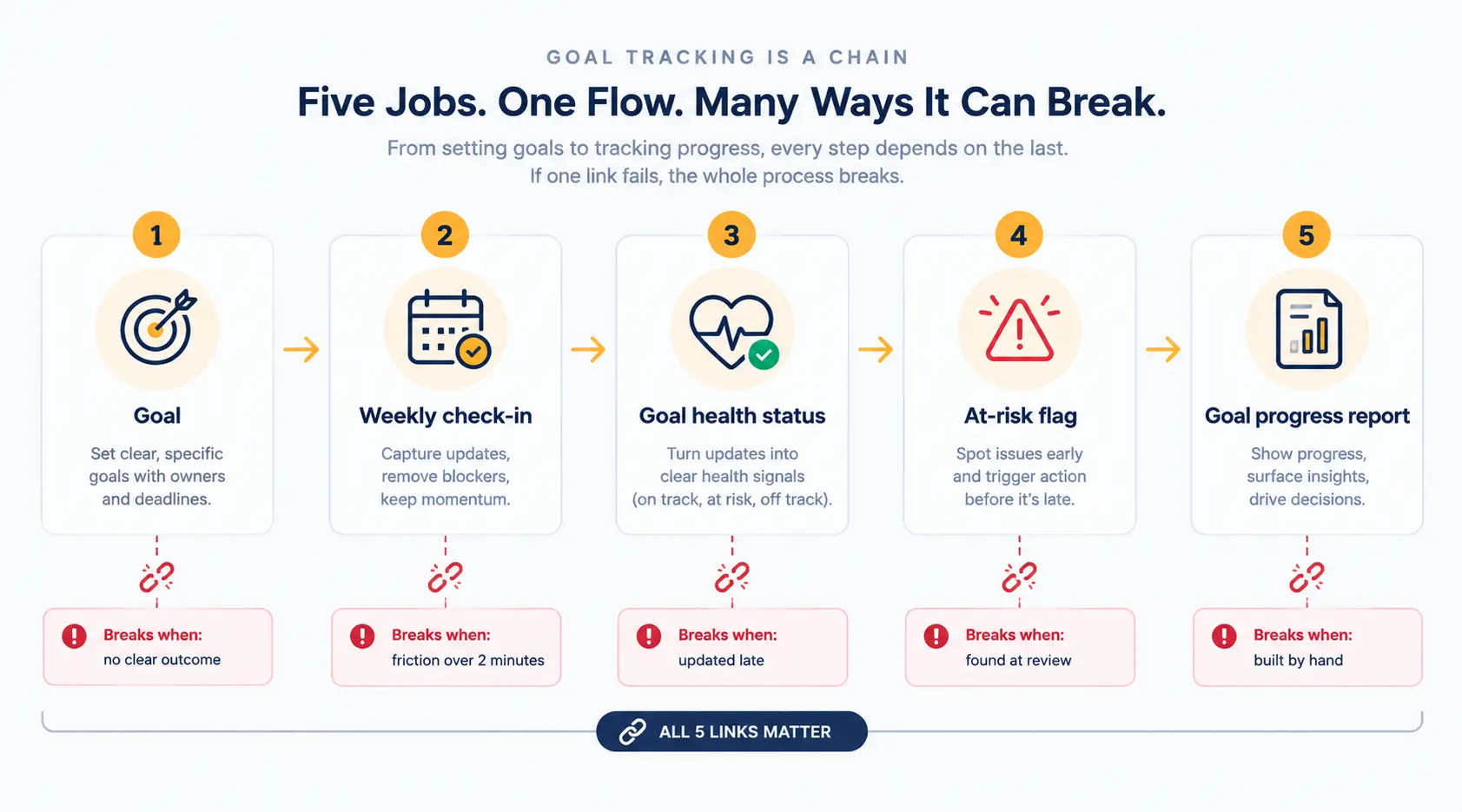
Five jobs decide whether a tool earns its licence fee. Here is what breaks when each one is missing.
- Without goal visibility, leaders learn a goal slipped at the quarterly review. A goal tracking dashboard shows goal health status and slipping goals while there is still time to act.
- Without weekly goal tracking, quarterly goal tracking becomes an autopsy. A goal progress tracker that takes more than two minutes to update loses to Slack every time. A team raising 15 to 20 product queries a day in week one will break adoption within weeks.
- Without cascading goals, goal alignment across teams stays a slide. Alignment is agreement, and a tool can only display it. See goal alignment.
- Without goal tracking and reporting, somebody builds the monthly review deck by hand. Good reports write themselves from the data.
- Without goal tracking integrations, people type the same update twice, in Jira and again in the tool, and then stop doing either.
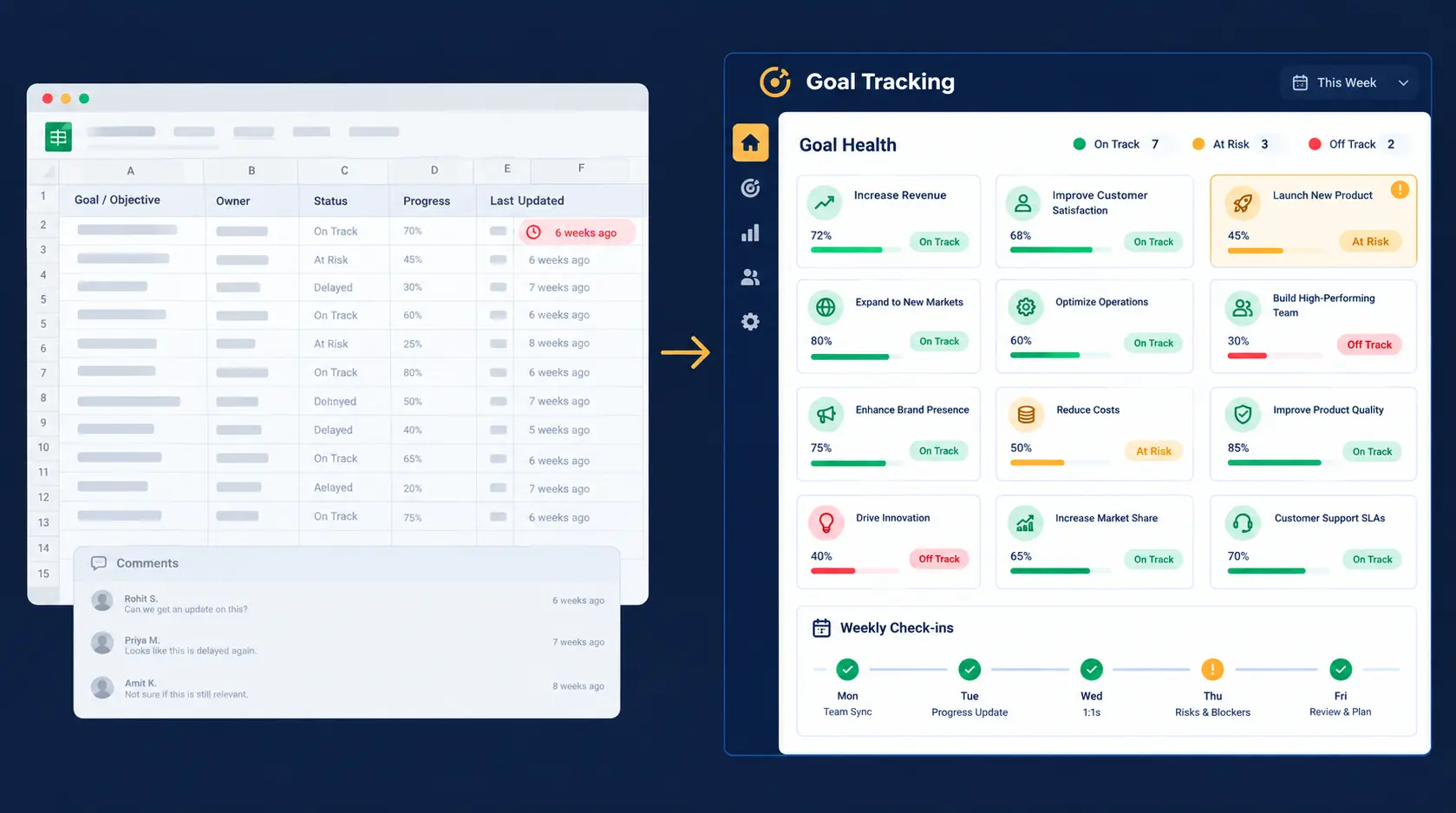
Goal tracking spreadsheet vs software
A goal tracking template in a sheet is a fine place to start, and I have seen successful first cycles run on one. For the long version, read OKR tracking spreadsheet and spreadsheet vs OKR software.
| Situation | Spreadsheet or goal tracking template | Goal tracking software |
|---|---|---|
| One team, under 20 goals | Works well, costs nothing | Overkill in cycle one |
| Check-in reminders | Manual, first to fail | Automated, at a set cadence |
| Spotting slipping goals | Someone has to read every row | Flagged automatically |
| Cross-team alignment | Copy-pasted, stale by week three | Cascade shown live |
| Leadership reporting | Assembled by hand | Generated from live data |
One completed goal, with honest check-ins, real blockers surfaced and a retrospective, is worth more than five goals written and tracked loosely. Whatever you choose, start there.
Is your goal tracking a habit or a hope?
Score your organisation on the OKR Execution Maturity Framework 2026 before you shortlist any tool. It shows whether the gap is your software or your goal quality.
How I evaluated the best goal tracking software
I scored every tool on six things I have watched break in real programmes. For the OKR-specific version of this test, see my OKR software field report and the how to evaluate OKR software guide.
- Time to first live goal. If setup takes more than a week, the tool is working against you.
- Check-in friction. How many steps to log an update? Habits break at friction.
- Dashboard and at-risk signals. Does it warn you mid-cycle or only report afterwards?
- Alignment visibility. Can you see how goals connect across teams, including cross-functional co-ownership?
- Integrations. Does progress flow in from Jira, Slack, Teams, Sheets or your CRM?
- Cost behaviour at scale. Does per-seat pricing become a growth tax as you hire?
Use the OKR software features checklist to build your own scorecard of goal tracking software features.
Goal tracking software comparison: 17 tools at a glance
This goal tracking software comparison covers purpose-built platforms, people platforms with goals attached, and work management tools with a goals module. Whether you need employee goal tracking software, team goal tracking software or one view for the whole company, the watch-outs sit in the reviews below. Prices with a tilde are indicative figures from Worxmate’s own pricing comparison, not vendor quotes.
| # | Tool | Best for | Goal tracking strength | Starting price |
|---|---|---|---|---|
| 1 | Worxmate | Mid to large orgs wanting execution plus people intelligence | At-risk detection, cascade health, DEEP AI | From $3/user/mo (annual, 11-user minimum); free qualified pilot |
| 2 | Mooncamp | Mid-market needing visual alignment | Strategy map, Slack and Teams check-ins | From €6/user/mo |
| 3 | Tability | Weekly check-in habit | Automated check-ins, AI drafting | From $6/user/mo |
| 4 | Perdoo | Strategy-heavy teams | Goals and KPIs in one framework | Free up to 5; from €8/user/mo |
| 5 | Weekdone | Small disciplined teams | Weekly planning and goals together | Free up to 3; $10/user/mo |
| 6 | Profit.co | Governance-heavy enterprise | Weighted scoring, KPI linkage | Quote-based |
| 7 | Quantive | Enterprise with data infrastructure | Live data feeds into goals | Quote-based |
| 8 | Peoplebox | Scale-ups on Slack and Teams | Check-ins inside collaboration tools | From $8/user/mo |
| 9 | Lattice | HR-led orgs already on Lattice | Goals linked to review data | Quote-based (~$16/user/mo) |
| 10 | 15Five | Manager-led weekly conversations | Check-ins plus engagement pulse | From $4/user/mo |
| 11 | Betterworks | Large enterprise, manager effectiveness | Goals tied to continuous performance | Quote-based (~$8 to $15) |
| 12 | Leapsome | People leaders linking learning | Goals, reviews and learning together | Quote-based (~$10 to $16) |
| 13 | Teamflect | Microsoft 365 organisations | Goal tracking inside Teams | Free up to 10; $3 to $7/user/mo |
| 14 | Range | Remote-first, async teams | Daily check-ins plus goals | Free up to 12; from $8/user/mo |
| 15 | ClickUp | Teams already in ClickUp | Goals rolled up from tasks | Free; $7 or $12/user/mo tiers |
| 16 | monday.com | Teams running work boards | Goals boards tied to task boards | Free up to 2 seats; from $9/seat/mo |
| 17 | Asana | Teams running projects in Asana | Goals linked to projects and portfolios | Goals on Advanced, $24.99/user/mo annual |
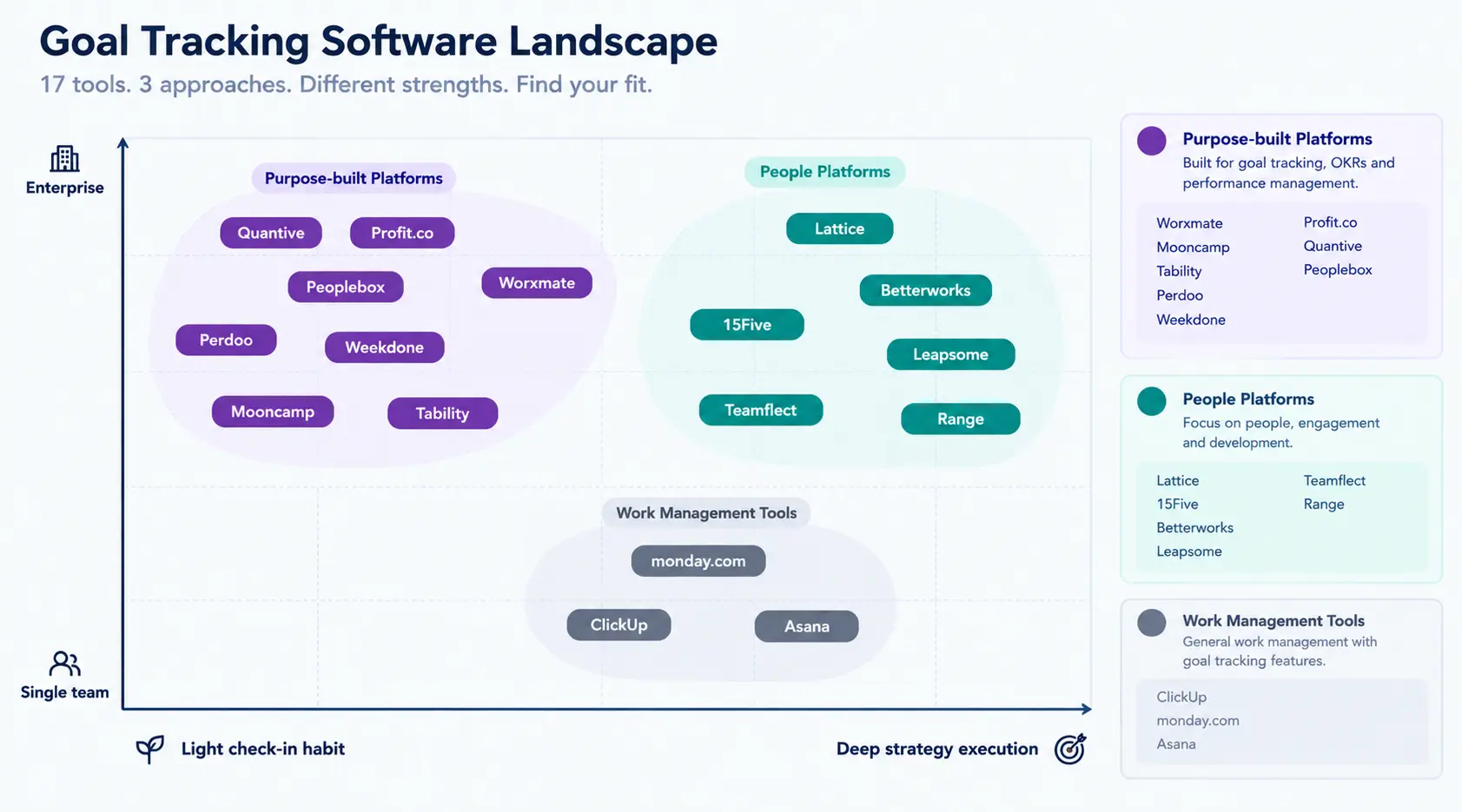
The 17 goal tracking tools, reviewed
Purpose-built goal tracking platforms
1. Worxmate: It was built from field failures, not a roadmap. Without Axis AI, goal progress and business KPIs live in separate reports and every review turns into reconciliation. Without Nexus AI, cascade problems stay invisible. That is what I saw in a 70,000-person IT services organisation, where leaders had no view of what was blocking their own functions. Orbit AI adds the people side through six named signals: Burnout Risk, Attrition Trigger, Engagement Decline, Top Performer Flight Risk, Rating Inflation Drift and Skills Decay. All of it runs on the DEEP AI framework: Define scores goal quality before the cycle, Execute catches slipping goals, Evaluate separates real wins from vanity metrics, and Plan carries learning into the next cycle. Not the right fit if you have fewer than about 20 people, run only on Microsoft, or need the longest integrations list today. The integrations library covers Jira, Slack, Teams, Google Workspace and 36+ tools and is still growing.
2. Mooncamp: The cleanest alignment map here, showing company, department and team levels on one screen. It works when leadership has done the cultural groundwork. Setup pre-fills sample data that confuses teams still finding their footing. Compare alternatives to Mooncamp.
3. Tability: Built so teams update goals every week without being chased. The nudge solves the reminder problem, not the reflection problem: a team can log a number without thinking about what it means. Expect to outgrow it in two cycles if you need review or strategy layers. See alternatives to Tability.
4. Perdoo: Goals and KPIs in one framework with a strong strategy map, best where a Strategy Head runs the discipline. Older interface, and paid plans start at ten seats. Read OKR and KPI software in one framework and alternatives to Perdoo.
5. Weekdone: Weekly planning and goals in one view make the link between this week’s work and this quarter’s goal structural. Great for small disciplined teams, though the bill climbs quickly at $10 per user. See OKR software with weekly planning.
6. Profit.co: I served as Business Head there, so I know it from the inside. Weighted scoring and KPI linkage make it one of the deepest tools here. It rewards patient rollouts, and four to six weeks of configuration before the first cycle is normal. Need live goals in three weeks? Start elsewhere. See alternatives to Profit.co.
7. Quantive: Live data feeds from Salesforce, HubSpot, Jira and Google Sheets remove manual updates in enterprise programmes. I have watched teams spend more time configuring than coaching, the wrong order in cycle one. See alternatives to Quantive.
8. Peoplebox: It lives inside Slack, Teams, Jira and Asana, so engineering, product and revenue teams update goals without opening another portal. Deep multi-layer cascades feel cluttered next to enterprise strategy platforms.
People platforms with goal tracking
9. Lattice: A performance platform with goals attached, and the link between goal progress and review data is its real strength. It creates friction when the CEO or Strategy Head drives goals, because the habit gets absorbed into the HR rhythm and not the business rhythm. Compare alternatives to Lattice and Keka vs Lattice vs Worxmate.
10. 15Five: The most refined weekly check-in here: what did you finish, what is blocking you, how are you feeling. It works best where a manager and employee conversation culture already exists. Cascade visibility is not the focus. See alternatives to 15Five.
11. Betterworks: It sits where goals meet continuous performance management. The manager effectiveness layer stands out, because goal programmes live or die at the manager layer. Budget for a demo and a procurement cycle. See alternatives to Betterworks.
12. Leapsome: A skill gap found in a review can point to a learning path tracked beside goal progress. Broader than you need if all you want is goal progress tracking software. See alternatives to Leapsome.
13. Teamflect: It runs natively inside Microsoft Teams, so updates and 1:1s happen where people already work. It is the strongest goal tracking software with Microsoft Teams integration here, and has little to offer outside Microsoft 365. See OKR tools with Microsoft Teams integration.
14. Range: Built for remote-first teams where connection matters as much as execution. It tracks goals, but it is a team-connection platform first, so expect no cascade or dependency mapping. See performance tracking tools for remote teams.
Work management tools with goals
15. ClickUp: Goals roll up from tasks, which suits teams under about 50 who already live in ClickUp. The trap is that it counts tasks completed, not outcomes moved. Read output vs outcome before you trust a goal that shows 100% green.
16. monday.com: Goals boards sit beside the task boards you already run, and progress updates itself when a Key Result rolls up from tracked tasks. Cascade and dependency mapping must be rebuilt by hand with columns and formulas. See alternatives to monday.com.
17. Asana: Goals link to projects and portfolios, so a leader can trace a goal to the work driving it. Goals sit on the Advanced plan, currently $24.99 per user per month billed annually, the highest entry price for goals here.
Diagnose the gap before you buy the tool
If your leaders cannot say where strategy is slipping, a new dashboard will only show it faster. The Organization Performance Audit finds the strategy gap first.
Unlock Goal Clarity & Accelerate Employee Growth
Looking to drive goal clarity and employee growth? Discover how Worxmate’s AI-powered Performance Management Software can help.
How to choose goal tracking software for your business
Before any demo I ask “what broke last time?”, not “which tool has the most features?” That is how to pick a tool without buying twice. This table maps the situations I see most often.
| Your situation | Start with | Why |
|---|---|---|
| Small business or startup under 50 people | Tability, Weekdone, Teamflect free tier | Low cost, fast start, validates the habit |
| Manager-led culture | 15Five, Tability | Built around the weekly conversation |
| HR-led programme, goals plus reviews | Lattice, Leapsome, Betterworks | Goals sit beside performance data |
| Enterprise with a strategy team | Quantive, Profit.co, Worxmate Illuminate | Depth, governance, data feeds |
| Microsoft 365 organisation | Teamflect, Mooncamp | Native Teams experience |
| Engineering on Jira and Slack | Peoplebox, Worxmate | Updates without a new portal |
| Already in a work management tool | ClickUp, monday.com, Asana | No extra vendor |
Read the goal tracking software for small business row as a warning as much as advice: a minimum seat count or an enterprise sales cycle slows a ten-person team more than it helps. Goal tracking software for startups should be judged on how fast the first live goal appears. See OKR software for small businesses and OKR software for startups. Goal tracking software for enterprise is a different problem of permissions and reporting, covered in OKR software for enterprise and enterprise performance tracking.
Goal tracking software for HR teams should tie goals to people data. Read goal alignment software for HR, and see the performance management software for HR teams page for goal tracking tools for HR. Goal tracking software for managers needs a goal tracking dashboard for managers that shows team goals without a reporting exercise (OKR software for managers). For goal tracking software for remote teams and goal tracking for hybrid teams, async check-ins decide everything: start with OKRs for remote teams and OKR software for hybrid teams. Goal tracking software with Jira integration stops engineers typing every update twice (OKR software for Jira, integrating Jira).
Local support and pricing currency matter too. Goal tracking software UK buyers should see OKR software UK and OKR software for UK SMEs. For goal tracking software USA, start with OKR software USA. For goal tracking software India and goal tracking software for Indian companies, read OKR software India and best OKR software in India.
Goal tracking software pricing and free options
Per-seat pricing is where good tools become expensive. At $10 per user per month, 200 people cost $24,000 a year. Worxmate’s Execute tier at $3 per user per month is $7,200 for the same headcount, and Illuminate at $7 is $16,800. Annual billing saves 25% on the monthly rate, per the Worxmate pricing page. Compare per-seat costs in OKR software cost per user and affordable OKR software.
For free goal tracking software, the honest options are limited tiers: Perdoo (5 users), Weekdone (3), Teamflect (10), Range (12), monday.com (2 seats) and ClickUp’s free tier. Worxmate’s Foundation programme is free for up to 10 users, but it is a qualified pilot for organisations of 100 or more, not an open sandbox. Apply through the free OKR pilot programme, or read free OKR software and free performance management tools.
Searching for goal tracking software alternatives because a tool was discontinued? Viva Goals shut down in December 2025. Start with the how to migrate from Viva Goals guide and the Viva Goals alternatives page. When you are ready for a goal tracking software demo, book a Worxmate demo and bring one real goal that failed last quarter.
Goal tracking software with AI: where it helps and where it does not
AI earns its place in three jobs: drafting a first version of a goal, flagging automated goal tracking signals such as a goal with no update in two weeks, and summarising progress for leaders. It cannot tell you whether the Key Result behind a well-formed sentence is an output dressed as an outcome. That is still a coaching problem. Read automate OKRs with AI and the AI OKR generator for HR managers for where the line sits.
The Worxmate answer is intelligence by domain. Axis reads business performance, Nexus reads structure and alignment, and Orbit reads people. That is real-time goal tracking with context: not just that a goal is red, but why, and who else it affects. For the people side, see AI-driven performance management software.
Where AI belongs in your goal tracking
The AI for HR ebook shows how HR leaders are using AI to move from tracking activity to reading performance, and where human judgement still has to stay in the loop.
How to track goals at work: the rhythm that makes any tool work
Here is the routine for how to track team goals online, without a new process each quarter.
Write fewer goals. Top-down for the first two quarters, with coaching at every level. Then move toward bottom-up. Use measurable goals for employees and SMART goals for employees to sharpen the wording, and see OKR vs KPI vs SMART goals for SMART goal tracking against other frameworks.
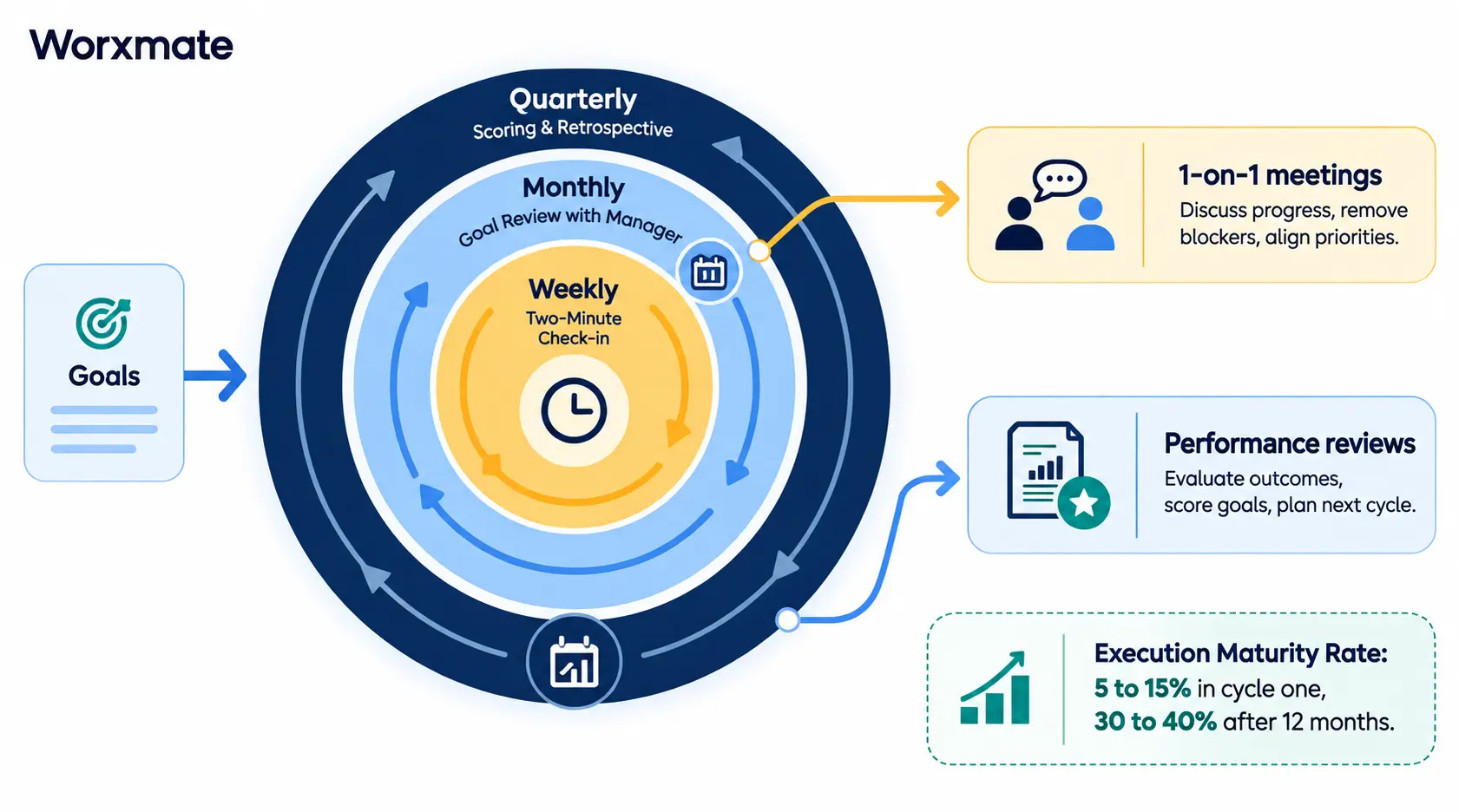
Run weekly goal tracking. Good goal check-in software takes two minutes: one update, one blocker. Use OKR check-ins and the check-in meeting template.
Run quarterly goal tracking. Score, retrospect, decide what to stop. See OKR scoring system and automated OKR scoring for goal scoring, and OKR retrospective.
Wire goals into conversations. In my conversations with 135+ HR leaders, two systemic failures repeat: 1:1s treated as optional, and KRAs disconnected from business goals. Fix both with goal tracking with 1-on-1 meetings (see standardizing 1-on-1 meetings) and goal tracking in performance reviews through the PMS-OKR Bridge, the structural link between performance and business execution. To track employee goals and performance together, see OKR and performance management.
Track these goal tracking KPIs, and know the trap in each:
| Metric | What it tells you | The trap |
|---|---|---|
| Goal completion rate | How many goals finished | A team can complete 80% and move nothing if goals were outputs |
| Goal progress percentage | Distance covered this cycle | Generous self-scoring inflates it |
| Goal health status | On track, at risk or off track | Only useful if updated weekly |
| Check-in compliance | Whether the habit exists | Compliance is not reflection |
| Execution Maturity Rate | Leaders who can write an outcome-driven goal unaided | Rarely measured at all |
The last row is the one I trust. Execution Maturity Rate is the percentage of leaders who can independently write a genuine outcome-driven goal without coaching, a template or a quality review. In a typical first cycle it sits between 5% and 15%. After 12 months of well-coached practice it reaches 30% to 40%. Use goal analytics and goal progress reports to trace it, along with OKR tracking metrics and real-time performance dashboards.
Goal tracking vs OKR software vs performance management software
This is where buyers lose the plot, and where I keep the pillar pages separate. Goal tracking vs OKR software is a question of framework. Goal tracking vs performance management software is a question of who owns it.
| Question | Goal tracking software | OKR software | Performance management software |
|---|---|---|---|
| Primary job | Track progress on any goal type | Run the OKR cycle end to end | Run reviews, feedback and calibration |
| Frameworks | OKRs, KPIs, SMART goals, MBOs | OKRs (with KPIs) | Goals as one input to appraisal |
| Usually driven by | Business or HR leaders | CEO or Strategy Head | HR |
| Read next | This guide | Best OKR software | Best performance management software |
If you are choosing a dedicated OKR platform, read my OKR software field report and compare OKR vs PMS software. If you are choosing a review system, go to performance management software. For the tracking layer alone, use OKR tracking, OKR tracking tools, real-time OKR tracking, OKR progress tracking, team OKR tracking, OKR dashboards real-time and the best performance tracking tools. The setting side lives on goal setting software, objective setting software, goal management and strategy execution software. Goal management software only works when the goals it manages are well set.
Track at every level, from employee goals and team goals to company goal tracking and department goal tracking. Individual and team goal tracking should roll up into one view, and employee goal setting and tracking should feed the system leaders actually read. OKR and KPI tracking belong together too: see using OKR and KPI together.
Two ways to take this forward
If you already know which tool to evaluate, Worxmate is available to explore directly. See Worxmate pricing, explore the OKR software or book a demo.
If you recognise that the platform is not your first problem, that is the more common case. My OKR consulting work is built around one outcome: your leaders running their own cycles within two to three quarters, with goals that are honest about outcomes.
The software is the infrastructure. The coaching is the capability. You need both, and in the right order.


Written by
An OKR Coach with 20+ years of implementation experience, Madhusudan has guided over 50 organisations through successful OKR transformations, training more than 500 leaders. Learn more about Worxmate.